Argue Against the Story Your Market Believes

Every market holds a story that explains its problem, and each part of that story rests on some evidence. Adding one more argument for your solution puts you next to every competitor. Arguing against the story, by showing its evidence is limited or out of date, makes the reader stop and rethink.
The method has four steps: write the story in the market's words, find the evidence it rests on, show where that evidence stops being true, and offer a better explanation with your proof. Only do it when your evidence shows the story is wrong.
The story every doctor knew
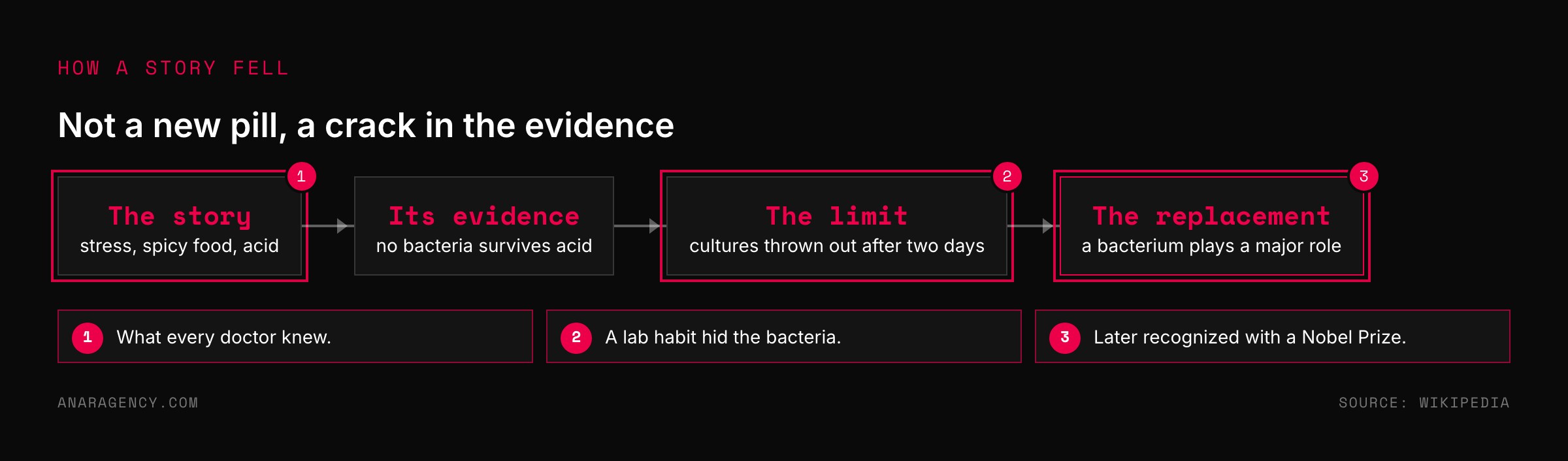
For decades, doctors knew why people got stomach ulcers. Stress, spicy food, and too much acid.
In Perth in the early 1980s, a physician named Barry Marshall and a pathologist named Robin Warren thought a bacterium was involved. In 1982 they grew the first culture of H. pylori, after early samples failed because the lab threw cultures out after two days, before the slow-growing bacteria appeared.
The established view held that no bacteria could live in an acid stomach. To test it, Marshall drank a broth of the bacteria and developed stomach inflammation within days.
In 2005 the two men received the Nobel Prize in Physiology or Medicine for showing the bacterium's role in gastritis and peptic ulcer disease.
Notice what they did not do. They did not add another reason to treat acid. They showed that the old story's evidence was incomplete.
Every market runs on a story
Your market has a story too. It is the explanation buyers repeat about why their problem exists and what fixes it.
Ask an owner why sales are flat and you will often hear one: we need more traffic. Ask a homeowner why the bills are high and you will hear another: the energy company keeps raising prices.
These stories are not lazy. Each one rests on real evidence, usually something the person saw happen.
People hold on to beliefs even after the evidence for them has been weakened, a pattern researchers call belief perseverance. A story that has served someone for years does not move for a slogan.
That is why most marketing bounces off. It argues for a new answer while the old story is still standing.
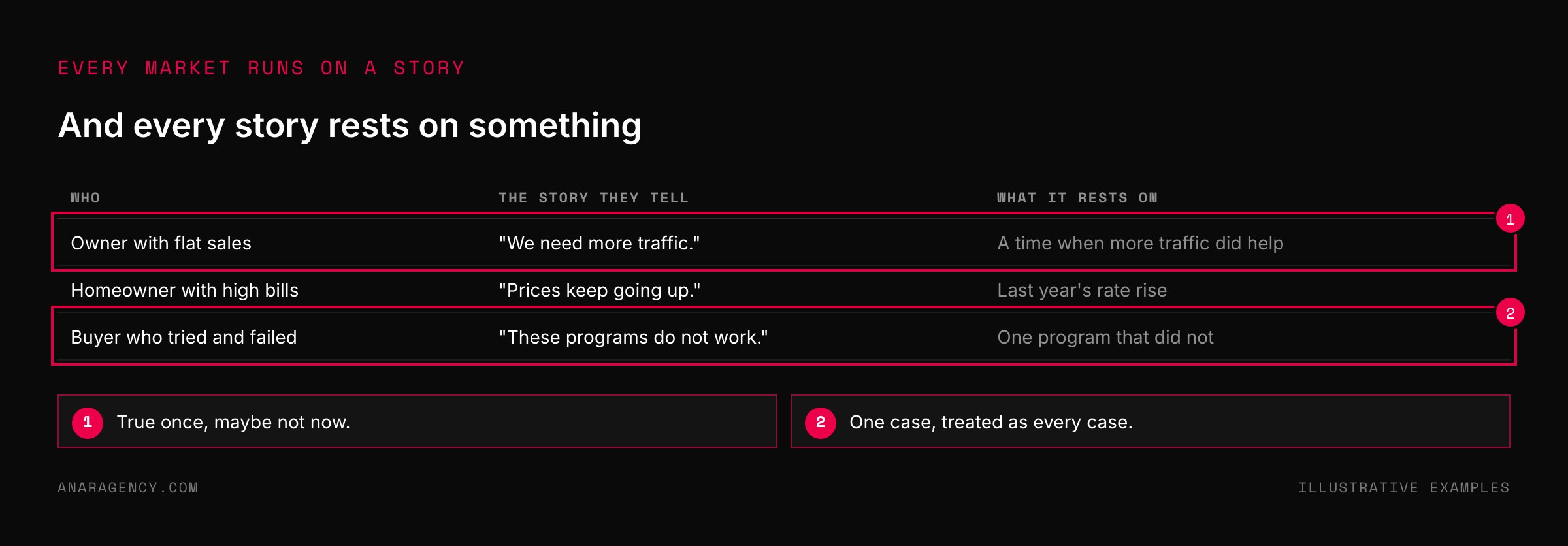
Every market explains its problem with a story, and each story rests on evidence. Arguing for your answer adds one more claim to a crowded room; arguing against the story, by showing its evidence is limited or out of date, makes the reader rethink. Write the story in the market's words, find its evidence, show where that evidence stops being true, then offer a better explanation with proof.
Attack the story, never the reader, and only when your evidence holds.
Why arguing for loses to arguing against
Picture the reader's head as a courtroom where the verdict is already in. Your ad walks in with one more witness for a different answer.
The reader has heard witnesses all week. Every competitor brought one too.
Now picture a different move. You do not call a new witness. You show the old evidence was collected wrong.
That changes the reader's job. They cannot simply file your claim next to the others, because now the thing they believed has a crack in it.
Holding two clashing ideas is uncomfortable, a state psychologists call cognitive dissonance. People want it resolved, and your explanation is standing right there.
So the competition is not other offers. It is the explanation.
The Market Story method: four steps
1. Write the story in the market's own words. Read reviews, forums, and your own call notes.
Write down the sentence buyers use to explain their problem, word for word.
2. Find the evidence it rests on. Every story has a reason behind it.
"More traffic fixes sales" usually rests on a time when more traffic did.
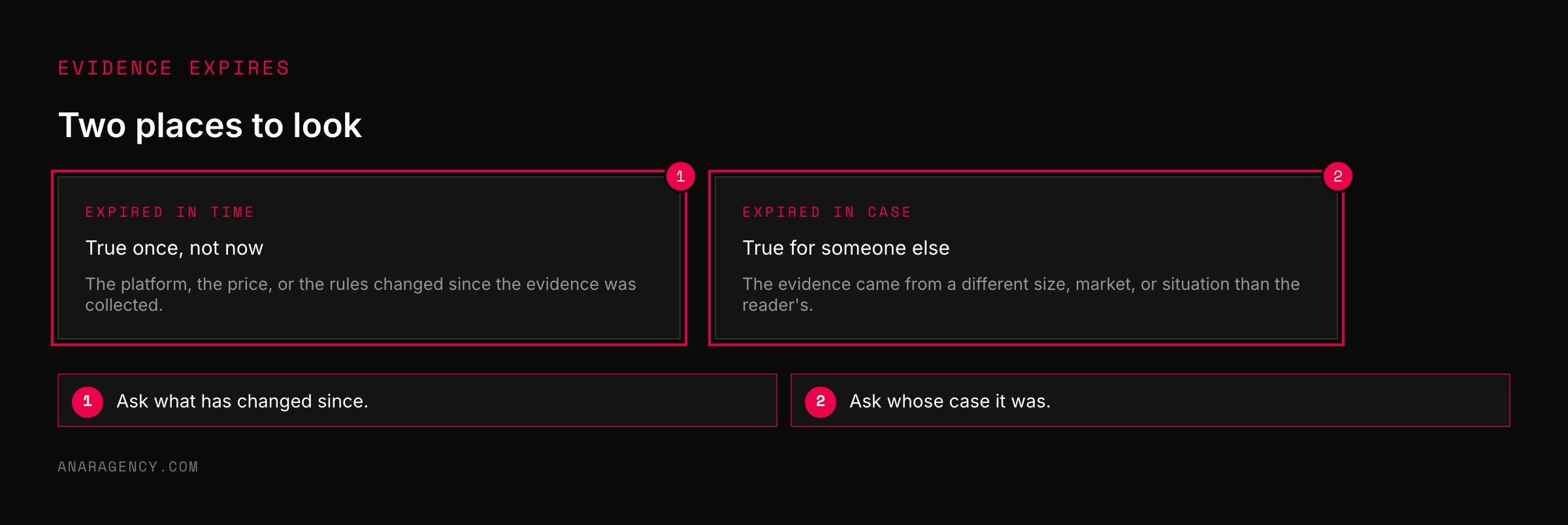
3. Show where the evidence stops being true. Evidence expires in two ways.
It was true at a different time, or it was true for a different case.
In the ulcer case, the evidence was the failed cultures. The method threw samples away too early.
4. Offer the replacement, with proof. Give a better explanation, back it with evidence the reader can check, and only then show your product as the way through.
For how to win agreement on the explanation before you argue, see agree on the cause first.
If the replacement is weaker than the old story, stop. You have found a story that is right.
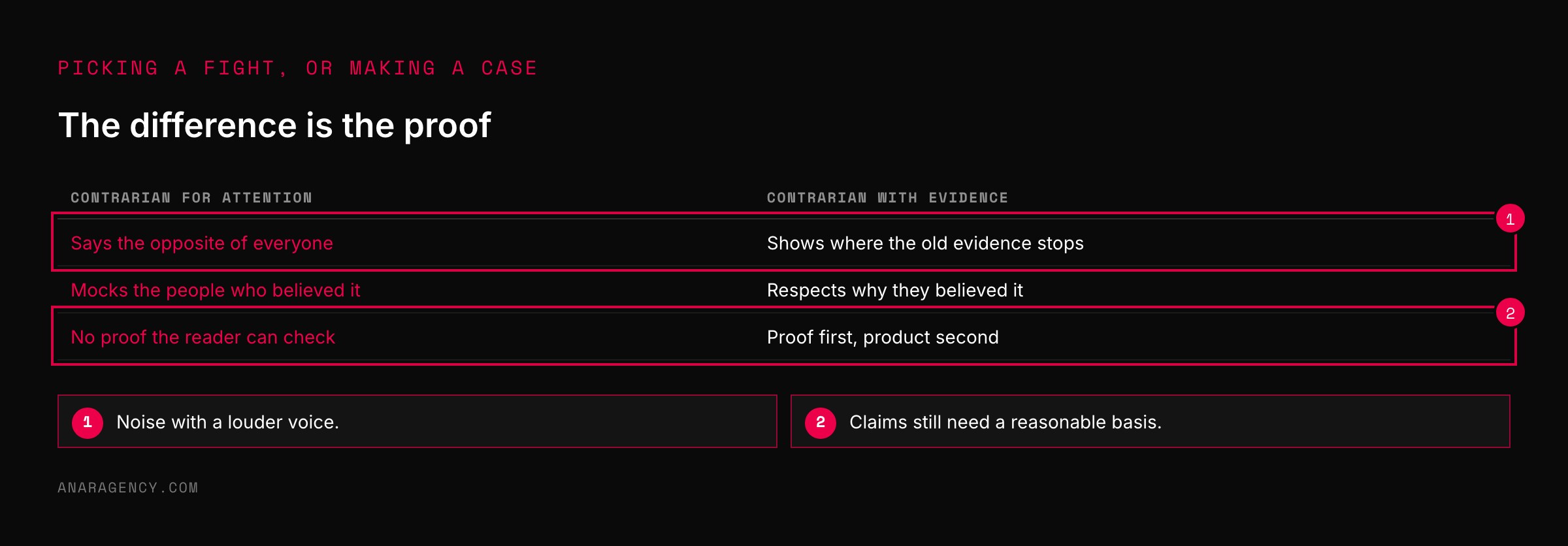
"Contrarian marketing sounds like picking fights."
It is, when it is done for attention. Saying the opposite of everyone else, without evidence, is noise with a louder voice.
There is also a legal line. In the US, advertisers need a reasonable basis for objective claims before they make them, and an attack on a common belief is a claim like any other.
Attack the story, never the reader. They believed it for good reasons, with the evidence they had.
History has a warning for the other side too. In 1847 Ignaz Semmelweis showed that hand-washing cut deaths on a maternity ward, and many colleagues rejected it. Being right was not enough; the evidence had to be shown in a way people could accept.
So make it easy to accept. Show the reader exactly where the old evidence came from, and let them see the limit for themselves. Then see selling to buyers who have seen it all for when the market has heard every claim.
What to read next, and why
Barry Marshall (encyclopedia entry): The full ulcer story, including the argument that early skeptics were right to demand evidence.
Helicobacter pylori (encyclopedia entry): What the bacterium does and how the medical view changed.
Belief perseverance (encyclopedia entry): Why old beliefs outlive their evidence.
Advertising FAQs for small business (FTC guide): The substantiation rule that applies to every contrarian claim.
So the simple takeaway is this: write down the sentence your market uses to explain its problem, and find the one piece of evidence it rests on before you write another ad.
Questions executives ask
What is contrarian marketing?
Marketing that challenges a belief the market already holds, instead of adding another claim for a solution. It works when it is backed by evidence and fails when it is opposition for attention.
How do you change a customer's belief?
Find the evidence the belief rests on and show where that evidence is limited or out of date. Then offer a better explanation with proof the customer can check.
Why do customers ignore new claims?
Because they already hold an explanation for their problem, and a new claim sits next to every competitor's. Beliefs also tend to persist after their evidence has been weakened.
Is it risky to challenge what customers believe?
It is if you lack evidence or attack the customer. Claims must be substantiated, and the story should be challenged, not the person who believed it.
What is an example of challenging a market belief?
The discovery that a bacterium plays a major role in many stomach ulcers challenged the long-held view that stress, spicy food, and acid were the main causes, and it was later recognized with a Nobel Prize.

Filip Kovacevic is the founder of Anar Agency in Phoenix. He spent five years running SEO, Meta ads, email, and content for medical practices across the United States, and now does the same work for healthcare, home-service, legal, and professional-service businesses, alongside AI implementation. More from Filip →
Talk it through in 15 minutes
Bring one AI question from this article. We will tell you what we would do, whether or not you hire us.
Book a 15-Min Chat →