Problem Pages, Not Product Pages

A product page starts with what you sell. A problem page starts with what is going wrong for the visitor. Most buyers arrive knowing their problem and not knowing your product's name, so product pages only catch the small group who have already decided what to buy.
A problem page has five parts: the problem in the visitor's words, why it happens, how to check which cause applies, what fixing it involves, and only then the offer. Keep your product pages for people who search for the product. Build problem pages for everyone else.
Nobody searches for your product name
A woman runs a twelve-person accounting office. Every afternoon around three, the Wi-Fi drops. Calls cut out.
The printer vanishes from everyone's laptop.
She does not go looking for "managed IT services." She does not know that is what it is called. She types "wifi keeps dropping in office every afternoon."
Somewhere there is an IT company that would fix this in a morning. Its website has a page titled Managed IT Services, with three plans and a list of what is included.
She will never see that page. And if she did, she would not recognize it as the answer.
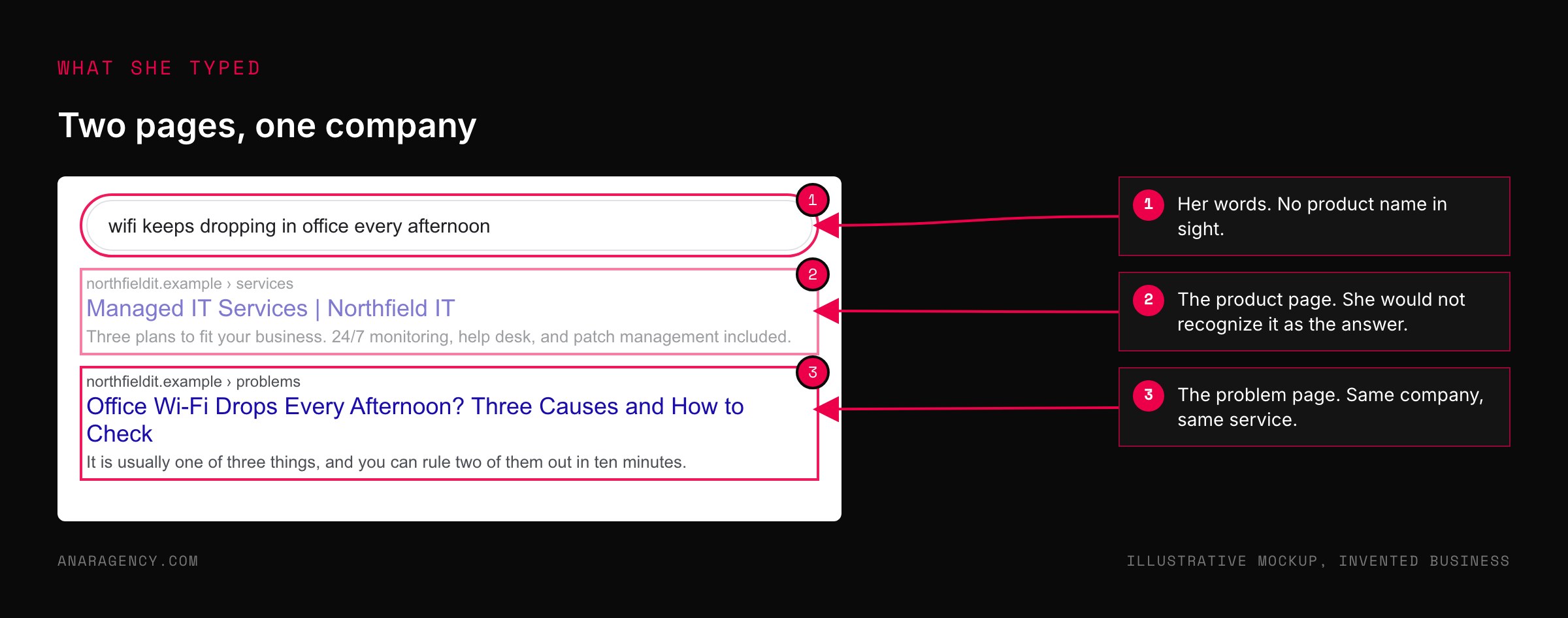
Two kinds of page
That company has what almost every business has: a site made of product pages. Each one says what we sell, what is in it, and what it costs.
Product pages are written from the inside. They use the company's name for things. They are organized the way the company is organized.
They work fine for one kind of visitor: the person who already knows what they need and is comparing providers. That person exists. There are just not many of them.
The other kind of page starts from the outside. Its headline is the problem, in the words the customer would use. We call it a problem page.
This matters for two reasons. People search in problem words, so the page gets found. And visitors decide within seconds whether a page is about them, by following what researchers call information scent.
A headline that names their problem smells right.
Five parts, in this order. One: the problem as the headline, in the customer's own words. Two: the two or three real causes.
Three: a check the reader can do themselves in ten minutes to find which cause applies. Four: what fixing it involves, honest about what is do-it-yourself and what is not. Five: one offer, for the people who would rather hand it over.
Write one for every problem your customers describe when they call. Keep product pages for visitors who already search by product name.
The builder who stopped selling condos
The clearest version of this idea comes from the late Harvard professor Clayton Christensen.
He and his coauthors wrote about condo developers who were building for retirees who wanted to downsize. The units were good. Sales were weak.
The developers did what a product company does. They looked at the product. They added features.
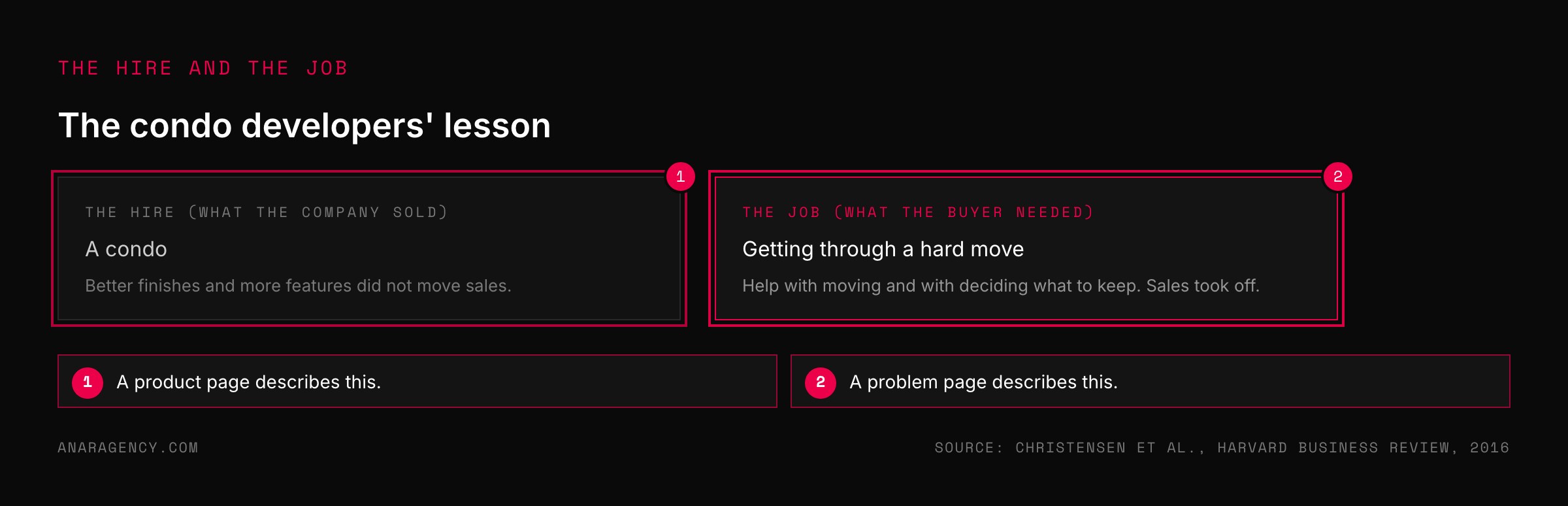
Nothing changed, until they saw the thing from the buyer's side. These customers were not shopping for a condo. They were facing one of the hardest moves of their lives, and deciding what to do with forty years of belongings.
The developers concluded that their business was not construction. It was helping people through a transition. They added services for the move and for deciding what to keep and what to let go.
Sales took off. The condos were the same. What changed was that the company started from the problem.
Christensen's phrase for this is that people hire a product to do a job. Your product page describes the hire. A problem page describes the job.
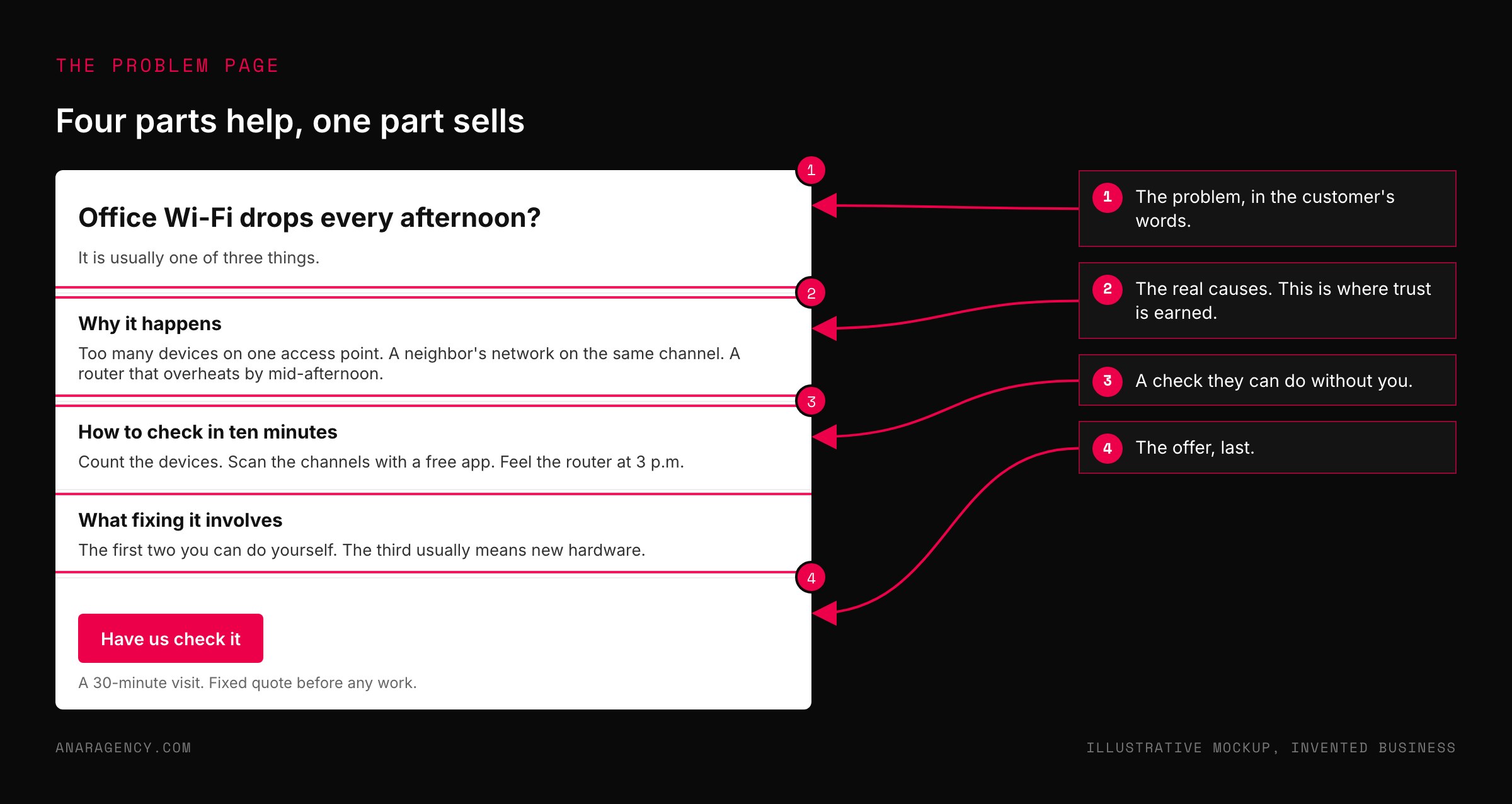
The Problem Page, in five parts
Here is the shape we use.
One: the problem, in their words. The headline is what they would say to a friend. "Wi-Fi drops every afternoon."
Not "network reliability solutions."
Two: why it happens. The two or three real causes. This is where a reader decides you know what you are talking about.
Three: how to check which one it is. Something they can do in ten minutes, without you. Give it away for free.
Four: what fixing it involves. Be honest about which fixes they can do themselves and which need a professional.
Five: the offer. One next step, for the people who would rather not do it themselves.
Four parts help and one part sells. That ratio is what Google asks for, too. Its guidance on helpful content asks whether a page leaves the reader feeling they learned enough to reach their goal.
"If I tell them how to fix it, they will not need me."
You may be thinking that part three gives away the business. It is the fear that keeps most service pages vague. It is also backward.
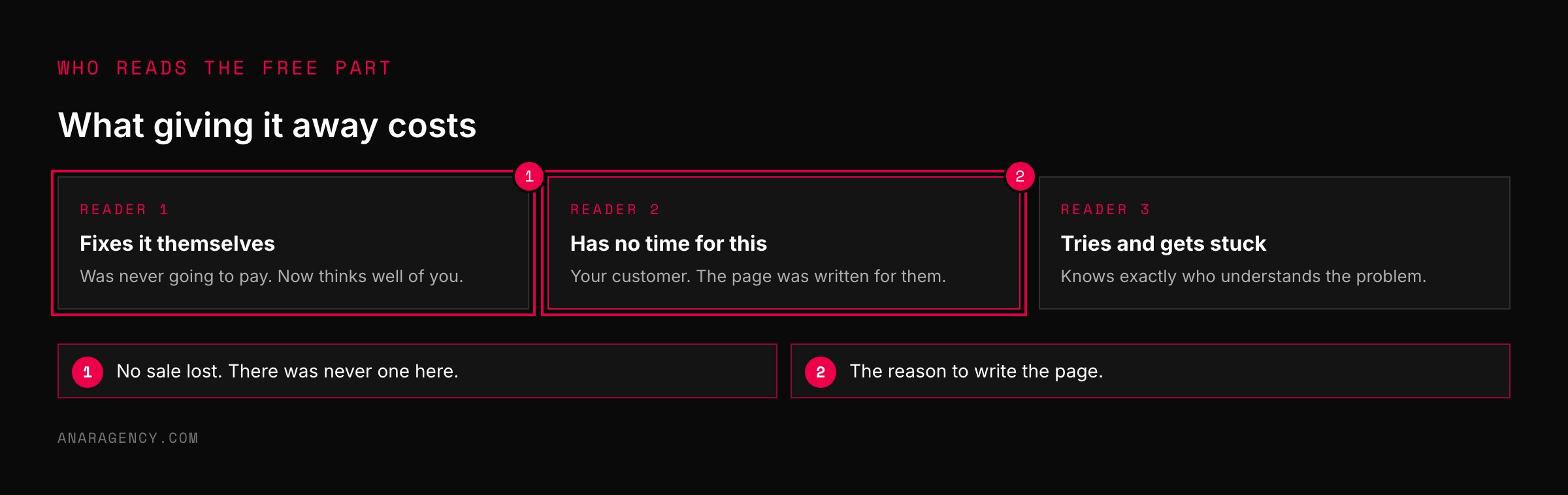
The person who fixes it themselves after reading your page was never going to pay you. You have lost nothing, and they now think well of you.
The person who reads it and thinks "I do not have time for this" is your customer. They are the reason the page exists.
And the person who tries, gets halfway, and gets stuck now knows exactly who understands their problem.
We have had to learn this ourselves. Our own service pages are product pages. In the last 28 days our AI implementation page was shown 532 times in search, at an average position of 44, and clicked once.
The pages of ours that Google shows most are the ones that start from a question a buyer asks. That is why this whole series exists, and it is the same lesson as the Page-2 Problem.
If you run ads, the gain is direct. Google's landing page experience looks at how relevant and useful a page is to the person who clicked. A problem ad that lands on a problem page is as relevant as it gets.
What to read next, and why
Know Your Customers' "Jobs to Be Done" (Harvard Business Review): The condo story and the idea behind it. The best single article on seeing your product from the buyer's side.
Creating helpful, reliable, people-first content (Google documentation): Google's own questions for judging a page. A problem page passes most of them by design.
Information Scent (research): Why a headline in the visitor's own words keeps them on the page.
Our own unasked questions (article): The six things every visitor silently asks. A problem page answers the first three in its headline.
So the simple takeaway is this: keep your product pages. Then write one page for each problem your customers describe on the phone, in the words they use.
Questions executives ask
What is a problem page?
A page that opens with the customer's problem in their own words instead of with the product. It explains why the problem happens, shows how to check the cause, describes what fixing it involves, and then makes one offer. It is written for visitors who know what is wrong but not what the solution is called.
What is the difference between a product page and a problem page?
A product page starts with what you sell and suits visitors who already know what they want. A problem page starts with what is going wrong for the visitor and suits the larger group who are still trying to understand their situation. Most sites need both.
Will giving away advice on my service page cost me customers?
Rarely. People who fix the problem themselves after reading were unlikely to pay. People who decide they do not have the time are your customers, and those who try and get stuck now know who understands the problem.
How many problem pages do I need?
One for each distinct problem your customers describe when they first contact you. Listen to sales calls and read incoming emails, list the problems in the customers' words, and start with the three you hear most.
Do problem pages help with SEO and ads?
They tend to help both. People search using the words for their problem, so a page titled that way is easier to find. For ads, Google's landing page experience measure looks at how relevant and useful the page is to the person who clicked, and a problem-focused ad matched to a problem page is highly relevant.

Filip Kovacevic is the founder of Anar Agency in Phoenix. He spent five years running SEO, Meta ads, email, and content for medical practices across the United States, and now does the same work for healthcare, home-service, legal, and professional-service businesses, alongside AI implementation. More from Filip →
Talk it through in 15 minutes
Bring one AI question from this article. We will tell you what we would do, whether or not you hire us.
Book a 15-Min Chat →