Experience vs Experienced: Positioning When You Are New

A new business cannot honestly claim a track record it does not have. But buyers judge competence in four ways: your credentials, what you have done, what you have witnessed up close, and what you can show them. The last two are open to a newcomer.
Describe the patterns you have seen in jobs, client accounts, or your trade, and say plainly that you saw them. Then show the work on screen. That builds real authority quickly without a single false claim.
Never present something you watched as something you did.
Why a degree gets you hired
In 1973 an economist named Michael Spence asked an awkward question. Why do employers pay more for a degree, even when the job uses nothing taught in the course?
His answer was that the degree is a signal. An employer cannot see how capable you are. But a degree is costly to get, and it costs less for capable people, so having one tells the employer something.
He called it signalling, and the work later earned him a share of a Nobel Prize.
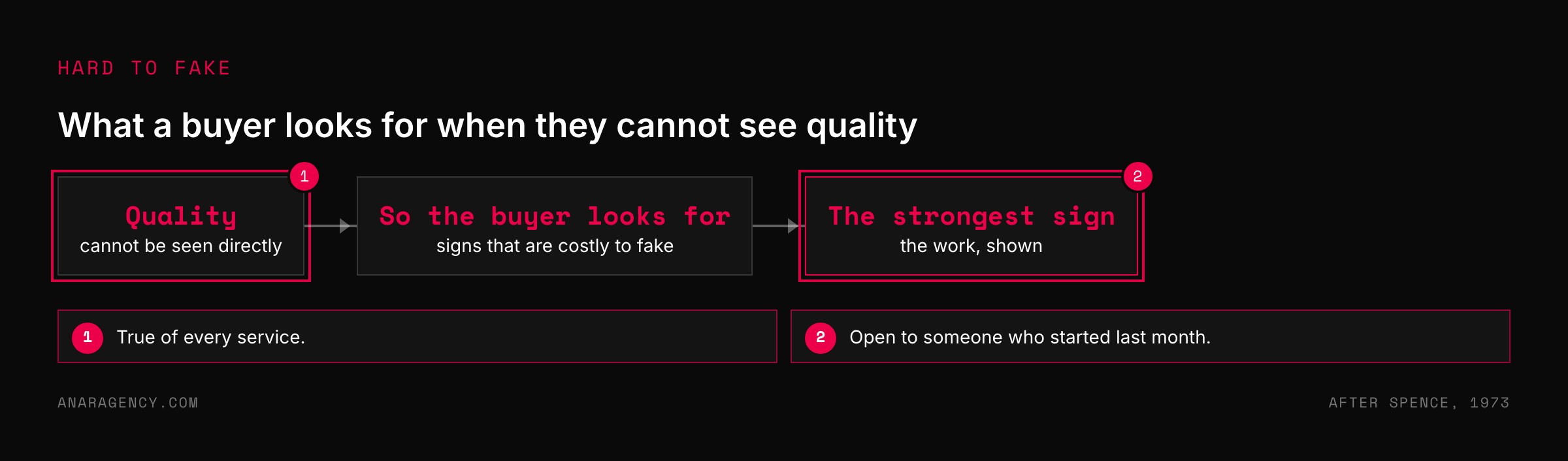
The idea reaches well past job interviews. Whenever one side cannot observe quality directly, it looks for signs that are hard to fake.
A buyer cannot see your competence either. So the practical question for a new business is which signs you can honestly give.
The Credibility Layers
Most new businesses believe there is one sign: a track record. Since they have none, they feel stuck. There are four.
Paper. Degrees, licenses, certificates. In regulated trades they are required.
Elsewhere buyers glance at them and move on.
What you have done. Results you produced yourself. This is the strongest claim and the one a newcomer has least of.
What you have seen. Patterns you watched at close range. Three years inside an agency.
Forty client accounts you worked on under someone else. A trade you grew up around.
What you can show. The work itself, on screen, in front of the buyer.
The third layer is where most people undersell themselves. Much of what an expert knows was never written down. It was absorbed by being present, a kind of knowing researchers call tacit knowledge.
That is how skill has always been passed on. Studies of apprenticeship describe newcomers learning by taking part at the edge of real work alongside experienced people, which the researchers named legitimate peripheral participation.
Buyers judge competence four ways: paper credentials, what you have done, what you have seen up close, and what you can show. A newcomer is short on the second and usually rich in the third and fourth. Publish patterns you have observed, stated as observed.
Show the work on screen. Diagnose the buyer's own situation for free. Credit public evidence for what you have not done.
Say plainly that you are new. Never present something you watched as something you did, and never invent a result.
The line: seen, not done
This is where care is needed, because the third layer can be abused.
There is a version of this advice that says buyers cannot tell what you did from what you watched, so blur the two. We do not recommend it. It is deception by arrangement, and it is fragile.
The honest version is stronger and simple. Say what you saw, and say that you saw it.
"Across the dental accounts I worked on at my last agency, the practices that answered within five minutes booked about twice as many patients." That is a specific, useful observation. It claims nothing you did not do.
Compare "I have helped dozens of dental practices double their bookings." If you were a junior on those accounts, that sentence is false, and one question on a sales call will expose it.
The rule also has legal weight. The FTC requires that advertising claims be truthful and supported, and that covers claims about your own experience and results.
Honest Witnesses: how they build authority in a month
A few newcomers are taken seriously almost at once, with no borrowed results and no bluff. They report what they have seen and prove they can see. We call them Honest Witnesses.
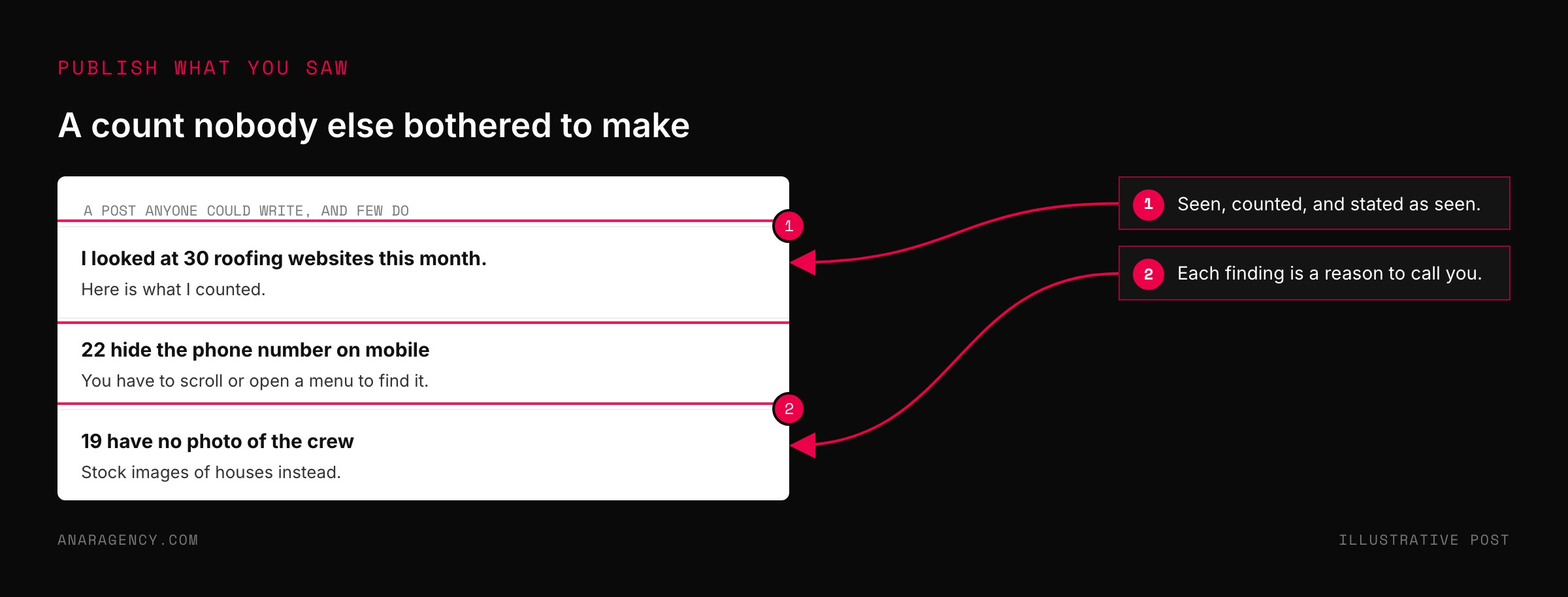
They publish patterns. "I have looked at thirty roofing websites this month. Twenty-two hide the phone number on mobile."
Anyone can do this work. Few do, and it is real expertise the day it is published.
They show the work. A recorded teardown of a public page. A before and after of something they rebuilt for practice.
Showing is the layer hardest to fake, which is why it persuades.
They do the diagnosis for free. An audit of the buyer's own account demonstrates competence on the one example the buyer can check. We cover the method in audits as lead magnets.
They cite what they did not do. Public studies and other people's published cases, credited, fill the gaps in their own record. The grid for that is in the Proof Grid.
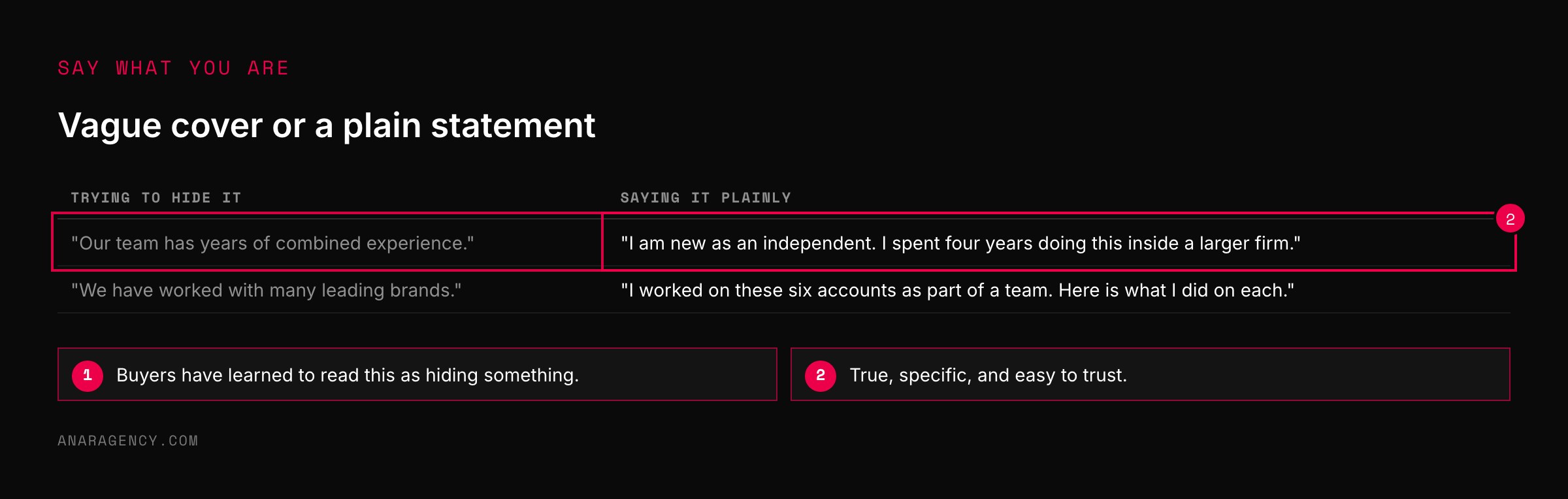
They say what they are. "I am new as an independent. I spent four years doing this inside a larger firm."
Stated plainly, that reads as confidence.
Search engines look for the same thing. Google's guidance on helpful content asks whether a page shows first-hand experience, such as having actually used a product or visited a place. We unpack that in the E-E-A-T checklist.
"Should I not wait until I have real results?"
You may feel it is more honest to stay quiet until you have case studies. It is a decent instinct, and it keeps capable people invisible for years.
Nobody is asking you to claim results. The four moves above are things you can do truthfully today.
And results do not arrive by waiting. They arrive from clients, who arrive because they could see you knew the work.
There is one layer we would skip. Some people stand in for a track record with signs of wealth: the car, the view, the airport lounge. It attracts buyers who are shopping for a lifestyle, and it says nothing about competence.
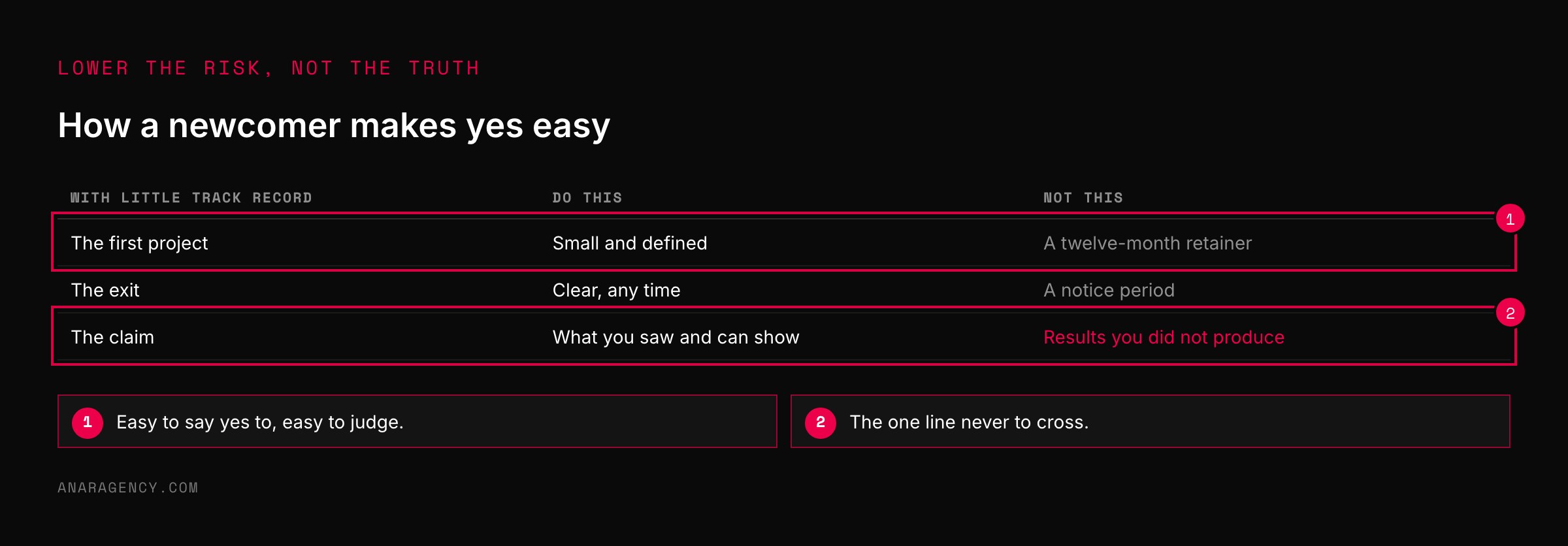
Price is the last piece. With little record, lower the buyer's risk instead of your claims: a small first project, a clear exit, a fee tied to a defined piece of work. See quick-win offers.
What to read next, and why
Signalling (economics) (encyclopedia entry): Spence's idea, explained. Why hard-to-fake signs carry weight when quality cannot be seen.
Tacit knowledge (encyclopedia entry): The knowledge people hold and cannot easily write down, and how it is passed on.
Legitimate peripheral participation (encyclopedia entry): How newcomers become skilled by working at the edge of a practice.
Creating helpful, reliable, people-first content (Google guidance): What a search engine means by first-hand experience.
So the simple takeaway is this: write down ten patterns you have seen with your own eyes in your trade. Publish them as things you saw. That is your authority, and it is true.
Questions executives ask
How do you build authority when you are new?
Publish specific patterns you have observed in your trade, show your work on screen through teardowns and before-and-after examples, and offer to diagnose a buyer's own situation. These demonstrate competence without claiming a track record you do not have.
Can I talk about results I saw at a previous job?
Yes, if you describe them accurately as things you observed or worked on, and make your role clear. Do not present a team's or employer's results as your own, and respect any confidentiality you agreed to.
How do I get clients with no case studies?
Lower the buyer's risk instead of raising your claims. Offer a small, defined first project, a free diagnosis of their current setup, and a clear exit. Use credited public data and published cases to show the approach works in general.
What is the difference between experience and having experienced something?
Experience, in this sense, is what you personally did and are responsible for. Having experienced something is what you witnessed at close range. Both carry real knowledge, but they are different claims and should be stated differently.
Do credentials matter for marketing a service?
In licensed trades they are essential. Elsewhere buyers treat them as a baseline check. Demonstrated understanding of the buyer's specific problem usually carries more weight than certificates.

Filip Kovacevic is the founder of Anar Agency in Phoenix. He spent five years running SEO, Meta ads, email, and content for medical practices across the United States, and now does the same work for healthcare, home-service, legal, and professional-service businesses, alongside AI implementation. More from Filip →
Talk it through in 15 minutes
Bring one AI question from this article. We will tell you what we would do, whether or not you hire us.
Book a 15-Min Chat →