AI Workflows for Ads, Content and Lead Gen
There are three places AI reliably helps a marketing team today. In ads, it produces many checked variations of an idea that already works. In content, it turns your own notes into a first draft in your voice.
In lead generation, it replies at once, asks a few questions, and books a time. None works well with a copied prompt. What makes them work is a loop: get a baseline draft, compare it with your best work, list the gaps, turn each gap into a written rule, and repeat.
A person still decides what is true and what goes out.
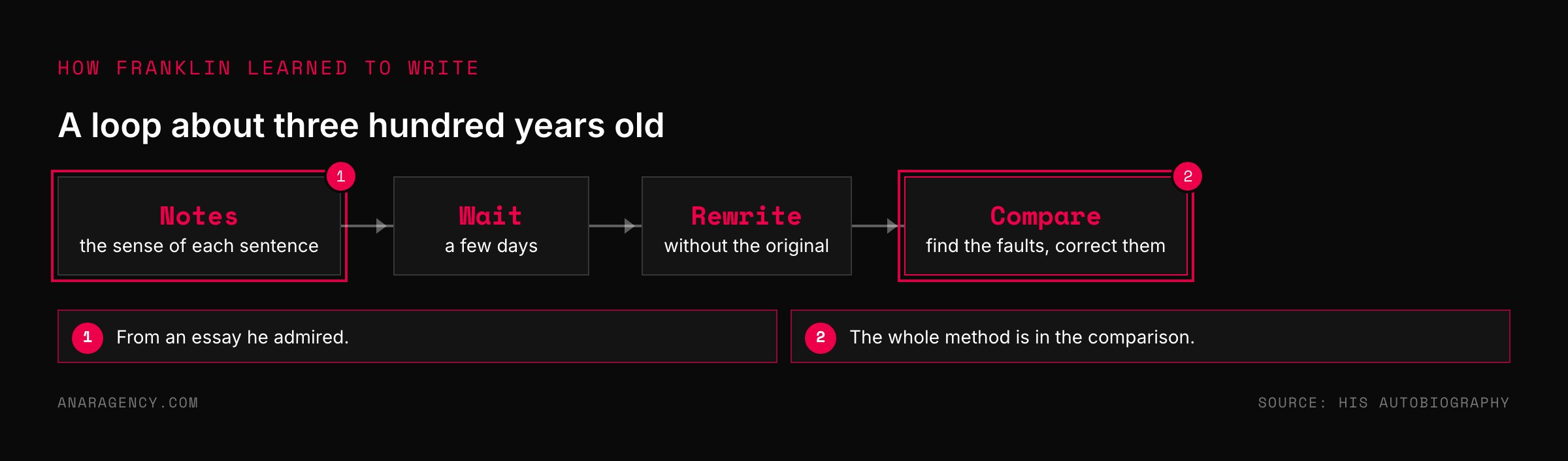
How Franklin learned to write
As a teenager working in his brother's print shop, Benjamin Franklin decided his writing was not good enough.
He found a volume of a London paper he admired, the Spectator. In his autobiography he describes what he did next.
He took an essay and made short notes on the sense of each sentence. He set the notes aside for a few days. Then, without looking at the original, he tried to write the essay again in his own words.
Then came the step that mattered. He compared his version with the original, found his faults, and corrected them.
Draft, compare with something excellent, list the faults, fix, repeat. It is about three hundred years old, and it is the most useful thing to know about getting good work from an AI model.
Why copied prompts disappoint
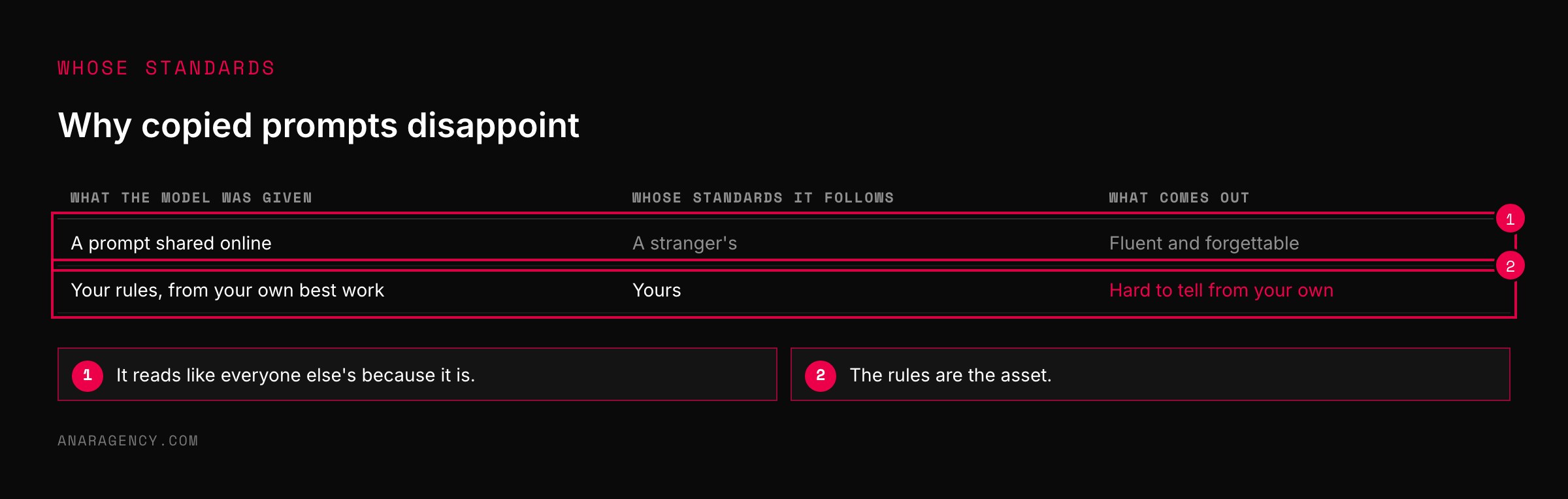
Most people's first try with AI for marketing goes the same way. They find a prompt someone shared, paste it in, and get something fluent and forgettable.
It reads like everyone else's because it was made from everyone else's instructions.
The model does not know your customers, your voice, the claims you are allowed to make, or the phrases you would never use. A prompt written by a stranger does not know either.
What is missing is not a cleverer prompt. It is your standards, written down.
And those can only be found the way Franklin found his faults. Put the model's attempt next to work you are proud of and look at the difference.
Three uses: ads for volume, content for speed, lead generation for coverage. In each, run the gap loop first: baseline draft, compare with your five best pieces, list the gaps, turn each into a written rule, repeat. Keep each one a fixed workflow with a person at the decision point.
Feed content from your own notes, never a bare topic. Add an automated check against the rules before human review. Verify every claim, never invent customers, follow labeling rules, and measure leads and sales, not output.
The gap loop
Here is the method in five steps.
Baseline. Ask the model for the piece with a plain request. Do not try to be clever.
Gold. Put five examples you are proud of beside it. Real ones that worked.
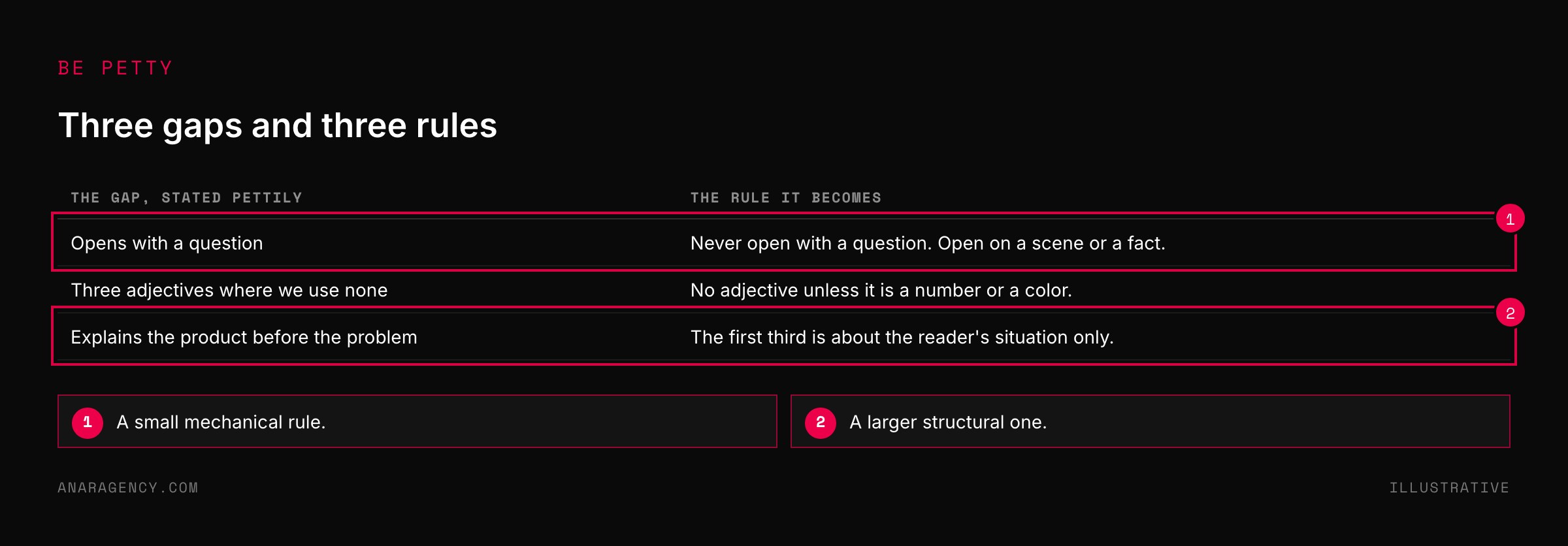
Gaps. List every way the draft falls short. Be petty.
"Opens with a question." "Uses three adjectives where we use none." "Explains the product before the problem."
Rules. Turn each gap into a written rule. Small mechanical ones and larger structural ones.
Add them to the standing instructions.
Again. Run it, compare, and add what is still missing. After a few rounds the draft is hard to tell from the gold.
The list of rules is the asset. It is your voice in a form a machine can follow, and it is why we keep ours in files, as described in source-of-truth skills.
The Three-Workflow Map
With the loop in hand, there are three places to use it. The teams that do well keep a person at one fixed point in each. We call them Editors-in-Chief.
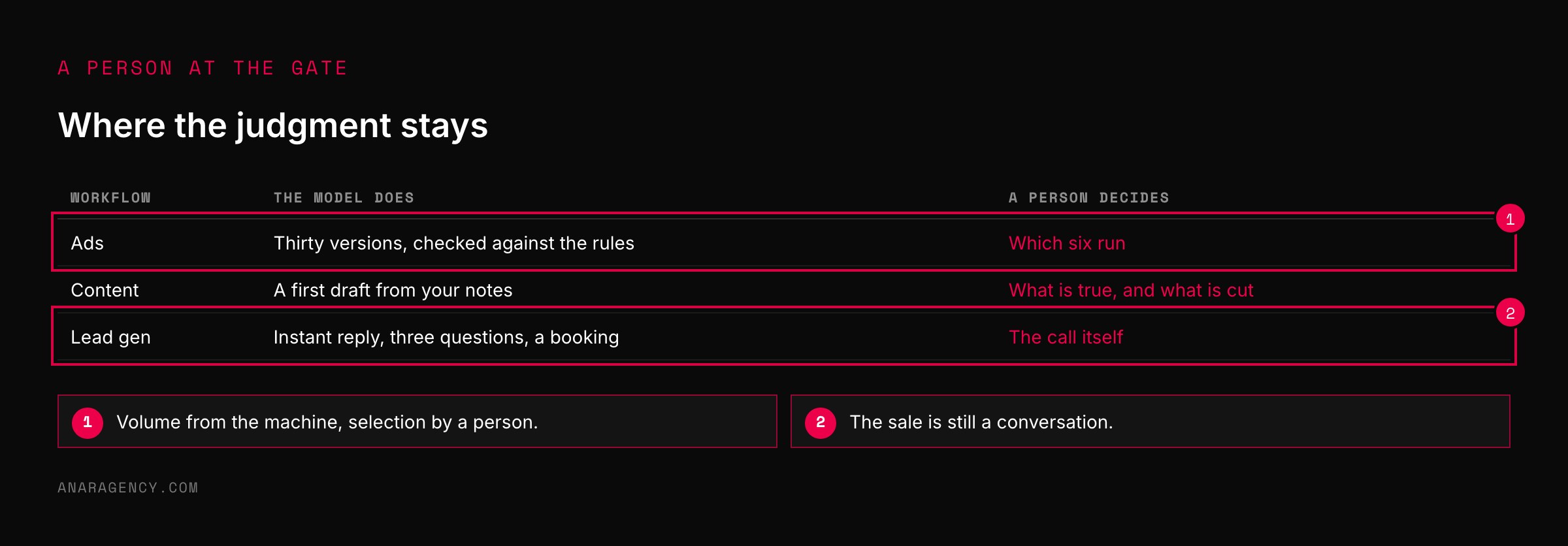
Ads: volume. Platforms now reward a steady supply of new creative. Give the model one idea that works and your rules, and have it produce thirty versions.
A person picks the six that run. The pipeline is in creative volume for Meta ads.
Content: speed. Feed it your own notes, calls, and numbers, never a bare topic. It drafts.
You cut, correct, and add what only you know. Where the notes come from is in collect, don't invent.
Lead gen: coverage. An instant reply to every enquiry, three qualifying questions, a booking link. The human call follows.
See speed to lead.
Keep it a workflow. Each of these is a fixed sequence with a model at some steps. Anthropic's own guidance is to prefer that simple form and add autonomy only where it is needed.
Add a second reader. Have a separate pass check the draft against the rules before a person sees it. It catches the mechanical misses and saves your attention for judgment.
Measure the outcome. Cost per lead, replies, booked calls. Pieces produced is not a result.
"Will search engines and customers punish AI content?"
You may have heard that AI-written pages get penalized. That is not what the search engine says.
Google's guidance on generative AI content is that it judges content on whether it is helpful and original, not on how it was produced. Using AI to mass-produce pages with little value is treated as spam.
So the risk is not the tool. It is publishing drafts nobody improved.
Customers react the same way. They do not object to a clear, accurate email. They object to filler, and to being fooled.
That gives three rules. Every factual claim in an ad or article is checked by a person, because advertising claims must be truthful and supported however they were written.
No invented customers or testimonials. And anything that looks like a real person or a real photograph follows the platform's labeling rules, which we cover in the clip pipeline.
What to read next, and why
The Autobiography of Benjamin Franklin (book, free online): The passage on the Spectator is a few paragraphs long and worth reading in his words.
Building effective agents (engineering guide): Why a simple workflow usually beats an elaborate one.
Google Search's guidance on using generative AI content (Google documentation): What the search engine rewards and what it treats as spam.
Advertising FAQs: A Guide for Small Business (FTC guide): The standard every claim has to meet, whoever or whatever wrote it.
So the simple takeaway is this: take one thing you write every week. Get a draft from a model, lay it beside your best five, and write down ten differences. Those ten lines are the start of your system.
Questions executives ask
How can a small business use AI for marketing?
Three uses work reliably: producing many checked variations of an ad that already performs, drafting content from your own notes in your voice, and replying to new leads at once with a few qualifying questions and a booking link.
Why does AI-written copy sound generic?
Because the model has not been given your standards. A shared prompt carries someone else's. Comparing a draft with your own best work, listing the differences, and writing each as a rule gives the model your voice.
Does Google penalize AI-generated content?
Google says it evaluates content on helpfulness and originality, not on how it was produced. It treats using AI to generate many low-value pages as spam. Content that a person has checked and improved is judged like any other.
What is the gap loop?
A five-step method: get a baseline draft from the model, set it beside examples you are proud of, list every shortfall, convert each into a written rule in the model's instructions, and repeat until drafts match your standard.
What should a human still do in an AI marketing workflow?
Decide what is true and what is published. That means checking every factual claim, choosing which variations run, adding first-hand knowledge the model lacks, and owning the result.

Filip Kovacevic is the founder of Anar Agency in Phoenix. He spent five years running SEO, Meta ads, email, and content for medical practices across the United States, and now does the same work for healthcare, home-service, legal, and professional-service businesses, alongside AI implementation. More from Filip →
Talk it through in 15 minutes
Bring one AI question from this article. We will tell you what we would do, whether or not you hire us.
Book a 15-Min Chat →