Source-of-Truth Skills: How We Run an Agency on Claude Code

A skill is a written procedure that an AI agent loads when a matching task comes up. In Claude Code it is a file of instructions that says when to use it, where the facts are, what steps to follow, and how to check the result. We run about fifty of them.
They hold the things that must not vary: client rules, brand standards, deploy checks. The model supplies speed, and the skills supply memory and discipline. The pattern works with any capable agent, and the hard part is writing down what your business actually knows.
Nineteen items
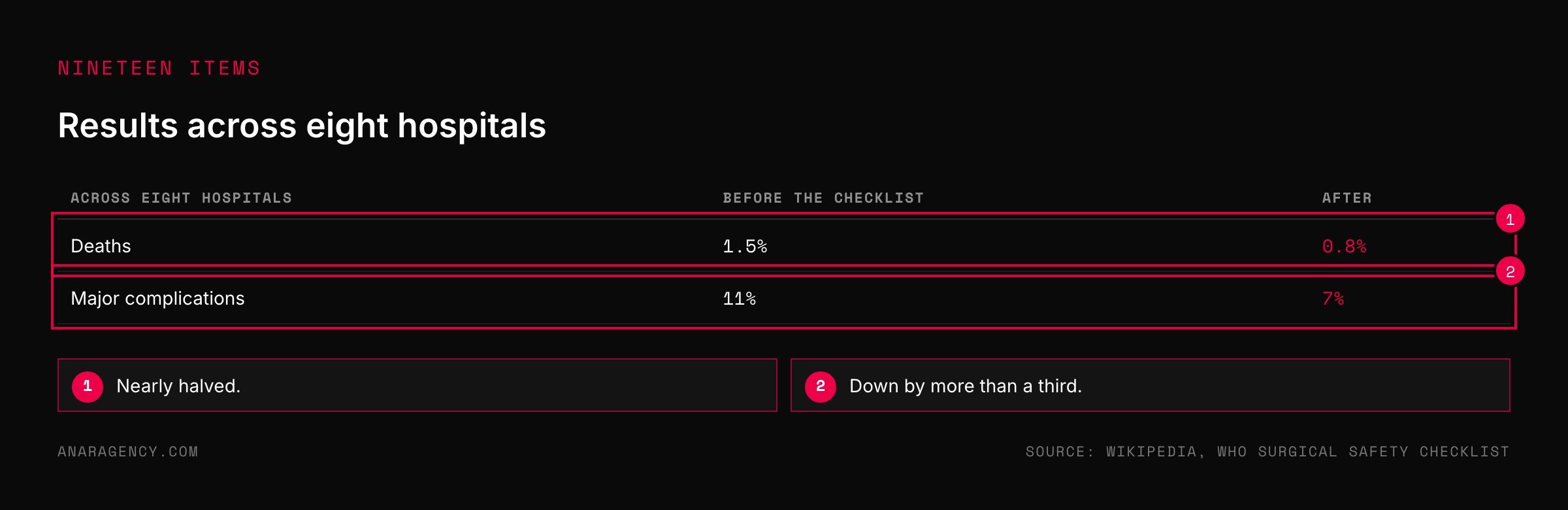
In 2007 and 2008, eight hospitals in eight cities, from Seattle to New Delhi, tested a single page used before every operation.
It had nineteen items. Confirm the patient's name. Confirm the site of the surgery.
Check for allergies. Introduce everyone in the room. Count the instruments afterwards.
These were experienced surgical teams. Nothing on the page was news to any of them.
The surgeons did not get more skilled. The page made sure that what everyone already knew was done every time. That is the entire idea behind what follows.
The problem with a brilliant assistant
An AI model is fast, widely read, and willing. It also arrives each morning having forgotten yesterday.
It does not know that this client forbids a certain phrase. It does not know that a push to the main branch publishes the site, or that a page is not finished until its links have been checked on the live site.
You can tell it. Then you tell it again tomorrow, and you forget one thing, and that is the thing that goes wrong.
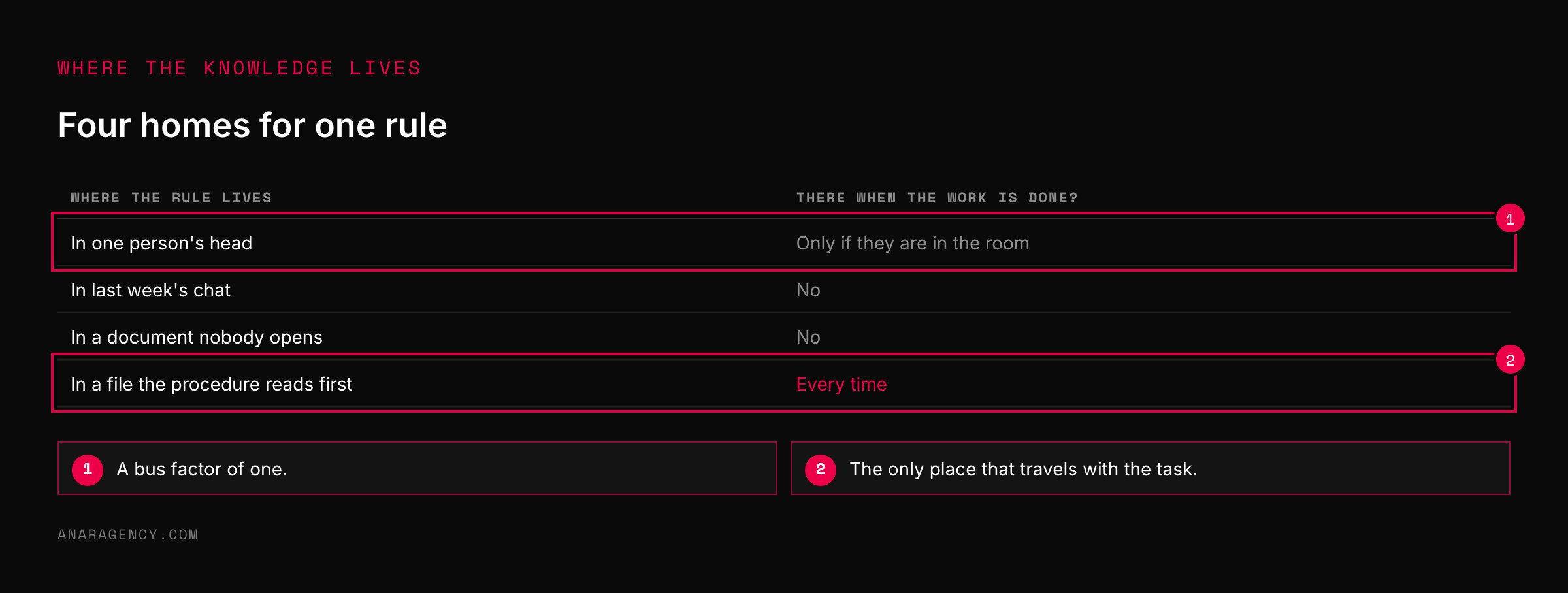
People have the same weakness. Teams measure how exposed they are with the bus factor: how many people would have to disappear before nobody knew how something worked. In a small agency the number is often one.
So the real question is not which model to use. It is where the knowledge lives. If it lives in someone's head or in last week's chat, it is not there when the work is being done.
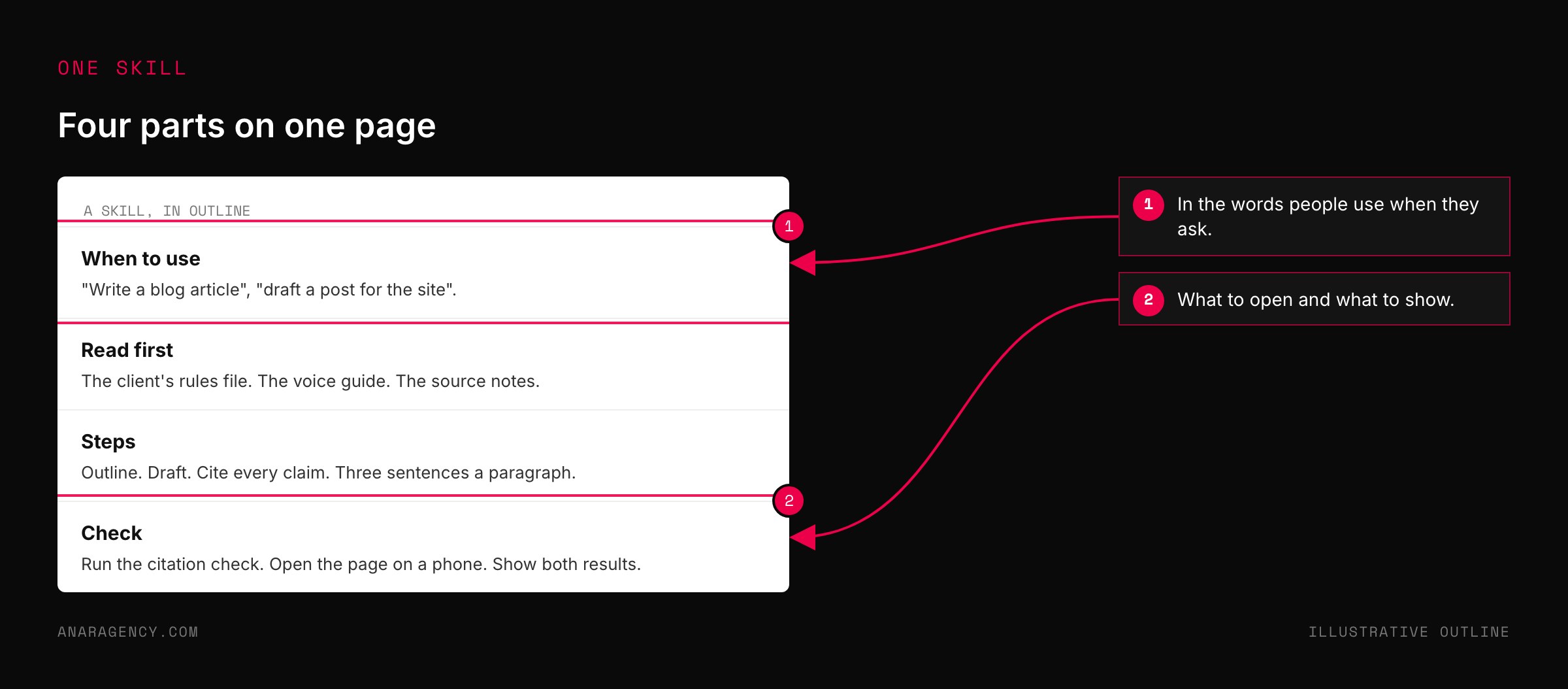
Keep what your business knows in files, and write a short procedure for each repeated task. Each skill has four parts: when to use it, where the facts are, the steps, and the check. Store each fact once and point to it.
Write a skill after the second repeat. Be loose on exploratory work and strict on repeated work. Turn every lesson into a rule, put the proof required into the skill, rank rules for when they conflict, and prune monthly.
Skills, and the source of truth
The answer in the tool we use is called a skill.
In Claude Code's own description, you create a file of instructions and the agent adds it to its toolkit. It uses the skill when a task is relevant, or you can call it by name. The advice is to make one when you keep pasting the same checklist or procedure into the chat.
A good skill has four parts. When to use it. Where the facts are.
The steps. The check.
The second part matters most. The facts do not go in the instructions as prose. They live in files: the client's rules, the brand guide, the framework, the transcript.
The skill points to them and says to read them before writing anything.
Engineers call that a single source of truth. Each fact is kept in one place, and everything else refers to it. Change the client's rule once and every task that follows uses the new one.
It also keeps the model honest. An agent told to defer to the files before its general knowledge produces work that sounds like the client, not like the internet.
Librarians: how the library is built
The firms getting dependable work from AI agents are not the ones with clever prompts. They have a shelf of plain procedures and keep it tidy. We call them Librarians.
They write a skill after the second repeat. The first time is exploration. The second time you notice.
The third time it should be a file.
They are loose where it is new and strict where it repeats. For a first draft, give the goal and the facts and leave the method open. For the weekly report or a deploy, spell out every step.
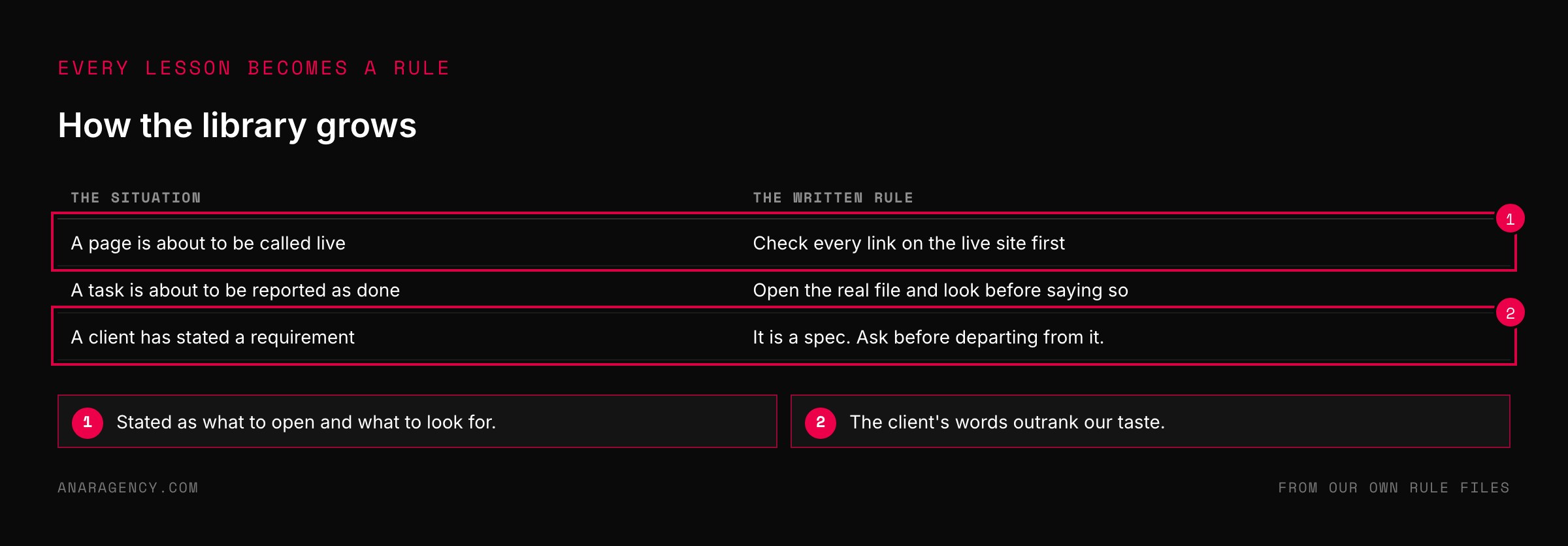
They turn every lesson into a rule. One of ours says that no page is called live until every link on it has been checked on the live site. A lesson that is not written down has to be learned again.
They put the check in the skill. Not "make sure it works" but what to open, what to look for, and what to show as proof. Without that, an agent will report success on its own say-so.
They rank the rules. When two instructions conflict, which wins? Ours puts client legal rules above brand style, and both above speed.
They prune. A library that only grows becomes unreadable. Once a month, remove what is stale.
Anthropic's own guidance makes the same point about keeping instruction files short and reviewed.
"Is this just prompts in a folder?"
You could describe it that way. You could also describe a surgical checklist as a list on a clipboard.
The difference from a prompt is where it sits and how long it lasts. A prompt is typed, used, and gone. A skill is kept, versioned, improved after each failure, and loaded without anyone remembering to paste it.
It is not magic either. A skill does not make a model reliable by existing. An instruction can be missed, misread, or followed to the letter in a way that misses the point.
The fix is the same each time. Make the instruction more specific, and add a check that fails loudly.
And none of this replaces judgment about what to automate. Some work should stay with a person, and the work that is handed over needs an owner. We cover both in who owns AI and what an agent harness is.
The name of the tool will change. The practice will not. Write down what your business knows, keep each fact in one place, and make the work prove it followed the page.
What to read next, and why
WHO Surgical Safety Checklist (encyclopedia entry): The nineteen items and the eight-hospital study. The strongest case there is for writing things down.
Extend Claude with skills (product documentation): What a skill is, how one is written, and when the agent uses it.
Claude Code: Best practices for agentic coding (engineering guide): The maker's own advice on instruction files, context, and verification.
Single source of truth (encyclopedia entry): Why each fact should be stored once and referred to everywhere else.
So the simple takeaway is this: pick the task you explained to an AI tool twice this week. Write the explanation into a file, with the facts and the check. That is your first skill.
Questions executives ask
What is a skill in Claude Code?
A file of instructions the agent loads when a relevant task comes up or when you call it by name. It typically states when it applies, what reference material to read, the steps to follow, and how to verify the result.
How can a business use Claude Code if it is a coding tool?
It reads and writes files and runs commands, which covers a great deal of non-coding work: drafting from a brief, building reports and documents, checking pages, and following written procedures. The business supplies the knowledge as files.
What does source of truth mean for AI workflows?
Each fact the work depends on, such as a client rule or a brand standard, is stored in one file. Procedures point to that file instead of repeating its contents, so a change in one place applies everywhere.
How many skills does a small agency need?
Start with one for the task you repeat most. We run about fifty, built up over time, mostly one per content format or recurring operation. The number matters less than keeping each one current.
Do skills make AI output reliable?
They improve consistency, but they do not guarantee it. Instructions can be missed or followed too literally. Reliability comes from adding a specific check to each procedure and requiring evidence that it passed.

Filip Kovacevic is the founder of Anar Agency in Phoenix. He spent five years running SEO, Meta ads, email, and content for medical practices across the United States, and now does the same work for healthcare, home-service, legal, and professional-service businesses, alongside AI implementation. More from Filip →
Talk it through in 15 minutes
Bring one AI question from this article. We will tell you what we would do, whether or not you hire us.
Book a 15-Min Chat →