The AI Maturity Model: From AI Literate to AI Enabled to AI First

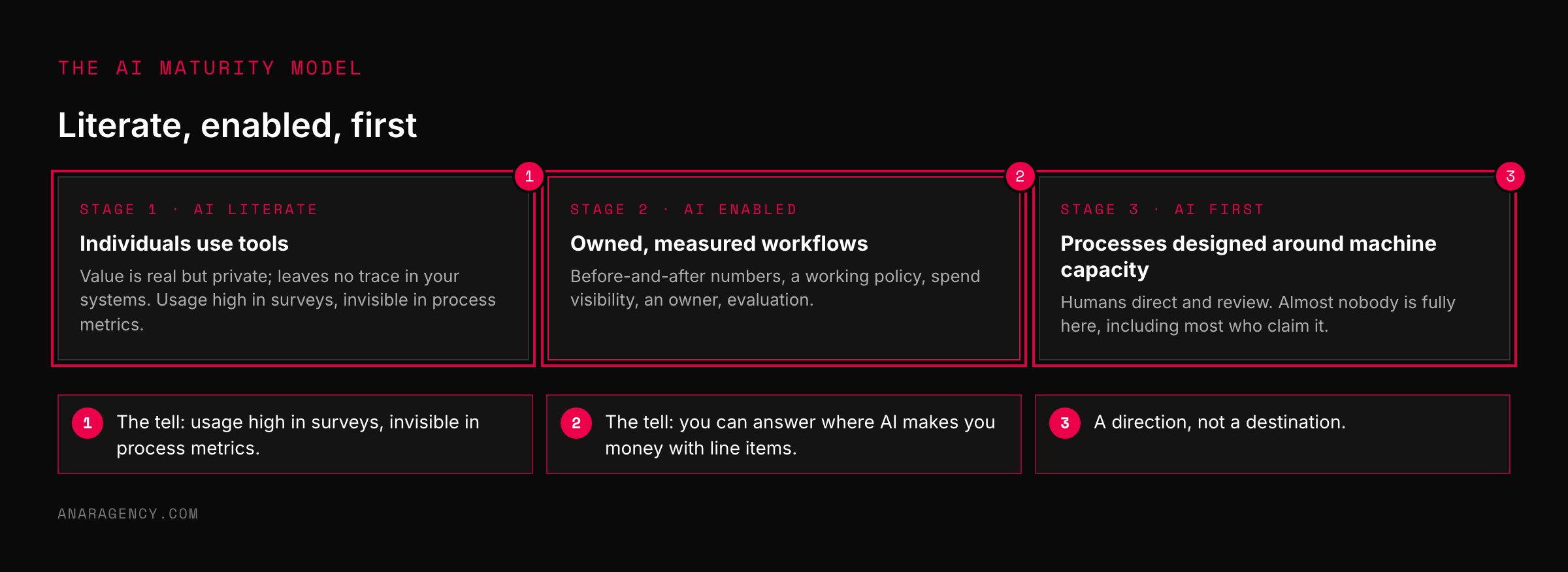
AI maturity moves through three stages. AI Literate: your people understand the tools and use them on their own. AI Enabled: AI sits inside measured workflows with owners, guardrails, and evaluation.
AI First: new processes are designed on the assumption that AI does the work and humans direct it. Most companies overestimate their stage by one, and twenty minutes with four people will tell you which one you are really at.
Stage one: AI Literate
Your people use AI tools personally: drafting, summarizing, searching. The value is real but private. It leaves no trace in your systems and it walks out the door with the employee.
There are no shared workflows, no evaluation, and usually no policy beyond an anxious memo.
Here is the tell. Usage is high in surveys and invisible in process metrics. If you cannot name one workflow whose cycle time changed, you are Literate, no matter how many licenses you bought.
The move that advances you: pick three recurring workflows, instrument them, and rebuild each one with AI inside and an owner accountable for the metric. Individual skill only becomes company capability through owned, measured workflows.
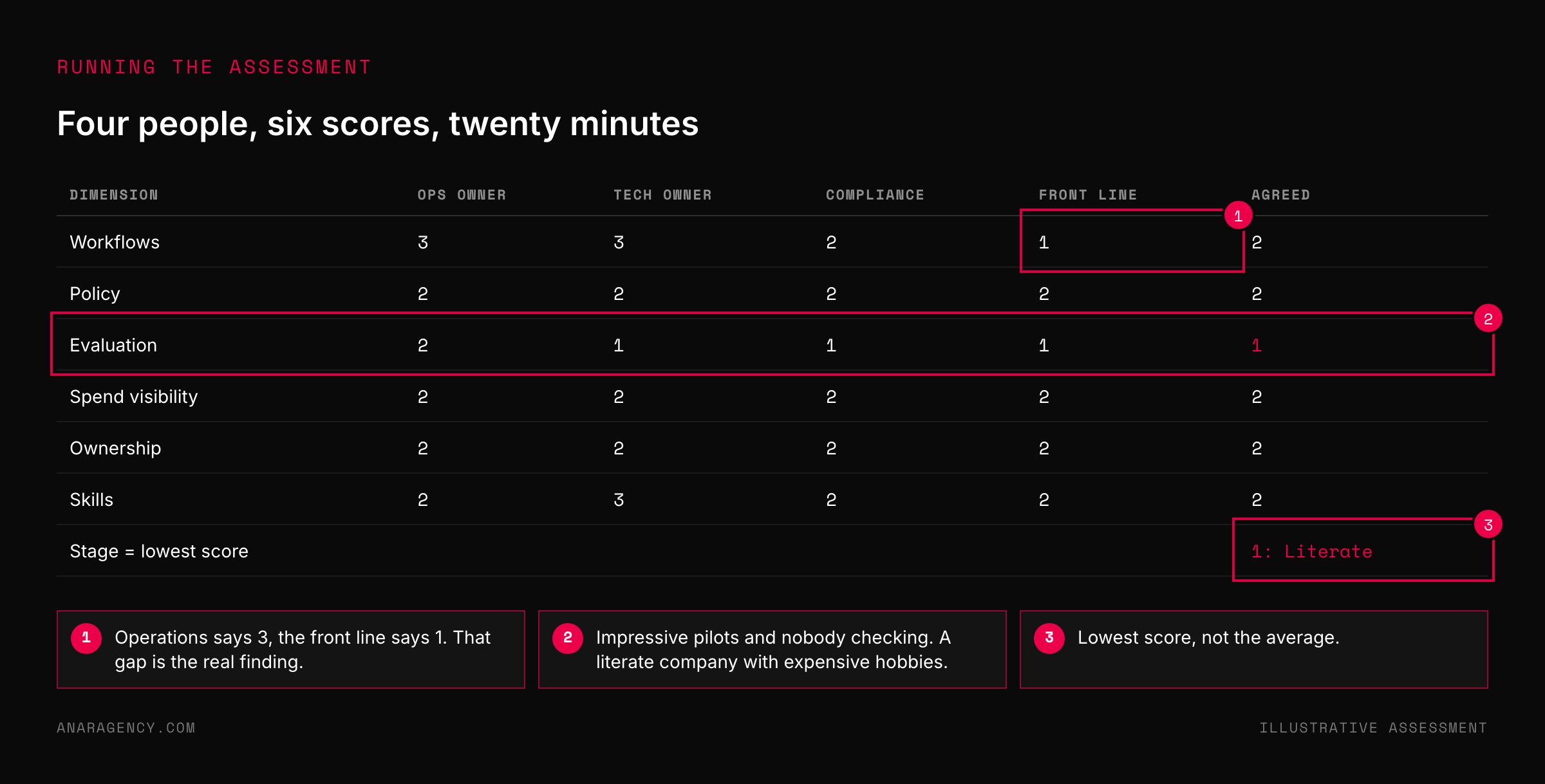
Score each dimension honestly. Your stage is your lowest score, not your average.
Stage two: AI Enabled
AI is embedded in named workflows with before-and-after numbers. There is a working policy for what data can go where, a permission model, spend you can see, and someone who owns AI operations even if it is a fraction of their job. Evaluation exists: sampled review, regression cases, tripwires.
The tell is simple. You can answer "where does AI make you money?" with line items instead of anecdotes.
The move that advances you: stop retrofitting AI into human-shaped processes and start designing processes around AI capacity. That is an org-design exercise, not a tooling exercise, and it is where the operating model conversation begins in earnest.
Rate yourself 1 to 3 across six dimensions: workflows, policy, evaluation, spend visibility, ownership, skills. Your true maturity stage is your lowest score. Invest there, not in the dimension that demos best.
Stage three: AI First
New processes are designed assuming the agent does the work and humans set direction and review output. Hiring plans, budgets, and org charts account for machine capacity. The company maintains its evaluation infrastructure the way it maintains accounting: continuously, boringly, as a cost of doing business.
Almost nobody is fully here, including most of the companies claiming it.
So treat AI First as a direction, not a destination. Every workflow you redesign around machine capacity moves you one step along the gradient.
Scoring yourself honestly
Score each dimension 1 to 3, for Literate, Enabled, First: workflows, policy, evaluation, spend visibility, ownership, and skills.
Now the rule that changes the answer. Your stage is your lowest score, not your average, because the lowest dimension is the one that produces the incident or the stall.
The common result: a company with impressive pilots scores 3 on workflows and 1 on evaluation and policy. That is a Literate company with expensive hobbies, and it is one bad week away from a retrenchment.
How not to leave people behind
Fear of replacement is rational, so answer it with structure, not slogans.
Publish which roles change and how. Fund training on work time. Turn your best internal users into paid champions with real mandates.
Make the first automations remove drudgery visibly instead of removing headcount quietly.
Adoption follows evidence. People move when they can see the company intends to redeploy them, not merely reduce them.
How this compares with the cloud providers' adoption frameworks
The large vendors each publish a maturity or adoption framework, and they are worth your time because they are free and detailed. Microsoft's AI scenario in the Cloud Adoption Framework walks strategy, plan, ready, govern, secure, manage. AWS's Cloud Adoption Framework for AI sorts the same ground into business, people, governance, platform, security, and operations perspectives.
Google Cloud's AI adoption framework covers lead, learn, access, secure, and scale. All three are good checklists for the enabled stage.
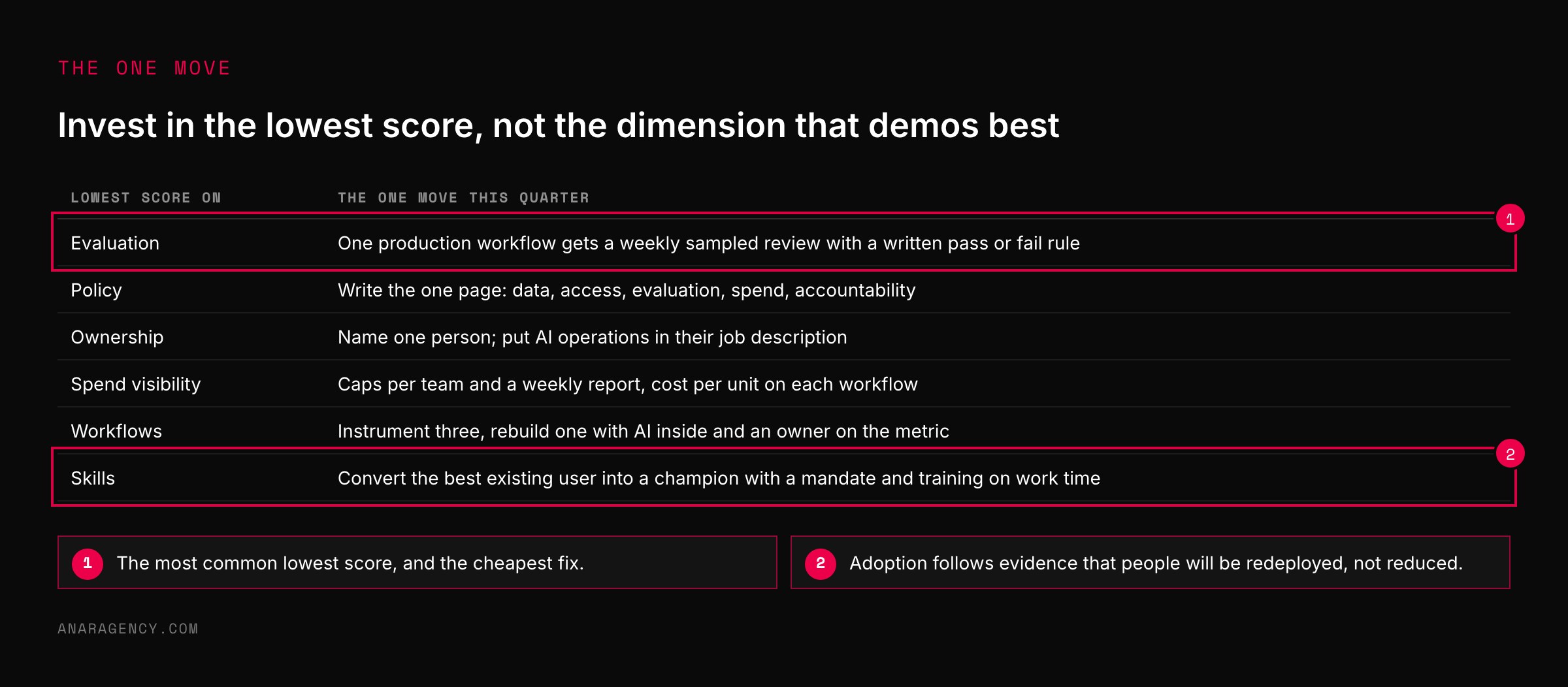
What they share is a lean toward their own platform and toward companies big enough to have a platform team. What they miss is the scoring rule. A framework that lists forty capabilities invites you to count the ones you have and feel reassured.
The lowest-score rule does the opposite. It finds the one dimension that will produce the incident. A company with a beautiful platform, a trained team, and no evaluation is one bad week from a retrenchment, and the forty-item checklist would have scored it well.
That is the difference between a vendor framework and a diagnostic.
The lineage behind all of these is older than AI. The Capability Maturity Model from software engineering set the idea of staged capability, with the organization's process, not its tools, as the thing being measured.
The technology adoption life cycle and the research on the diffusion of innovations explain why most companies sit at the literate stage at any given moment. The majority adopts after the evidence exists, not before, and the evidence is exactly what the enabled stage produces.
Running the assessment, and what to do with the result
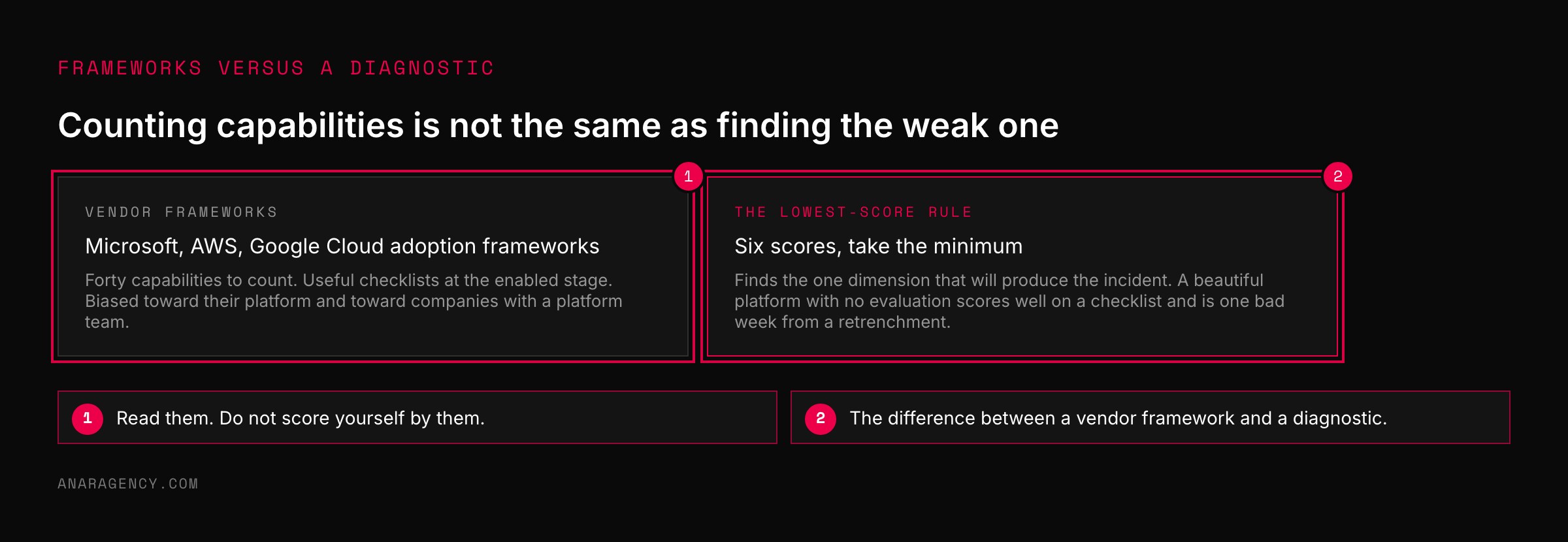
The assessment takes twenty minutes with the right four people in the room: whoever owns operations, whoever owns technology, whoever owns compliance, and one front-line user. Each of you scores the six dimensions one to three using the descriptions in the figure above, on your own, and then you compare.
The disagreements are the most useful thing you will get. The gap between the operations owner's score and the front-line user's score on the workflows dimension is usually the real finding.
Take the lowest score as the stage. Then make one move. For a 1 on evaluation, pick one production workflow and give it a weekly sampled review with a written pass or fail rule.
For a 1 on policy, write the one page from our governance framework. For a 1 on ownership, name one person and put AI operations in their job description.
For a 1 on spend, set caps and a weekly report using the method in controlling token spend. For a 1 on workflows, instrument three and rebuild one. For a 1 on skills, turn the best existing user into a champion with a mandate.
One move, one quarter, then re-score.
Outside references help when you take this to a board or a regulator. The NIST AI Risk Management Framework maps the policy and evaluation dimensions to its govern and measure functions. ISO/IEC 42001 is the standard a company at the enabled stage can realistically certify against.
The OECD principles supply the vocabulary, and the Stanford AI Index is the yearly dataset for checking whether your pace matches the field. None of them replaces the twenty minutes with four people and six scores.
You are not committing to anything by running it. You are finding out which stage you are really at. If you would rather have us run it with you, our consultant versus in-house article explains how we structure the first engagement so the capability stays with you.
Questions executives ask
What are the stages of AI maturity?
Three: AI Literate (individual tool use, no organizational capability), AI Enabled (AI embedded in owned, measured workflows with policy and evaluation), and AI First (processes designed around machine capacity with humans directing and reviewing).
How long does it take to move from AI Literate to AI Enabled?
With focus, one to two quarters: three instrumented workflows, a one-page policy, basic evaluation, and named ownership. Scale extends the timeline; complexity of ambition extends it more.
Are we behind on AI?
If you are Literate, you are with the majority, and the gap to Enabled is closable in a quarter of focused work. Behind is not the risk; staying unmeasured is.
How do I run an AI maturity assessment?
Put four people in a room, operations, technology, compliance, and one front-line user, and have each score six dimensions one to three independently: workflows, policy, evaluation, spend visibility, ownership, skills. Compare scores, take the lowest as your stage, and make one move on that dimension this quarter. Twenty minutes.
How is this different from the Microsoft, AWS, or Google AI frameworks?
Those are detailed checklists of capabilities, useful at the enabled stage and biased toward their own platforms. This is a diagnostic: it scores six dimensions and takes the lowest as your stage, because the weakest dimension is where the incident or the stall comes from, which a checklist that counts capabilities will not show.

Filip Kovacevic is the founder of Anar Agency in Phoenix. He spent five years running SEO, Meta ads, email, and content for medical practices across the United States, and now does the same work for healthcare, home-service, legal, and professional-service businesses, alongside AI implementation. More from Filip →
Talk it through in 15 minutes
Bring one AI question from this article. We will tell you what we would do, whether or not you hire us.
Book a 15-Min Chat →