The AI Podcast Clip Pipeline for Short-Form Volume
The AI clip pipeline produces short talking-head videos in volume by holding almost everything fixed. One designed presenter, one opening and closing frame, and one prompt structure are set up once. After that only the spoken line changes.
A script is cut into lines of a few seconds, each line is generated as a clip, and the clips are joined and captioned. It is the simplest AI video format because there are no scenes to manage. Label it as AI where platforms require, never use a real person's likeness without consent, and never let the presenter pose as a customer.
A presenter who does not exist
In 2016 an Instagram account appeared for a young woman in Los Angeles who posted about clothes, music, and her friends.
She was not real. Miquela was a computer-generated character run by a company, and in time her makers said so.
It did not seem to matter. The account drew millions of followers. She released music and worked with fashion brands.
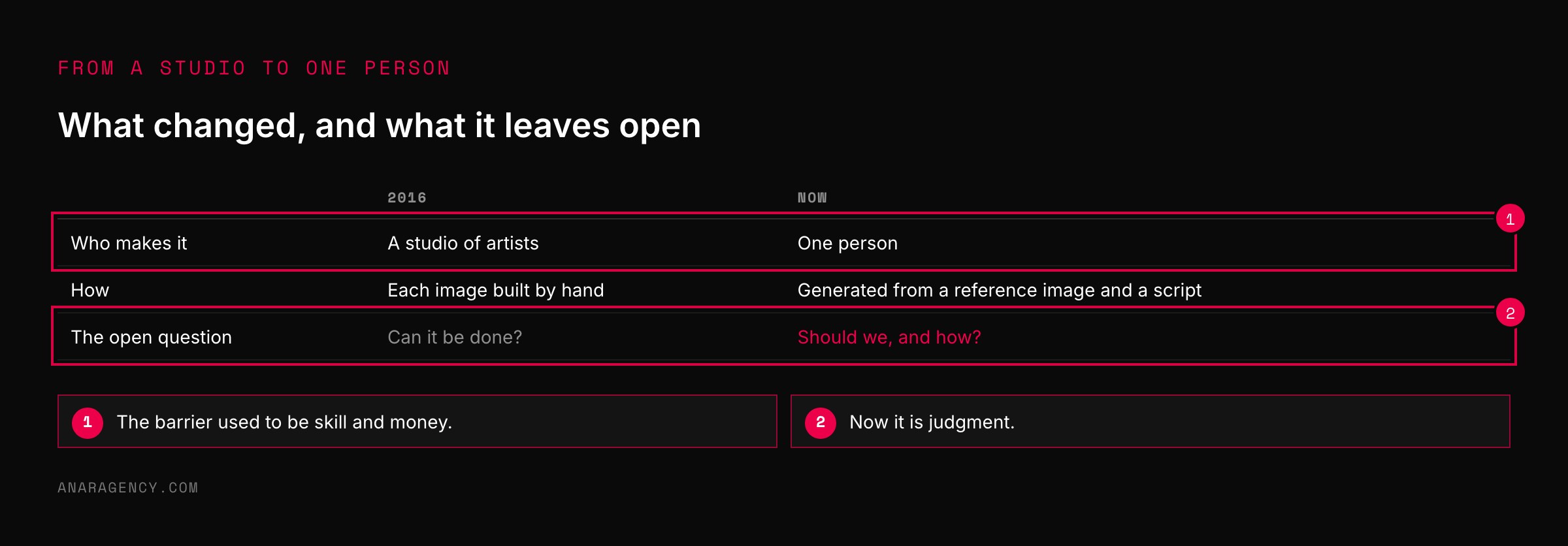
At the time that took a studio. A team of artists built every image by hand.
What has changed since is the cost. A consistent on-screen character speaking a script can now be produced by one person with a subscription. The question for a business is no longer whether it can be done, but whether to do it and how.
Why this format is the easy one
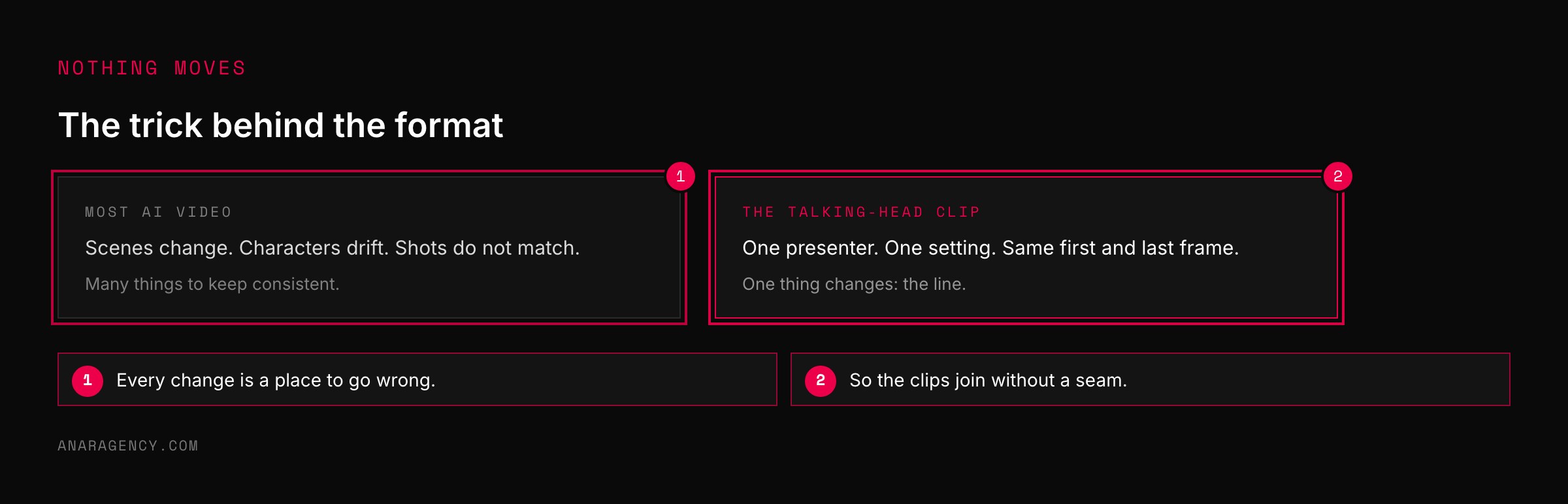
Most AI video is hard to make well. Scenes change, characters drift, hands go wrong, and nothing matches the shot before it.
The talking-head clip avoids nearly all of that by refusing to move.
One presenter, looking at the camera, in one setting, as if recording a podcast. The opening picture and the closing picture are the same for every clip.
Because the frame never changes, the clips join without a visible seam. Because the presenter never changes, there is one face to keep consistent instead of a cast.
The only thing that varies is the line being spoken. That turns video production into something closer to typing.
Hold everything fixed except the words. Set up once: one designed presenter and one opening and closing frame. For each video: write a script in lines short enough for one clip each, generate the clips, stitch and caption them, watch the full playback, label it as AI, and post.
Never use a real person's likeness without consent, never let the presenter pose as a customer, and check every claim as advertising. Judge the channel on leads and sales, not views.
The Clip Pipeline
Here are the five stations.
One character. Design a single presenter and keep the reference image. Make them plainly a character, not a copy of a real person.
One frame. Fix the opening and closing image. Every clip starts and ends on it.
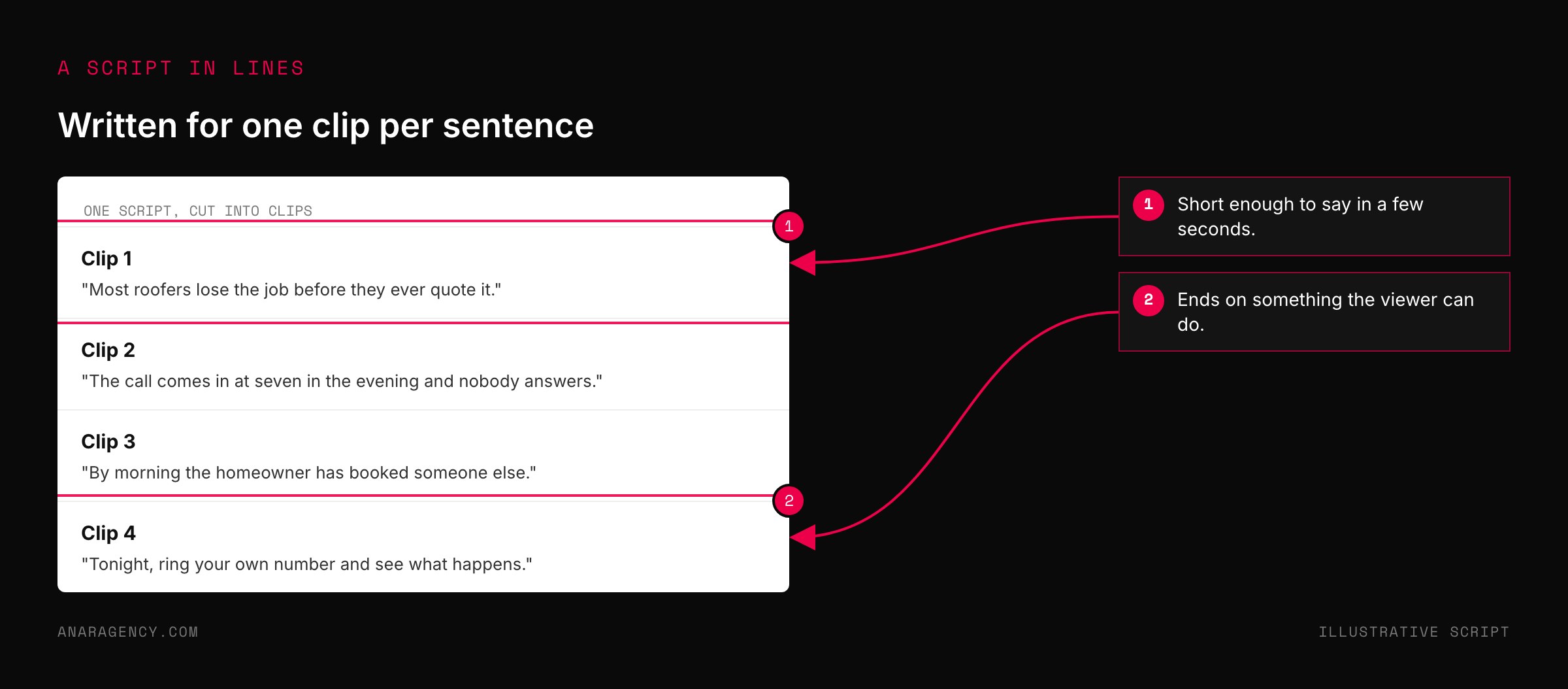
One script, cut into lines. Video models produce short clips, around eight seconds each in the tools we use. So each line has to be short enough to be said in one.
Write for that length from the start.
Generate and stitch. Produce each line as a clip. Join them in order, add captions, and check every join by watching it play.
Label and post. Mark the video as AI where the platform asks, and publish. One a day is plenty.
The first two stations are done once. Everything after is repeated, which is why the pipeline scales. What goes into the script is the same question as any other content, and we answer it in collect, don't invent.
Clear Labelers: the rules of the road
The businesses that will still be using this in two years are treating it as advertising, with the rules that apply to advertising. We call them Clear Labelers.
They disclose. YouTube requires creators to disclose when they use AI to generate or meaningfully alter realistic-looking content. TikTok asks creators to label AI-generated content that shows realistic scenes.
Meta applies AI labels across its apps.
They never use a real person. No real face and no real voice without that person's written consent. This is the line between a character and a fake.
They never fake a customer. An AI presenter can explain a product. It cannot say "I tried this and it changed my life," because nobody did.
The FTC has rules against fake reviews and testimonials, and they cover ones made by AI.
They check the script. Every claim in it is an advertising claim. The same standard of truth and evidence applies whether a person or a model reads the line.
They watch the playback. A still frame hides a jump in the face or a slip in the lips. Play every video from start to end before it is posted.
Our own rule on the testimony point is stricter than the law requires. An AI character explains, and never claims personal experience of anything.
"Does it actually get views?"
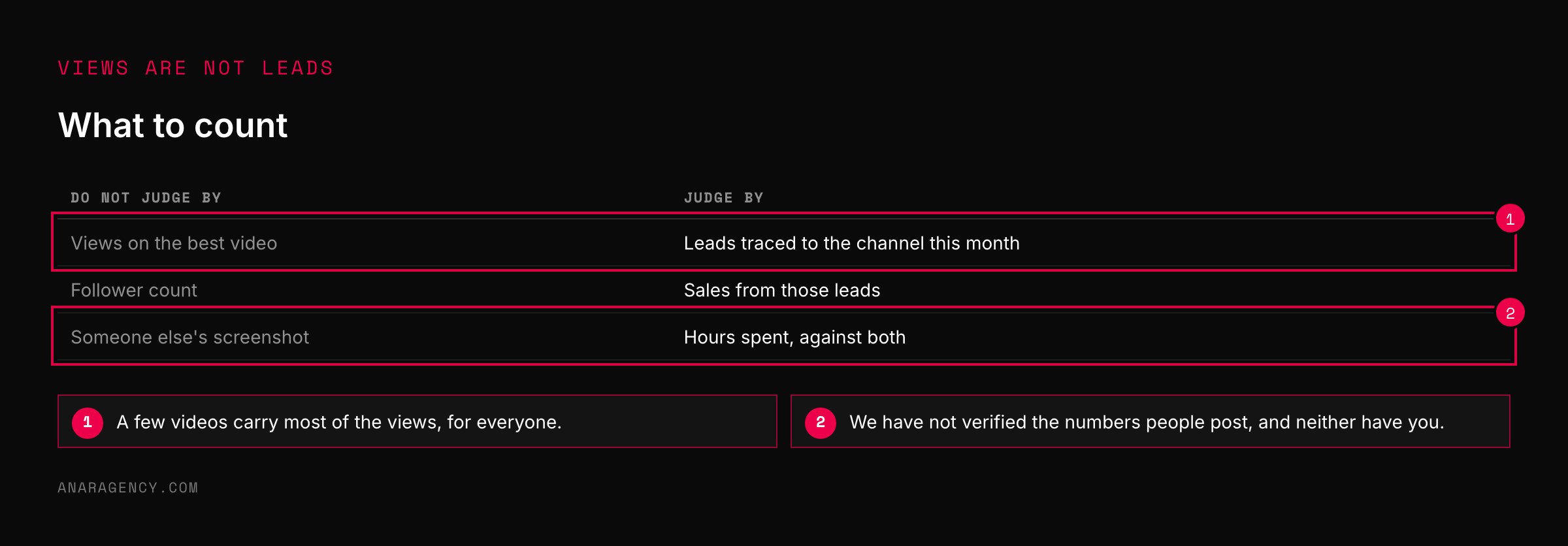
You will have seen claims of a million views in two weeks from this format. We have not verified any of them, and we will not repeat the numbers.
Here is what can be said plainly. Reach on short video is uneven. A few videos carry most of the views and most carry few, for human and AI creators alike.
Views are also not revenue. An account can collect a large audience and sell almost nothing, if the content entertains people who were never going to buy.
So judge this the way you would any channel. Count leads and sales traced back to it, against the hours it takes. We set out that discipline in reading ad data.
And decide whether it suits you. A firm whose selling point is a real, named expert may lose more than it gains by putting a synthetic face in front.
Where it fits best is explanation: a short answer to a common question, in a consistent voice, every day. The human expert still writes the script. The pipeline only reads it out.
What to read next, and why
Miquela (encyclopedia entry): The virtual influencer from 2016, and the debate she started about disclosure.
Disclosing use of altered or synthetic content (YouTube Help): What has to be labeled and what does not.
AI-generated content (TikTok Support): The platform's labeling rules for creators.
Our approach to labeling AI-generated content and manipulated media (Meta newsroom): How labels are applied across Facebook, Instagram, and Threads.
So the simple takeaway is this: if you try this format, fix the character and the frame once, write short true lines, label the result, and judge it on leads, not views.
Questions executives ask
What is an AI podcast clip?
A short video in which an AI-generated presenter speaks directly to the camera in a fixed setting, as if recording a podcast. It is assembled from several clips of a few seconds each that share the same opening and closing frame.
Do I have to disclose AI-generated videos?
On the major platforms, yes for realistic content. YouTube requires disclosure when AI is used to generate or meaningfully alter realistic-looking content, TikTok asks creators to label realistic AI-generated content, and Meta applies AI labels across its apps.
Can an AI character give a testimonial?
No. A testimonial reports a real person's experience, and an AI character has none. US rules prohibit fake reviews and testimonials, including AI-generated ones. An AI presenter can explain a product but should not claim to have used it.
How long does each AI video clip need to be?
It depends on the tool. Many current video models generate short clips of a few seconds, so scripts are written as lines that each fit one clip, then joined into a video of about a minute.
Does AI short-form video work for lead generation?
We have not verified the view counts claimed for this format and do not rely on them. Treat it like any channel: track leads and sales against the time spent, and remember that views do not equal revenue.

Filip Kovacevic is the founder of Anar Agency in Phoenix. He spent five years running SEO, Meta ads, email, and content for medical practices across the United States, and now does the same work for healthcare, home-service, legal, and professional-service businesses, alongside AI implementation. More from Filip →
Talk it through in 15 minutes
Bring one AI question from this article. We will tell you what we would do, whether or not you hire us.
Book a 15-Min Chat →