Collect, Don't Invent: Where Content Actually Comes From
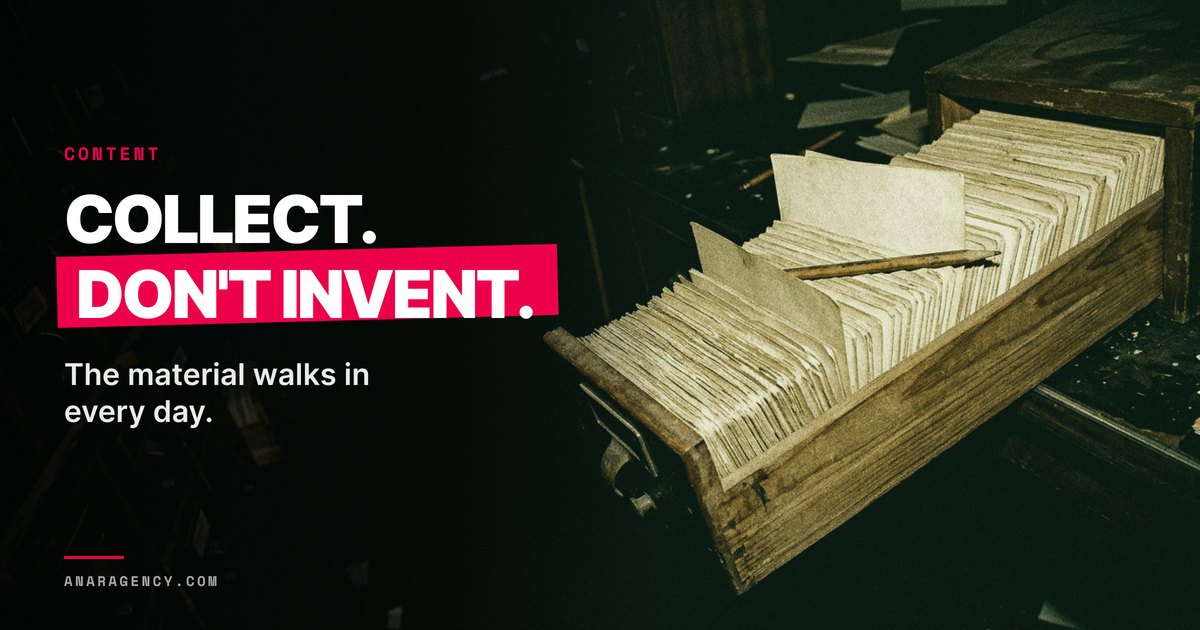
People who publish steadily do not think up ideas at a blank page. They collect material all week and write from the pile. For a service business the material is already there: questions from sales calls, confusions from support, the work you did this week, your own numbers, and changes in your trade.
Capture each one the day it happens, in the speaker's exact words, with where it came from and why it struck you. Once a week, sort the notes and pick what to write. The rule is simple: collect first, write second, never invent.
Ninety thousand cards
Niklas Luhmann was a German sociologist who died in 1998. He is remembered partly for his ideas and partly for how much he wrote.
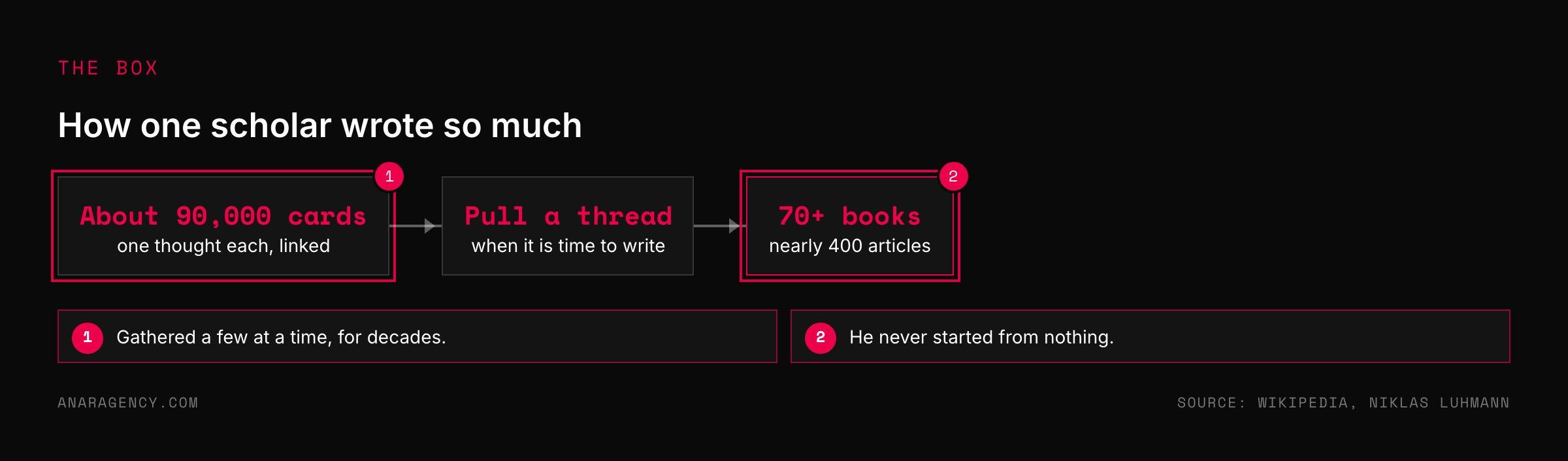
He published more than 70 books and nearly 400 scholarly articles. Asked how, he pointed at a set of wooden drawers.
Inside were about 90,000 index cards. Each held one thought, written in his own words, numbered, and linked to others. He called it his Zettelkasten, a slip box.
He said he did not think everything up alone. Much of it happened in the box. He collected every day and, when it was time to write, pulled a thread of cards and found the argument already there.
He was not a faster thinker than his peers. He never started from nothing.
The blank page is the wrong place to start
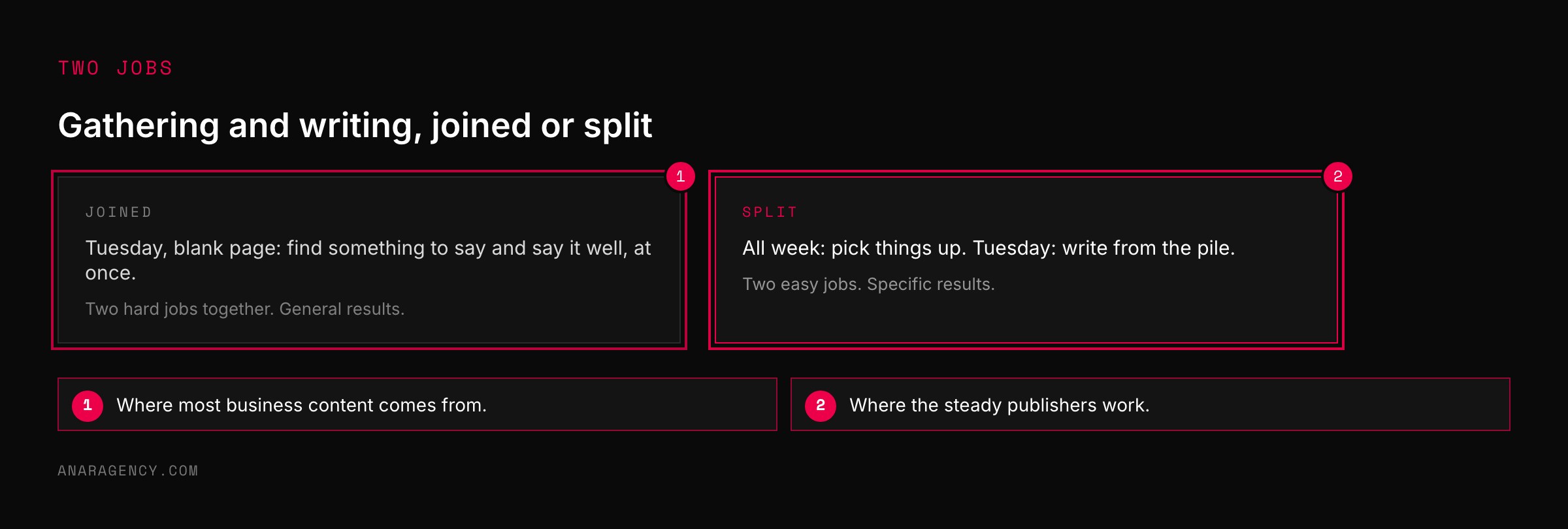
Most business owners treat content as invention. Tuesday morning, an empty box, a cursor. What should I say?
It is the hardest way to do it, and it gives the weakest results. What comes out is general, because nothing specific is in front of you.
The habit of collecting is old. For centuries readers kept a commonplace book, a notebook for copying out passages, facts, and observations worth keeping. Writers and scientists used them as the raw stock of their work.
The principle is the same in every version. Separate the gathering from the writing. Do the first constantly and the second on a schedule.
When the two are joined you are doing two difficult things at once. When they are split, each is easy.
Collect first, write second, never invent. Gather from five sources: sales calls, support and email, your own work, your own numbers, and changes in your trade. Capture on the day, in the speaker's exact words, with the source and your reaction.
Keep one place for notes. Sort for fifteen minutes a week and write the two or three strongest, starting with anything three customers have said. Credit other people's ideas, protect customer identities, and do not call one remark a trend.
The Collect Rule
We put it as a rule. Collect first, write second, never invent.
For a service business, the collecting is nearly free, because the material walks in every day. There are five places to look.
Sales calls. The questions people ask before they buy, in their own words. This is the richest source and the most wasted.
Support and email. What confused people after they bought. Each confusion is an article that should have existed.
Your own work. What you fixed this week and what changed because of it.
Your numbers. Counts and comparisons from your own accounts. Nobody else can publish them, which is why they get cited.
See what AI engines cite.
Your trade. A rule that changed, a price that moved, a public report. Add what it means for your customers and you have a post.
Marketers call the first two sources the voice of the customer.
Magpies: how the collecting is done
The people who never run dry are not more creative than you. They pick things up. We call them Magpies.
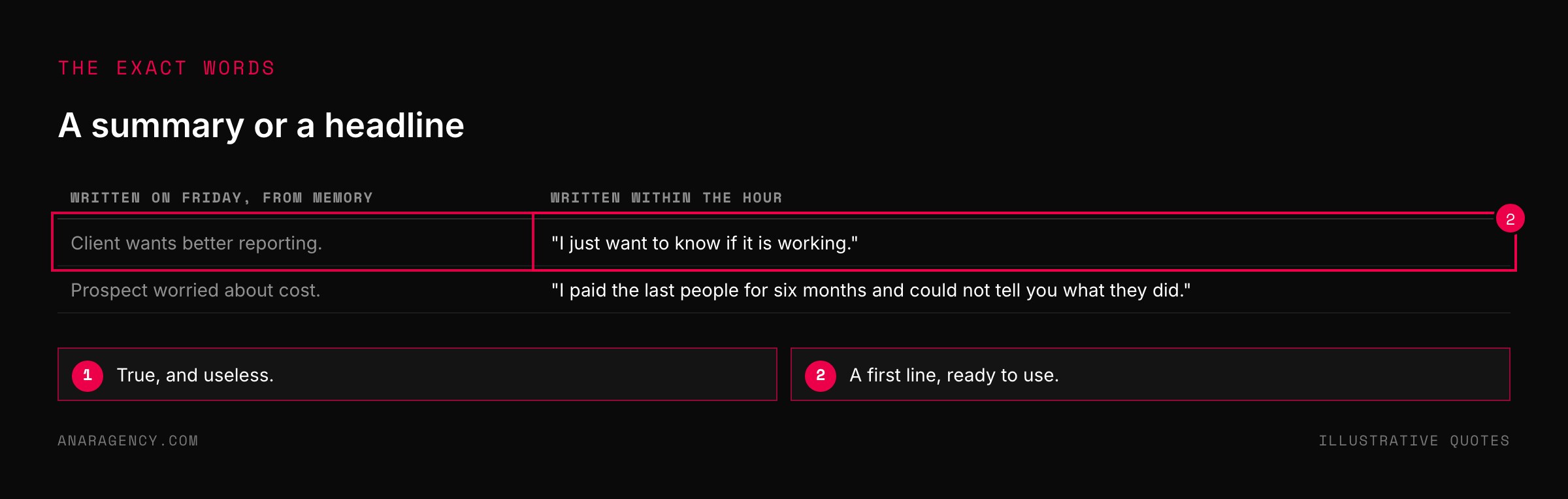
They capture on the day. A note written within the hour has the exact phrase. A note written on Friday has your summary, which is worth far less.
They keep the exact words. "I just want to know if it is working" is a headline. "Client wants better reporting" is nothing.
They add two lines of their own. Where it came from, and why it struck them. Six months on, the reaction is what makes the note usable.
They keep one place. A notes app, a document, a box of cards. The tool does not matter.
Having six of them does.
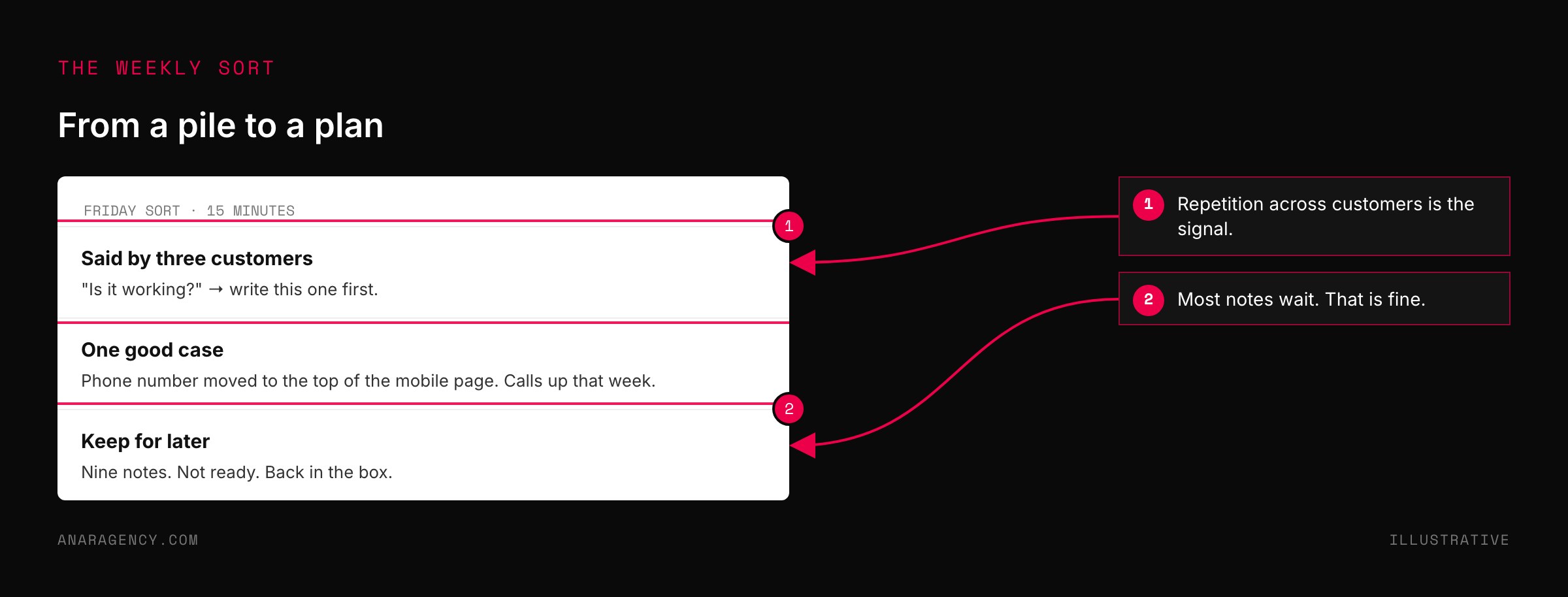
They sort once a week. Fifteen minutes. Read the week's notes, group the ones that belong together, and pick two or three to write.
Anything said by three different customers goes to the top.
From there the writing is assembly. One note becomes a post through the Six Openings, and a cluster becomes an article that is cut into twenty pieces.
"Is that not just copying other people?"
You may hear collect and think of lifting someone else's posts. That is a different activity, and we are against it.
What you collect here is raw material from your own work: what your customers said, what you saw, what your numbers show. Nobody else has it.
Other people's published ideas can go in the box too, with their name on the card. When you use one, you credit it and add something of your own. A note that says where it came from keeps you honest later.
Two cautions on customer material. Do not publish anything that identifies a customer without their permission. Change the details or ask.
And do not turn one remark into a trend. "A customer asked" is true. "Everyone is asking" needs more than one call behind it.
The larger point is that collected material is true, and invented material has to be made to sound true. Readers can usually tell which they are reading, and so can search systems looking for first-hand experience.
What to read next, and why
Niklas Luhmann (encyclopedia entry): The sociologist, his output, and the box he credited for it.
Zettelkasten (encyclopedia entry): How a slip box works: one idea per note, each linked to others.
Commonplace book (encyclopedia entry): The centuries-old habit of collecting what you read and hear.
Voice of the customer (encyclopedia entry): The practice of gathering customers' own words and what it is used for.
So the simple takeaway is this: after your next three customer calls, write down one sentence each person said, word for word. That is next week's content, and you did not have to think of it.
Questions executives ask
Where do content ideas come from?
For a service business, mostly from daily work: questions asked on sales calls, things that confused customers, problems you solved this week, numbers from your own accounts, and changes in your trade. The task is capturing them, not thinking them up.
How do I never run out of content ideas?
Separate collecting from writing. Capture material every day as it happens and keep it in one place. Once a week, sort the notes and choose what to write.
A steady supply of notes removes the blank page.
What is a Zettelkasten?
A note system associated with the sociologist Niklas Luhmann, who kept about 90,000 index cards. Each card holds one idea in the writer's own words and is linked to related cards, so arguments can be assembled from existing notes.
What should a content note include?
The exact words that were said, where and when you heard them, why they struck you, and what the note might become. The last two take seconds to add and make the note usable months later.
Can I use customer conversations in my content?
Yes, with care. Remove or change anything that identifies the customer unless you have permission, and describe one remark as one remark instead of presenting it as a general trend.

Filip Kovacevic is the founder of Anar Agency in Phoenix. He spent five years running SEO, Meta ads, email, and content for medical practices across the United States, and now does the same work for healthcare, home-service, legal, and professional-service businesses, alongside AI implementation. More from Filip →
Talk it through in 15 minutes
Bring one AI question from this article. We will tell you what we would do, whether or not you hire us.
Book a 15-Min Chat →