Fifty Ads a Week: Creative Volume for Meta's New Ranking Model
Meta's ad system now leans on the ad itself to find the right person, and it was rebuilt to handle far more ads than before. That rewards accounts that keep producing clearly different ads, and AI tools have made that affordable. The way to do it without chaos is a pipeline with six stations: a bank of lines, a bank of scenes, assembly, a human gate, release in batches, and a weekly retire-and-learn review.
Size the output to your budget, since a small budget cannot feed fifty ads. And never let an AI-generated person pose as a customer, which the FTC's 2024 rule prohibits.
The ad that used to last a year
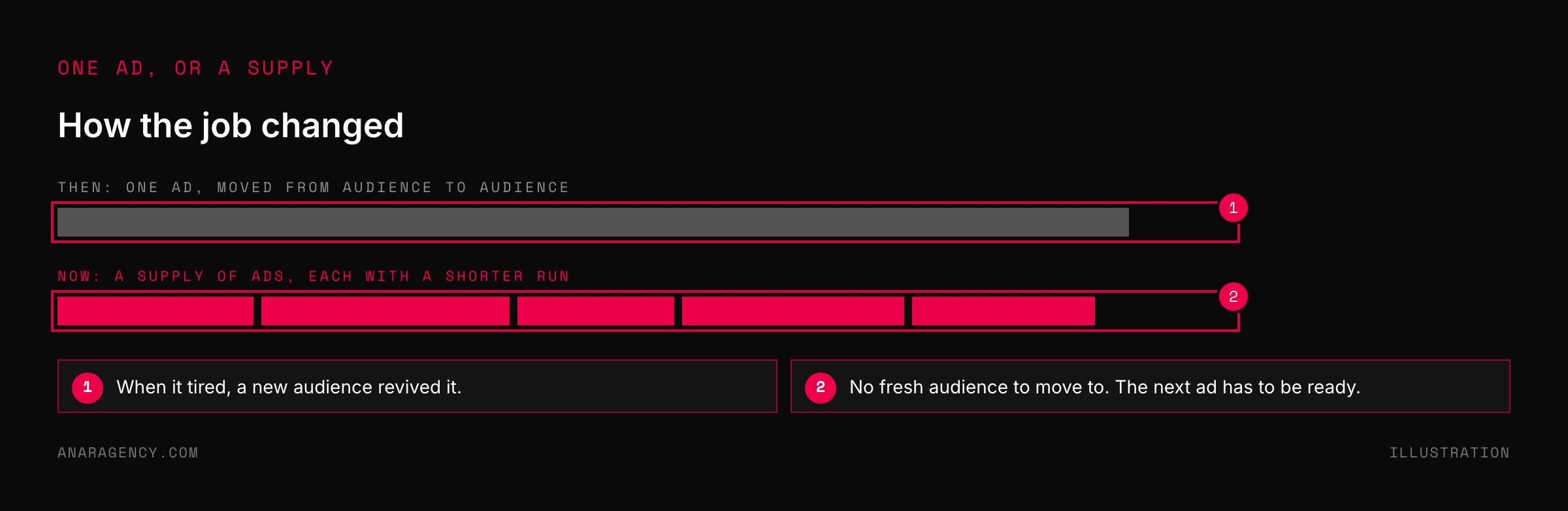
Not long ago, one good ad could carry an account for a year. When it slowed down, you showed it to a new audience and it picked up again.
That trick is mostly gone. Advertisers who have been at this a while all describe the same thing: winners burn out faster, and there is no fresh audience to move them to.
So the job changed. It used to be finding one great ad. Now it is building a way to keep making them.
That sounds exhausting, and done by hand it is. This article is about doing it as a system.
Why the machine wants more ads
This is not only advertisers grumbling. Meta said so, in engineering terms.
In December 2024 its engineers described a new system for the first step of ad delivery: choosing, out of millions of possible ads, the few thousand worth considering for one person.
They wrote that it was designed to handle the exponential growth in the number of ad creatives, and to deliver a more diverse set of ad candidates.
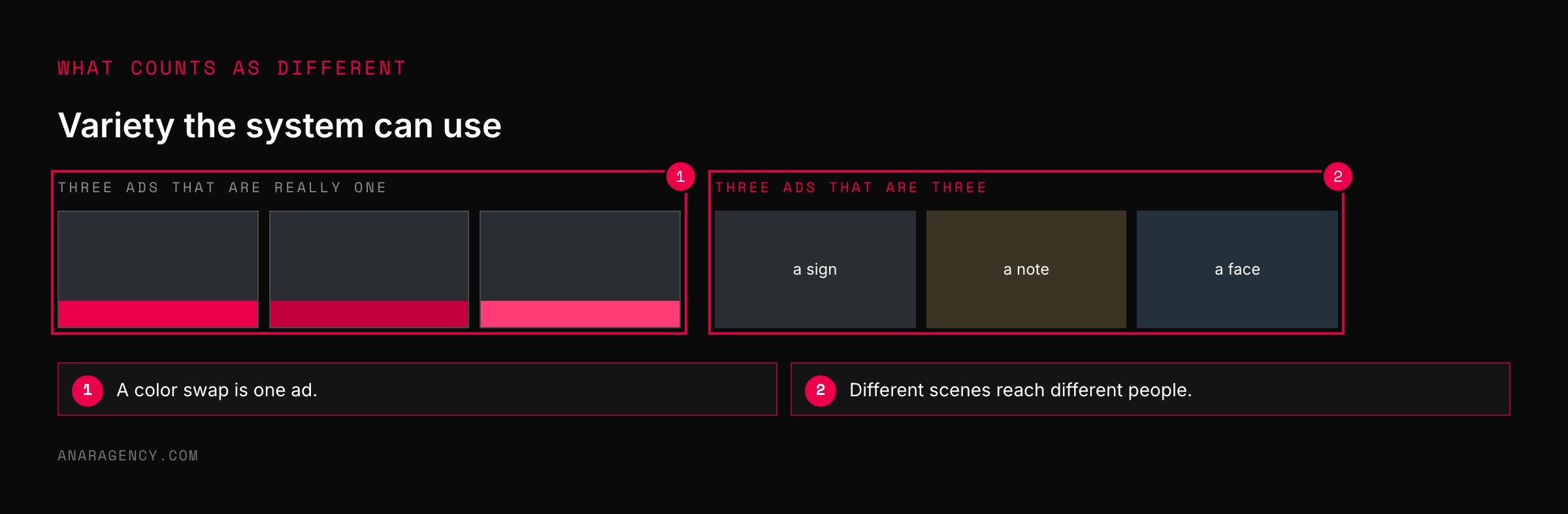
Read that as an advertiser. The system is built for a world with far more ads in it, and it is looking for variety. An account with three similar ads gives it very little to work with.
Our read, and it is an interpretation, is that each clearly different ad is another chance to be matched with a kind of person the others would have missed. We explain the model behind that in how Meta finds your buyers.
Six stations. One: a line bank of thirty or more lines, sorted by pain, outcome, objection, and proof. Two: a scene bank of clearly different pictures and clips.
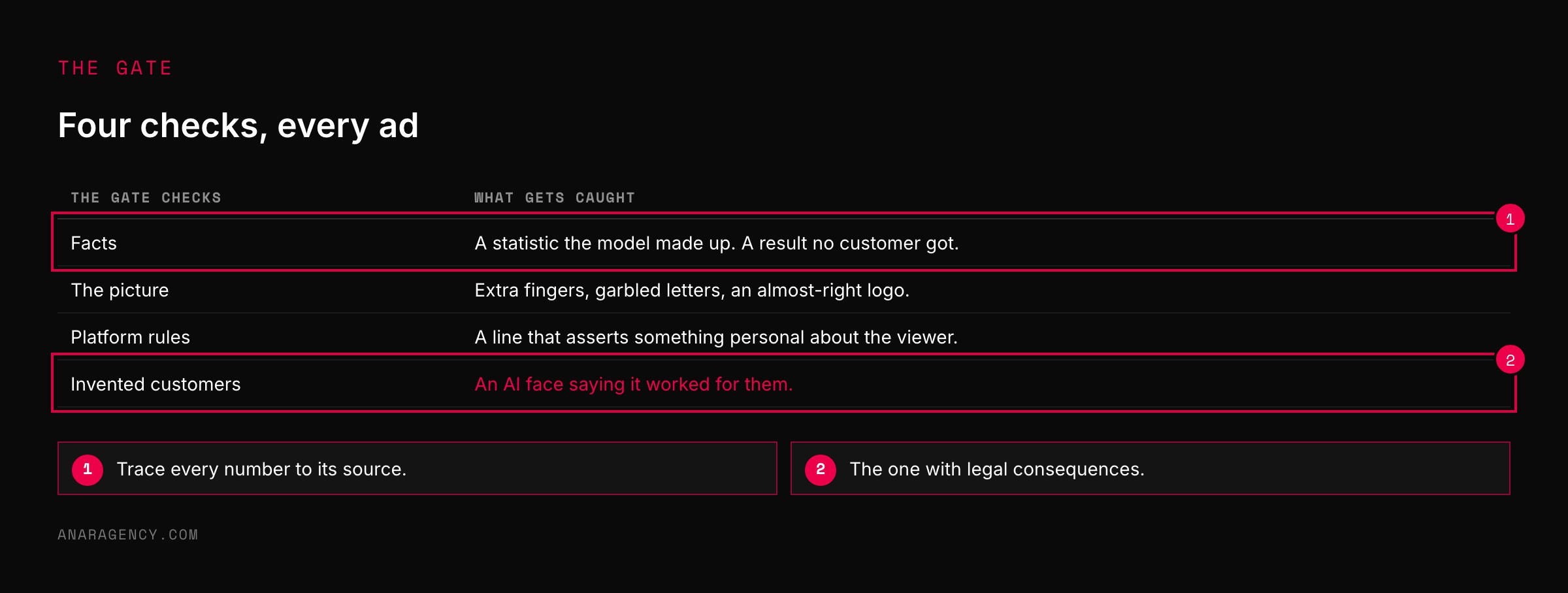
Three: assembly, pairing lines with scenes. Four: a human gate that checks every ad for facts, visual errors, platform policy, and invented customers. Five: release in batches sized to the budget.
Six: a weekly review that retires tired ads and feeds what the winners shared back into the line bank. AI helps in stations one to three and is never left alone at station four.
The Volume Pipeline
Making many ads is not the same as making ads many times. The first is a factory. The second is a bad week, repeated.
Station one is the line bank. Before anyone opens a design tool, write thirty or more candidate lines. Sort them by what they lead with: a pain, an outcome, an objection, a piece of proof.
Station two is the scene bank. A small library of pictures and short clips that look nothing alike. A sign, a desk, a street, a face.
AI image and video tools make this cheap now.
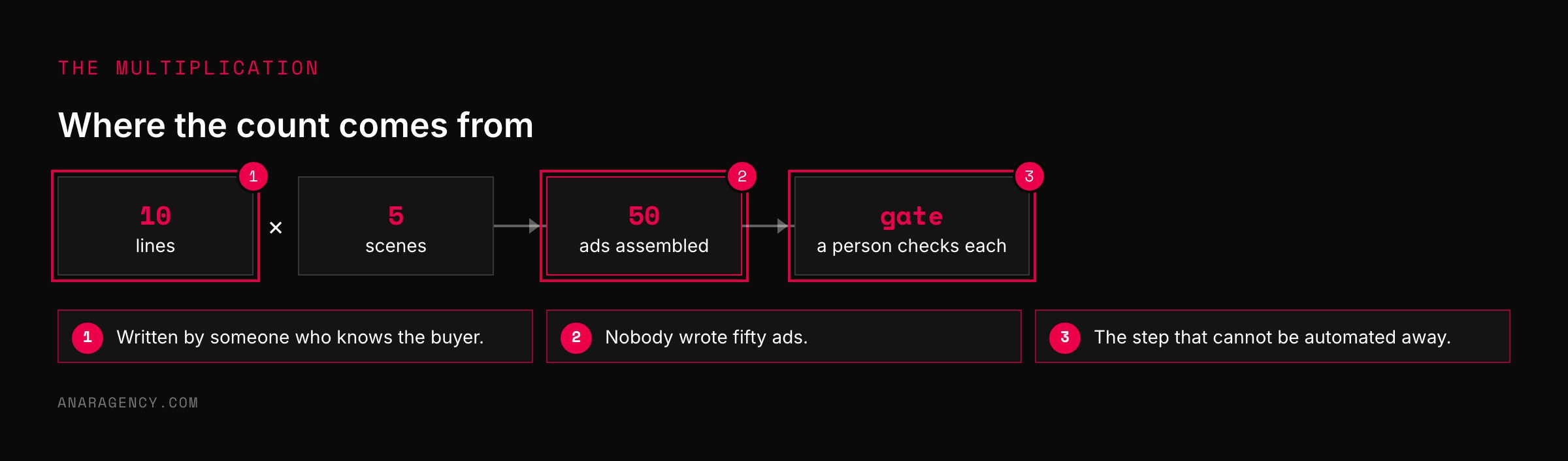
Station three is assembly. Pair lines with scenes. Ten lines on five scenes is fifty ads, and nobody wrote fifty ads.
Station four is the gate. A person looks at every single one. More on this below, because it is where accounts get hurt.
Station five is release. Ads go out in batches the budget can feed. Station six is the weekly review.
Tired ads come out, and whatever the winners shared goes back to station one.
The details of varying one line at a time are in our article on text-on-image ads.
Gatekeepers: what careful high-volume accounts do
Some teams ship fifty ads a week for a year and never get a rejection or an angry customer. They are not luckier. They guard one station.
We call them Gatekeepers.
They check facts by hand. AI writes fluent claims that are simply untrue: a statistic that does not exist, a result nobody got. Every number in an ad gets traced to its source by a person.
They check the picture. Six fingers, melted lettering, a logo that is almost right. One of those in a live ad tells every viewer the brand did not look.
They check the rules. Meta's policy against asserting personal attributes applies to every one of the fifty. Volume multiplies mistakes as easily as it multiplies ads.
They never invent a customer. This is the line that carries legal weight. In August 2024 the Federal Trade Commission announced a rule banning fake reviews and testimonials, and it names AI-generated ones specifically.
The rule prohibits testimonials that misrepresent that they are by someone who does not exist, or by someone who did not have actual experience with the product. The FTC's guidance says the rule lets courts impose civil penalties for knowing violations.
So an AI presenter may explain your product. An AI face may not say "this changed my life." The first is an illustration.
The second is a made-up customer.
"I have $50 a day. I cannot run fifty ads."
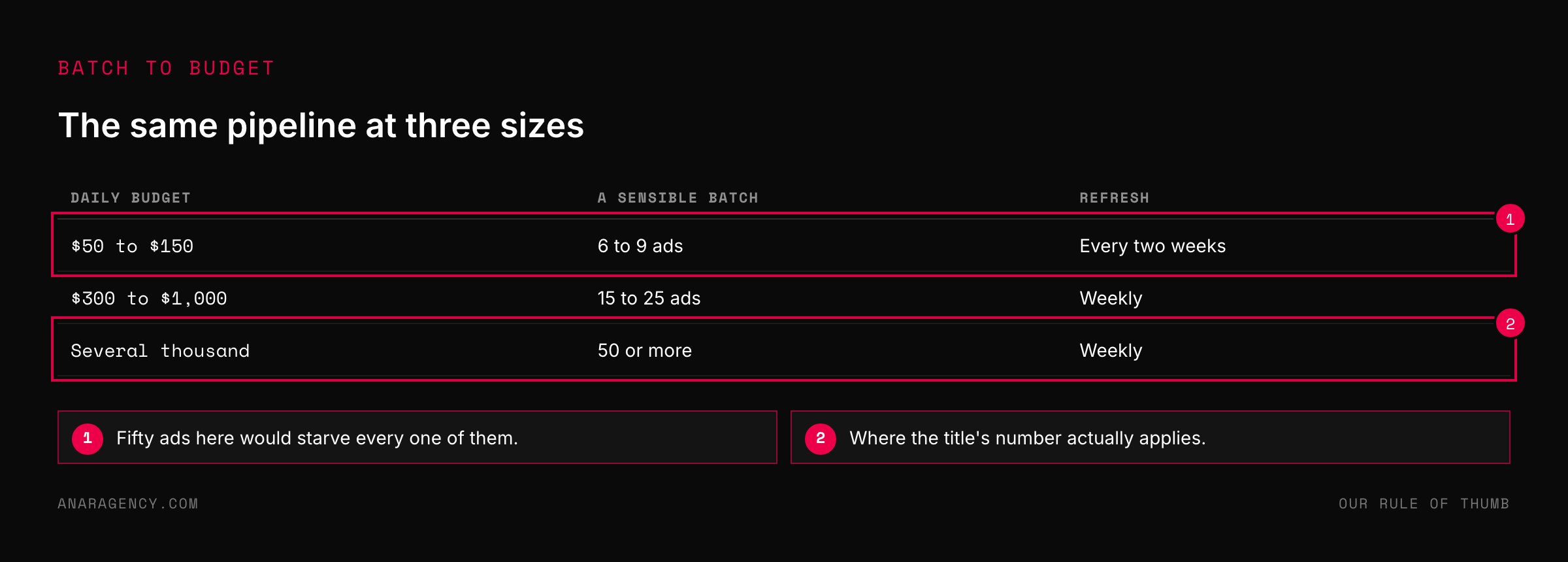
You are right, and you should not try. Fifty is what a large budget can feed. The number is not the idea.
Meta's own guidance pushes back on volume for its own sake. Its learning phase documentation says to avoid high ad volumes, because the system learns less about each ad when there are many.
Both things are true. The system wants variety over time, and it cannot learn from fifty ads sharing fifty dollars.
So keep the pipeline and shrink the batch. A small account might release six to nine ads, let them run, retire the weak ones, and release six more two weeks later. That is still a steady supply of new, different ads.
How to work out the right batch size from your budget is in launching ads for a new offer.
The other objection is that AI ads all look the same. They do, when everyone uses the same prompt. Your line bank is the fix.
The scenes are a commodity. What you know about your buyer is not.
What to read next, and why
Meta Andromeda (engineering post): Dense, but the introduction says plainly what the system was built to handle. Worth ten minutes.
FTC final rule banning fake reviews and testimonials (press release): The list of what is prohibited is short and specific. Read the first bullet twice.
Our Approach to Labeling AI-Generated Content (Meta announcement): How Meta labels AI media, so a label on your ad does not come as a surprise.
About the learning phase (Meta documentation): The brake on all of this. It explains why a small budget and a huge batch do not mix.
So the simple takeaway is this: do not try to make more ads. Build the line bank, the scene bank, and the gate, and more ads become a by-product.
Questions executives ask
How many ads should I run on Meta?
As many clearly different ads as your budget can feed. Large accounts may release dozens a week. A small account is better served by six to nine at a time, refreshed every couple of weeks, because Meta's guidance notes that the system learns less about each ad when there are too many.
What is Meta Andromeda?
It is Meta's name for a system that handles ads retrieval, the first step of ad delivery in which millions of possible ads are narrowed to a few thousand candidates for one person. Meta's engineers wrote that it was designed for the exponential growth in ad creatives and to deliver more diverse candidates.
Can I use AI-generated people in ads?
Yes, to present or explain. Not as fake customers. The FTC's 2024 rule prohibits testimonials that misrepresent that they are by someone who does not exist or who did not have real experience with the product, and it names AI-generated fake reviews and testimonials.
Why do my winning ads stop working faster than before?
Advertisers widely report shorter ad lifespans, and the old remedy of moving a winner to a fresh audience works less well now that delivery systems do more of the matching themselves. The practical response is a steady supply of new, clearly different ads.
How do I keep AI-made ads from all looking the same?
Start from the words, not the tool. Write a bank of lines based on what you know about your buyers, then pair them with varied scenes. The images are easy for anyone to generate.
The knowledge of the buyer is what makes the ads yours.

Filip Kovacevic is the founder of Anar Agency in Phoenix. He spent five years running SEO, Meta ads, email, and content for medical practices across the United States, and now does the same work for healthcare, home-service, legal, and professional-service businesses, alongside AI implementation. More from Filip →
Talk it through in 15 minutes
Bring one AI question from this article. We will tell you what we would do, whether or not you hire us.
Book a 15-Min Chat →