Each Email Isolates One Lever: Writing a Sequence From a Pillar
Write each email to do one job. There are six levers a message can pull: who (a person like the reader), why (the real cause), how (one usable step), where (where the reader stands), when (what waiting costs), and what (the offer). One email, one lever, one link.
Build the whole sequence from a single pillar article or video so the research is done once: its story becomes the who email, its cause section the why email, its first step the how email, and so on. The sequence covers all six; no single email tries to.
Fewer jams, happier tasters
Researchers Sheena Iyengar and Mark Lepper ran a well-known study with jam. Shoppers who faced a smaller selection of jams were more satisfied with their tasting than those faced with a larger one.
The finding became famous as the paradox of choice. Later studies were mixed, and a 2015 review of 99 studies found the effect depends on conditions such as how hard the decision is and how unsure people are of what they want.
One of those conditions describes most marketing email well. A busy reader, unsure what they want, deciding quickly.
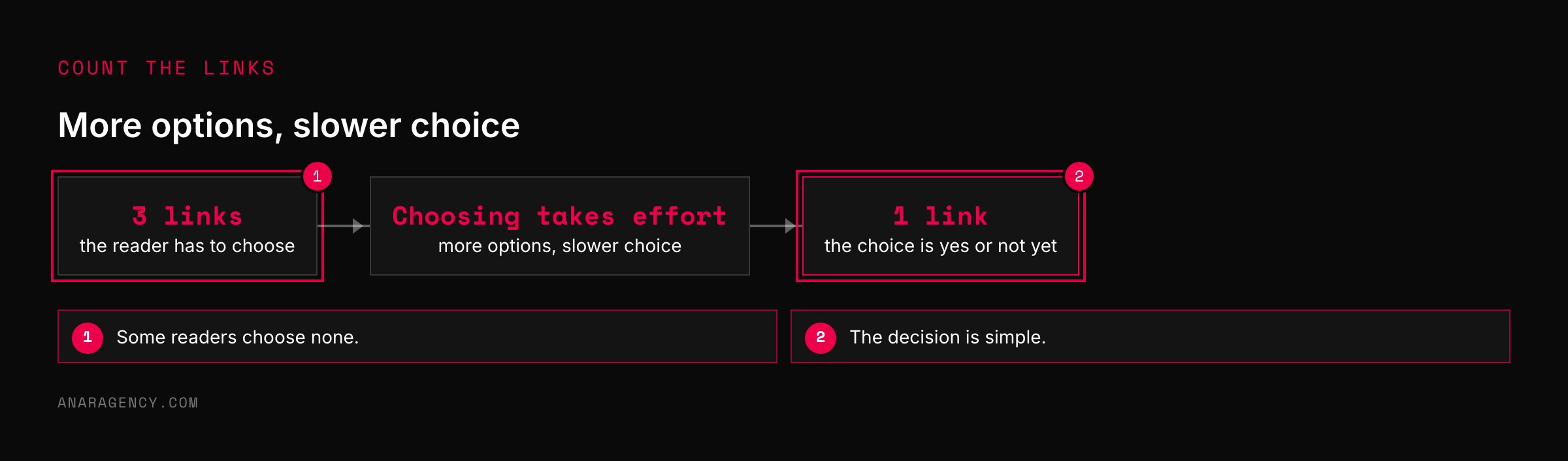
Give that reader five ideas and three links, and they often do none of it. Give them one, and they might.
So the rule for email is simple. One email, one lever.
Six levers a message can pull
Journalists learn the five Ws: who, what, when, where, why, and the H that goes with them, how. Each one is a different job for a message.
Who connects. A person like the reader, and what happened to them.
Why explains. The real reason the problem exists, which is usually not the one the reader assumes.
How moves. One step the reader can use today.
Where orients. Where the reader stands now, and where this road leads.
When times it. What waiting costs, and why now is different from later.
What decides. The offer, as one clear thing with one next step.
Each email does one job by pulling one of six levers: who (a person like the reader), why (the real cause), how (one usable step), where (where the reader stands), when (what waiting costs), and what (the offer). One lever, one link per email. Build the sequence from a single pillar piece so research is done once: its story is the who email, its cause the why email, its first step the how email, its self-check the where email, its cost the when email, and the offer the what email.
Why one lever per email works
Working memory is small. Researchers estimate people can hold only a few items in mind at once, which is why working memory is a bottleneck for any message.
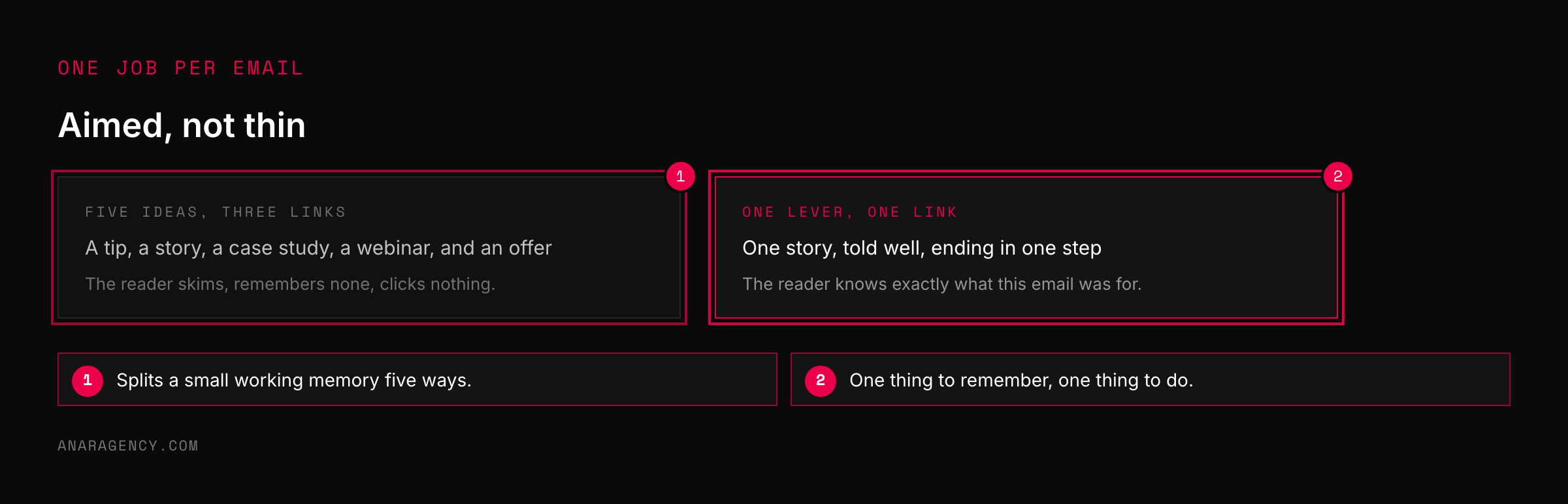
An email that pulls three levers splits that small space three ways. The reader remembers none of them well.
More choices also slow decisions. Hick's law describes how the time to choose rises as the number of options grows.
So an email with one idea and one link is not thin. It is aimed.
And it is easier to measure. When each email has one job, you can see which job your readers respond to.
Writing the sequence from one pillar
The hard part of email is not writing. It is having something worth saying six times in a row.
So start from a pillar: one long article, video, or talk that already holds your best thinking on a topic.
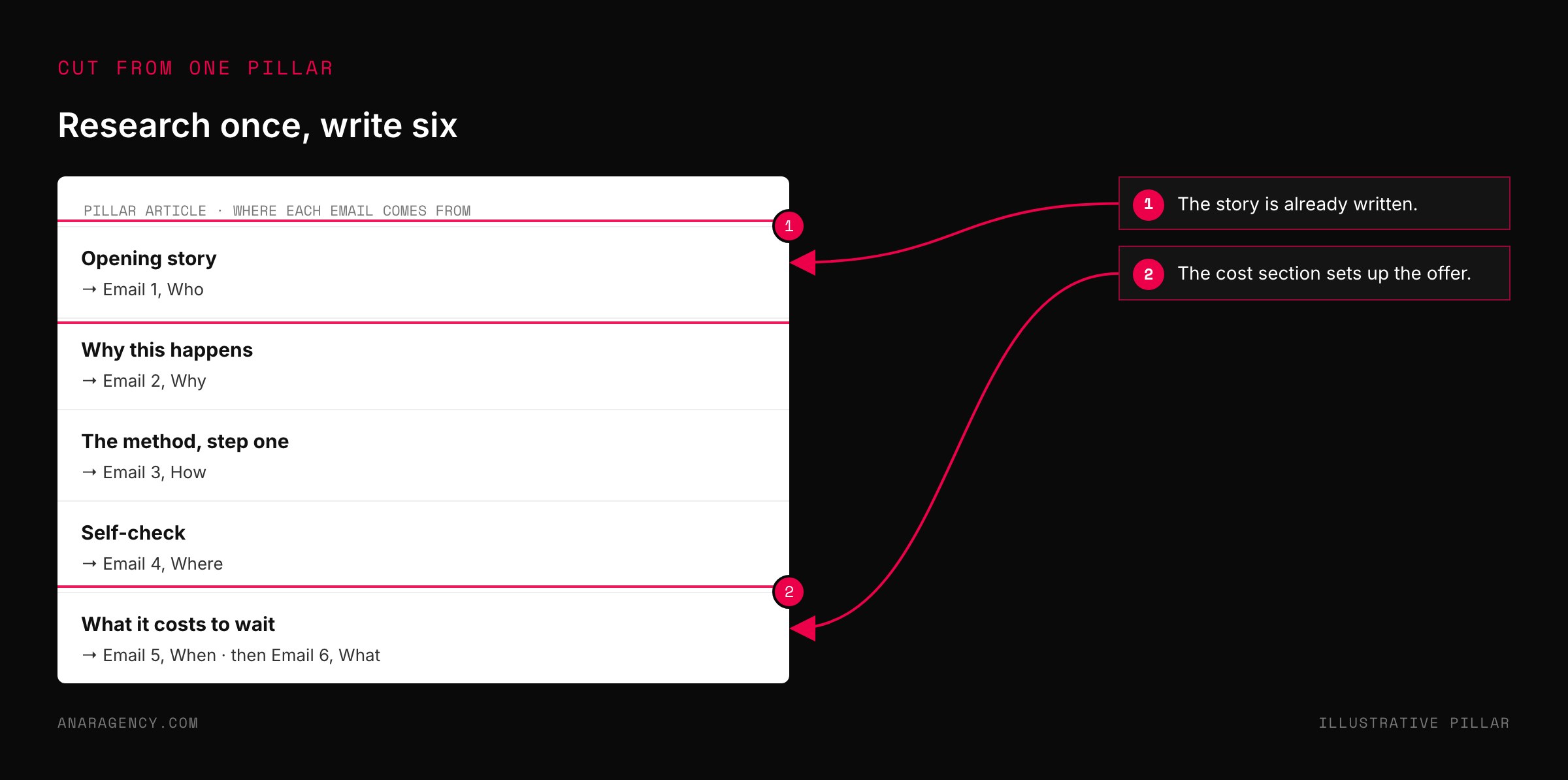
Then cut. The pillar's customer story becomes the who email. Its root-cause section becomes the why email.
Its first step becomes the how email.
A self-check from the pillar becomes the where email. The cost of the problem becomes the when email. And the offer gets its own email, the what.
Research once, write six short emails. For more ways to cut a pillar, see one article, twenty pieces.
For a full eight-email sequence for new leads, written out, see the nurture email sequence.
"Isn't one idea per email too little?"
Only if the idea is small. One idea told well, with a story and a step, fills an email nicely.
Length is not the problem. A long email on one lever reads easily, while a short email on four levers feels scattered.
Keep one link. If there is a second link, the reader has to choose, and some will choose neither.
Write the subject line from the lever. A who email gets a person's name in the subject, and a when email gets a date or a cost.
Then check each draft with one question: which lever is this email pulling? If the answer takes more than one word, cut until it does not.
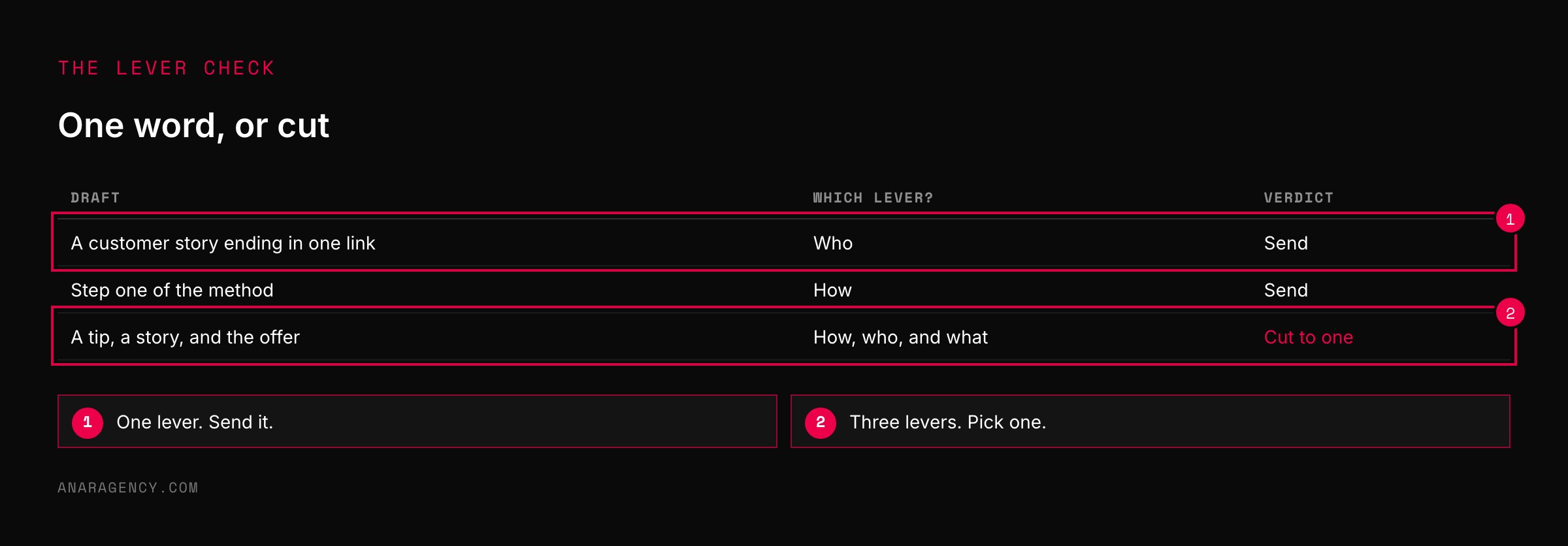
A worked example: six emails from one article
Here is the method applied to one pillar article, about why leads go cold before anyone calls them. The subject line and opening line of each email show the lever.
Who. Subject: "The practice that called back in four minutes." Opening: "Picture two clinics with the same ads, on the same street, getting very different results."
Why. Subject: "It is not the leads." Opening: "Most leads that go cold were warm when they arrived.
They cooled while they waited."
How. Subject: "One change for this week." Opening: "Turn on a text alert for every new enquiry, sent to the person who will call."
Where. Subject: "Which of these is you?" Opening: "Three kinds of practice: calls back the same hour, the same day, or whenever someone gets to it."
When. Subject: "What a slow week costs." Opening: "Count the enquiries you got last month, then count the ones that never reached a call."
What. Subject: "If you want us to set it up." Opening: "We install the alert, the script, and the follow-up for you, and here is what that costs."
Notice that each opening line does one job. None of them tries to tell the story, explain the cause, and sell the offer at once.
The examples above are illustrative. Write yours from your own pillar, in your own words, and keep each one to its lever.
What to read next, and why
The Paradox of Choice (encyclopedia entry): The jam study, and the mixed results that followed.
Choice overload (encyclopedia entry): When fewer options help, and when they do not.
Working memory (encyclopedia entry): Why one idea is easier to keep than three.
Five Ws (encyclopedia entry): The journalist's checklist the six levers come from.
So the simple takeaway is this: pick one pillar piece you have already made, and write six emails from it, each pulling one lever with one link.
Questions executives ask
How do you write an email sequence?
Start from one pillar article or video and cut six emails from it, each pulling one lever: who, why, how, where, when, and what. One idea and one link per email.
Should an email have only one call to action?
Usually yes. More options can slow decisions and split a reader's small working memory, so one clear next step tends to work better than several.
What is the paradox of choice?
The idea that more options can make choosing harder and less satisfying. It comes partly from a well-known jam study; later research found the effect depends on conditions.
How many emails should a sequence have?
Enough to pull each lever once. Six covers who, why, how, where, when, and what, and many sequences add a welcome and a final note.
Can I reuse a blog post as an email sequence?
Yes. A strong article usually contains a story, a cause, a method, a self-check, a cost, and an offer, and each can become its own email.

Filip Kovacevic is the founder of Anar Agency in Phoenix. He spent five years running SEO, Meta ads, email, and content for medical practices across the United States, and now does the same work for healthcare, home-service, legal, and professional-service businesses, alongside AI implementation. More from Filip →
Talk it through in 15 minutes
Bring one AI question from this article. We will tell you what we would do, whether or not you hire us.
Book a 15-Min Chat →