Speed to Lead: The First Five Minutes Decide the Deal

Speed to lead is how quickly a business responds to a new enquiry, and it is among the largest levers on whether that lead becomes a customer. A Harvard Business Review study of 2,241 US companies found that firms trying to reach a lead within an hour were nearly seven times as likely to qualify it as those that waited even an hour longer. The average company took 42 hours and 23 percent never replied.
Aim for an automatic acknowledgment at once, a human reply within five minutes in working hours, and an alert if neither has happened.
Two thousand enquiries, timed
Around 2010 a group of researchers ran a simple experiment on American business. They sent web enquiries to 2,241 companies and started a clock.
These were companies that had built the forms and invited the enquiries. They wanted the business.
Only 37 percent responded within an hour. Another 16 percent took up to a day. Twenty-four percent took longer than a day.
And 23 percent never responded at all. Among the companies that did reply within thirty days, the average wait was 42 hours.
Nearly a quarter of firms paid to make the phone ring and then did not pick it up.
What the delay costs
The same research measured what happened to leads depending on how fast they were contacted.
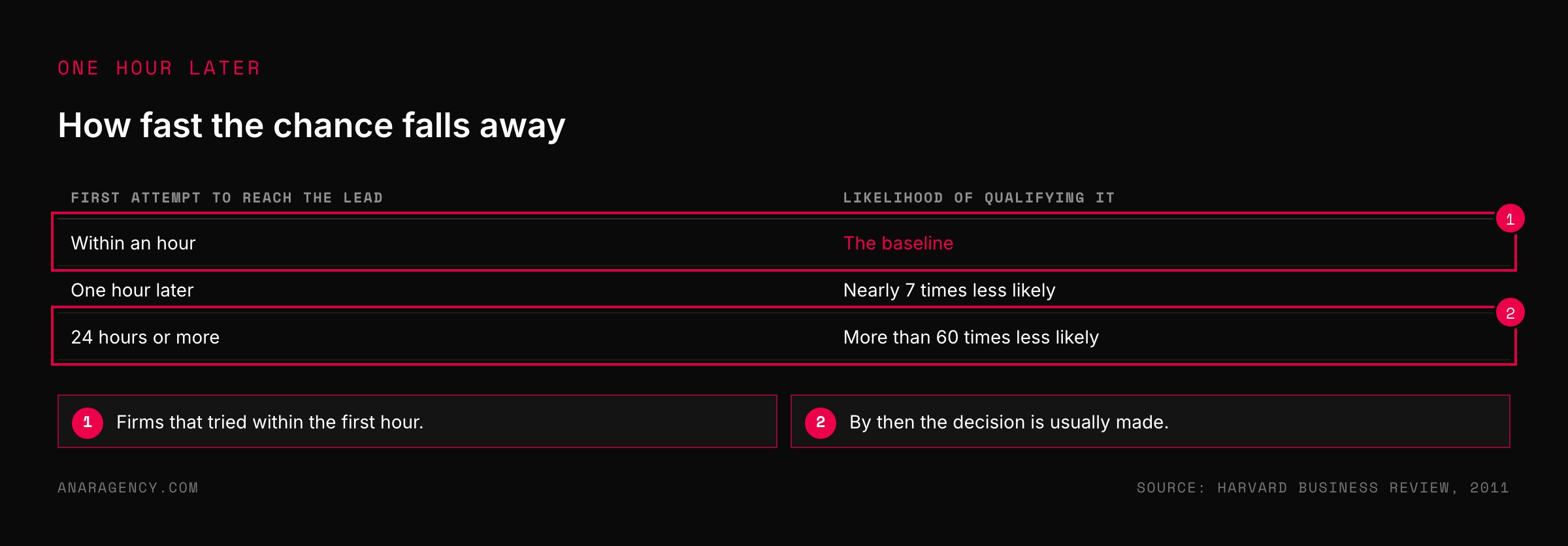
Firms that tried to reach a potential customer within an hour were nearly seven times as likely to qualify the lead as those that tried even one hour later. Qualify meant having a real conversation with a decision maker.
Compared with companies that waited a day or more, the fast ones were more than sixty times as likely.
Why so steep? The person who filled in your form did it at a moment when the problem was in front of them. An hour later they are in a meeting, or have had a reply from someone else.
People weigh what is recent most heavily, a tendency psychologists call recency bias. The first business to answer is the one in mind when the decision gets made.
The study counted hours. Ours is a stricter rule of thumb: in working hours, aim for five minutes. Nobody has shown that five is a magic number, but "within the hour" in practice turns into fifty-nine minutes.
Three layers. Instant: an automatic text and email on submission that confirms receipt and names who will call and when. Human: a named person responds within five minutes in working hours, or at the promised time out of hours.
Backstop: an alert to the owner if nobody has responded in fifteen minutes. Route leads to a phone, name who is on duty, script the first thirty seconds, call then text then email, and record minutes to first human contact for every lead. Get consent for texts and automated calls.
The 5-Minute Window
Fast response is not a matter of trying harder. It is a system with three layers.
The instant layer. The second a form is submitted, a text and an email go out automatically. They confirm you received it, say who will be in touch and when, and answer the most common first question.
This layer works at two in the morning and on Sundays. It is what the lead sees while a person is still putting down a coffee.
The human layer. A named person calls or replies. In working hours the target is five minutes.
Out of hours, first thing the next morning, at a time the instant message already promised.
The backstop. If fifteen minutes pass in working hours and nobody has responded, an alert goes to the owner or manager. Without this, the system depends on everyone remembering.
Large companies write targets like these into a service-level agreement: a stated response time, measured and reported. A small firm can do the same on one line of paper.
What you say in the first reply matters as much as when. That is the first email of the email profit center.
First Responders: what fast firms do
Some small firms answer faster than companies fifty times their size. They have fewer people, not more. They have arranged things so that speed does not depend on anyone's mood.
We call them First Responders.
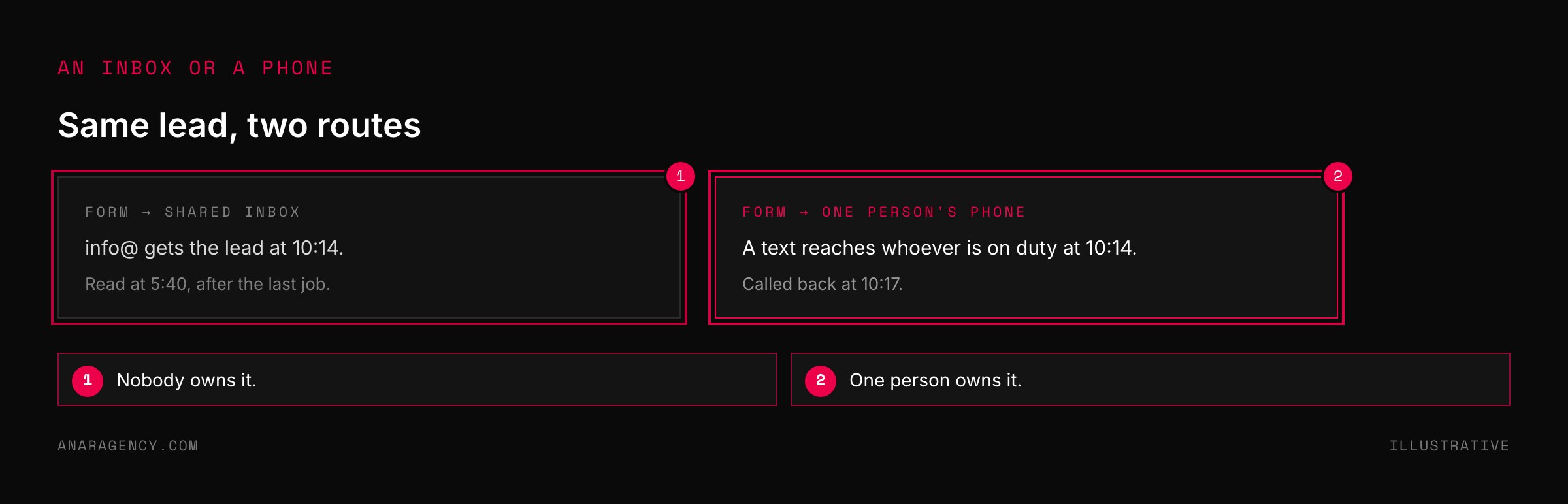
They send leads to a phone, not an inbox. A form that emails a shared address is read at the end of the day. A form that texts the person on duty is read now.
They name who is on duty. One person owns new leads for each block of the day. "Whoever sees it" means nobody.
They script the first thirty seconds. Name, the thing the lead asked about, one question. Nobody has to think about how to open.
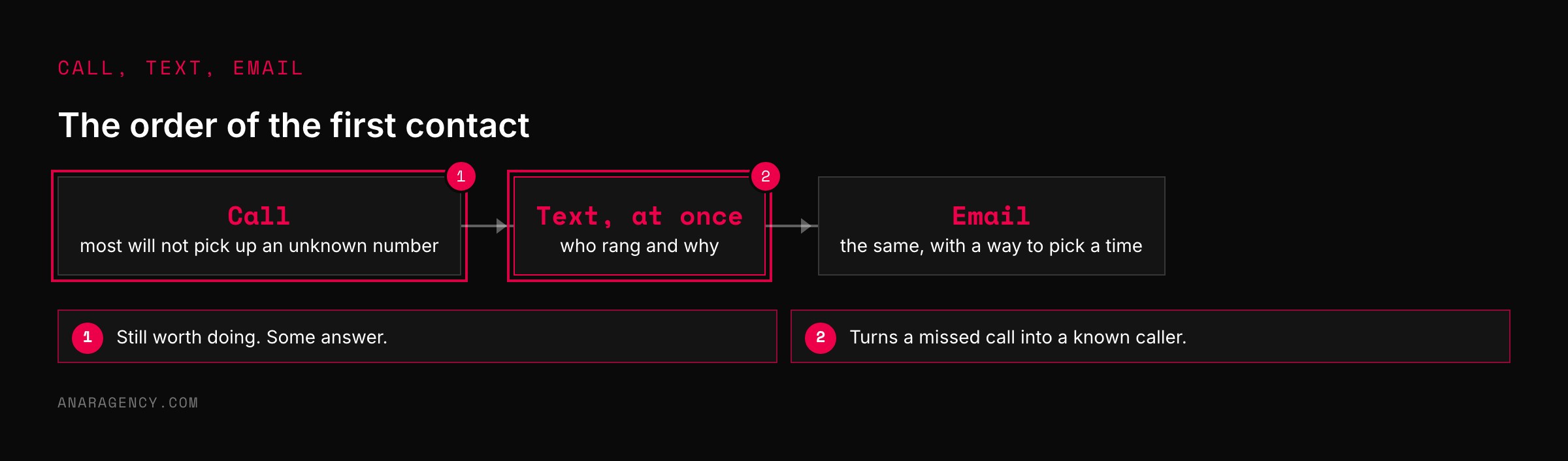
They call, then text, then email. A call that is not answered is followed straight away by a text saying who rang and why. Most people will not pick up an unknown number, and will read the text.
They time themselves. Minutes from form to first human contact, every lead, reviewed weekly. It belongs beside the four rates in book-a-call math.
They let software cover the gaps. An automated assistant can answer at night, ask the first questions, and book a time. It should say plainly that it is automated, and hand over to a person the moment the lead asks.
"We are a small shop. We cannot answer in five minutes."
You may be on a roof or with a client when the lead arrives. Of course you cannot call in five minutes. Nobody is asking you to.
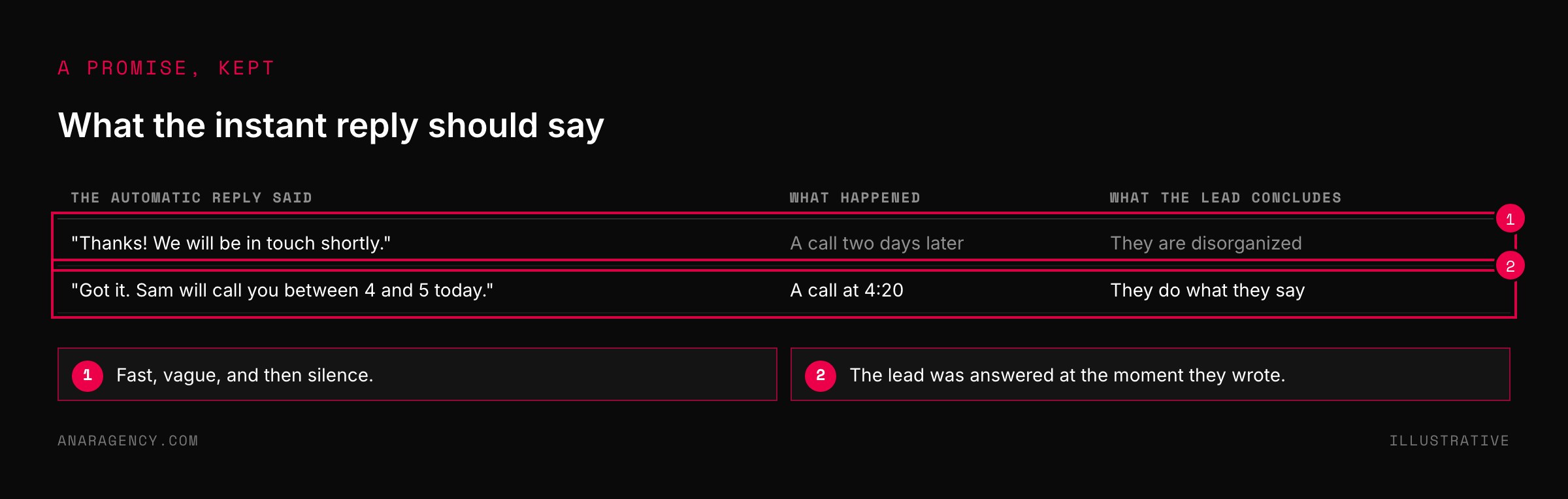
The instant layer is the point. An automatic text that says "Got it. Sam will call you between four and five today" has answered the lead.
They know they were heard and when to expect you.
Then keep the promise. A specific time, kept, beats a fast reply followed by silence.
There are rules to respect. In the United States, the Telephone Consumer Protection Act restricts automated calls and texts, and consent requirements apply. Get clear permission on the form for the kind of contact you will make.
One caution on the research itself. The study is from 2011 and measured business-to-business leads. Your trade will differ in the numbers.
We have not seen anything since that suggests waiting helps. If you fix one thing in your follow-up this month, make it the first reply. The rest of the sequence is in the eight emails.
What to read next, and why
The Short Life of Online Sales Leads (Harvard Business Review): The study. Short, and the source of most lead-response figures quoted since.
Service-level agreement (encyclopedia entry): How organizations turn "respond quickly" into a number that gets measured.
Recency bias (encyclopedia entry): Why the most recent contact carries the most weight in a decision.
Telephone Consumer Protection Act of 1991 (encyclopedia entry): The US law governing automated calls and texts.
So the simple takeaway is this: fill in your own contact form tonight from a private email address, and time how long it takes to hear back. That number is your speed to lead.
Questions executives ask
What is speed to lead?
The time between a prospect submitting an enquiry and the business making its first real response. It is measured in minutes and tracked per lead.
How fast should you respond to a lead?
As fast as you can do it reliably. Research published in Harvard Business Review found firms that tried to make contact within an hour were nearly seven times as likely to qualify the lead as those that waited an hour longer. A practical target is an instant automatic reply and a human response within five minutes in working hours.
What did the Harvard Business Review lead response study find?
In an audit of 2,241 US companies, 37 percent responded to a web lead within an hour, 16 percent within one to 24 hours, 24 percent took longer than 24 hours, and 23 percent never responded. The average response time among those that replied was 42 hours.
How can a small business respond to leads quickly?
Send an automatic text and email the moment a form is submitted, stating who will call and when. Route new leads to the phone of a named person on duty, and set an alert if nobody has responded within fifteen minutes.
Is it legal to text leads automatically?
It depends on the country and on consent. In the United States the Telephone Consumer Protection Act restricts automated calls and texts. Ask for clear permission on the form for the kind of contact you intend to make, and check the rules where you operate.

Filip Kovacevic is the founder of Anar Agency in Phoenix. He spent five years running SEO, Meta ads, email, and content for medical practices across the United States, and now does the same work for healthcare, home-service, legal, and professional-service businesses, alongside AI implementation. More from Filip →
Talk it through in 15 minutes
Bring one AI question from this article. We will tell you what we would do, whether or not you hire us.
Book a 15-Min Chat →