Market Maturity: Where Beats When Beats What Beats How

Four decisions shape how an offer sells, and they carry different weight. Where you sell matters most, then when (the stage your market is in), then what format you sell, and last how you sell it. Most teams spend their effort on the last one.
Markets tend to move through five stages: new, crowded, skeptical, prove it, and settled. In each stage buyers trade on something different: the idea, the difference, proof, trust, and finally the brand. Knowing the stage mainly tells you what to stop doing.
A curve drawn in 1995
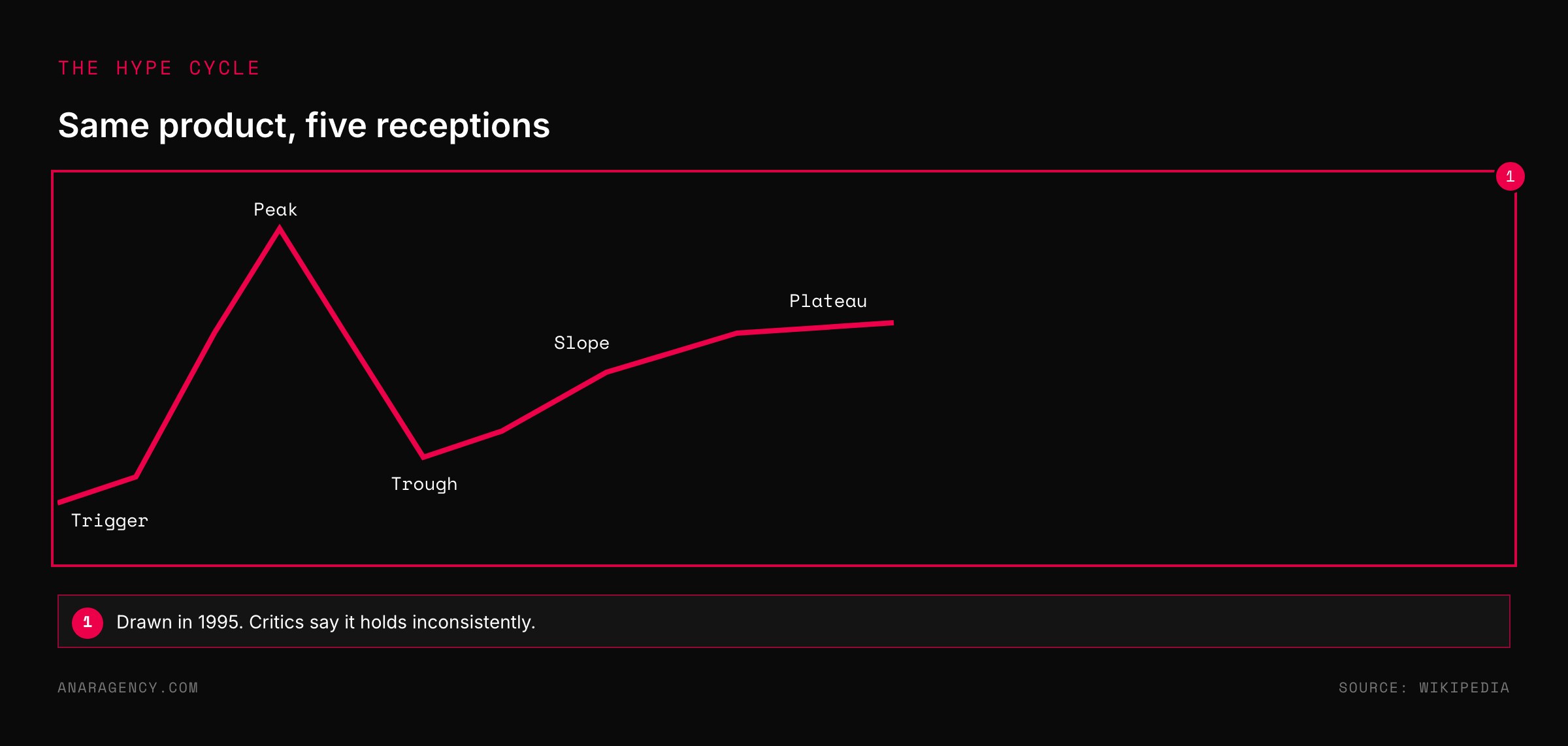
In 1995 a Gartner analyst named Jackie Fenn noticed a pattern in how new technologies were received. She drew it as a curve, and it became the Gartner hype cycle.
The curve has five stages. A trigger, a peak of inflated expectations, a trough of disillusionment, a slope of enlightenment, and a plateau of productivity.
It is not a law. Critics point out that it is not really a cycle and that studies find it holds inconsistently.
But one idea inside it is hard to argue with. The same product meets a very different buyer depending on when it arrives.
Sell a new kind of tool at the peak and buyers want the dream. Sell the same tool in the trough and they want proof it works at all.
Four decisions, in order of weight
Every offer rests on four decisions. We call the order the Maturity Ladder.
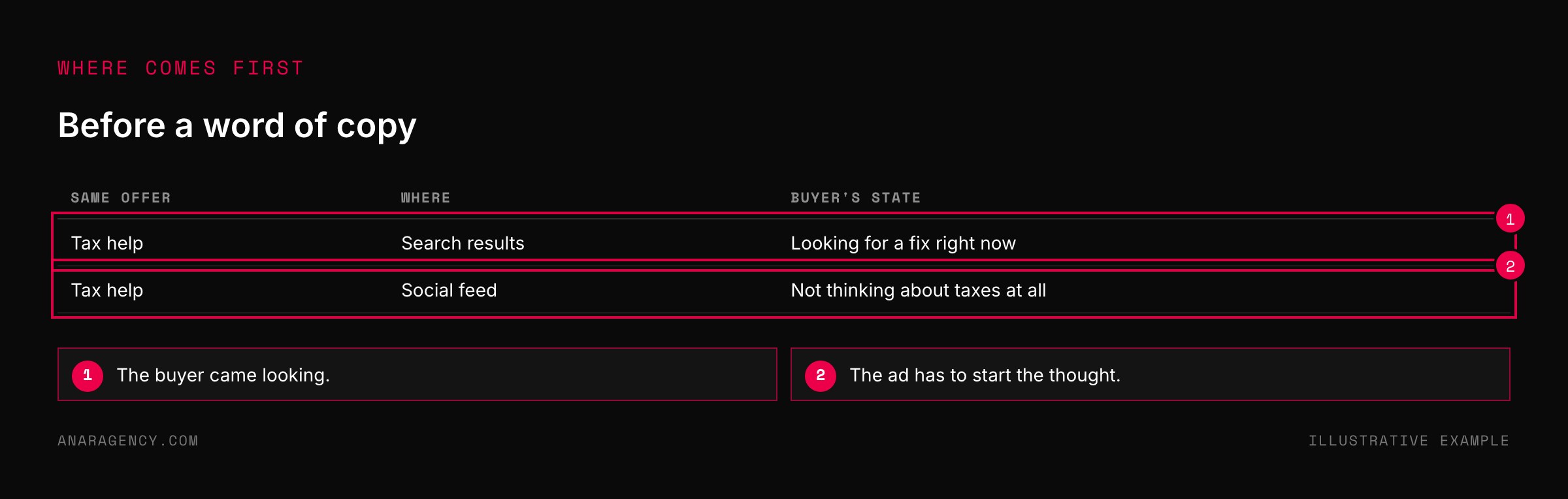
Where. The place you sell. A buyer searching for a fix is in a different state from a buyer scrolling a feed, and the same page will perform differently in each.
When. The stage your market is in. This sets what buyers already believe, how many sellers they have heard from, and what they now doubt.
What. The format of the product. Do it yourself, done with you, or done for you.
How. The sales format. A page, a video, a webinar, a call.
Most marketing time goes into the fourth decision. Headlines, scripts, and button colors get rewritten while the first three were decided by accident.
The market shapes the offer far more than the offer shapes the market.
Four decisions shape an offer, in order of weight: where you sell, when (the market's stage), what format you sell, and how you sell it. Markets tend to move through five stages, new, crowded, skeptical, prove it, and settled, and buyers trade on something different in each: the idea, the difference, proof, trust, and the brand. Formats shift from do it yourself toward done for you as trust falls.
Use the stage mainly to decide what to stop doing.
Five stages of a market
This is our working model, not a law. It sits beside older ideas such as the product life cycle and diffusion of innovations.
New. One or two sellers. Buyers are curious and optimistic, and what they buy is the idea.
A simple pitch works.
Crowded. Copycats arrive, repeating the first sellers' promise. Buyers now ask how this one is different.
Skeptical. Many sellers, mixed results. Buyers have been burned, and they want the truth about what works.
Templates and done-with-you offers start to win.
Prove it. Everyone tells the same story, and few deliver. Trust is the currency, the sale takes more steps, and done-for-you offers do best.
Settled. A few survivors remain. Their name carries the sale, and the next new idea is usually forming nearby.
Notice the format shift. As a market matures, buyers want more done for them, because they no longer trust that doing it themselves will work.
What to stop doing at each stage
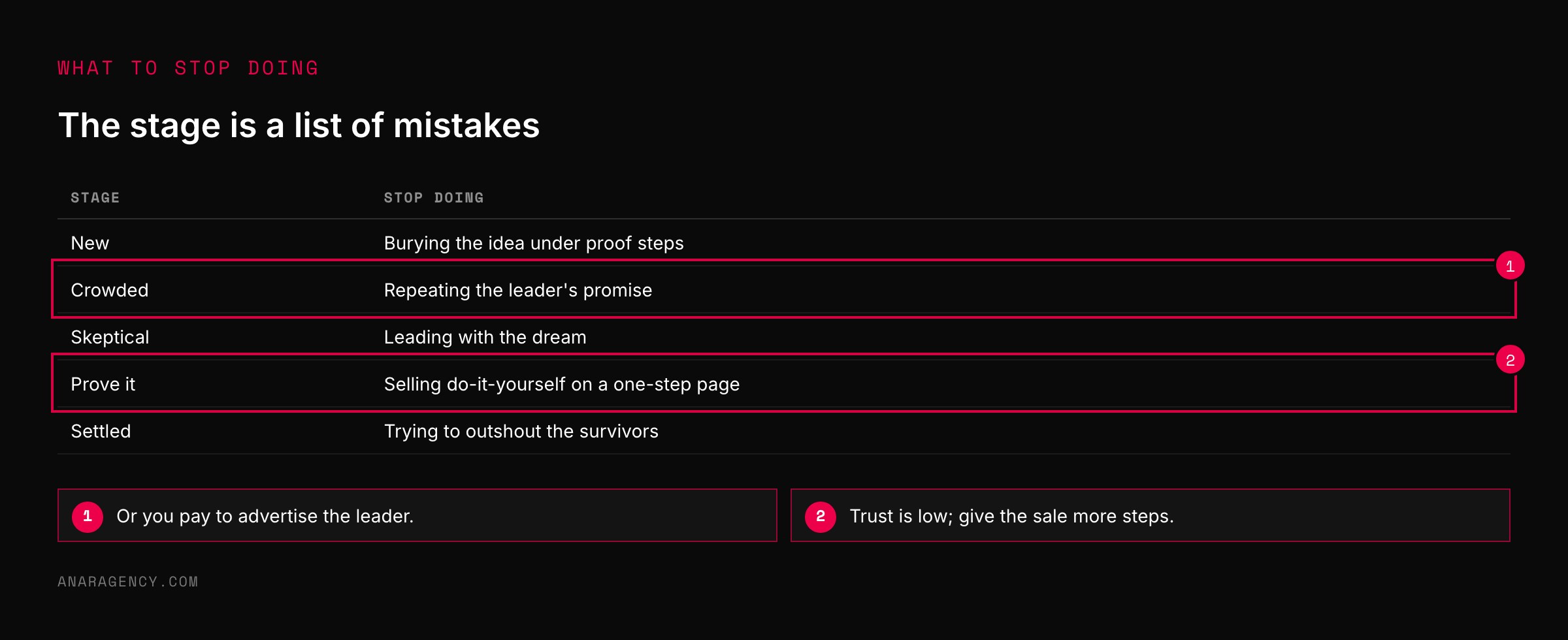
The stages are most useful as a list of mistakes to avoid.
In a new market, do not bury the idea under proof steps. Buyers have nothing to compare it with yet, so long qualification only slows them down.
In a crowded market, do not repeat the leader's promise. Say what is different, or you are paying to advertise them.
In a skeptical market, do not lead with the dream. Lead with what is true, including the limits, as in selling to buyers who have seen it all.
In a prove-it market, do not sell a do-it-yourself course on a one-step page. Show the work, take more of it on, and give the sale room for more steps.
In a settled market, do not try to outshout the survivors. Find the next problem forming at the edge, the one the survivors are too big to notice.
"How do I know which stage my market is in?"
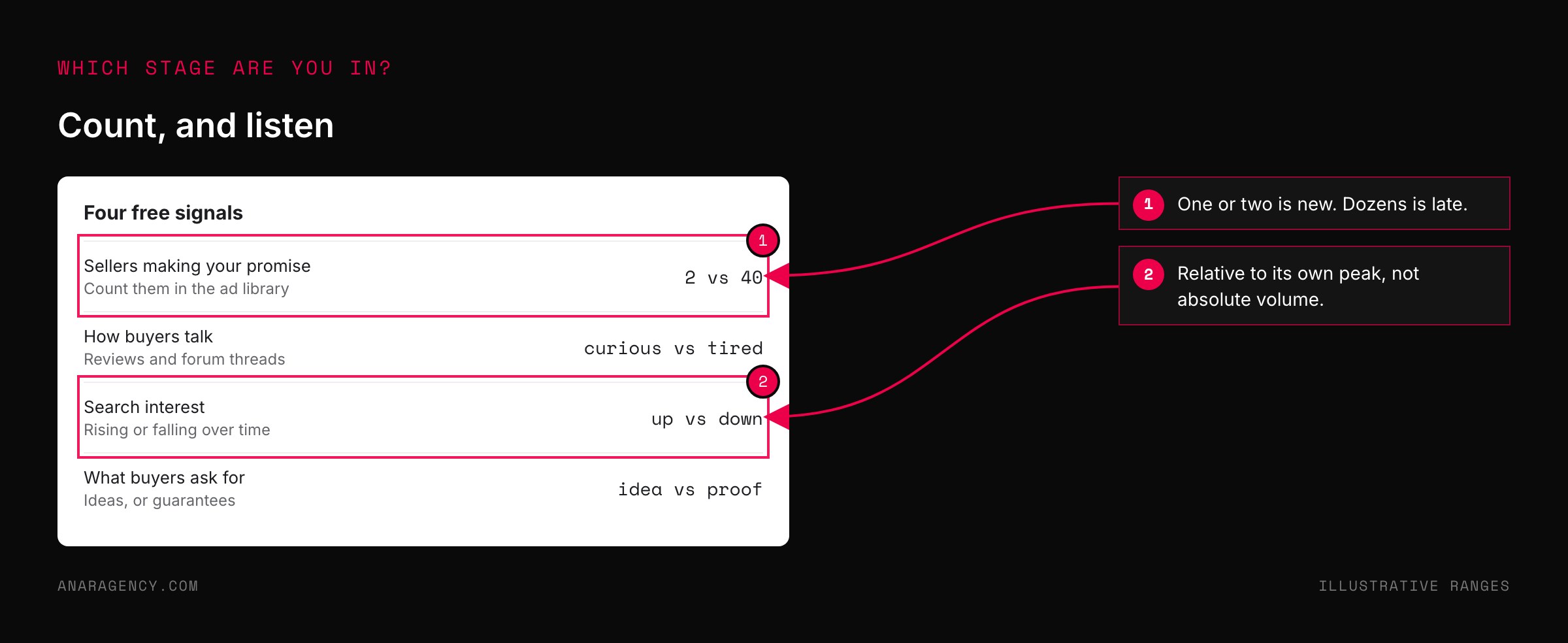
Count, and listen. Both are free.
Count the sellers making your promise. Search the Meta Ad Library for the main claim in your market and see how many advertisers are running it. One or two is new, dozens is crowded or later.
Listen to the buyers. Read reviews and forum threads. Curiosity and excitement point to an early stage, while words like "another one" or "does this actually work" point to a skeptical market.
Watch the interest curve. Google Trends shows how search interest in a term has moved over time, relative to its own peak. A rising line with few sellers is early, while a falling line with many sellers is late.
Notice what buyers ask for. When they want guarantees, case studies, and someone to do it for them, the market has moved past the idea stage.
None of these is exact. Together, they will usually tell you which of the five you are in.
What to read next, and why
Gartner hype cycle (encyclopedia entry): The stages, and the criticisms worth knowing before you lean on them.
Diffusion of innovations (encyclopedia entry): The classic model of how new ideas spread through a population.
Crossing the Chasm (book summary): Why the jump from early buyers to the mainstream is where many products stall.
Meta Ad Library (tool): The fastest way to count how many sellers are making your promise right now.
So the simple takeaway is this: before you rewrite another sales page, write down where you sell and which stage your market is in, because those two decide more than the page does.
Questions executives ask
What are the stages of market sophistication?
One working model uses five: new, crowded, skeptical, prove it, and settled. Buyers in each trade on something different, from the idea itself early on to proof, trust, and finally brand.
How do you market in a saturated market?
Stop repeating the leading promise. Lead with what is true and different, show proof, and consider a format that does more of the work for the buyer, since trust is usually low.
What matters more, the offer or the market?
Usually the market. Where you sell and the stage the market is in shape results more than the sales format or the copy.
How can I tell what stage my market is in?
Count how many advertisers are making your main promise, read how buyers talk in reviews and forums, check the search interest trend, and notice whether buyers are asking for guarantees and done-for-you options.
Is the Gartner hype cycle accurate?
It is widely used but disputed. Critics note it is not a true cycle and that studies find it holds inconsistently, so treat it as a prompt for thinking rather than a forecast.

Filip Kovacevic is the founder of Anar Agency in Phoenix. He spent five years running SEO, Meta ads, email, and content for medical practices across the United States, and now does the same work for healthcare, home-service, legal, and professional-service businesses, alongside AI implementation. More from Filip →
Talk it through in 15 minutes
Bring one AI question from this article. We will tell you what we would do, whether or not you hire us.
Book a 15-Min Chat →