What Business Are You Really In?
Define your business by the customer's need, not your product. Answer three questions: what result you deliver in the customer's words, what systems and skills make it happen, and what customers would buy instead. Then place the business in one of four boxes: whether your market changes fast or slowly, and whether the work is creative or mechanical.
Fast, creative markets need constant adaptation; slow, mechanical ones reward systems and scale. Finally, aim to be relied upon rather than compared on price, and pick a model you will be happy running.
Levitt's warning
In 1960 the Harvard professor Theodore Levitt published an idea that business schools still teach. He called it marketing myopia.
His argument was that companies fail when they define themselves by their product instead of their customer's need. They believe they are in a growth industry and stop watching what customers actually want.
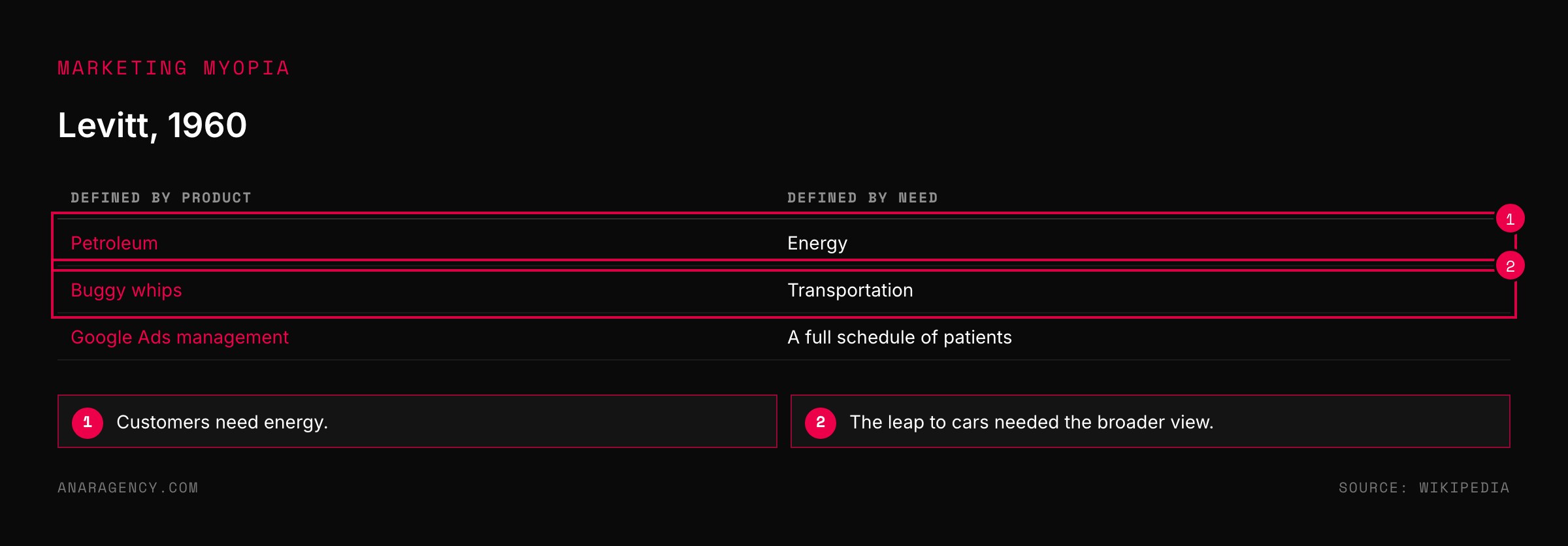
The examples have become famous. Oil company customers will always need energy, but they may not always need petroleum.
And a buggy whip maker in 1910 that saw itself in the transportation business might have made the leap into cars. One that saw itself in the whip business could not.
Small firms make the same mistake every day. They name the product on the sign and forget the need behind the sale.
Three questions that find your real business
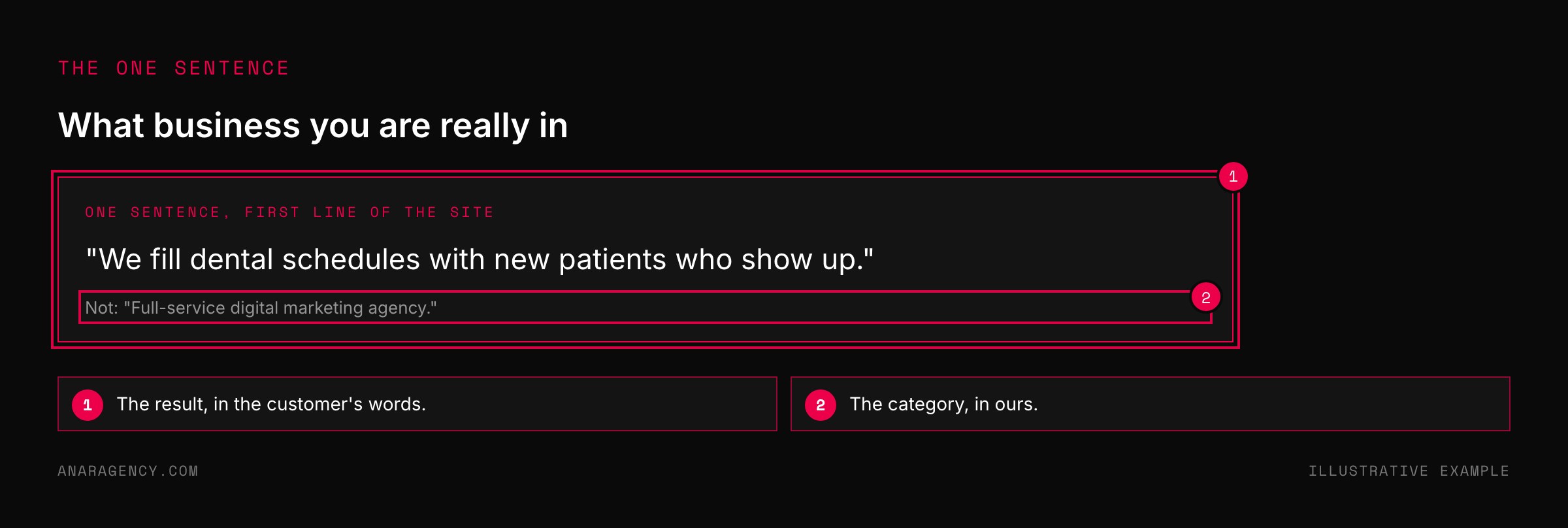
What do you deliver, in the customer's words? Not "Google Ads management" but "enough booked patients to fill the schedule."
What makes that happen? The systems, people, and skills behind the result. This is the engine you are actually building.
What would they buy instead? Every alternative that solves the same need. A new hire, a referral program, a different channel, doing nothing.
The answer to the third question names your real competitors. They are rarely just the firms that sell what you sell.
Put the three answers together, and the business you are really in is usually broader, and more defensible, than the one on your website.
Define the business by the customer's need: what you deliver in their words, what makes it happen, and what they would buy instead. Place it on two axes, how fast the market changes and whether the work is creative or mechanical, and build what that box needs: adaptation and scarce talent, or systems and scale. Aim to be relied upon through honest switching costs rather than compared as a commodity, and choose a model that fits the person running it.
Four boxes: how fast, and how the work gets done
Two more questions place a business on a simple map. This is our working model, not a law.
How fast does the market change? In some markets the methods change every year or two, such as advertising on platforms that update constantly. In others they barely change in a decade, such as bookkeeping or plumbing.
How is the work done? Creative work depends on skilled judgment each time. Mechanical work follows steps that can be written down and handed on.
The four boxes behave very differently. A fast-changing, creative business must keep adapting and depends on scarce people. A slow-changing, mechanical one can be systematized, priced for volume, and scaled.
Neither is better. But a firm that does not know which box it is in will build the wrong things: rigid systems in a market that keeps moving, or bespoke craft where customers want reliable volume.
Here is how one firm might place itself. Take an agency that runs paid ads for dental practices.
The ad platforms change their tools every year, so the market is fast-changing. Writing ads and judging creative is skilled work, so it is creative.
That puts it in the fast, creative box. It should expect its methods to age quickly, invest in people who learn fast, and avoid building heavy systems around today's platform features.
The same firm's reporting and patient follow-up, though, may be slow-changing and mechanical. Those parts can be systematized, and often should be, even while the creative core keeps moving.
Commodity or relied upon
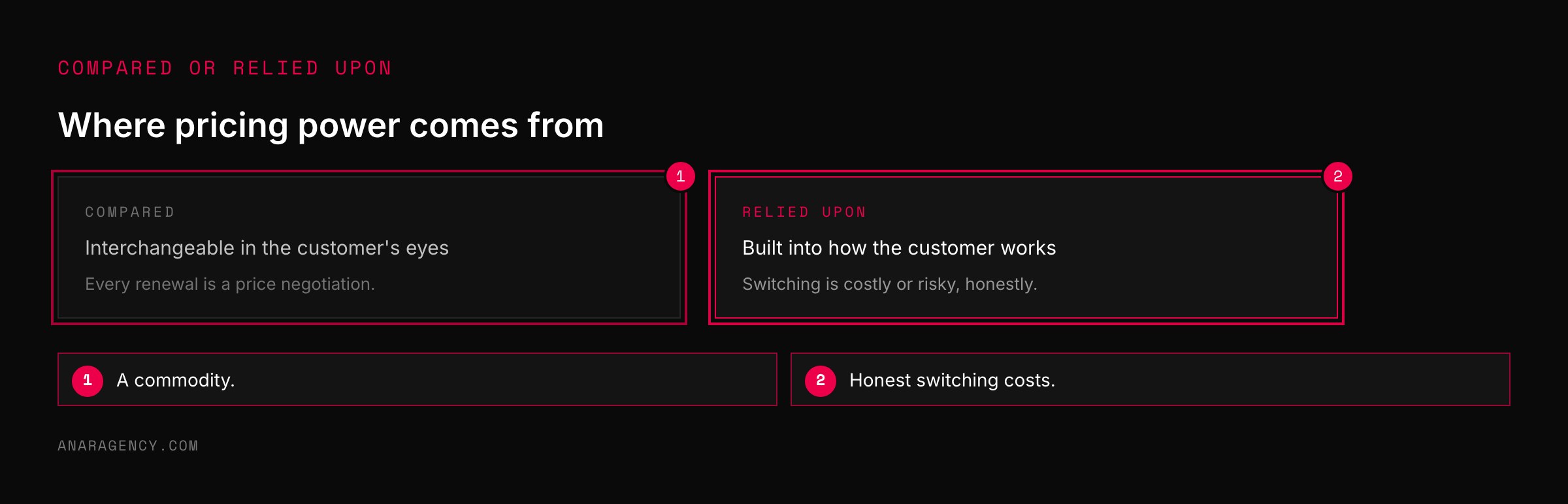
Pricing power comes from one distinction. Are customers comparing you, or relying on you?
A commodity is something customers treat as interchangeable, so they compare on price. A firm that is relied upon is built into how the customer works, so switching is costly or risky.
Economists call those costs switching barriers. They include learning a new system, moving data, and the risk that a new supplier gets it wrong.
Honest ways to become relied upon: hold the customer's data and history, run a process they depend on every week, and get measurably better results over time.
Dishonest ways, such as hiding cancellation or locking up the customer's own data, buy a short lead and a long reputation problem.
For the economics of keeping customers buying, see buy versus stay.
Pick a business you will be happy running
There is one more fit question, and most owners skip it. Which box suits the person running it?
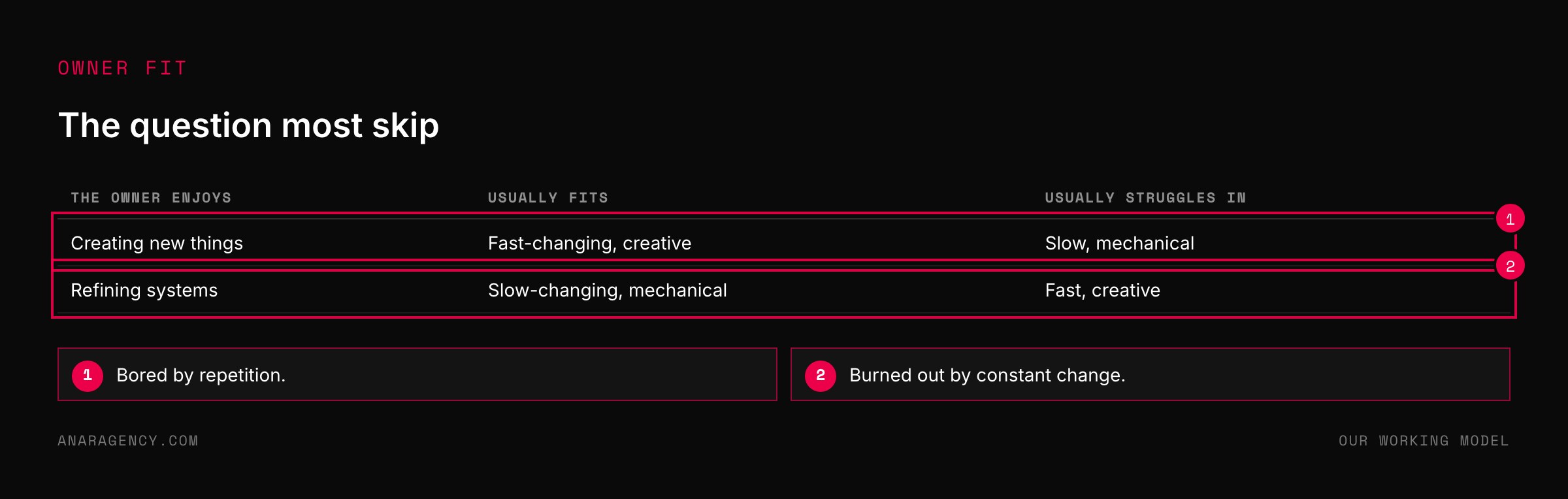
Some people love creating new things and get bored by repetition. Others enjoy refining a system until it runs without them.
Some like being the public face. Others prefer supporting a team from behind.
A creator stuck running a mechanical business tends to drift, and a systems person stuck in a fast, creative market tends to burn out.
Build the business you would happily run in five years. A model that makes money and makes you miserable is not finished.
"We are too small to think about business models."
Small is when it is cheapest to choose. Every year you wait, more systems, clients, and habits lock in the model you drifted into.
Start with the three questions. They take an hour and often change how you describe your business on the website.
Then place yourself in a box. If it surprises you, look at what you are building and ask whether it fits that box.
Revisit both once a year. Markets move between boxes, and so do businesses.
For a structured look at the whole business model, the Business Model Canvas is a common starting point.
What to read next, and why
Marketing myopia (encyclopedia entry): Levitt's argument and its famous examples.
Theodore Levitt (encyclopedia entry): The professor behind the idea.
Commodity (encyclopedia entry): What happens when customers see you as interchangeable.
Switching barriers (encyclopedia entry): The honest and dishonest sources of being relied upon.
So the simple takeaway is this: write one sentence that names the result your customer buys in their words, and make it the first line on your website.
Questions executives ask
What does "what business are you really in" mean?
It means defining your business by the customer's need rather than your product. Theodore Levitt's 1960 idea of marketing myopia argued that product-focused companies miss shifts in what customers want.
What is marketing myopia?
A short-sighted focus on selling a product rather than meeting a customer need. Levitt described it in 1960 using examples such as oil companies, whose customers need energy rather than petroleum.
How do I choose the right business model?
Define the need you meet, place your business by how fast its market changes and whether the work is creative or mechanical, build what that position requires, and choose a model you will be happy running.
What is the difference between a commodity and being relied upon?
Customers compare commodities on price. A firm they rely on is built into how they work, so switching is costly or risky, which gives pricing power.
Can a small business change its business model?
Yes, and it is cheapest to do early. Revisit the model once a year, because markets and businesses both shift over time.

Filip Kovacevic is the founder of Anar Agency in Phoenix. He spent five years running SEO, Meta ads, email, and content for medical practices across the United States, and now does the same work for healthcare, home-service, legal, and professional-service businesses, alongside AI implementation. More from Filip →
Talk it through in 15 minutes
Bring one AI question from this article. We will tell you what we would do, whether or not you hire us.
Book a 15-Min Chat →