Hide the Pitch: Podcast and Editorial Sales Formats

Every sales format starts as content people want: radio dramas, articles, TV shows, free trainings. Each one sells well until the audience learns to spot the pitch, then response fades. Today podcasts and editorial content are where attention is.
The lesson is to put the pitch later, not to hide it. Give real, complete value first and make the offer at the end, clearly labeled as an offer. Disguising an ad as independent content is deceptive under FTC guidance.
Delay is fine; deception is not.
Why it is called a soap opera
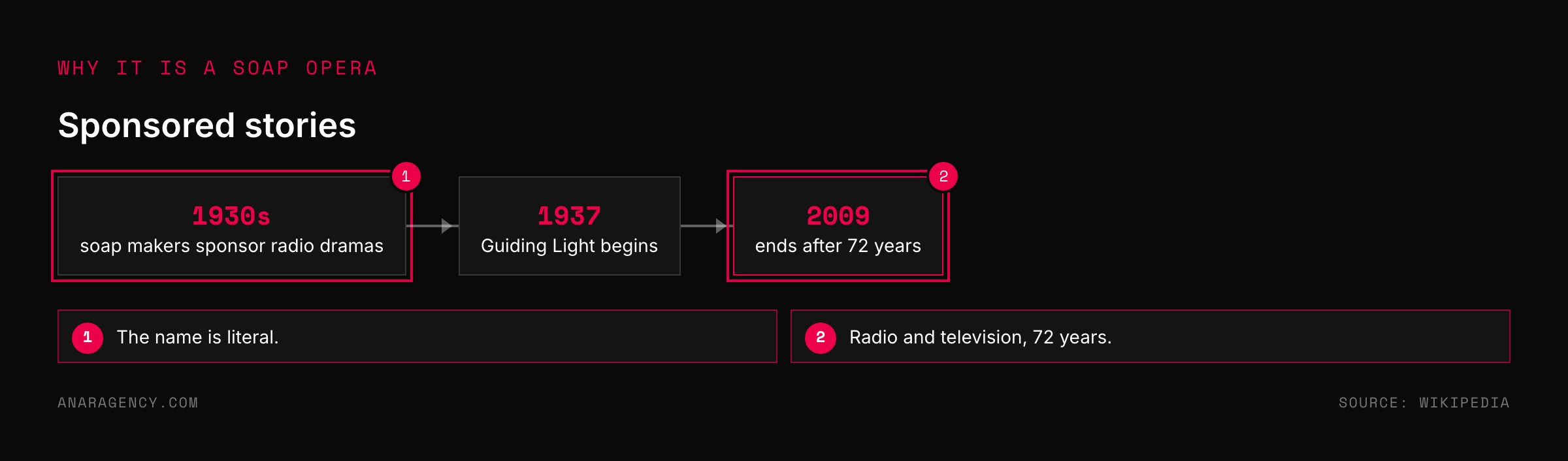
The name is literal. The term came from the soap manufacturers who sponsored the original radio dramas.
Procter and Gamble produced 20 soap operas over the years. One of them, Guiding Light, ran from 1937 to 2009, a 72-year run across radio and television.
Nobody tuned in for the soap. They tuned in for the story, and the soap came along with it.
That is the oldest trick in selling at scale. Give people something they want to consume, and bring the offer with it.
The format changes every few decades. The trick does not.
Every sales format starts as something else
Look at the formats that have sold the most, and notice what each one looked like at first.
An advertorial was an ad written to read like an article. An infomercial was an ad shaped like a TV show. A webinar was a sales presentation called a free training.
Each worked because it felt like content. And each faded as audiences learned what it was.
When a market can see the sales process coming, it raises its guard. The copy can be just as good, and response still falls.
That is why a format that worked brilliantly in one year can underperform a few years later with no change to the offer.
Every sales format starts as content people want, such as radio dramas, articles, shows, and trainings, and fades once audiences learn to spot the pitch. Today long, voluntary formats like podcasts and editorial articles hold attention. Hide the pitch in time, not in disguise: deliver complete, real value first and make one clearly labeled offer later.
Never present an ad as independent content, and have connected guests disclose their ties.
Where attention is now
Today people give long, voluntary attention to podcasts, long videos, newsletters, and editorial articles.
Those formats share something useful for a seller. The listener chooses to spend twenty or forty minutes with you, and the trust built in that time is hard to buy with an ad.
A podcast episode that teaches something real, with your expertise on display, does more selling than a sales page. The offer at the end is the natural next step, not an interruption.
Editorial works the same way. An article that answers the buyer's question completely earns the right to mention what you sell.
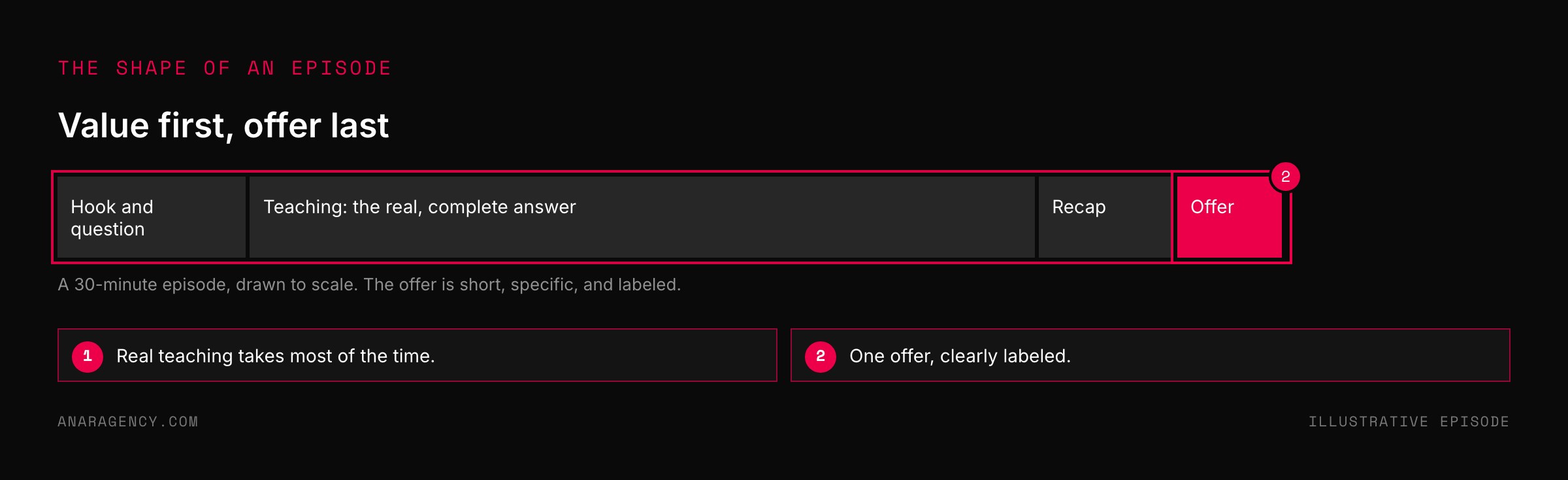
Notice the order. Value first, then the offer, later in time.
Hide the pitch in time, never in disguise
There are two ways to keep a pitch from triggering resistance. Only one is legitimate.
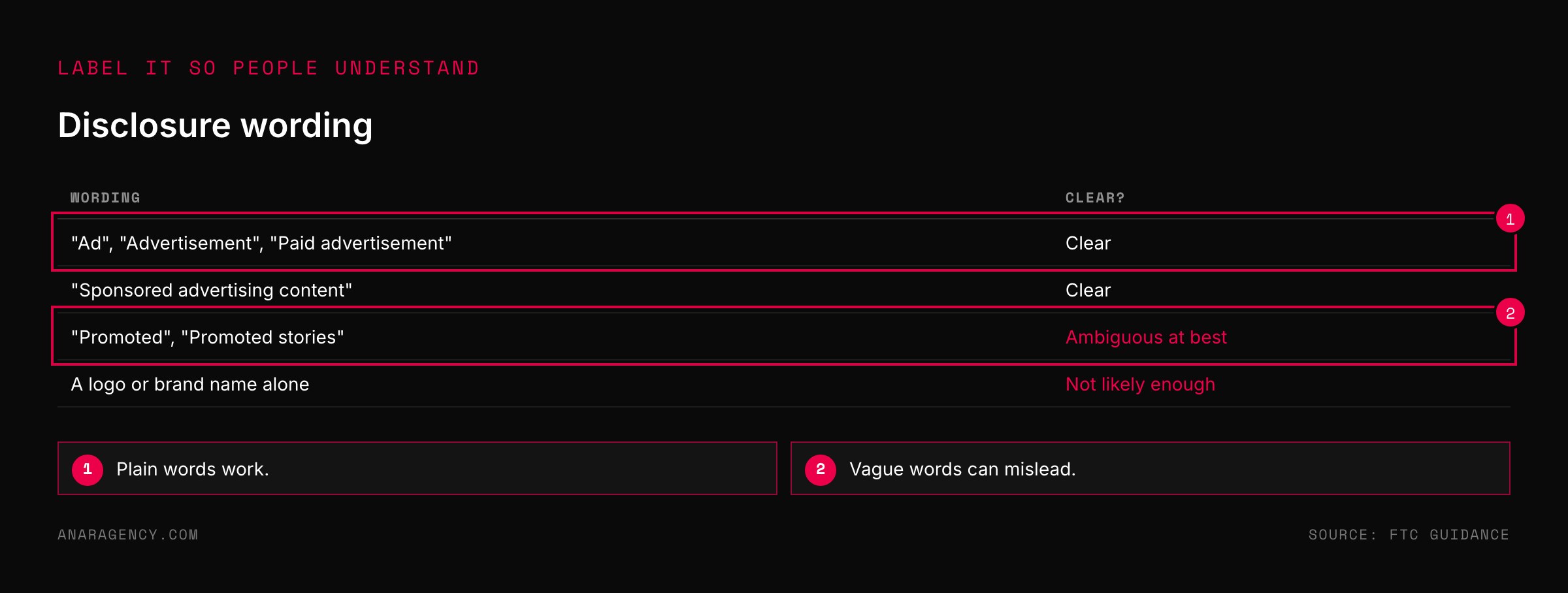
In disguise means pretending the ad is independent content. The FTC says plainly that it is deceptive to mislead consumers about the commercial nature of content. A paid article dressed as an independent review is the classic example.
In time means the content is real and complete, and the offer comes later, clearly marked as an offer. Nothing is hidden. The listener simply gets value before they are asked.
If someone else promotes you, the same rule applies. A guest who is paid or connected to you should disclose that connection clearly.
So: teach for thirty minutes, then say "here is what we sell, if you want help with this." That is not a trick. It is a fair trade.
"Won't people skip the pitch?"
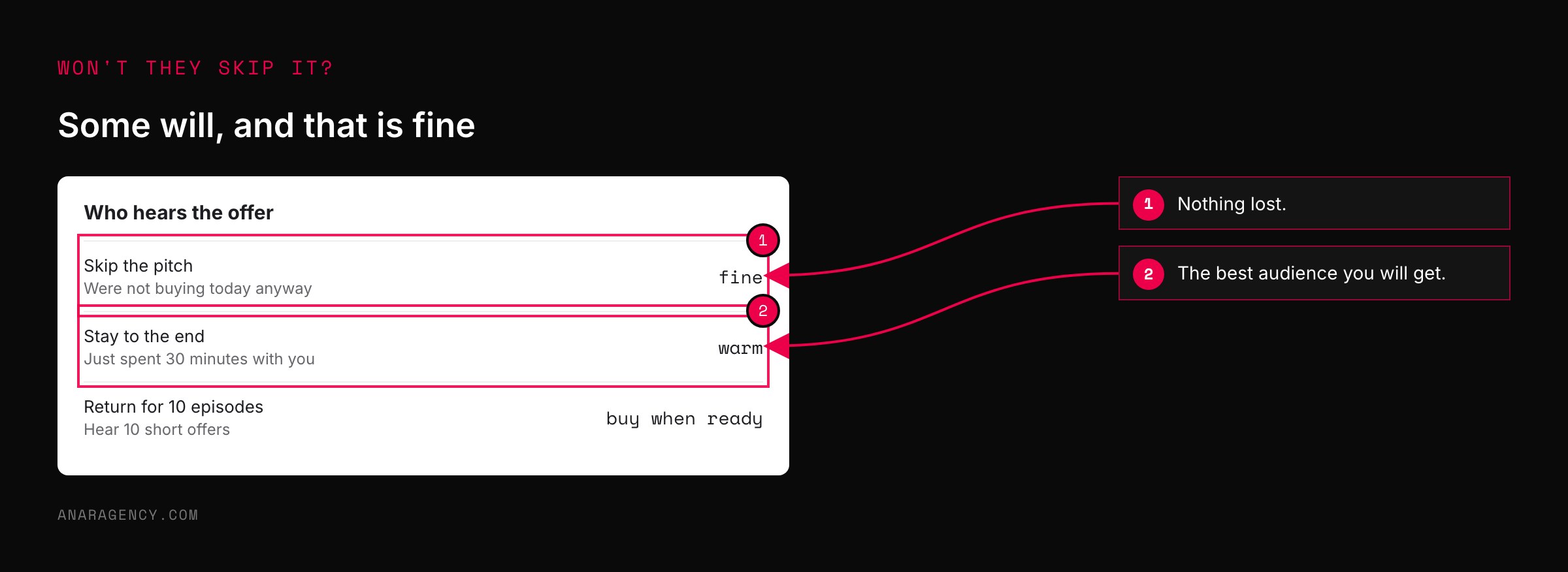
Some will. That is fine.
The people who skip it were not going to buy that day. The ones who stay have just spent half an hour with you and know how you think.
Make the pitch short and specific. One offer, who it is for, and one next step.
Then keep the content good enough that people come back. A listener who returns for ten episodes hears ten offers, and buys when they are ready.
For turning one long piece into many short ones, see one article, twenty pieces. For short clips at volume, see the AI clip pipeline.
What a good pitch sounds like at the end
In 2014 the podcast Serial became a hit. Its launch was sponsored by Mailchimp, and the sponsor became a running joke, parodied as "MailKimp".
People parodied the ad because they knew it, which means they heard it. It was short, it was plainly an ad, and it paid for a show people wanted.
That is the standard to aim for. A pitch the audience recognizes as a pitch, accepts as fair, and remembers.
For your own content, the offer at the end can follow a simple pattern. Who it is for, what it does, what it costs, and one next step.
"If you run a practice with more than three staff and your phones are busy but your calendar is not, we fix that. It is a fixed monthly fee. The link is in the notes."
That is under forty words. It does not repeat the episode, and it does not pretend to be anything other than an offer.
Say it the same way every time. A repeated, familiar pitch becomes part of the show, the way the sponsor line became part of Serial.
And say who it is not for. It saves the wrong listeners a call and tells the right ones you know exactly who you help.
Then stop. The content earned the attention; the pitch only has to point to the door.
What to read next, and why
Soap opera (encyclopedia entry): How sponsorship and entertainment grew up together.
Native Advertising: A Guide for Businesses (FTC guide): Where the line is between content and a disguised ad.
Advertorial (encyclopedia entry): The article-shaped ad, and why it needs a label.
Infomercial (encyclopedia entry): The show-shaped ad and its history.
So the simple takeaway is this: make your next piece of content worth consuming on its own, then put one clearly labeled offer at the end.
Questions executives ask
Can a podcast be used as a sales tool?
Yes. A podcast earns long, voluntary attention, and the trust built while teaching makes a short, clearly labeled offer at the end feel like a natural next step.
What is a hidden pitch?
Content that delivers real value first and makes the offer later. The pitch is delayed, not disguised; the audience is never misled about what is an ad.
Is native advertising legal?
It is legal when it is identifiable as advertising. The FTC treats ads that mislead people about their commercial nature as deceptive and expects clear disclosure where needed.
Why do sales formats stop working?
As more sellers use a format, audiences learn to recognize it as a sales vehicle and raise their guard, so response falls even when the offer and copy are unchanged.
Where did the term soap opera come from?
From the soap manufacturers, such as Procter and Gamble, that sponsored the original radio dramas.

Filip Kovacevic is the founder of Anar Agency in Phoenix. He spent five years running SEO, Meta ads, email, and content for medical practices across the United States, and now does the same work for healthcare, home-service, legal, and professional-service businesses, alongside AI implementation. More from Filip →
Talk it through in 15 minutes
Bring one AI question from this article. We will tell you what we would do, whether or not you hire us.
Book a 15-Min Chat →