Hooks That Work: Change Plus Hope
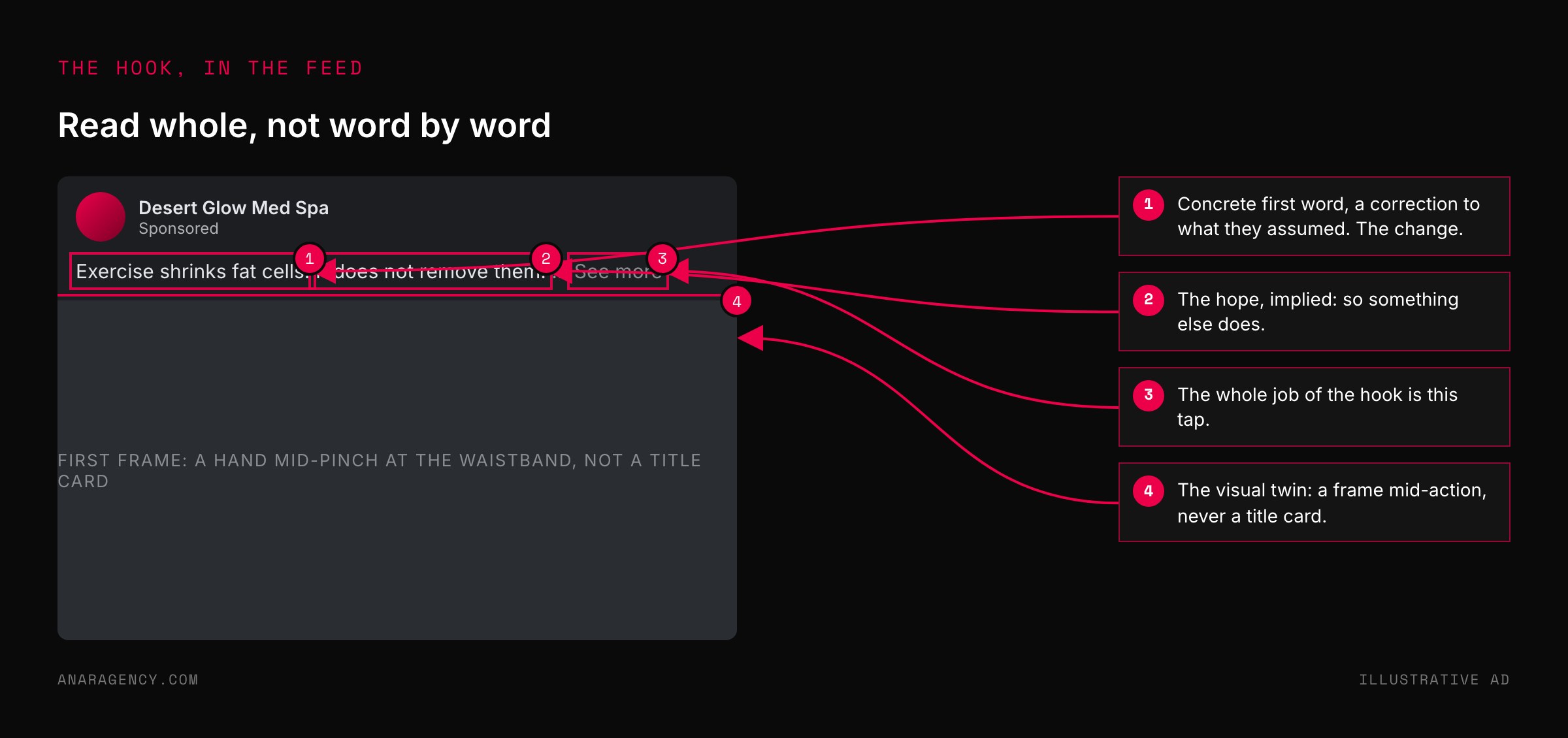
A hook works when it contains two things. A change: something different from what the reader assumed. And hope: a hint that the change points somewhere better.
Change alone is bad news and gets scrolled past. Hope alone is a promise the reader has heard a thousand times. The job of the hook is small and specific: earn the next three seconds, the see-more tap, the second line.
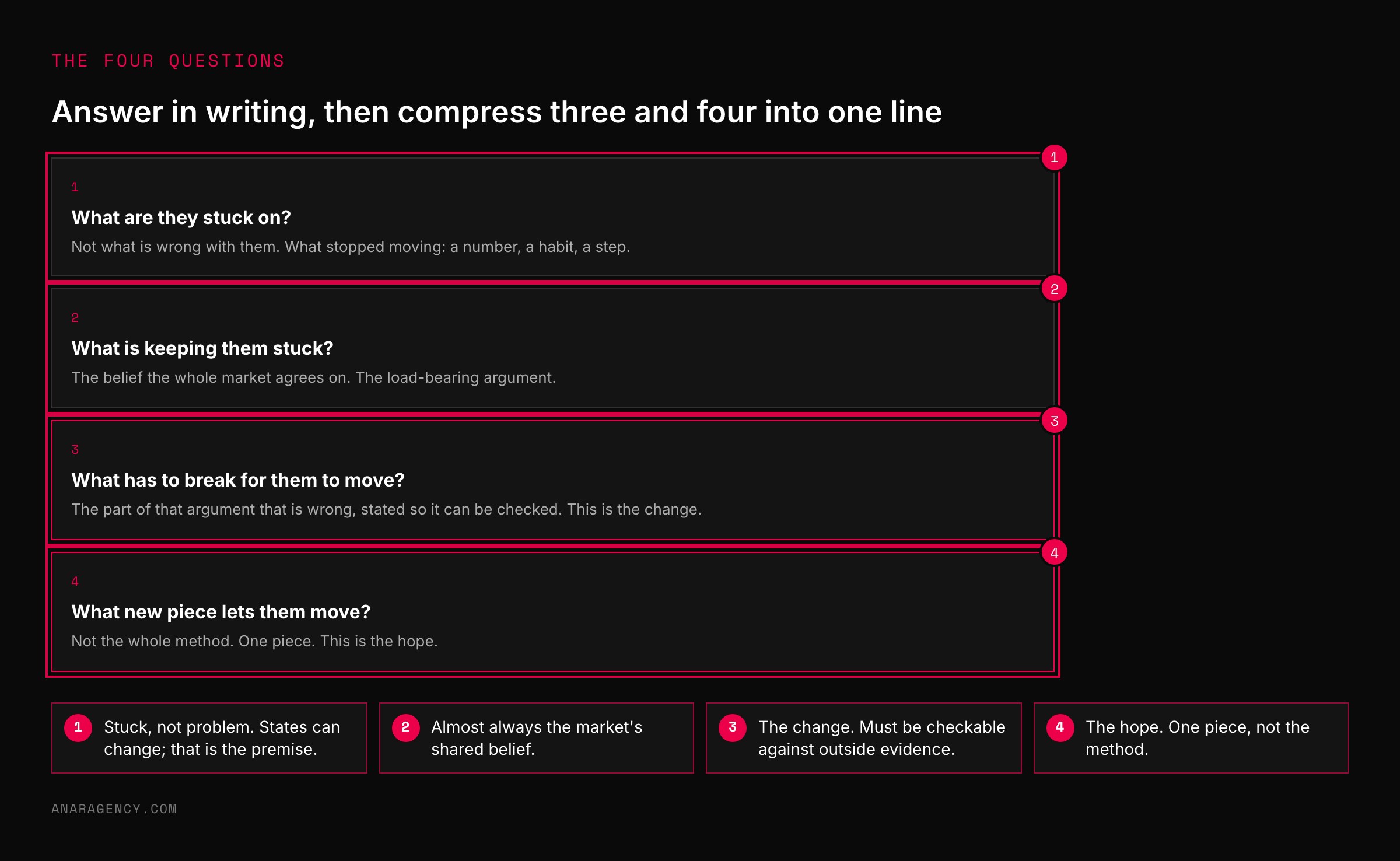
It does not explain the problem and it does not sell the solution. To find one, answer four questions in order: what the reader is stuck on, what belief keeps them stuck, what part of that belief has to break, and what new piece lets them move. The last two, compressed to one concrete line, are the hook.
What a hook is for, and what it is not for
The hook has one job, and most hooks fail because they are asked to do three.
Its job is to earn the next unit of attention: on a feed, the see-more tap; in a video, the second three seconds; in an email, the open. It is not the place to explain the problem, and it is not the place to sell the solution. Both of those come after, and both are easier once the hook has done its small job well.
The constraint is attention, and it is shorter than people plan for. The Nielsen Norman Group's analysis of how long people stay on a page found that the first ten seconds are decisive: most people leave in that window unless something holds them, and the ones who make it past it stay far longer.
YouTube's own guidance on audience retention points at the same opening window as the place where videos are won or lost. The hook lives entirely inside that window.
So the test for any hook is not "does this explain the offer." It is "does this make the reader need the next line."
The two ingredients: change and hope
Minds notice difference. A thing that has not changed is invisible, which is why camouflage works and why a feed full of ads that all say the same thing reads as wallpaper.
Psychologists describe the reflex that turns a head toward something new as the orienting response, and the memory effect that makes the one different item in a list the one you remember has its own name, the von Restorff effect. A hook needs a change in it because change is the only thing the scrolling mind is built to catch.
But change alone is bad news, and people are wired to weight bad news heavily, a pattern documented as negativity bias. A hook that says "your water heater will fail this winter" has a change in it and no exit. The reader protects themselves by scrolling, and over time the ad trains them to avoid the brand.
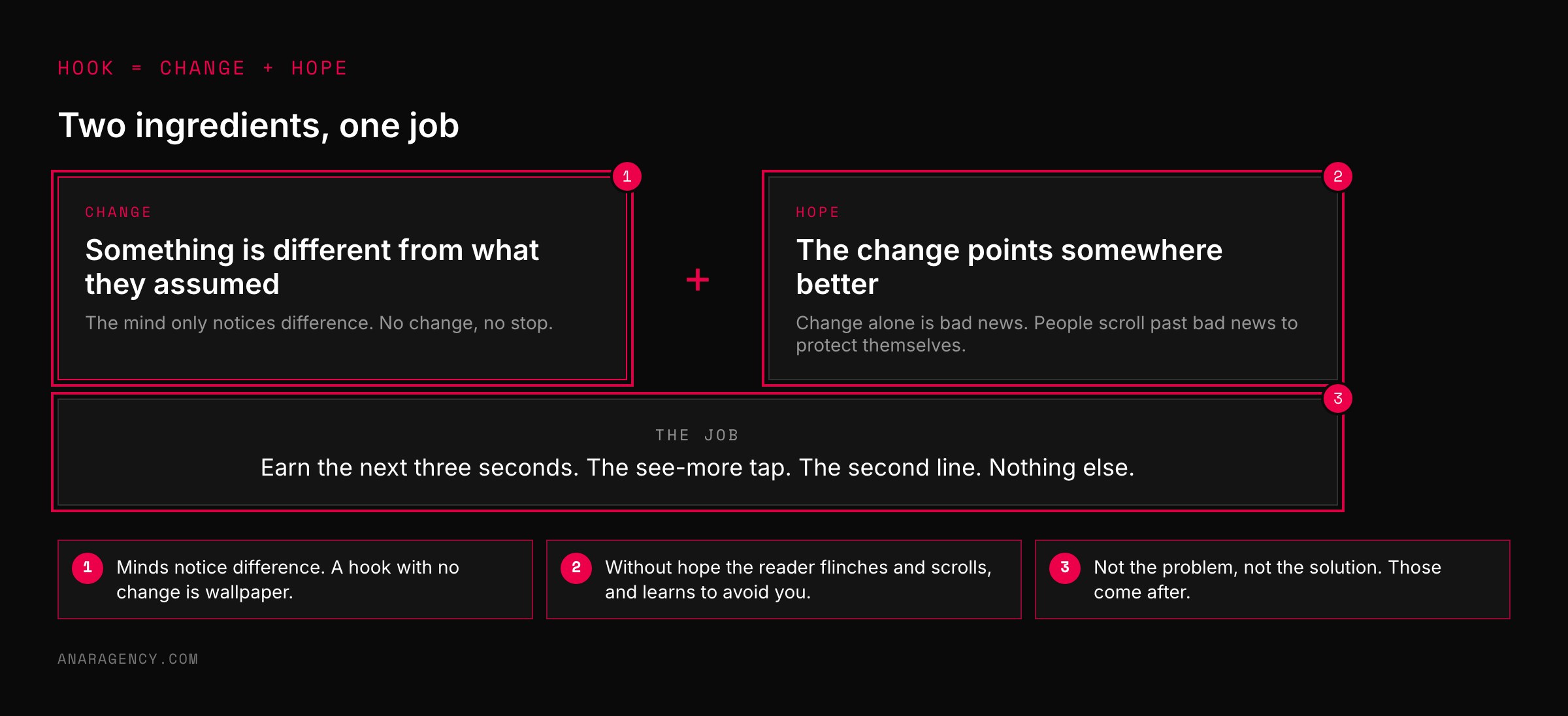
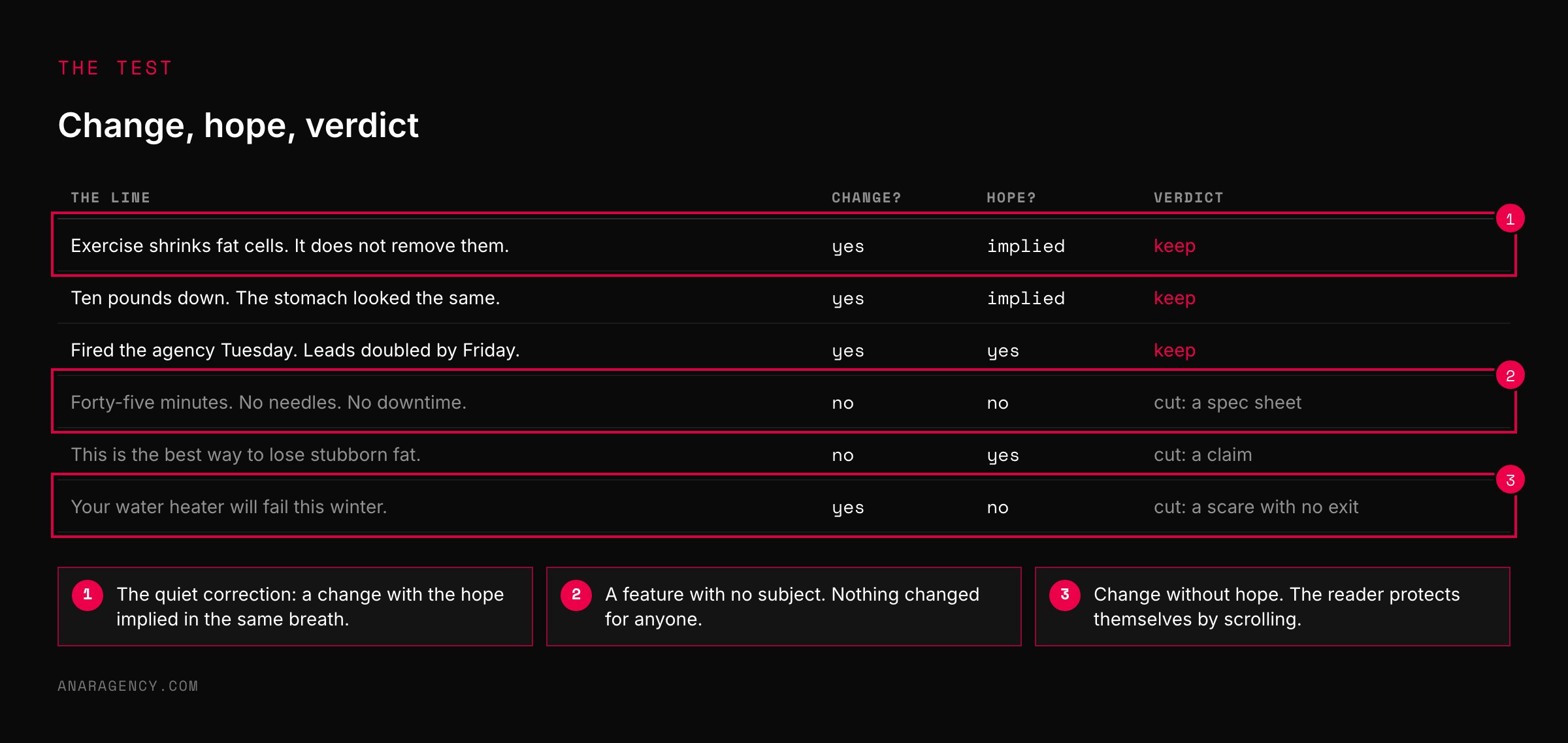
The second ingredient is hope: the change points somewhere better. "Exercise shrinks fat cells. It does not remove them" carries a correction and, implied in the same breath, that something else does.
Change plus hope is the whole formula, and it explains both common failures. A hopeful promise with nothing new in it, "the best way to lose stubborn fat," has hope and no change, and the reader has seen it a thousand times. A shocking statistic with no way out has change and no hope, and the reader flinches.
The hooks that work carry both, in a sentence short enough to be read whole instead of word by word.
Something is different from what the reader assumed. The mind only notices difference; a hook with no change is wallpaper.
The change points somewhere better. Change without hope is bad news, and people scroll past bad news to protect themselves.
Answer four questions in writing: what the reader is stuck on, what belief keeps them stuck, what part of that belief has to break, and what one new piece lets them move. Compress the last two into a single line of two to twelve words that starts with a concrete word and is already in motion. The line must contain a change (something different from what they assumed) and hope (the change points somewhere better).
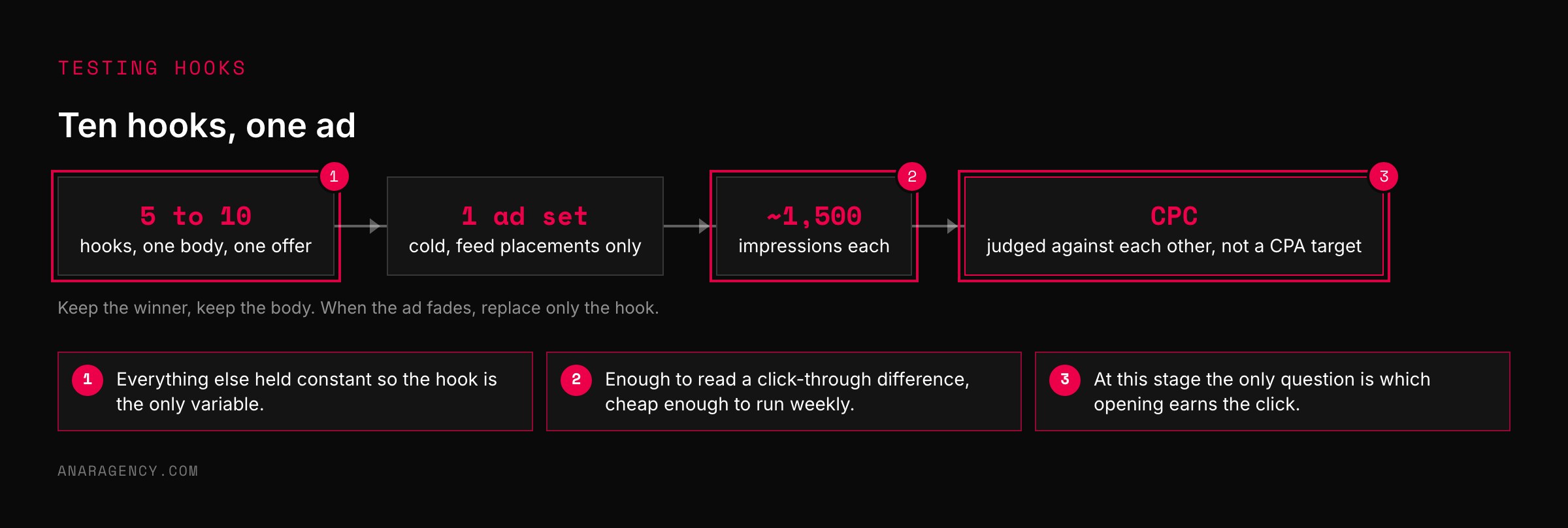
Test five to ten against one body on cold feed traffic at about 1,500 impressions each, judged on cost per click.
Every market is held together by one argument
Here is where the change comes from. Every market agrees on something.
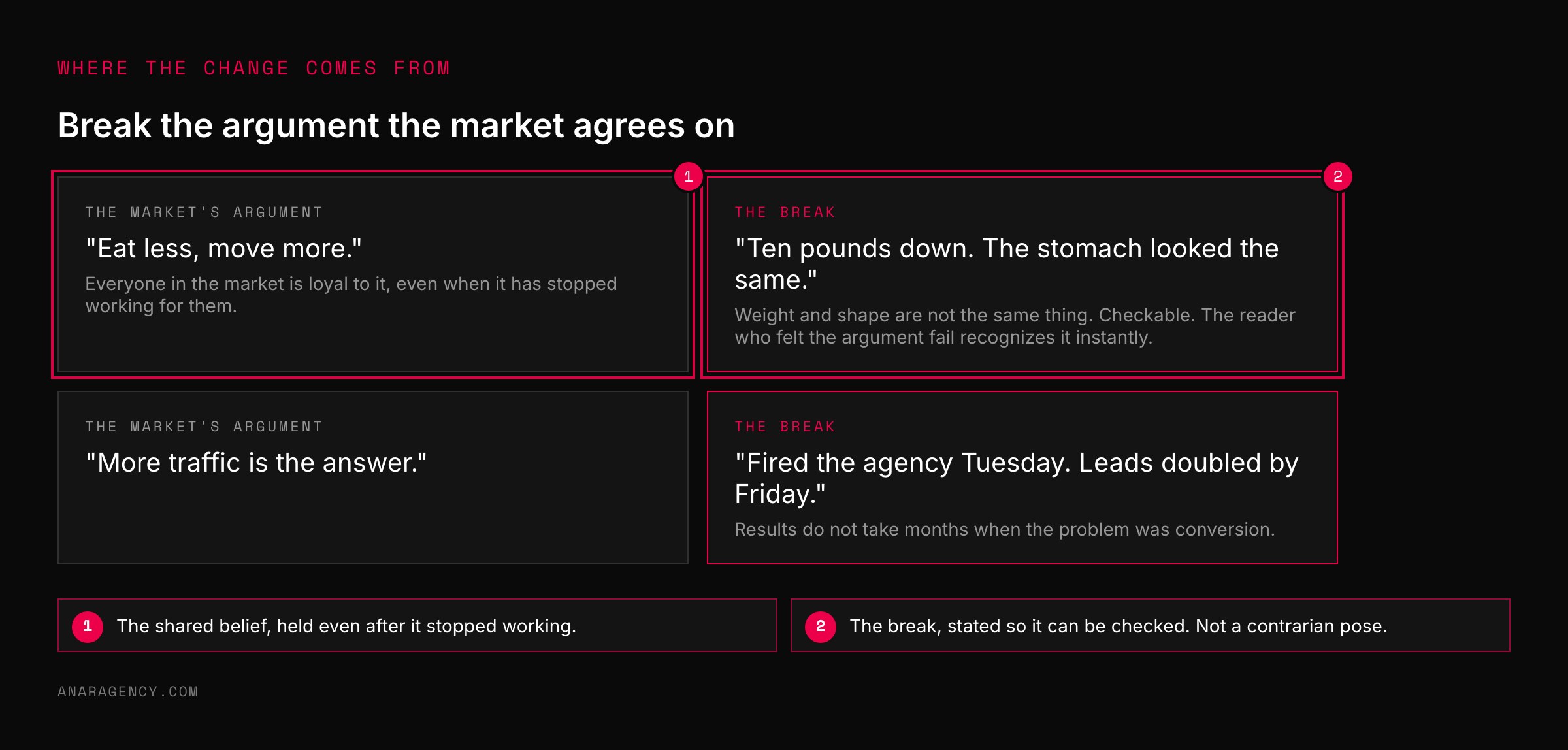
Weight loss agrees that eating less and moving more is the answer. Lead generation agrees that more traffic is the answer. Home services agree that the lowest quote wins.
That agreement is the argument the market is held together by. The people in the market are loyal to it even when it has stopped working for them, because loyalty to it is what makes them part of the market.
A hook that breaks that argument, plainly and provably, is the strongest change available, because it is a change to something the reader was certain of. "Ten pounds down, the stomach looked the same" breaks the argument that weight and shape are the same thing. "Fired the agency Tuesday, leads doubled by Friday" breaks the argument that results take months.
The break has to be checkable against outside evidence, or it is just a contrarian pose, and readers have a good nose for those.
The hope then follows on its own. If the argument was wrong, there is a different way, and the ad is about to show it. The reader who has felt the argument fail them, who ate less and moved more and kept the inch, who bought more traffic and got the same leads, recognizes the break at once.
That recognition is the see-more tap.
The four questions, in order
To build a hook from nothing, we answer four questions in writing before drafting a word.
What are they stuck on: not what is wrong with them, but what has stopped moving, a number, a habit, a step. What is keeping them stuck: the belief or method they are loyal to, which is almost always the market's argument.
What has to break for them to move: the specific part of that argument that is wrong, stated so it can be checked. And what is the new combination that lets them move: not the whole method, just the one piece that makes the break useful.
The first two answers never appear in the ad. They are how you find the third and fourth, and the third and fourth are the hook.
Compress them to one line of two to twelve words. Start with the most concrete word in the sentence, never with "this is" or "the best" or "are you", because the first word is the one a scanner reads and a stale first word ends the read. Put the change first and the hope second, so the line is already moving before the reader decides whether to stay.
"Stuck" is a better word than "problem" for the first question, and not for softness. A problem is a thing the reader has. Stuck is a state the reader is in, and states can change, which is the whole premise of the hook.
People do not scroll to solve problems. They stop when they see a way to move.
Three shapes that work
In our accounts three shapes pass the test more often than any others.
The quiet correction: a plain statement that contradicts what the reader assumed, with the hope implied in the contradiction. The result that did not come: a specific, recognizable situation where the usual method was followed and the outcome was not, which is the market's argument failing in one sentence. And the moving sentence: something already in motion, a concrete first word, the hope arriving in the second clause.
Three shapes fail reliably. The feature with no subject, a list of specifications with no one attached to them, which reads as a spec sheet because nothing has changed for anyone. The stale opener, a claim that starts with the weakest words available.
And the scare with no exit, a change with no hope, which the reader scrolls past to protect themselves.
A hook in motion beats a hook at rest. "I stopped counting calories in March" is a sentence already underway. "Calorie counting does not work" is a statement standing still.
The first invites the reader into something happening. The second asks them to agree with an opinion, and agreement is work.
Where a video is involved, the opening frame follows the same rule: a face mid-expression, an object mid-fall, a hand mid-reach, never a title card. Platform guidance on thumbnails and titles and Meta's feed video specs both assume the first frame is doing the work, and in our experience the first frame is the hook's visual twin.
How we test ten hooks for the price of one ad
Hooks are cheap to write and cheap to test, which is the best thing about them.
We write five to ten against a single body and a single offer, put them in one ad set, run them to cold traffic on feed placements only, and give each roughly 1,500 impressions. Then we judge them against each other on cost per click, not against a cost-per-lead target, because at that stage the only question is which opening earns the click.
The body and the offer are held constant, so the hook is the only variable.
The winner is then paired with the body it was tested on and promoted. The losers are not deleted. They are notes about what this audience does not respond to, which is as useful as the winner.
Two rounds of this, two weeks apart, usually produce a hook that holds for a quarter. When it fades, the body and offer stay and only the hook is replaced. Refreshing the hook alone has revived more dying ads in our accounts than any other single change, and it costs an afternoon.
The last rule is about where the audience lives. Pew's social media fact sheet is a reminder that platform use differs sharply by age and group, which means the argument a market is held together by differs by platform too.
A hook that breaks the right argument on one platform may be breaking an argument nobody on another platform holds. Test where the ad will run, and write the four answers for the people who are actually there.
Questions executives ask
What makes a good hook?
Two ingredients in one short line: a change, something different from what the reader assumed, and hope, a hint that the change leads somewhere better. The line should start with a concrete word and read as something already happening. Its only job is to earn the next three seconds.
How do I write a hook for a Facebook ad?
Write down what the reader is stuck on, what belief keeps them there, what part of that belief is wrong, and what one new piece lets them move. Turn the last two answers into a line of two to twelve words. Lead with the most concrete word; never open with "this is" or "the best".
How long should a hook be?
Short enough to be read as a whole, not word by word: two to twelve words for text, the first three seconds for video. If the reader has to parse it, it has already lost the scroll.
Why do scary hooks stop working?
Because a change without hope is bad news, and people protect themselves from bad news by scrolling. Over time an audience learns to avoid the brand that keeps delivering it. Pair every change with a hint that there is a way through.
How many hooks should I test?
Five to ten against one body and one offer, in one ad set, on cold feed traffic, with roughly 1,500 impressions each. Judge them against each other on cost per click. Keep the winner, keep the body, and replace only the hook when the ad fades.

Filip Kovacevic is the founder of Anar Agency in Phoenix. He spent five years running SEO, Meta ads, email, and content for medical practices across the United States, and now does the same work for healthcare, home-service, legal, and professional-service businesses, alongside AI implementation. More from Filip →
Talk it through in 15 minutes
Bring one AI question from this article. We will tell you what we would do, whether or not you hire us.
Book a 15-Min Chat →