The Lead-First Email Sequence: Eight Emails, Written Out
A nurture sequence is a short series of emails sent to a new lead, each with one job. Ours has eight over about two weeks. A welcome, one useful idea, a customer story, an answer to the belief that holds people back, a useful email that mentions the offer in one line, the offer itself, an answer to the main objection, and a short last note.
Five of the eight ask for nothing. Each email carries one story and at most one next step. After the last one the lead joins the regular weekly list.
Six signs in a row
In 1925 a small company in Minneapolis started selling a shaving cream you could use without a brush. Nobody had heard of it.
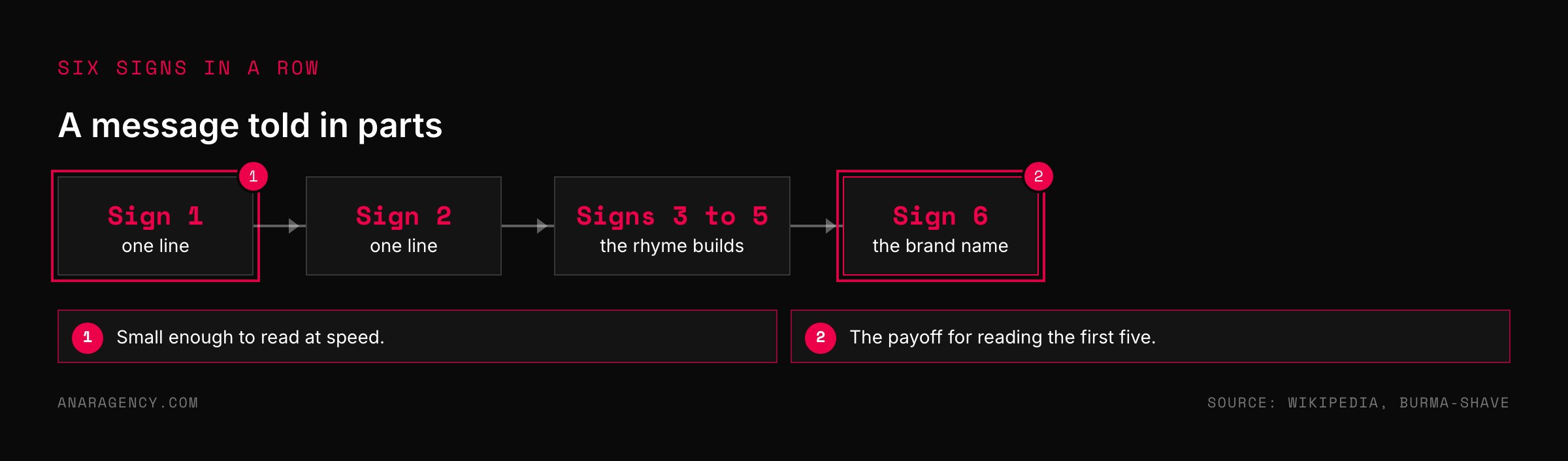
The owner's son had an idea. Along a highway he planted a row of small wooden signs, spaced so a driver read them one at a time, each with a single line of a rhyme. The brand name came on the last.
The first signs went up in 1926. They spread across most of the country and stayed until 1963.
At its peak the product was the second-highest-selling brushless shaving cream in the United States.
One big billboard would have said the same words. What worked was the series: a small piece, a gap, then the next piece.
Why one email is not enough
A new lead has just told you something valuable. They have a problem and they are thinking about it today.
Most businesses answer with one email, usually a receipt for the download. Then nothing, or a sales call.
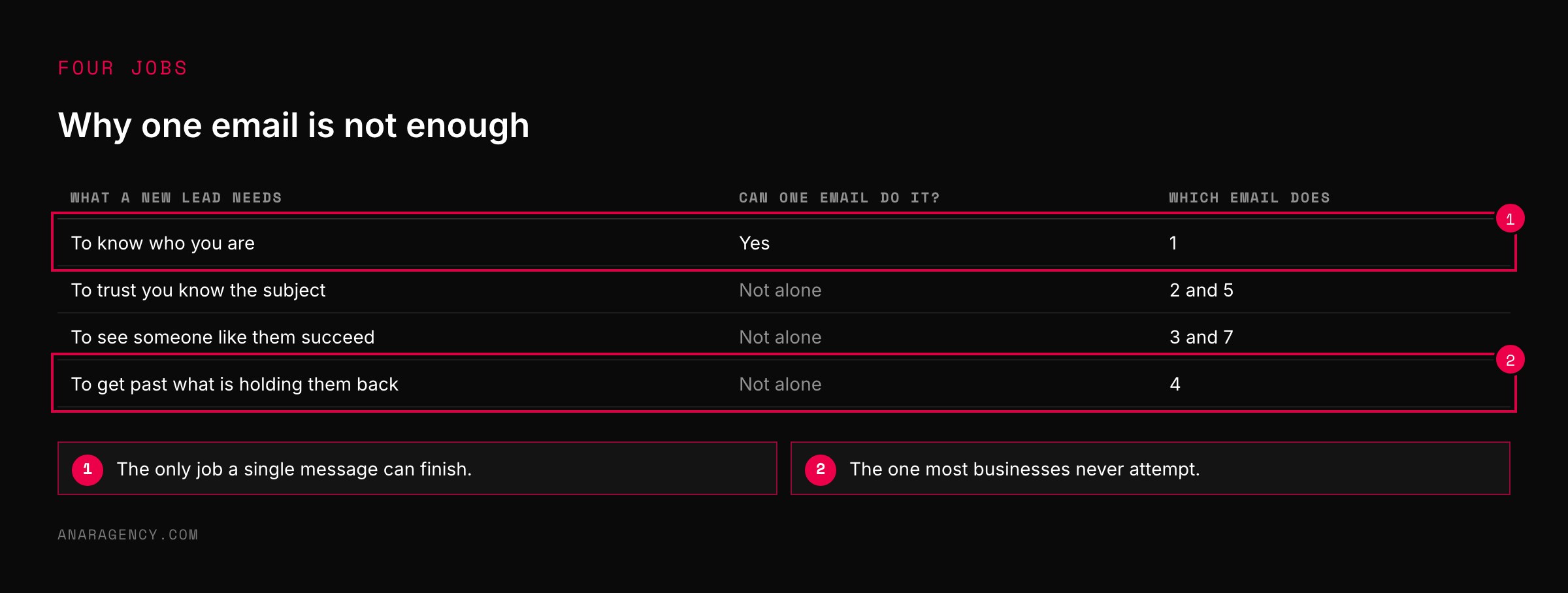
One message cannot do the work. The lead needs to learn who you are, trust that you know the subject, see someone like them succeed, and get past whatever is making them hesitate. Those are separate jobs.
Marketers call a timed series of messages drip marketing. The name is apt. A little at a time gets through where a flood runs off.
There is a reason a series holds attention. People remember unfinished things better than finished ones, a finding known as the Zeigarnik effect. An email that ends with "tomorrow I will show you the part most people miss" leaves a thread open.
Eight emails over about two weeks, each with one job: welcome, one useful idea, a customer story, the belief in the way, a useful email with a one-line mention of the offer, the offer, the main objection, and a short last note. Five of the eight ask for nothing. Each email has one story and at most one next step, opens on the reader, and points to the next email.
Include a clear unsubscribe in every one, watch unsubscribes per email, and move the lead to the weekly list at the end.
The eight emails
Here is the sequence we use as a starting point, with what each one is for.
1. Welcome, at once. Deliver what they asked for.
Say who you are in two lines and what will arrive over the next two weeks. 2. One useful idea, day two.
Something they can use today, which also introduces your way of seeing the problem.
3. A story, day four. One customer like them: where they started, what changed.
4. The belief in the way, day six. Name the thing most people in their position assume, and explain why it is not so.
5. Useful again, day eight. Another idea they can use, with a single line that mentions your service.
No link. 6. The offer, day ten.
What it is, who it is for, what it costs or how to start. One button.
7. The objection, day twelve. The most common reason people hold back, answered with a second story.
8. Last note, day thirteen. Three or four lines.
The offer is open, here is the link, and either way they will keep getting the weekly email.
Count the asks. Three of the eight mention the offer and only two carry a link. The other five give.
That balance is the point of what we call lead-first nurture, and it keeps you inside the Promotion Cap from the first day.
Signwriters: how each email is written
The sequences people actually read all the way through are plain. Each email does one thing. We call the people who write them Signwriters.
They give each email one job. If you cannot say what an email is for in a sentence, it is two emails.
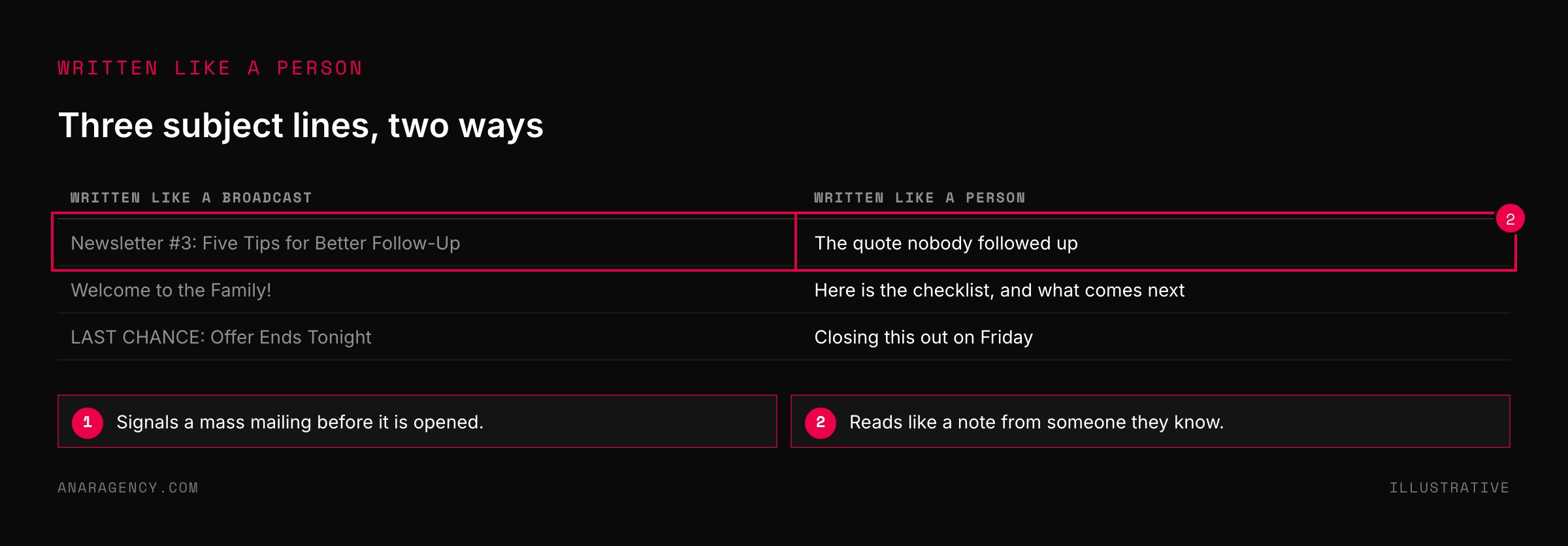
They write the subject line as a person would. "The quote nobody followed up" will be opened. "Newsletter #3: Five Tips" will not.
They open on the reader. The first line is about the reader's situation. Your company comes later, if at all.
They tell one story. A real customer, with the detail that makes it believable. Change the name or ask permission.
They end with one step or none. A link, or a question to reply to, or simply a sign-off. Two requests in one email usually get neither.
They connect the emails. A line at the end of one points to the next. How to pick the opening of each is in the Six Openings.
"Eight emails in two weeks is too many"
You may worry that this is a lot of mail for someone who only downloaded a checklist. It would be, if the emails were about you.
The timing is deliberate. Interest is highest in the days right after someone raises a hand, and it fades. Spreading eight emails across two months means most arrive after the reader has moved on.
And the lead can leave at any point. Every email needs a clear unsubscribe link. Gmail's sender guidelines tell senders to keep spam complaints below 0.3 percent, and senders of more than 5,000 messages a day must offer one-click unsubscribe.
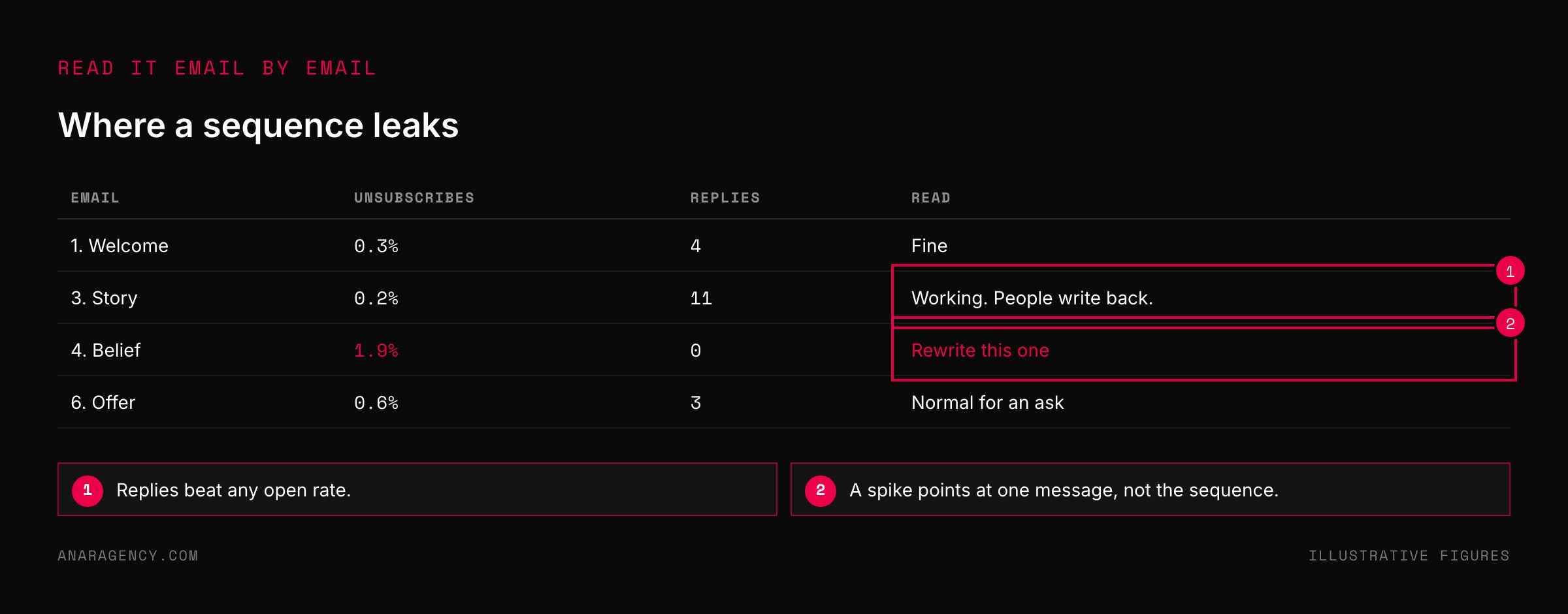
Watch two numbers. If unsubscribes jump at a particular email, that email is the problem. Rewrite it or cut it.
If replies arrive, you are doing it right. A sequence that gets people writing back is working, whatever the open rate says.
Treat the eight and the spacing as a default to test, not a law. A lead who asked for a quote needs a shorter, faster series, which we cover in email as the profit center.
What to read next, and why
Burma-Shave (encyclopedia entry): The roadside signs, with examples of the rhymes. The clearest case for a message told in parts.
Drip marketing (encyclopedia entry): The general practice of timed message series and where it came from.
Zeigarnik effect (encyclopedia entry): Why an open thread keeps a reader coming back.
Email sender guidelines (Google documentation): The complaint and unsubscribe rules a sequence has to live within.
So the simple takeaway is this: write the first email tonight. Deliver what they asked for, say who you are in two lines, and tell them what is coming. The other seven can follow one a week.
Questions executives ask
What is an email nurture sequence?
A timed series of emails sent automatically to a new lead. Each email does one job, such as introducing the business, teaching one idea, telling a customer story, or presenting an offer, so the lead builds trust over days instead of receiving one sales message.
How many emails should a nurture sequence have?
There is no fixed number. A reasonable default is about eight emails over two weeks, with most of them giving something useful and two or three mentioning the offer. A lead who asked for a quote needs a shorter, faster series.
How often should nurture emails be sent?
Closer together at the start, when interest is highest. Sending one immediately and then roughly every two days for two weeks is a sensible starting point. Spacing them over months means most arrive after the reader has lost interest.
What should the first email in a sequence say?
It should deliver whatever the person asked for, say who you are in a couple of lines, and tell them what they will receive over the coming days. It should not ask for anything.
How do I know if my email sequence is working?
Look at replies, clicks on the offer email, and what leads go on to spend. Check unsubscribes for each email separately. A spike at one email means that message needs rewriting.

Filip Kovacevic is the founder of Anar Agency in Phoenix. He spent five years running SEO, Meta ads, email, and content for medical practices across the United States, and now does the same work for healthcare, home-service, legal, and professional-service businesses, alongside AI implementation. More from Filip →
Talk it through in 15 minutes
Bring one AI question from this article. We will tell you what we would do, whether or not you hire us.
Book a 15-Min Chat →