The Promotion Cap: Sell Too Often and the Audience Dies
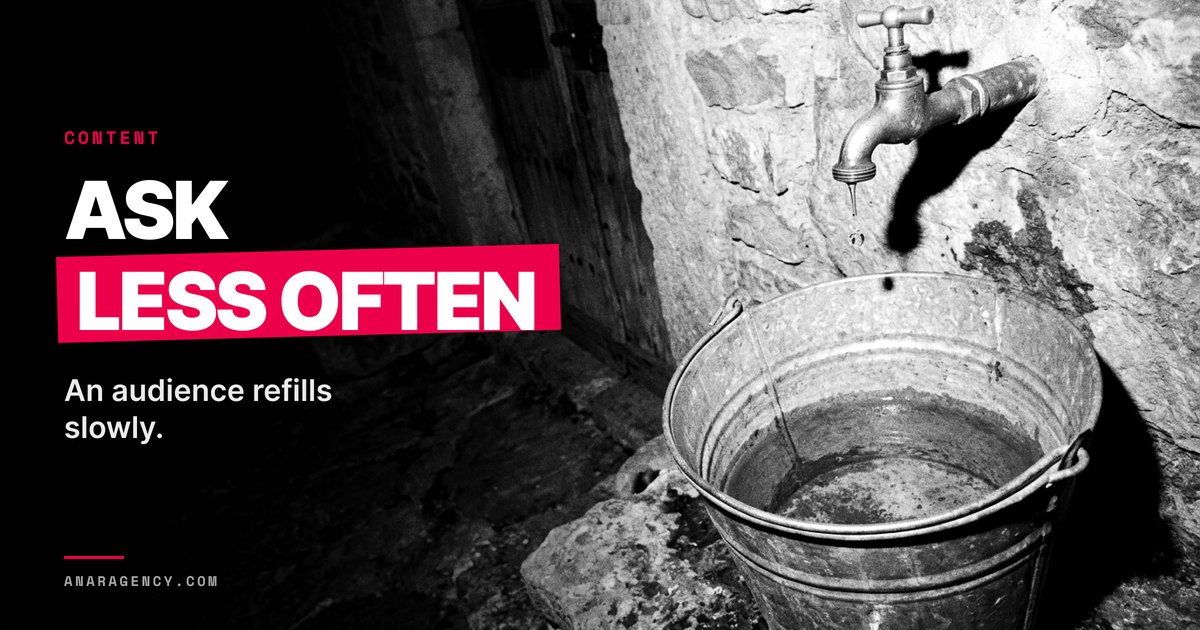
An audience refills at a limited rate, and every sales message draws it down. Ask too often and people leave or stop reading faster than new ones arrive. As a rule of thumb, we keep direct offers to about one piece in twenty and make the rest useful without a purchase.
The right number for you is whatever keeps the list growing and replies coming. Watch for rising unsubscribes on offer days, spam complaints, silence where there used to be replies, and each offer earning less than the last. Those mean you are over the cap.
One percent
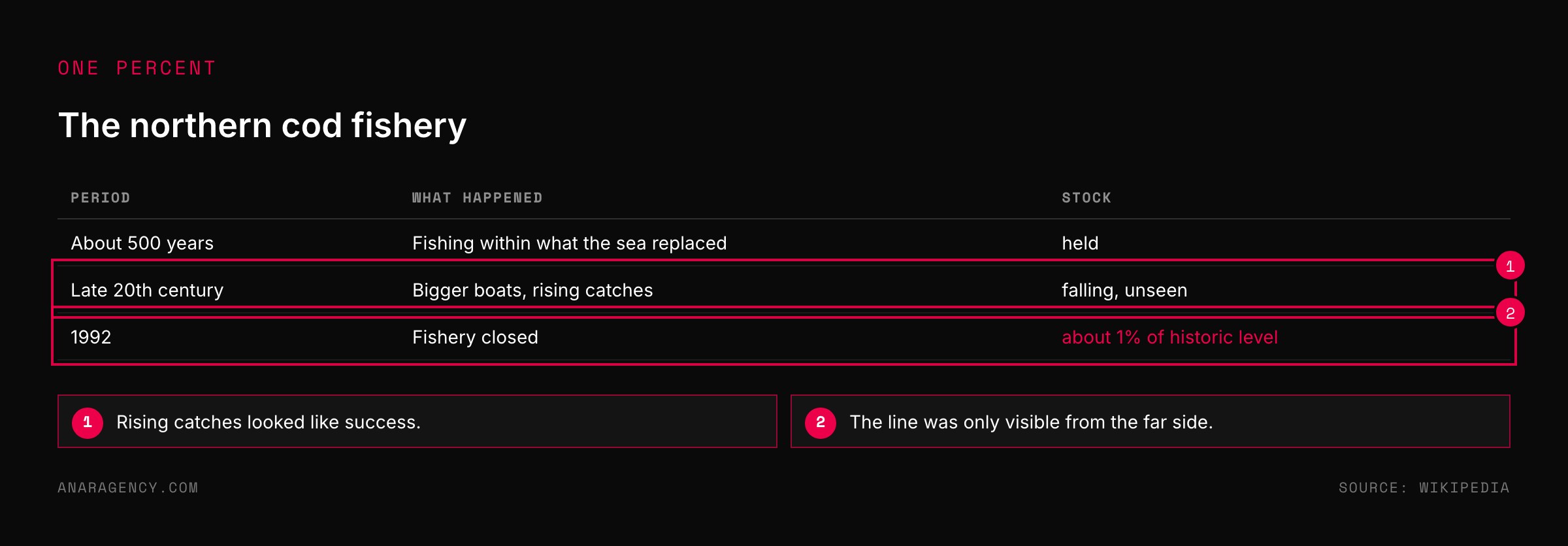
For about five hundred years, the cod off the east coast of Canada fed the towns along it. The fish seemed without end.
In the second half of the twentieth century the boats got bigger and the nets got better. Catches rose. For a while that looked like success.
By 1992 the northern cod population had fallen to about 1 percent of its historic level. The government closed the fishery, and the work that had shaped that coast for centuries stopped.
Nobody set out to destroy it. Each boat took a little more than the stock could replace, every year, and the total passed a line nobody could see until it was behind them.
An audience is a stock of that kind. It refills, slowly. And it can be fished out.
An audience has a refill rate
Fisheries scientists have a term for the largest catch that can be taken year after year without shrinking the stock: maximum sustainable yield. Take less and you leave value in the water. Take more and next year there is less to take.
Your list works the same way. New people arrive at some rate. Attention and goodwill rebuild at some rate.
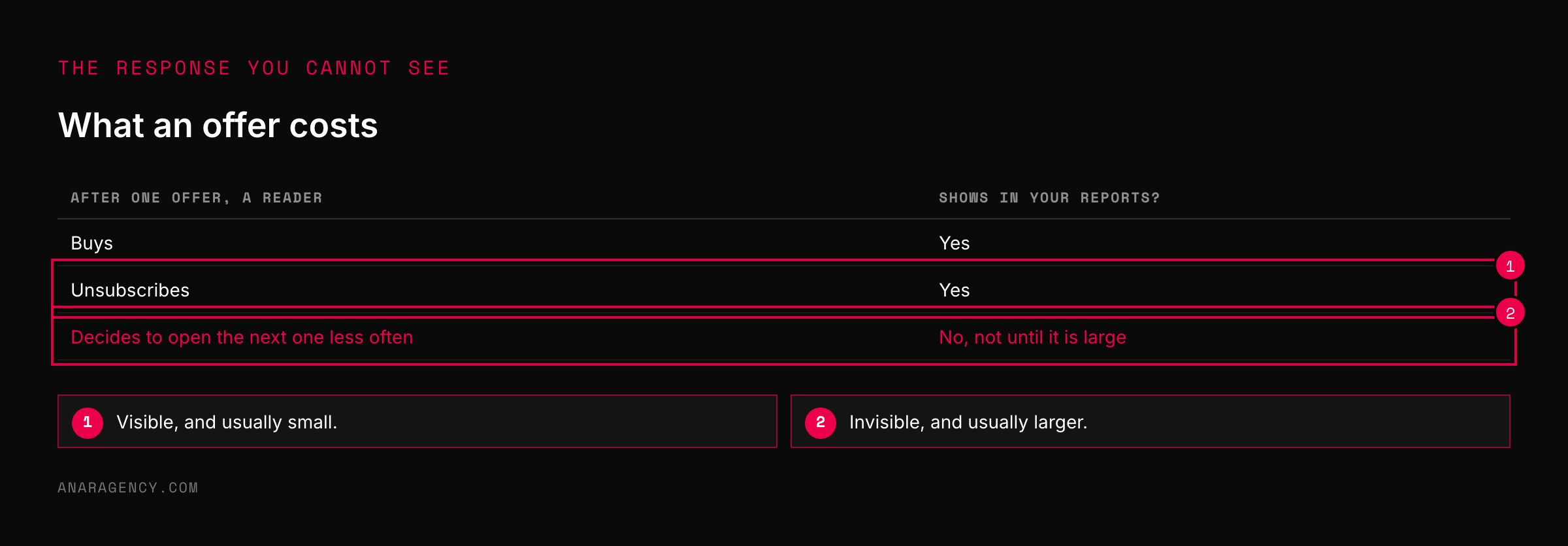
Every offer you send spends some of both. A few people buy. A few more unsubscribe.
A larger number quietly decide to open the next one less often.
That third group is the one that sinks businesses, because it does not show in any report until it is large.
So the question is never whether an offer makes money. Almost any offer to a warm list makes some. The question is whether the list is bigger and warmer a month later, or smaller and colder.
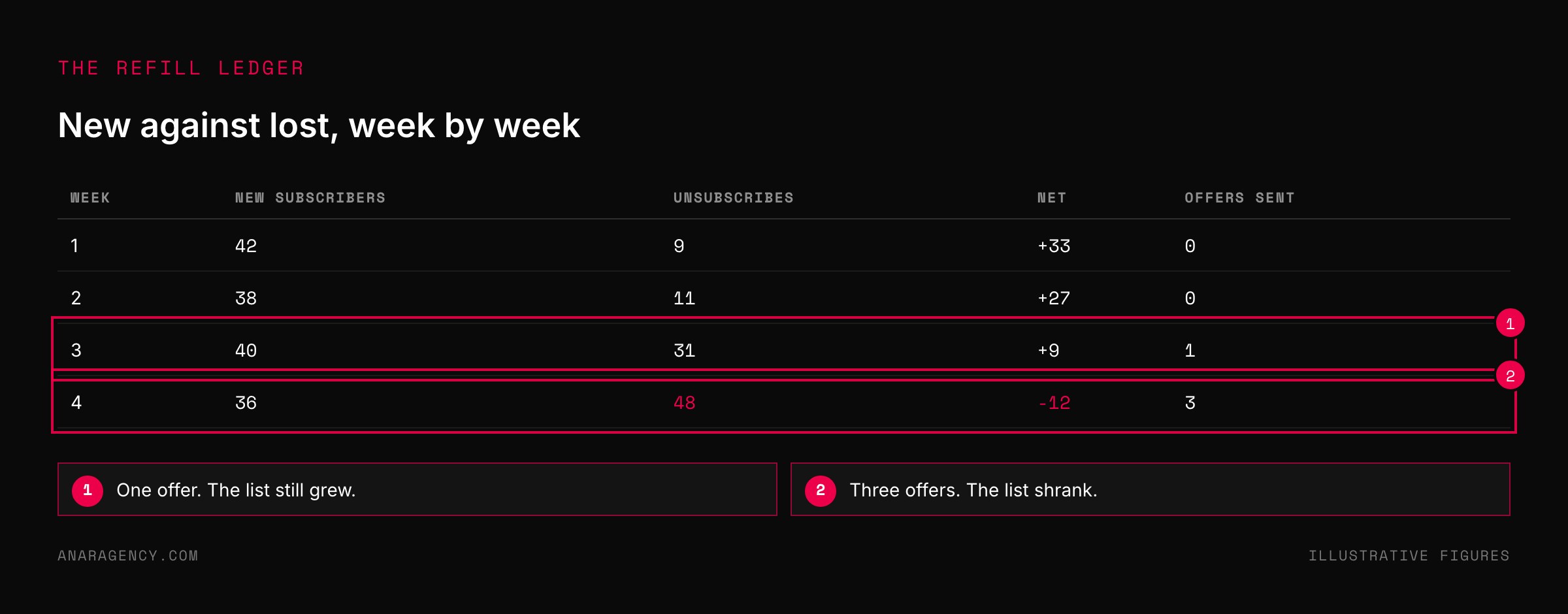
An audience refills slowly, and each offer draws it down. Keep direct offers to about one piece in twenty as a starting rule, and make the rest useful with no purchase. Track new subscribers against unsubscribes weekly.
Ask clearly when you ask: one offer, one price, one real deadline. Offer a fewer-emails option and send offers first to people who showed interest. Warning signs: unsubscribes that rise on offer days, spam complaints near 0.3 percent, fewer replies, and falling return per offer.
The Promotion Cap
We set a ceiling on how much of our output asks for money, and we call it the Promotion Cap.
As a rule of thumb, about one piece in twenty is a direct offer. The other nineteen teach, show, or report something a reader can use with no purchase.
That figure is our working rule, not a law. A list that signed up for deals will bear more. A list of busy professionals who joined for analysis will bear less.
There is a second assumption underneath it. Only a minority of any audience will ever buy, however good the offer. Selling harder does not enlarge that group.
It only reaches the same people more often.
Why does giving so much work? People tend to return what they receive, a tendency researchers call reciprocity. A reader who has had nineteen useful things from you meets the twentieth in a different frame of mind.
And note what counts as an ask. A post that teaches something and ends with "here is where to find us" is teaching. A post whose whole purpose is the link is an ask.
Stock Keepers: how they sell without draining the list
Some businesses sell to the same audience for a decade and it keeps growing. They treat the list as a stock to be kept. We call them Stock Keepers.
They watch the refill. New subscribers per week, set against unsubscribes per week. If the second is catching the first, they slow down before the revenue number tells them to.
They make the useful pieces sell. A good teardown shows what you can do better than an offer says it. Much of the selling happens in the nineteen, which is why the twentieth can be short.
They ask clearly when they ask. One offer, one price, one deadline that is real. A clear ask once a month does less damage than a vague one in every email.
They let people choose. A separate list for offers. A link that says "fewer emails" beside the one that says unsubscribe.
People who would have left stay on their own terms.
They ask the right people. An offer sent only to those who clicked on the subject last month reaches the likely buyers and spares everyone else.
The email side of this, including what to send in between, is in lead-first nurture.
"If I only sell one time in twenty, how do I make money?"
You may look at one in twenty and see nineteen wasted chances. It feels that way in the week. It does not work that way across a year.
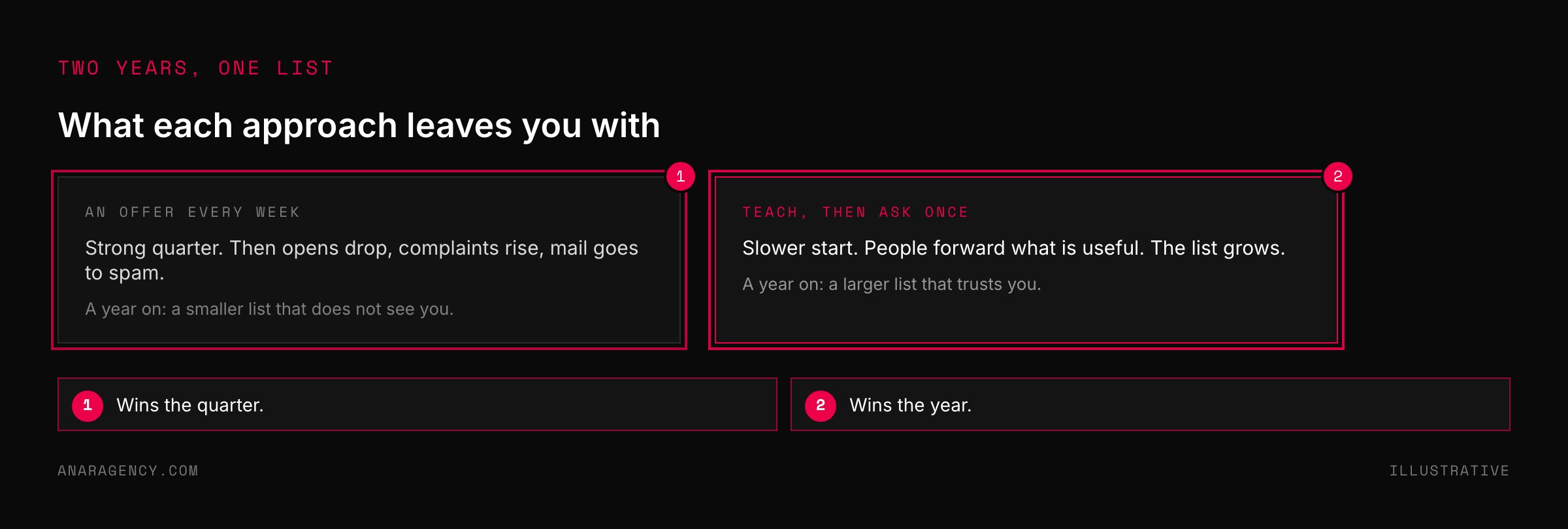
Take a list of 2,000. Send an offer every week and it may earn well for a quarter. Then the opens drop, the complaints rise, and the mail starts landing in spam.
That last part is not a figure of speech. Gmail's sender guidelines tell senders to keep reported spam rates below 0.3 percent. Three complaints in a thousand is enough to put delivery at risk.
Once you are filtered, the people who wanted your emails stop seeing them too. The whole list is lost, not just the annoyed part.
Compare a list that is taught for most of the month and offered something once. It grows, because people forward what is useful. In a year it is larger, and each offer goes to more people who trust you.
And the cap covers broadcasts to everyone. A reply to someone who asked for a quote is not promotion. Neither is a follow-up to a person who clicked "tell me more."
Sell to the interested as often as they are interested.
What to read next, and why
Collapse of the Atlantic northwest cod fishery (encyclopedia entry): How a five-century resource was taken past its limit in a few decades.
Maximum sustainable yield (encyclopedia entry): The idea of a harvest rate a stock can bear, and why it is hard to judge from the inside.
Email sender guidelines (Google documentation): The complaint rate and unsubscribe rules that decide whether your mail arrives at all.
Reciprocity (encyclopedia entry): The research on why giving first changes how an ask is received.
So the simple takeaway is this: count your last twenty posts or emails. If more than one or two asked for money, make the next ten useful and watch what the list does.
Questions executives ask
How often should I sell to my email list?
As a starting rule, make about one message in twenty a direct offer and the rest useful without a purchase. Adjust by watching whether the list keeps growing and replying. Lists that joined for deals tolerate more offers than lists that joined for expertise.
What is the Promotion Cap?
A ceiling on the share of your content that asks for money. It exists because an audience's attention and goodwill rebuild slowly, and frequent selling removes people faster than new ones arrive.
What are the signs of list fatigue?
Unsubscribes that climb on offer days and stay high, spam complaints, fewer replies to ordinary messages, and each successive offer earning less from the same list. Any of these means the audience is being drawn down.
What spam complaint rate is too high?
Gmail's sender guidelines tell senders to keep the spam rate reported in Postmaster Tools below 0.3 percent. Above that, messages are more likely to be filtered, including for subscribers who want them.
Does the cap apply to follow-ups with leads?
No. It applies to broadcasts sent to the whole audience. Replying to a quote request or following up with someone who asked for details is a conversation they started, and it should continue as long as they are engaged.

Filip Kovacevic is the founder of Anar Agency in Phoenix. He spent five years running SEO, Meta ads, email, and content for medical practices across the United States, and now does the same work for healthcare, home-service, legal, and professional-service businesses, alongside AI implementation. More from Filip →
Talk it through in 15 minutes
Bring one AI question from this article. We will tell you what we would do, whether or not you hire us.
Book a 15-Min Chat →