Six Openings: The Questions Every Post Can Start From
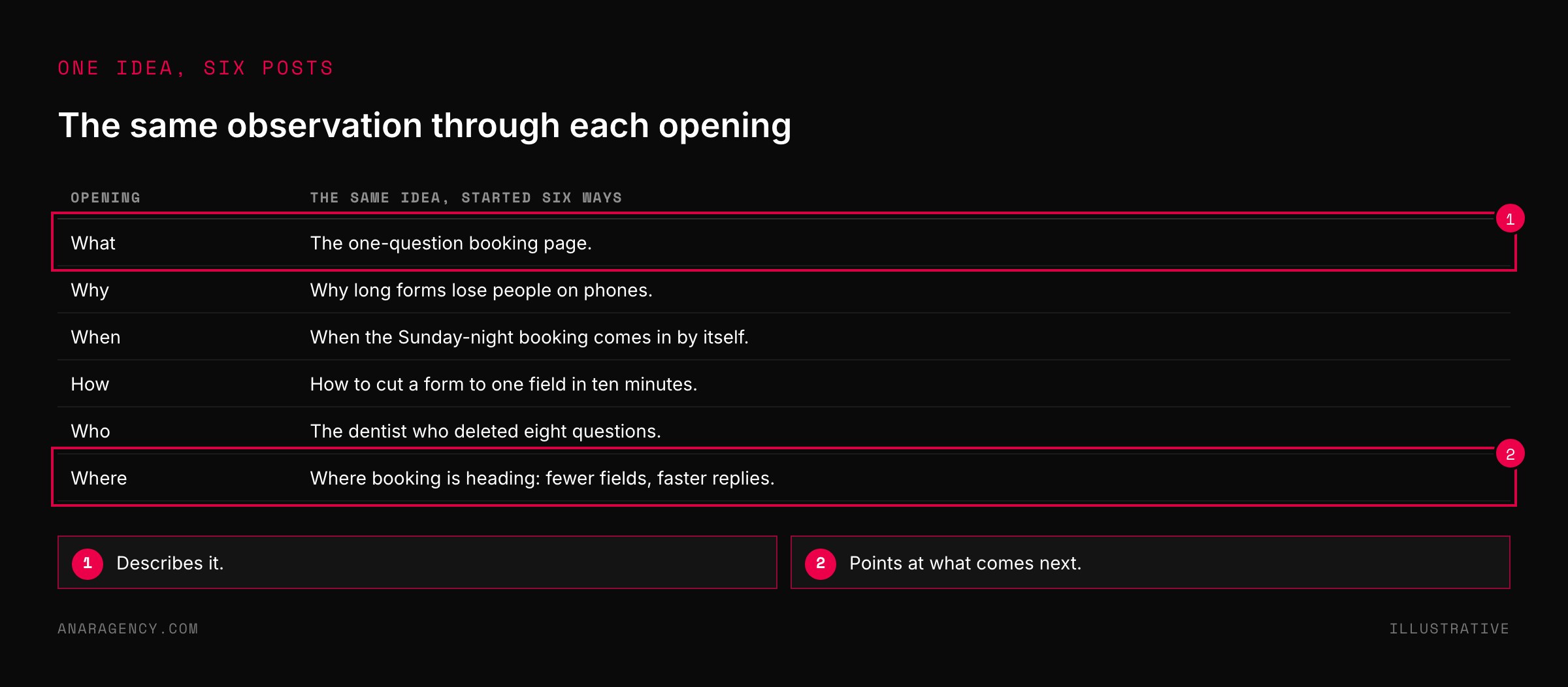
Every post can start from one of six questions: what, why, when, how, who, or where. Each does a different job. What gives the reader something to picture.
Why explains the cause. When points to a moment ahead. How gives the steps.
Who ties the idea to a person. Where gives direction. A post that answers at least three feels complete, and one that answers a single question leaves the reader to fill the gaps.
A reliable order is what, then why, then who or when, closing on how. One idea run through all six gives six different posts.
Six honest serving-men
In 1902 Rudyard Kipling ended one of his children's stories with a short verse about how he learned everything he knew.
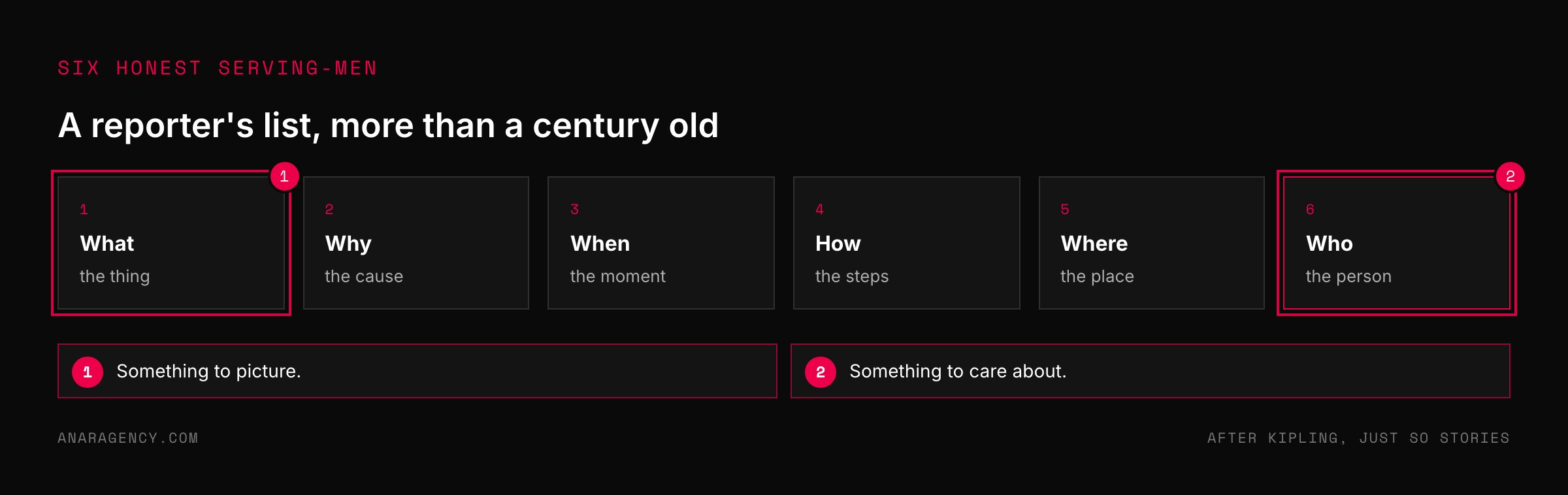
He kept six honest serving-men, he wrote, and their names were What and Why and When and How and Where and Who.
The verse comes from his Just So Stories. Newsrooms adopted the same list as a test of whether a report was finished.
Journalism teachers call it the Five Ws, usually with How added as a sixth. A story that leaves one out sends the reader away with a question.
It has lasted more than a century because it is a list of what a person needs in order to understand anything. That makes it useful to anyone who has to post on Monday and has nothing to say.
What each opening does
The six are not interchangeable. Each one sends the reader's mind somewhere different.
What gives them a thing. Something they can picture. "A booking page with one question on it."
Why gives the cause. It looks backward and it settles arguments before they start. "It works because nobody wants to fill in nine fields."
When gives a point in time, usually ahead. It is where the payoff lives. "When the first booking comes in on a Sunday night."
How gives the steps. It is the one that teaches.
Who ties the idea to a person. It only lands if the reader already knows of them, or knows the type.
Where gives a place or a direction. "This is where local search is heading."
What shows a thing. Why explains the cause. When points to a moment.
How gives the steps. Who ties it to a person. Where gives direction.
Start any post from one of them, and check every draft covers at least three. Default order: what, why, who or when, how. Put the main point first.
One idea run through all six yields six posts. Leave the how partly open only if the post is still useful without it.
The Six Openings as a test
The first use is the obvious one. Stuck for a post? Take one idea and start it six ways.
The second use is better. Read a draft and ask which of the six it answers.
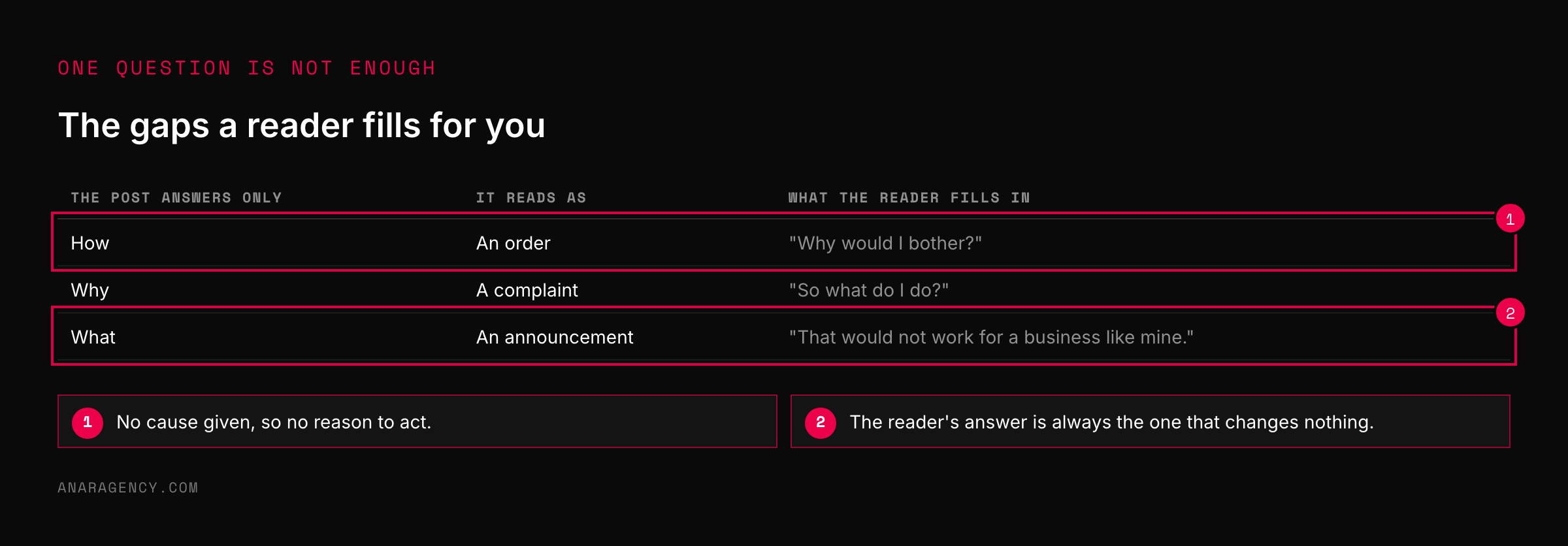
Most weak posts answer one. A how-to with no why reads as an order. A why with no how reads as a complaint.
A what with neither reads as an announcement.
When a post leaves a question open, the reader answers it themselves, and they answer it in whichever way lets them carry on as before. "That would not work for a business like mine."
So aim to cover at least three in any post. That is our rule of thumb, and in practice it is the point where a post starts to feel finished.
Online, put the main point first. Usability research on the inverted pyramid found that web readers often leave after the opening, so the conclusion belongs at the top and the detail below it.
Door Openers: a default order
Some people post every week for years and each piece still feels whole. They are running the same short sequence under different subjects. We call them Door Openers.
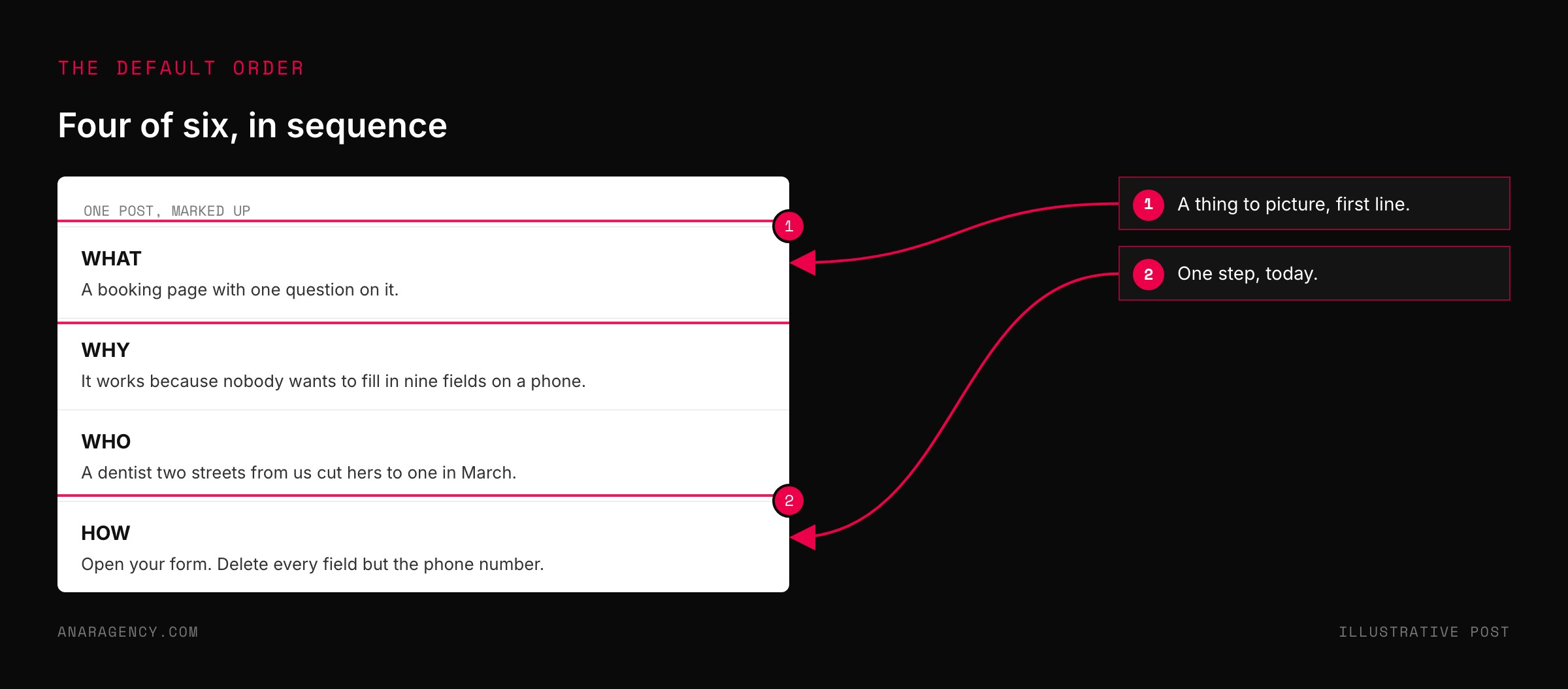
They open with what. A thing to picture, in the first line. Journalists call the opening the lead, and its job is to make the rest worth reading.
They follow with why. The cause, stated as "it works because." A post with a solid why draws fewer arguments, since the objection has been answered before it was raised.
Then who or when. A person who did it, or the moment it pays off. One or the other makes the idea real.
They close on how. One step the reader can take today. Ending on the how gives the post a finish.
What, why, who or when, how. That is our default, and it bends. A post about a trend may open on where.
One working assumption we plan around, which is not a measured fact. Why-led posts tend to draw the most discussion, and how-led posts tend to draw fewer readers who are closer to buying. Use both on purpose.
"Is this not just a formula?"
You may worry that a fixed list makes everything sound alike. It would, if the list were the content.
It is a checklist for completeness. A carpenter's square does not make every table look the same.
The substance still has to come from somewhere real: a thing you saw, a number you counted, a job that went wrong. We cover where that comes from in all content is about change.
And you may leave one question open on purpose. A post can give the what and the why in full and only sketch the how, if the full how is the service you sell.
That is fair as long as the post is useful by itself. A reader who learns something real and wants more is a lead. A reader who was teased and given nothing does not come back.
For a full week of posts built from one idea, pair this with hooks that work for the first line of each.
What to read next, and why
Five Ws (encyclopedia entry): The history of the questions, from classical rhetoric to the newsroom.
Just So Stories (encyclopedia entry): The book the six serving-men verse comes from.
Inverted Pyramid: Writing for Comprehension (usability research): Why the conclusion goes first when people read on a screen.
Lead paragraph (encyclopedia entry): What the first lines of a piece are for, and the common ways to write them.
So the simple takeaway is this: take the last post you wrote and mark which of the six questions it answers. If it is fewer than three, add one and post it again.
Questions executives ask
What should I post on LinkedIn for my business?
Take one thing you observed in your work this week and write it from one of six starting points: what it is, why it happens, when it matters, how to act on it, who it happened to, or where things are heading. Each gives a different post.
What are the Six Openings?
Six question words used as starting points and as a completeness check for a post: what, why, when, how, who, and where. They come from the reporter's list often called the Five Ws and How.
How do I structure a social media post?
A reliable order is to open with what, a thing the reader can picture, follow with why, add who did it or when it pays off, and close with how, one step they can take. Put the main point in the first line.
Why do my posts get no engagement?
A common cause is that the post answers only one question. A how with no why reads as an instruction, and a what with nothing else reads as an announcement. Covering at least three of the six questions makes a post feel complete.
How many posts can I get from one idea?
At least six, by opening the same idea from each of the six questions. The what-led version describes it, the why-led version explains it, the who-led version tells a story about it, and so on.

Filip Kovacevic is the founder of Anar Agency in Phoenix. He spent five years running SEO, Meta ads, email, and content for medical practices across the United States, and now does the same work for healthcare, home-service, legal, and professional-service businesses, alongside AI implementation. More from Filip →
Talk it through in 15 minutes
Bring one AI question from this article. We will tell you what we would do, whether or not you hire us.
Book a 15-Min Chat →