How Meta's Algorithm Actually Finds Your Buyers
Meta does not show your ad evenly to the audience you picked. It treats that audience as a pool and hunts inside it for the people most likely to do the thing you asked for. Its auction ranks ads by a total value made of your bid, the estimated chance the person takes your action, and the quality of the ad.
So your real levers are the goal you set, the budget you give it, and the ad itself. The audience matters less than it used to, and the four settings still worth your attention are location, exclusions, the result you optimize for, and any legal category limits.
You are not choosing who sees your ad
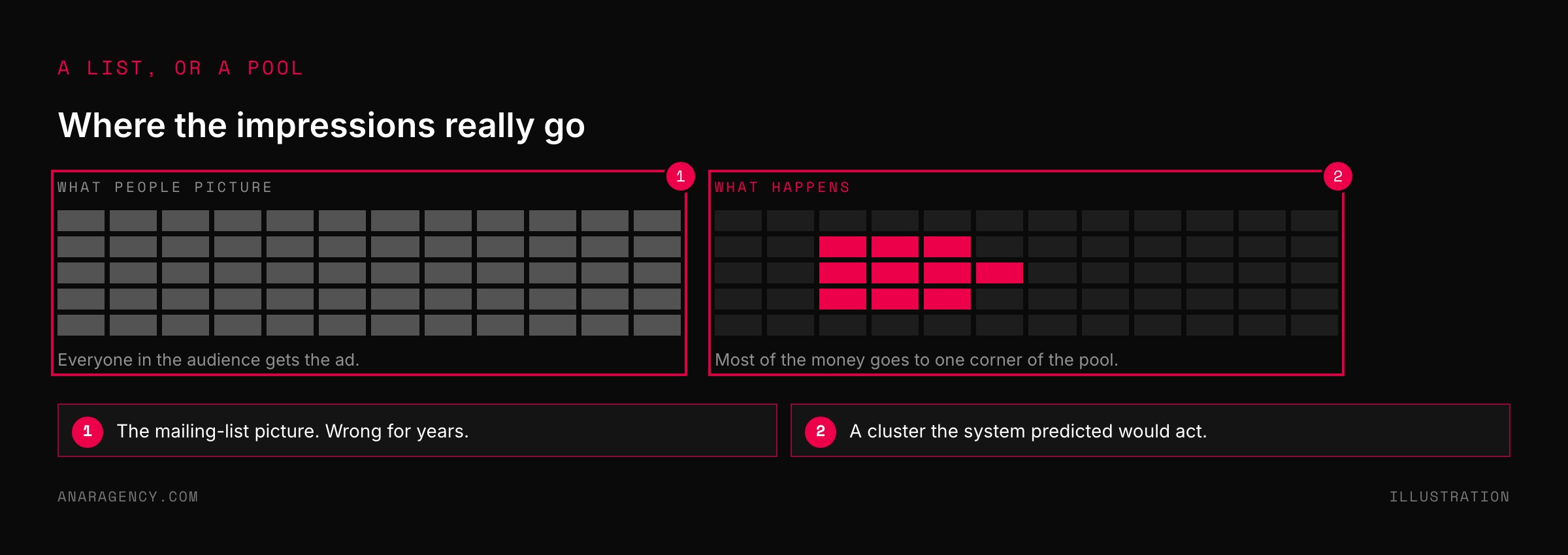
Most people picture Meta ads like a mailing list. You choose an audience of two million people, and your ad goes out to those two million.
That is not what happens. It has not been for years.
You give the system a group it is allowed to look in. Then it decides, one person at a time, whether to show your ad to them. It may spend most of your money on a small corner of that group and never touch the rest.
Once you see it that way, a lot of confusing things about ad results stop being confusing.
What Meta says decides it
This part is not a theory. Meta explains its ad auction in plain terms.
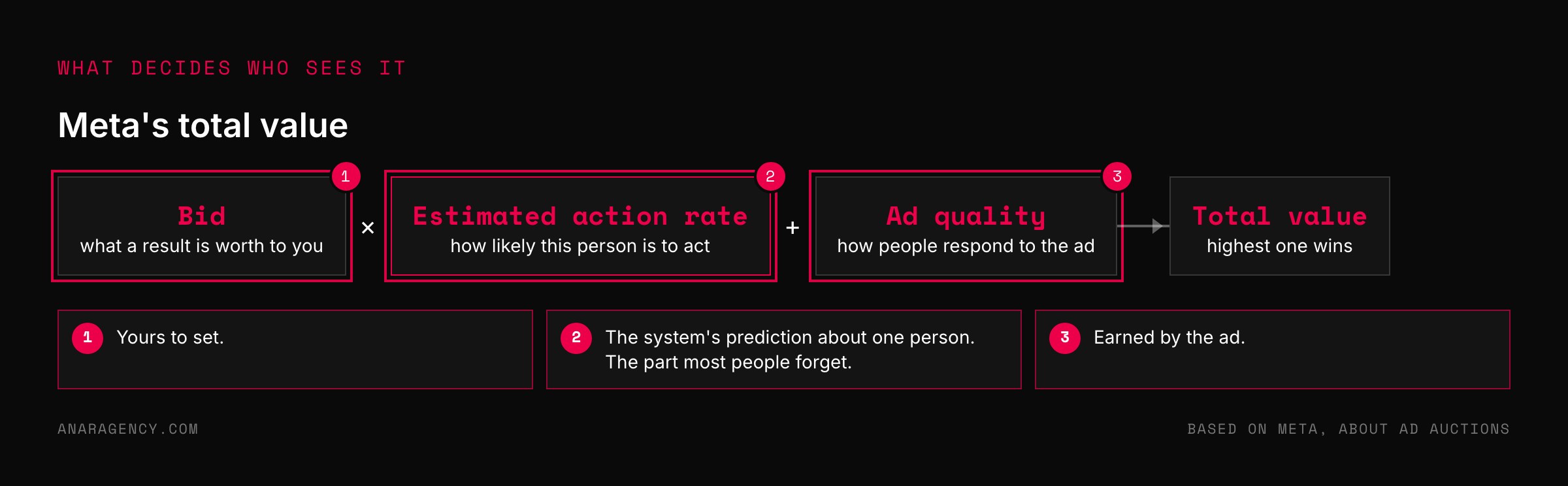
Every time there is a chance to show someone an ad, the ads that could be shown compete. The winner is the one with the highest total value. That value is built from three things.
Your bid: what a result is worth to you. The estimated action rate: how likely this particular person is to do what your ad is asking. And ad quality: how people have responded to the ad.
Look at the middle one. The system is estimating, for each person, the chance they will do your thing. So it is not handing out impressions.
It is making a prediction about a person and betting your money on it.
And it needs results to predict well. Meta says an ad set is still learning until it has had about 50 results in a week, and that performance is less stable before then.
Four ideas. The audience is a pool the system is allowed to search, not a list it delivers to evenly. The goal you optimize for is the scent it follows.
The cheapest results are found first, so cost tends to rise as you spend more in the same pool. The ad itself is the bait that decides who gets pulled out. Set the fence by hand, meaning location, exclusions, the result, and any legal category, and put the rest of your effort into clearly different ads.
The Pool Model
Here is the picture we use. It has four ideas, and it explains most of what you will see in an ad account.
The audience is a pool, not a list. It is the water the system is allowed to swim in. A bigger pool does not mean your ad reaches more kinds of people.
It means the system has more room to find the ones it wants.
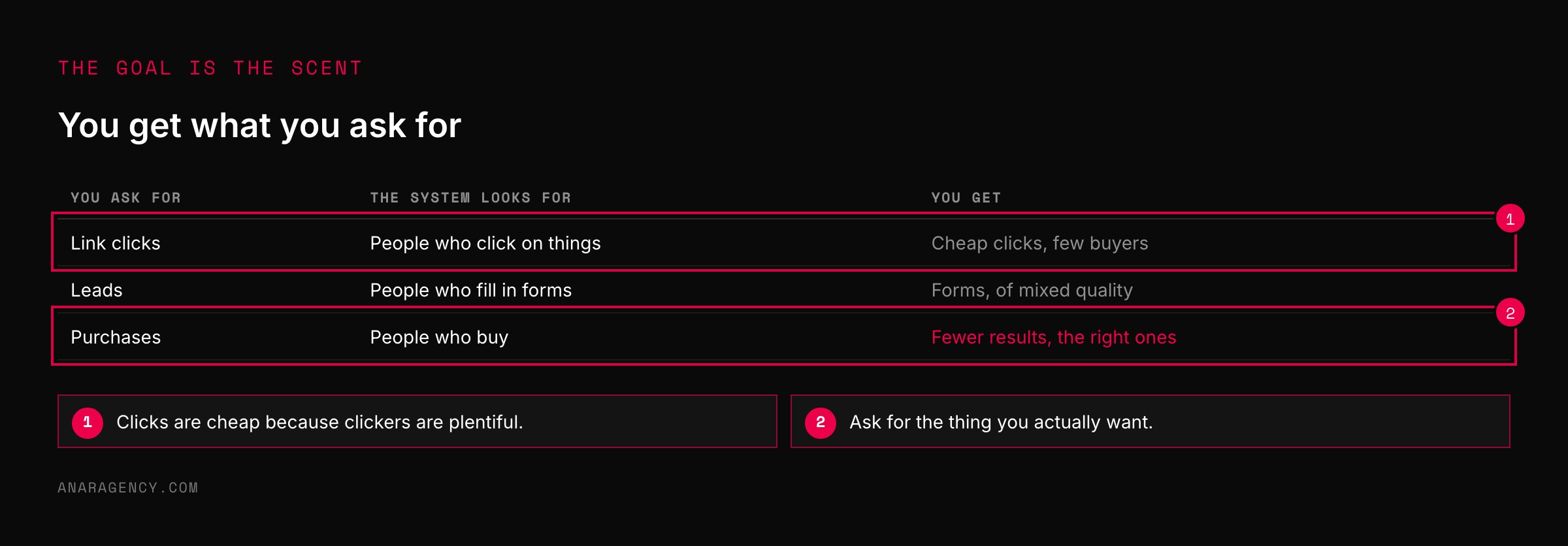
The goal is the scent. When you choose an objective and a result to optimize for, you are telling the system what to hunt. Ask for purchases and it looks for buyers.
Ask for clicks and it will find you people who click on things, which is a different crowd.
The easy buyers come first. The cheapest results get found early. Double the budget in the same pool and the system has to reach for people who are harder to convince.
Media buyers commonly see cost per result rise as spend rises, and this is the usual reason.
The ad is the bait. The picture and the words tell the system who to try. Two different ads in the same pool will pull out different people.
That last idea is the one that has grown. Meta's engineers described a newer system for choosing which ads to consider for each person, built for a world with far more ad creatives. More and more, the ad does the targeting.
The $10 billion push toward broad
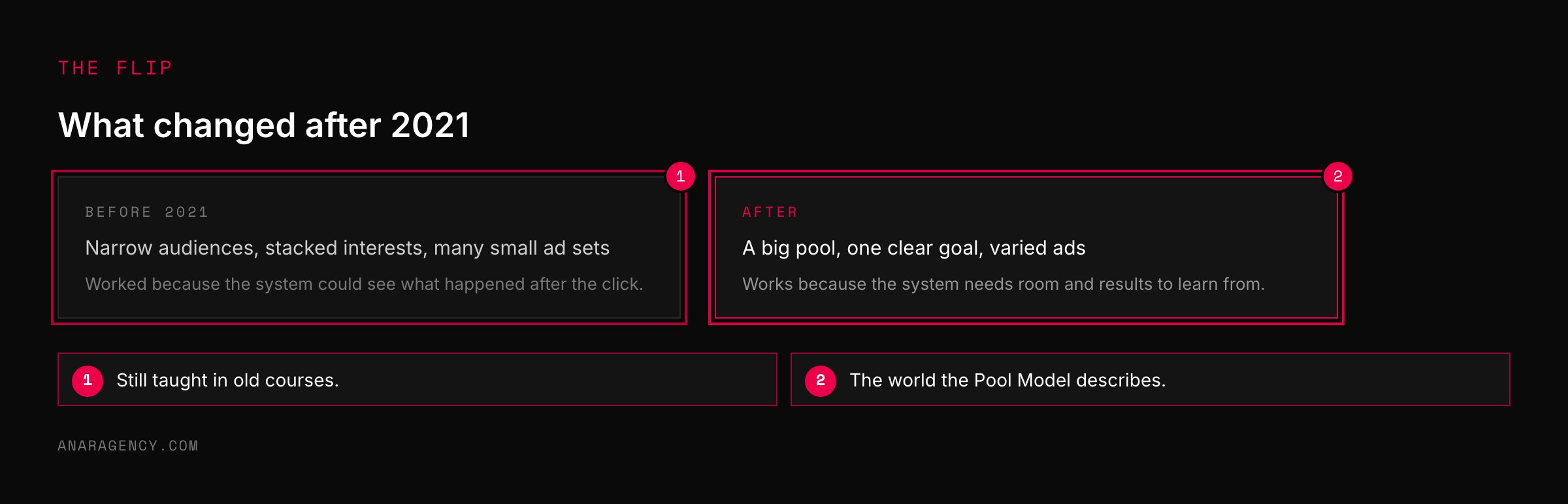
There is a reason advertisers stopped slicing audiences so finely, and it has a date on it.
In 2021 Apple began requiring apps to ask permission before tracking people across other companies' apps and websites. Many people said no.
For Meta that meant losing sight of a great deal of what happened after a click. In February 2022, Meta's finance chief told investors the change would cost the company on the order of $10 billion in revenue that year.
For advertisers the effect was quieter. The narrow audiences that used to work well got less reliable, because the system had less information about who was in them.
So the advice flipped. Give the system a bigger pool and a clear goal, and let it find the buyers with the signals it still has. That is the world the Pool Model describes.
It is also why the first campaign for a new offer looks so simple now. We walk through that setup in launching ads for a new offer.
"So targeting does not matter anymore."
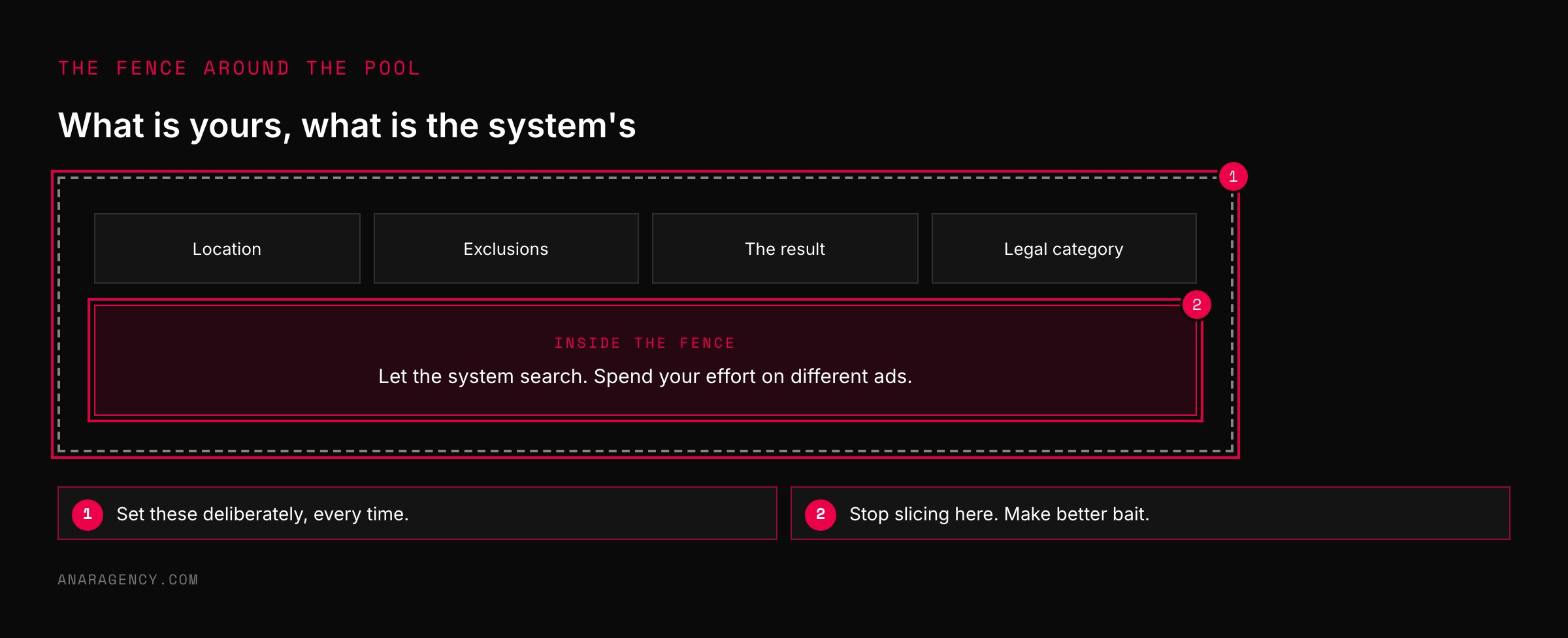
You may be thinking this means you can leave every setting open and let the machine sort it out. Not quite. There is still a fence around the pool, and you build it.
Location. A roofer in Phoenix should not be buying impressions in Ohio. Location targeting is the one setting almost every business must set by hand.
Exclusions. Leave out the people who already bought, unless you are selling them something new.
The result you optimize for. This is the scent. Getting it wrong sends the whole hunt after the wrong animal.
Legal limits. If you advertise housing, jobs, or credit, Meta restricts the audience options you can use, and that is not optional.
Inside that fence, the modern advice is to stop micromanaging. The money you used to spend testing six audiences is better spent making six ads that look different from each other.
What to read next, and why
About ad auctions (Meta documentation): The three ingredients of total value, straight from Meta. Ten minutes that replace a lot of folklore.
About the learning phase (Meta documentation): Why results swing early, and the number of results Meta looks for.
Facebook says Apple iOS privacy change will cost $10 billion this year (news): The moment the old way of targeting stopped working, in the company's own words.
Meta Andromeda (engineering post): Technical, but the opening section explains why the ad itself now carries so much weight.
So the simple takeaway is this: you do not choose who sees your ad. You choose the pool, the goal, and the bait. Spend your effort on the bait.
Questions executives ask
How does the Facebook ads algorithm work?
Each time an ad can be shown, Meta runs an auction and picks the ad with the highest total value. Meta says that value combines the advertiser's bid, the estimated chance that the person takes the action the ad is optimized for, and the quality of the ad. The system is predicting, person by person, who is likely to do what you asked.
Does Meta show my ad to my whole audience?
No. The audience you choose is the group the system may search. It concentrates delivery on the people inside that group it predicts are most likely to produce your result, and may barely reach the rest.
Is broad targeting better than interest targeting on Meta?
For many advertisers it now is. After Apple began requiring permission for tracking in 2021, narrow audiences became less reliable, and Meta's systems increasingly match ads to people from the ad itself. Broad targeting with a clear optimization goal lets the system use the signals it has.
Why does cost per result go up when I raise my budget?
The usual reason is that the cheapest results are found first. With more budget in the same audience, the system has to reach people who are less likely to act, so each additional result costs more.
What targeting settings still matter on Meta?
Location, exclusions such as past buyers, the result you optimize for, and any Special Ad Category limits for housing, employment, or financial products. Inside those limits, effort is better spent on varied creative than on slicing audiences.

Filip Kovacevic is the founder of Anar Agency in Phoenix. He spent five years running SEO, Meta ads, email, and content for medical practices across the United States, and now does the same work for healthcare, home-service, legal, and professional-service businesses, alongside AI implementation. More from Filip →
Talk it through in 15 minutes
Bring one AI question from this article. We will tell you what we would do, whether or not you hire us.
Book a 15-Min Chat →