Direct Mail Is Not Dead: List Sourcing and Cost Benchmarks
Direct mail still works for local and high-value offers, and its cost is easy to work out. Postage through the US Postal Service's Every Door Direct Mail program is currently $0.26 a piece for flats, with no mailing list or permit required. Add printing, and a list if you want named recipients.
The list matters most. In rising order of response, lists come from saturating a postal route, compiled data, rented buyer lists, your own enquiries, and your own customers. Before mailing, work out the response rate you need to break even and judge whether it is plausible.
Three million catalogs
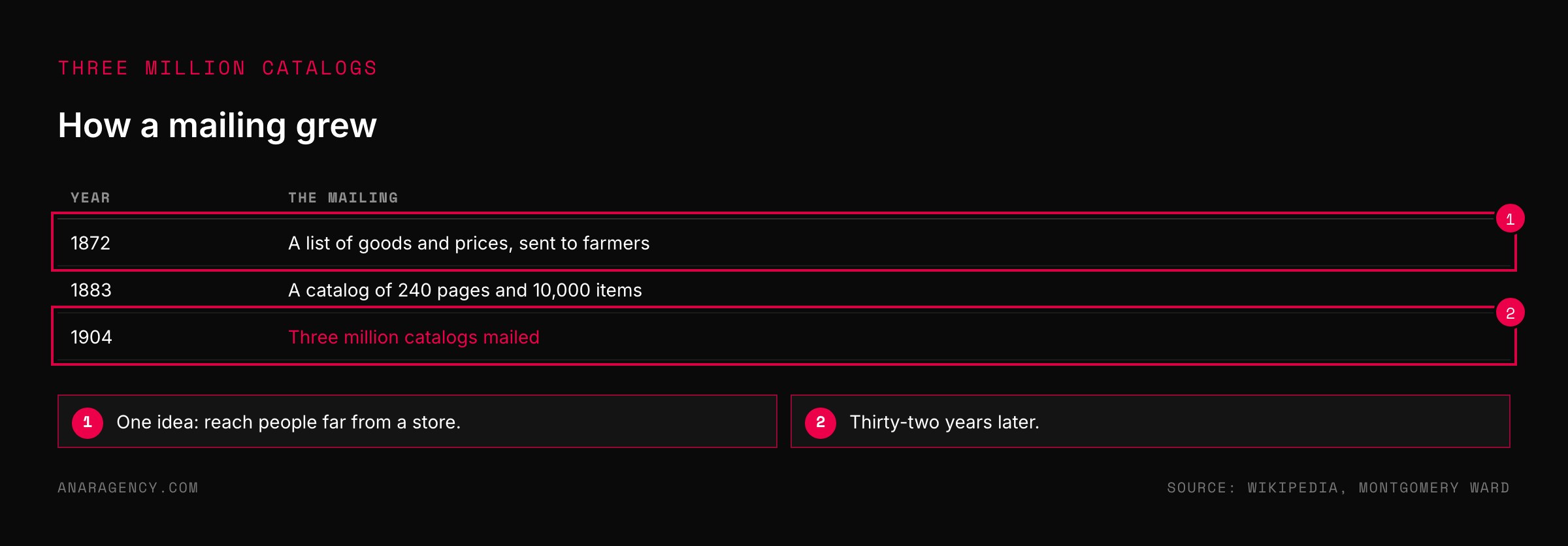
In 1872 a travelling salesman in Chicago named Aaron Montgomery Ward had an idea about farmers.
They lived far from any city and paid high prices at the local general store. If he mailed them a list of goods and prices, they could order by post and he could ship by rail.
By 1883 his catalog had grown to 240 pages and 10,000 items. By 1904 the company mailed three million catalogs.
It became one of the largest retailers in the country, and its catalog was copied by a rival named Sears.
The method has not changed in a century and a half. Choose who gets it. Put something in their hands.
Make an offer. Give them a way to answer.
Why mail still gets opened
A business owner today receives a great many emails and sees a great many ads. Their letterbox holds a handful of items.
That is the whole case for mail. It arrives in a place with little competition, it is physical, and someone has to pick it up to throw it away.
It also reaches people the internet cannot target well. An area. A street.
Every household within two miles of a shop.
Marketers class it as one form of direct marketing: a message sent straight to chosen people, with a response that can be counted.
That last part is what separates it from a billboard. A mailing has a known cost, a known number sent, and a count of replies. The sum can be done exactly.
It is not for everything. A cheap impulse product cannot carry the cost of a stamp. A roof, a legal matter, or a clinic visit can.
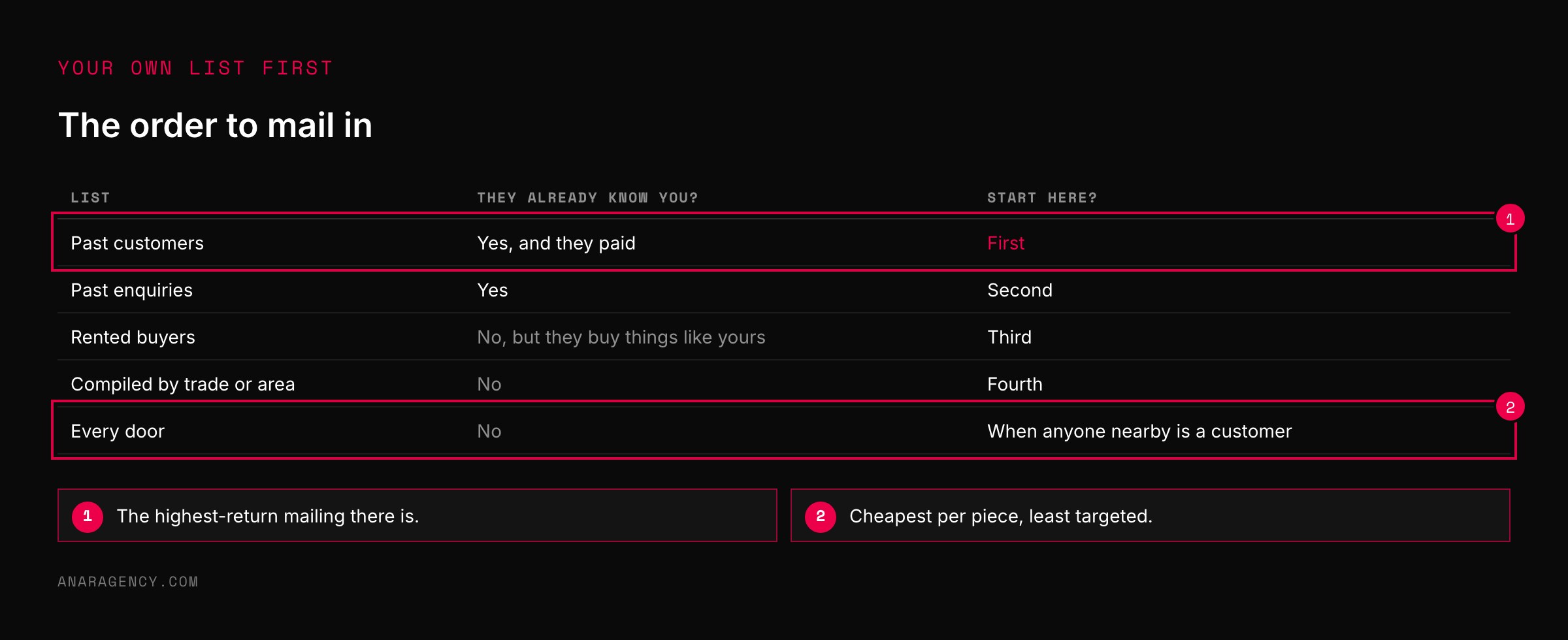
A mailing has four parts: who gets it, what they hold, what you offer, and how they answer. The list decides most of the result. In rising order of response: every door on a route, compiled lists, rented buyer lists, your own enquiries, your own customers.
Start with customers. Work out the break-even response rate from postage, printing, list cost, and profit per job before sending. Test a few hundred pieces, change one thing at a time, give one trackable way to reply, and count for a month.
What it costs
Start with the one price that is published. The US Postal Service runs a program for local businesses called Every Door Direct Mail.
You pick delivery routes on a map and the carrier puts your piece in every box on them. The retail postage is currently $0.26 a piece for flats. You need no mailing list and no special permit, and you can send 200 to 5,000 pieces a day per ZIP code.
Then add printing. That varies with size, paper, and quantity, so get three quotes. We will not give a figure, because it would be wrong by the time you read it.
If you want named recipients instead of every door, add the list and addressed postage, which costs more per piece.
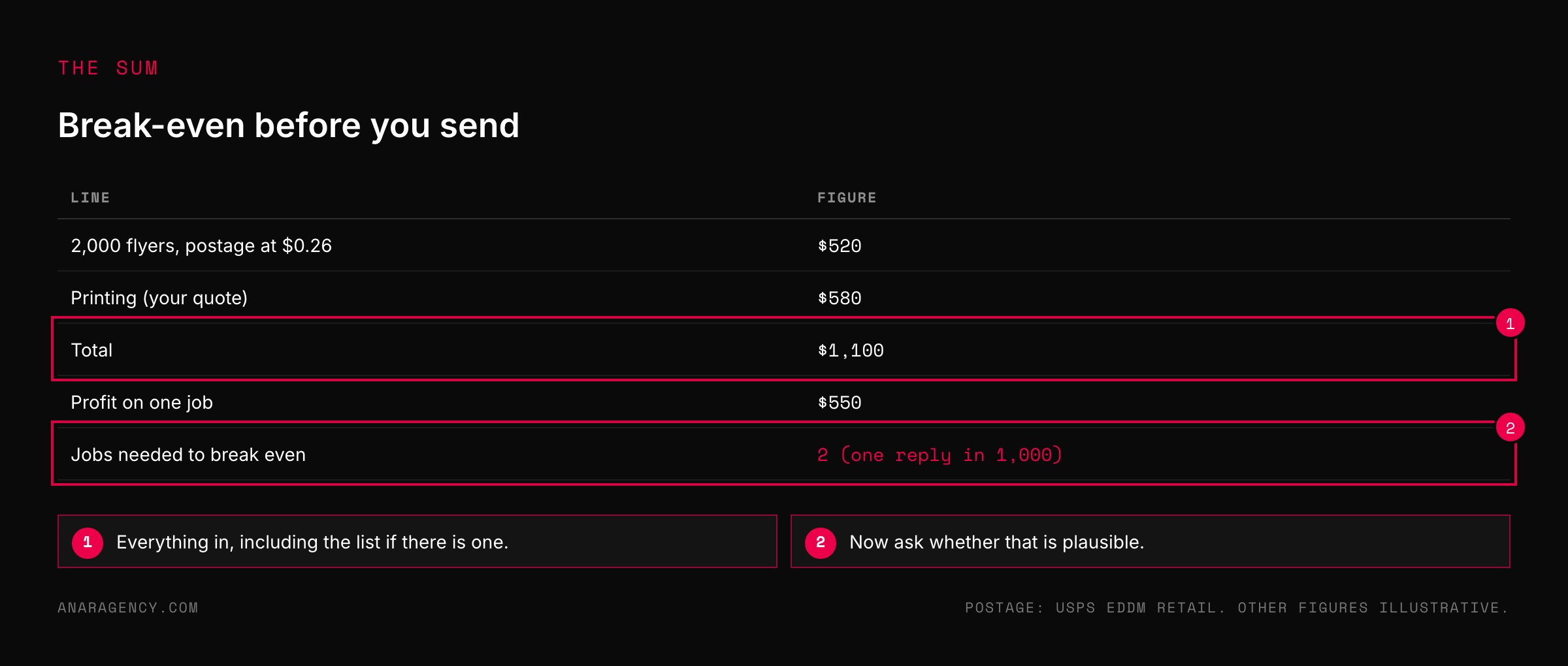
Now the sum that matters. Total cost, divided by the profit on one job, is the number of jobs you need to break even.
Divide that by the number of pieces and you have the response rate required. If 2,000 flyers cost $1,100 all in and a job is worth $550 in profit, you need two jobs. That is one in a thousand.
Whether that is plausible is a judgment you can now make with a real number. The method is in your maximum allowable cost.
List Pickers: where a list comes from
The mailers who make money spend most of their thought on who receives the piece. We call them List Pickers.
They start with their own customers. People who have already paid you respond better than any stranger. A postcard to past customers before the season is the highest-return mailing a local business can send.
Then their own enquiries. Everyone who asked for a quote and did not go ahead. Collect the postal address at the quote stage for this reason.
Then rented buyer lists. A broker will rent, for one use, the names of people who bought something related. Buyers of anything outperform people who merely fit a description.
Then compiled lists. Data vendors sell addresses selected by trade, company size, or household traits. "Every dental practice in three counties."
Last, every door. Saturating a route is the cheapest per piece and the least targeted. It suits a business whose customer is anyone nearby, as we discuss in local lead gen ads.
They test small. A few hundred pieces to one list before thousands to five. The same one-variable discipline as ad testing: change the list or the offer, never both.
"What response rate should I expect?"
Everyone asks, and industry averages are quoted everywhere. We do not repeat them, because they blend house lists with cold lists and catalogs with postcards.
The useful number is the one you worked out above: the rate you need. Then run a small test and see whether you get it.
Three things raise response more than design does. A better list. A clearer offer.
And one easy way to reply, with a code or a dedicated phone number so you can count.
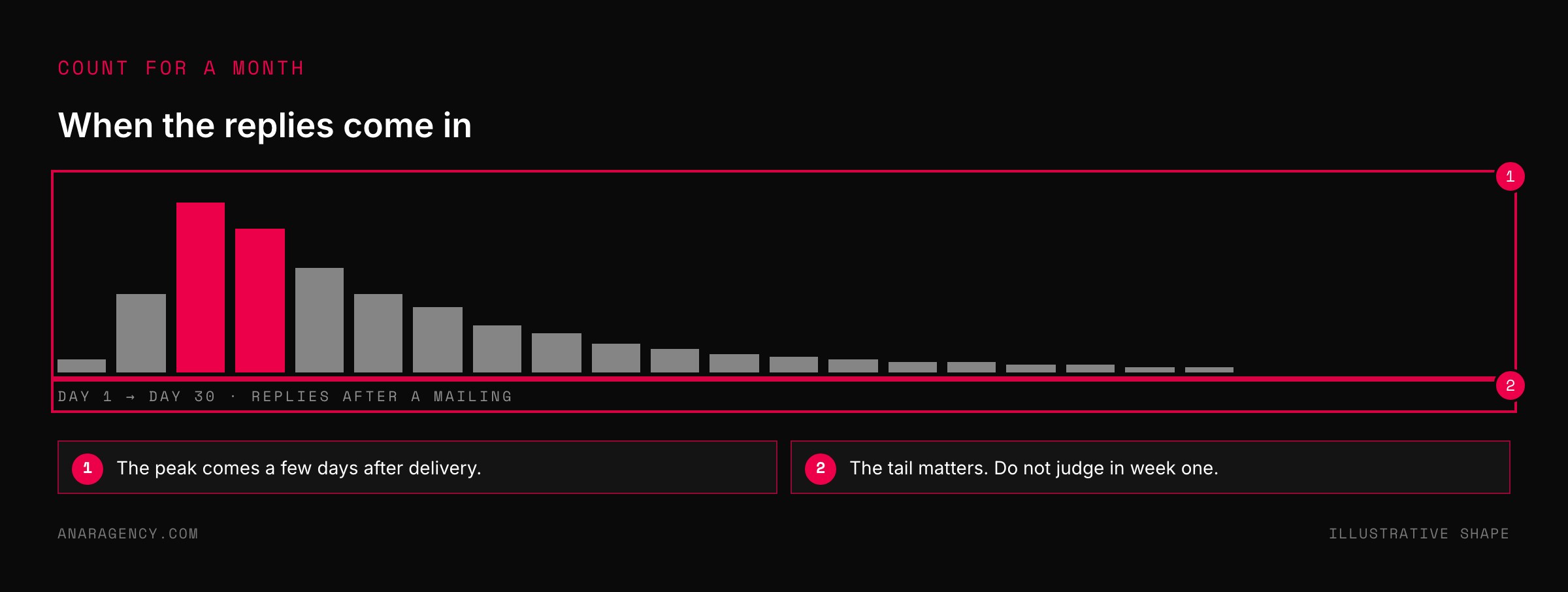
Count for at least a month. Mail is slow. Pieces sit on kitchen counters, and replies arrive for weeks.
The rules are light but real. Advertising mail is advertising, so claims have to be truthful and supported. Honor requests to be removed from your list.
And treat rented names as the contract says. A list rented for one use may be mailed once. People who respond become your own, which is how a house list gets built.
What to read next, and why
Montgomery Ward (encyclopedia entry): The first great mail-order business and how it grew.
Every Door Direct Mail (USPS): Current postage, size limits, and the route-mapping tool.
Direct marketing (encyclopedia entry): The wider practice and its history.
Advertising mail (encyclopedia entry): How mail advertising is classified and regulated.
So the simple takeaway is this: before anything else, send one postcard to every customer you served in the last two years. It is the cheapest test you can run of whether mail works for you.
Questions executives ask
How much does direct mail cost?
Postage through the USPS Every Door Direct Mail retail program is currently $0.26 a piece for flats, with no list or permit required. Printing is extra and varies with size and quantity. Addressed mail to a named list costs more per piece, plus the cost of the list.
Does direct mail still work for small businesses?
It can, particularly for local services and purchases valuable enough to cover the cost per piece. It reaches a place with little competing advertising, and its results can be counted exactly.
What is Every Door Direct Mail?
A US Postal Service program that delivers a mail piece to every address on the carrier routes you choose. No mailing list or special permit is needed for the retail version, and you can send 200 to 5,000 pieces a day per ZIP code.
Where do I get a mailing list?
Start with your own customers and past enquiries. Beyond those, a list broker can rent names of people who bought related products, and data vendors sell compiled lists selected by trade or household characteristics.
What is a good response rate for direct mail?
Published averages mix very different kinds of mailing and are of little use. Calculate the response rate you need to break even from your own costs and profit per job, then test a small mailing to see whether you reach it.

Filip Kovacevic is the founder of Anar Agency in Phoenix. He spent five years running SEO, Meta ads, email, and content for medical practices across the United States, and now does the same work for healthcare, home-service, legal, and professional-service businesses, alongside AI implementation. More from Filip →
Talk it through in 15 minutes
Bring one AI question from this article. We will tell you what we would do, whether or not you hire us.
Book a 15-Min Chat →