Find the One Element That Works and Amplify It

In most funnels one element outperforms everything around it: an add-on that sells better than the main offer, one email that gets replies, one ad that carries the account. That element shows what customers actually came for. Find it by comparing each part on the same measure.
Check that it holds over a second period and is not a fluke. Then amplify it: put it in the headline, build ads on it, open the email sequence with it, and consider making it the main product. Optimizing every part equally spreads effort across things that do not matter much.
An app called Burbn
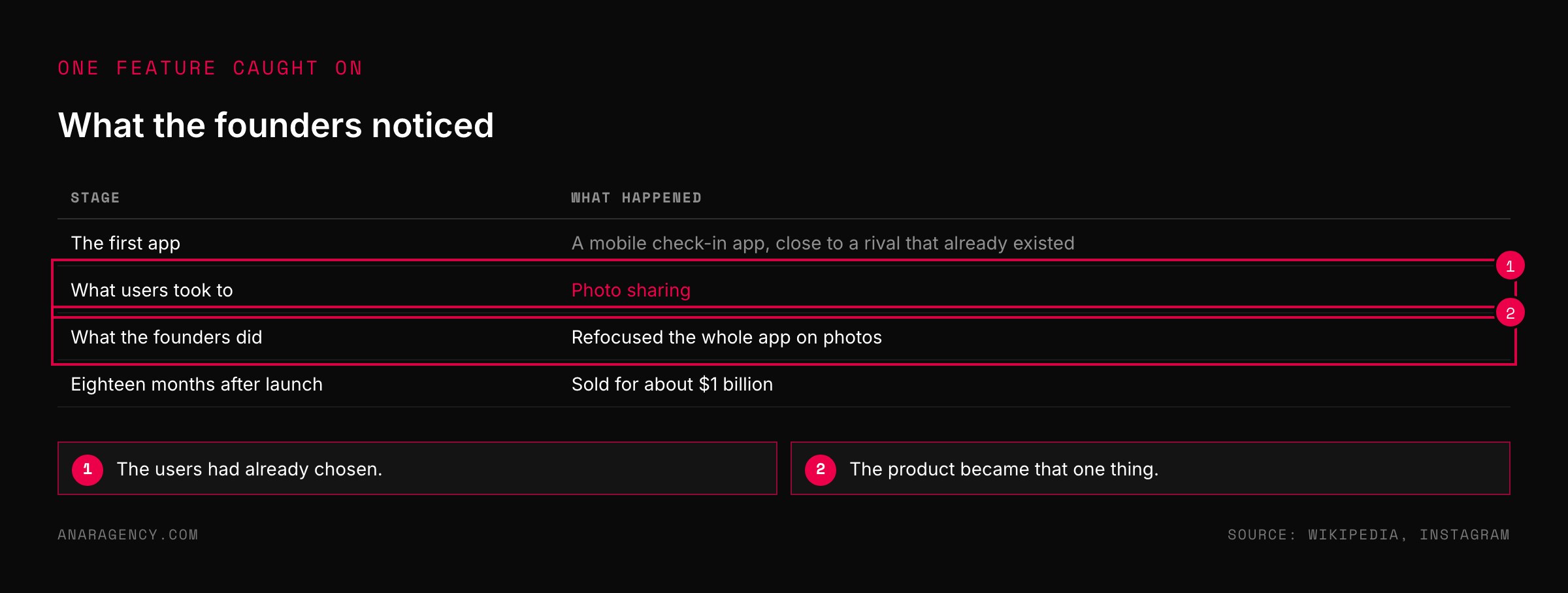
In 2010 two men in San Francisco were building a mobile app called Burbn.
It was a check-in app, a way to tell friends where you were. Among other things, it let you post pictures.
They looked at how people were using it. Photo sharing had become a popular feature among its users. The rest of the app was close to a rival product that already existed.
So they refocused the whole thing on photos. They renamed it Instagram and launched in October 2010.
Eighteen months later Facebook bought the company for about one billion dollars. They had not invented anything new. They had noticed which of their own features people wanted, and thrown the rest away.
The uneven shape of results
That story is a dramatic version of something true of nearly every business. Results are not spread evenly.
In the 1890s the Italian economist Vilfredo Pareto observed that about 80 percent of the land in Italy was owned by 20 percent of the people.
A quality engineer named Joseph Juran later found the same lopsided shape in factory defects. A few causes produced most of the problems. He called them the vital few, and the idea became known as the Pareto principle.
The exact split varies. The shape turns up everywhere. A few customers bring most of the revenue.
A few pages bring most of the visits.
It turns up inside a funnel too. One ad out of twelve. One email out of eight.
One add-on out of three.
The usual way of improving a funnel ignores this. It tests the button color, then the form, then the footer, giving every part equal attention.
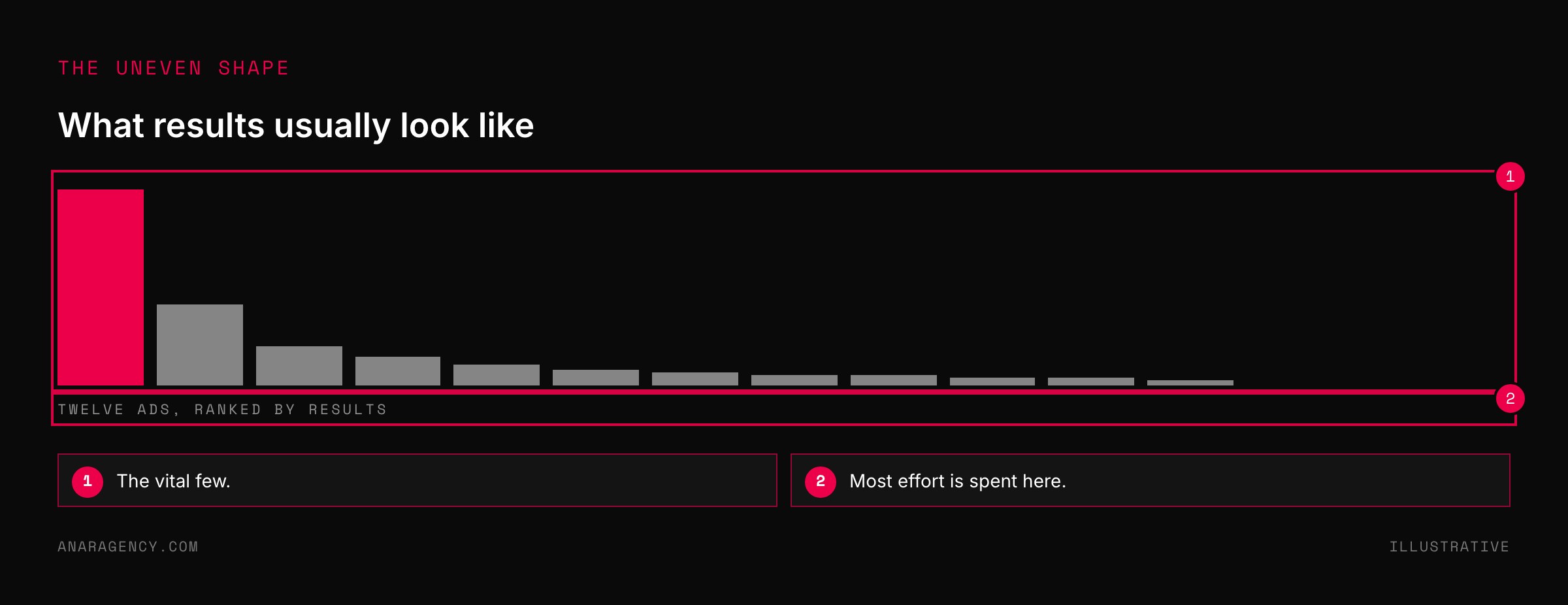
Results are uneven, and in most funnels one element clearly outperforms. Look for it in four places: an add-on that outsells expectations, an email that gets replies, an ad that carries the account, a question asked on every call. Compare elements on the same measure, confirm the lead over a second period, and work out why it wins.
Then move it to the headline, the ads, and the first email, and consider making it the main product. Stop polishing the rest, and keep testing an occasional new idea.
The One-Element Rule
We work to a simpler rule. Find the one element that is clearly outperforming, and carry it everywhere.
It hides in four common places.
An add-on that outsells expectations. You offered a small extra at checkout and half the buyers took it. That is not a nice bonus.
It may be what they wanted in the first place.
One email that gets replies. Seven emails get opened. One gets answered.
Whatever that email is about is what your readers care about.
One ad that carries the account. Read by ad, not in total, as we set out in read results, not leads.
One question on every call. If prospects keep asking about the same thing before anything else, they have told you your headline.
In each case the customer is voting. The element that wins is the truest statement you have of what they came for.
Amplifiers: what they do with a winner
Most businesses notice a winning element and leave it where it is. A few rebuild around it. We call them Amplifiers.
They compare like with like. Every ad on cost per result. Every email on replies.
Every add-on on the share of buyers who take it. A winner only shows up when the parts are measured the same way.
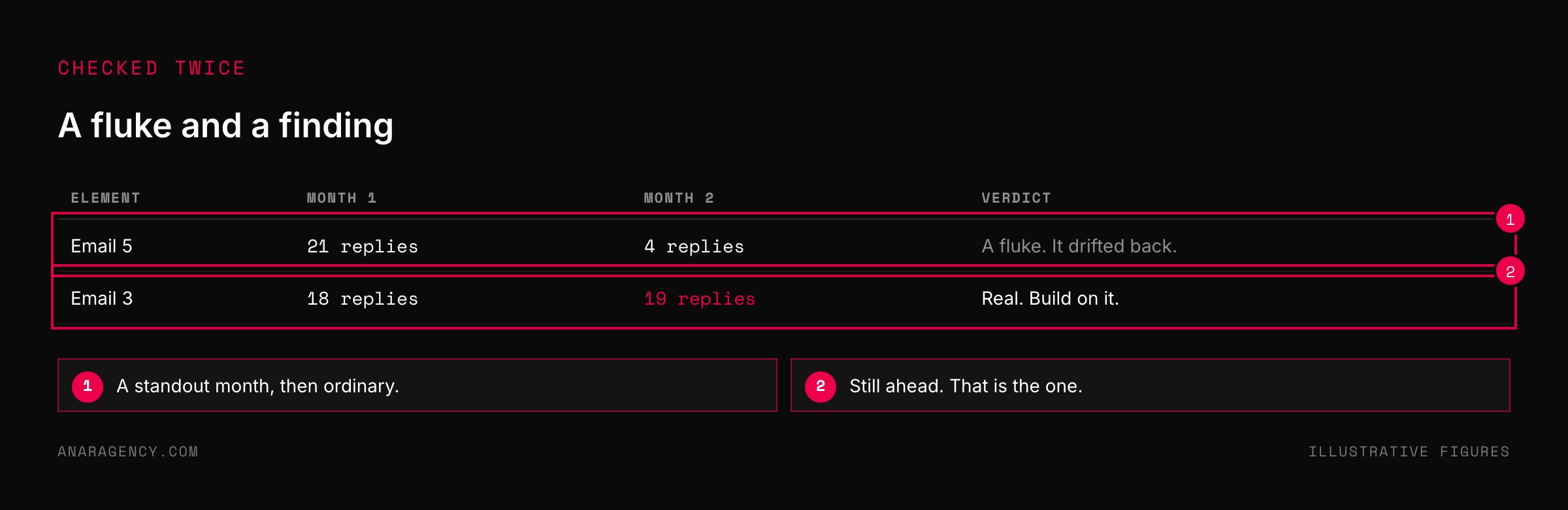
They check it twice. One good week is not a finding. Extreme results tend to drift back toward ordinary, which statisticians call regression toward the mean.
Does it still lead over a second month?
They ask why. What is it about this element? The topic, the promise, the price, the wording?
The reason is what can be reused, which is the argument of copy the rules, not the ad.
They move it to the front. If the add-on is what people want, say so in the headline. Build ads on it.
Open the email sequence with it.
They consider promoting it. Sometimes the add-on should be the product, and the old product becomes the add-on. That is what happened to Burbn.
They stop polishing the rest. Time spent improving the eighth email is time not spent on the one that works.
"What if nothing stands out?"
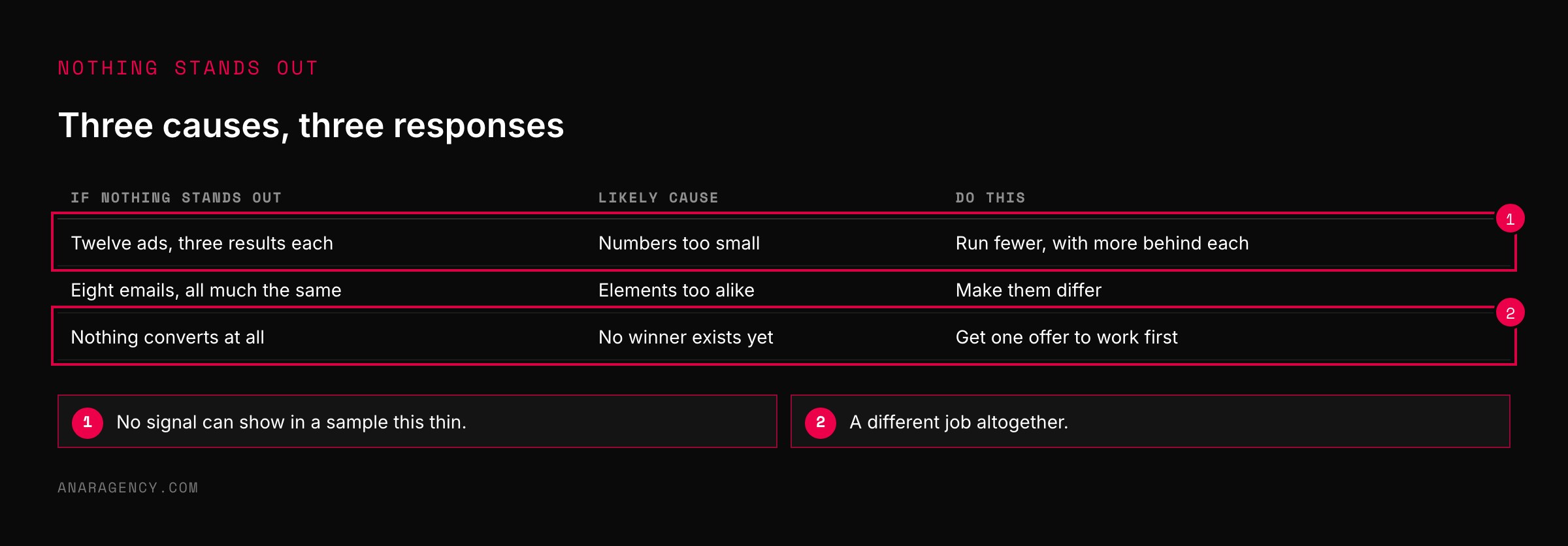
Sometimes you look and everything is about the same. That usually means one of three things.
The numbers are too small. Twelve ads with three results each cannot show you a winner. Run fewer things with more behind each, as in one variable at a time.
The elements are too alike. Eight emails making the same point in slightly different words will perform alike. Make them differ.
Or the funnel is not yet working, and there is no winner to find. Then the job is different: get one thing to work at all, which we cover in launching ads for a new offer.
A caution in the other direction. Do not go looking for a winner so hard that you invent one. If you slice results enough ways, something will always look best by chance.
And remember you only see what you tried. The best element in your funnel is the best of what you built, a point related to survivorship bias. Keep testing a new idea now and then, even while you amplify the one that works.
What to read next, and why
Instagram (encyclopedia entry): From a check-in app to a photo app to a billion-dollar sale.
Pareto principle (encyclopedia entry): The lopsided shape of results, from Italian land to factory defects.
Regression toward the mean (encyclopedia entry): Why a standout week needs a second look before you bet on it.
Survivorship bias (encyclopedia entry): The limits of judging only from what you happened to try.
So the simple takeaway is this: list every element in your funnel with one number beside each. If one of them is far ahead, stop improving the others and rebuild around that one.
Questions executives ask
What should I optimize first in a sales funnel?
Find the element that is already outperforming the others, such as one ad, one email, or one add-on, and build more of the funnel around it. That usually returns more than improving every part by a small amount.
What is the Pareto principle in marketing?
The observation that a small share of causes produces a large share of results. In marketing, a few ads, pages, or customers typically account for most of the outcome. The exact proportions vary, but the uneven shape is common.
How do I know if a winning ad or email is a fluke?
Check whether it still leads over a second period of similar length. Extreme results tend to move back toward average. If it holds, and you can explain why it works, it is worth building on.
What does it mean to amplify a winning element?
Carrying it through the rest of the funnel: leading the headline with it, building ads around it, opening the email sequence with it, and sometimes making it the main product instead of an extra.
What if no part of my funnel stands out?
The sample may be too small, the elements may be too similar to differ, or the funnel may not be working yet. Test fewer, more distinct things with more volume behind each, or return to getting a single offer to convert.

Filip Kovacevic is the founder of Anar Agency in Phoenix. He spent five years running SEO, Meta ads, email, and content for medical practices across the United States, and now does the same work for healthcare, home-service, legal, and professional-service businesses, alongside AI implementation. More from Filip →
Talk it through in 15 minutes
Bring one AI question from this article. We will tell you what we would do, whether or not you hire us.
Book a 15-Min Chat →