The Next Problem: How Every Solution Sets Up the Upsell
An upsell works when it solves a problem the first purchase created. Owning anything brings new needs: a website needs visitors, visitors need answering. Map that chain for your own product by asking, after each sale, what the customer now has to deal with.
Decide which of those next problems you will solve and which you will refer on. Design the full offer first, then divide it into a first purchase and additions. Present each addition as a small extension of the decision already made.
An upsell that answers a real next problem is service. One that does not is pressure.
The dressing gown
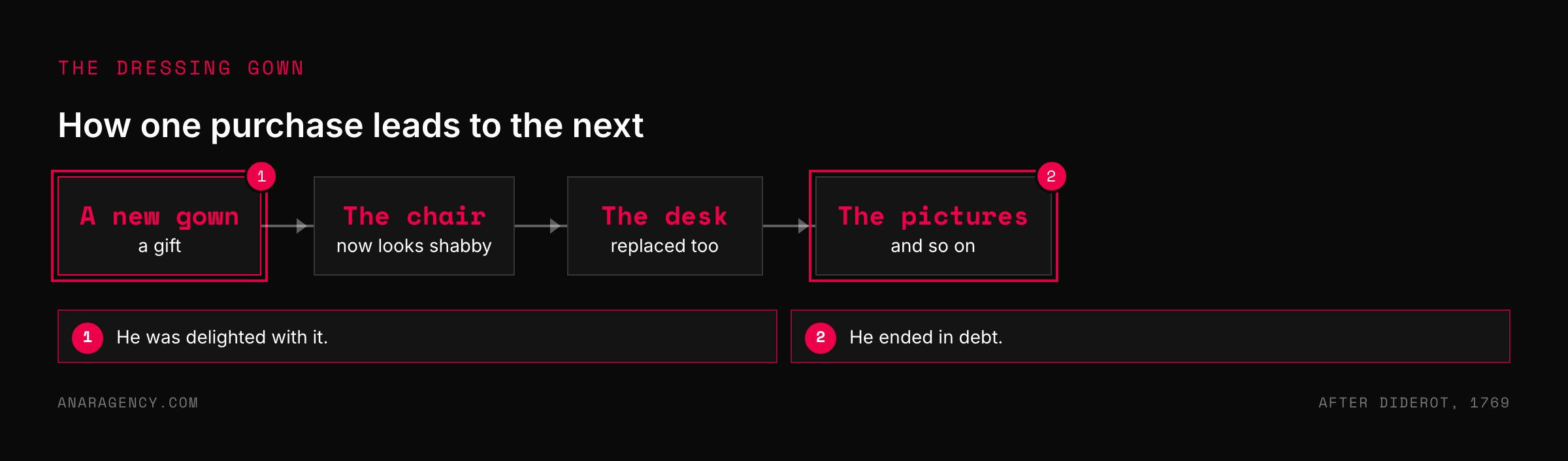
In 1769 the French philosopher Denis Diderot wrote an essay about a present.
He had been given a handsome new dressing gown. He was delighted with it, and then he looked around his study.
The gown made everything else look shabby. So he replaced the old straw chair with a leather one. Then the desk.
Then the prints on the wall.
He wrote that he had been master of his old gown and had become the slave of the new one.
Researchers who study consumption later named the pattern after him. One purchase sets off the need for others. Diderot treated it as a warning.
For anyone who sells, it is a description of how customers actually move.
A solution creates a problem
We usually think of selling as problem, then solution. The customer has a problem, you solve it, the story ends.
It does not end. Owning the solution brings a new set of needs.
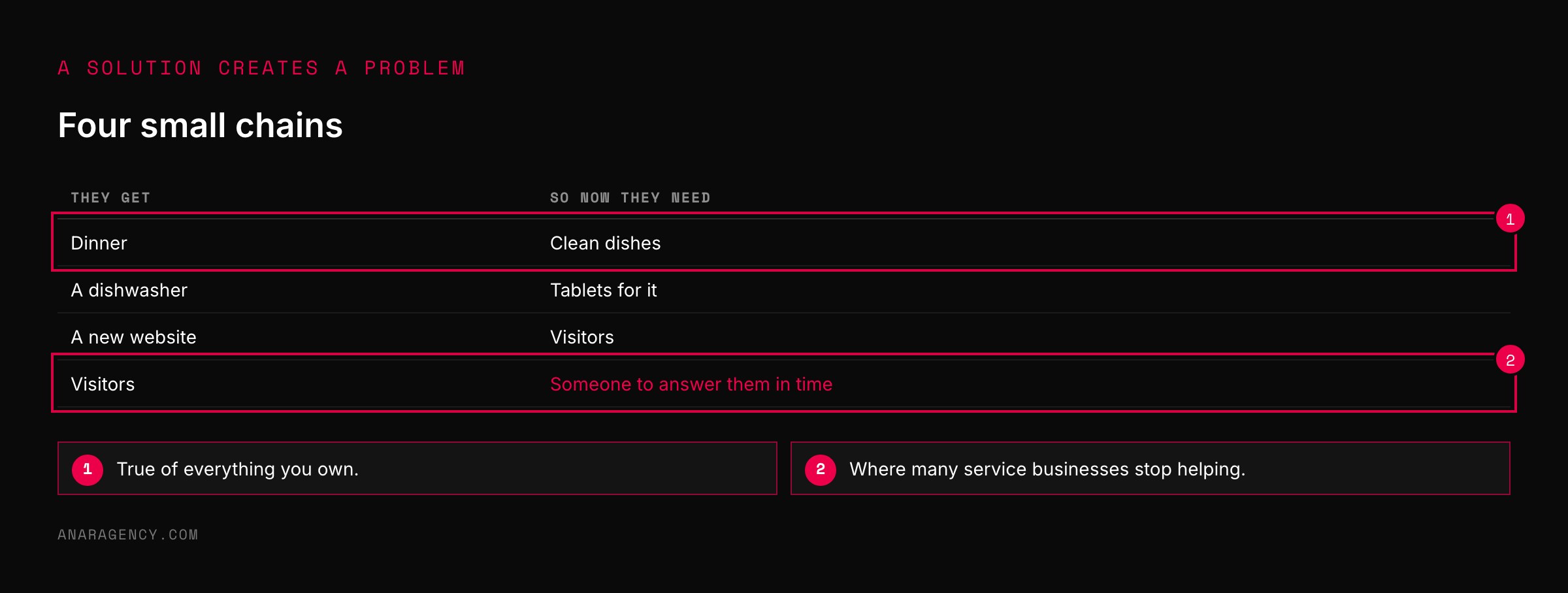
Cook dinner and you have dishes. Buy a dishwasher and you need tablets for it. Buy a car and you need fuel, insurance, and tyres.
Economists call products that are used together complementary goods. A printer and its ink. A phone and its case.
The same holds for services. A firm that gets a new website now has a site nobody visits. A firm that gets visitors now has enquiries nobody answers in time.
So every sale you make starts a chain. You can see where it leads before the customer can, because you have watched other customers walk it.
Every solution creates the next problem. Map the chain from your main product by asking what the customer now has to deal with, and what comes after that. Choose which links you will solve and which you will refer on.
Design the complete offer first, then divide it into a first purchase that works alone and additions. Present each addition as an extension of the decision already made, name the problem it solves, and time it to when the need appears. If it does not answer a real next problem, do not offer it.
The Next-Problem Chain
We call that sequence a Next-Problem Chain, and writing it down takes ten minutes.
Start from your main product. What does a customer have the day after they buy it?
Ask what they now have to deal with. Not what else you could sell them. What they will actually run into.
Ask it again. After that is solved, what comes next? A second useful question is "what is better than that?"
A client who has leads wants booked calls. One who has booked calls wants them to show up.
Decide which links are yours. You do not have to solve every next problem. Some you will build.
Some are better referred to a partner. The decision should be made on purpose.
Order them by time. Some needs arrive within minutes of buying. Others take six months.
Each belongs at a different point, which we cover in the funnel decision timeline.
What you have at the end is an offer plan that came from the customer's experience instead of from a list of things you would like to sell.
Whole-Offer Builders: design it complete, then divide it
Some businesses have add-ons that customers thank them for. They did not bolt those on later. They designed the whole thing first.
We call them Whole-Offer Builders.
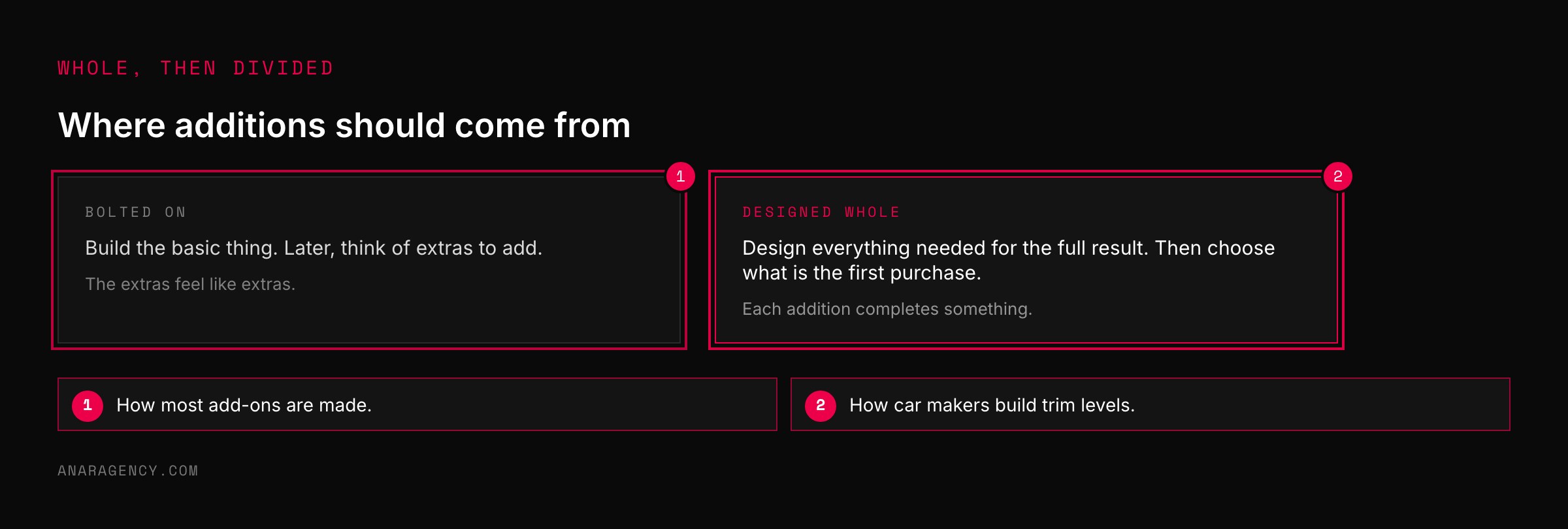
They build the complete version. Everything a customer would need to get the full result. Then they decide which part is the first purchase and which parts are additions.
Car makers work this way. The fully equipped model is designed first, and features are taken out to make the cheaper trims. Buyers assume it happened the other way round.
They make the first purchase whole. It has to deliver what it promised without the additions. An offer that only works once you buy the second thing is a trick.
They price additions as a wider yes. "With care and hosting included, it is $100 a month more" asks the buyer to extend a decision already made. "Would you also like a care plan for $1,200?" asks for a new one.
In sales, an offer of a larger version is called upselling.
They offer the first addition at once. The moment after someone commits is when they are most open to completing the job. Later additions follow the need.
They name the problem, not the product. "Most new sites get no visitors for months. Here is how we fix that."
That is help. "Add our SEO package" is a pitch.
"Is an upsell not just squeezing the customer?"
It often is, and you have been on the receiving end. Six screens of offers between you and your receipt.
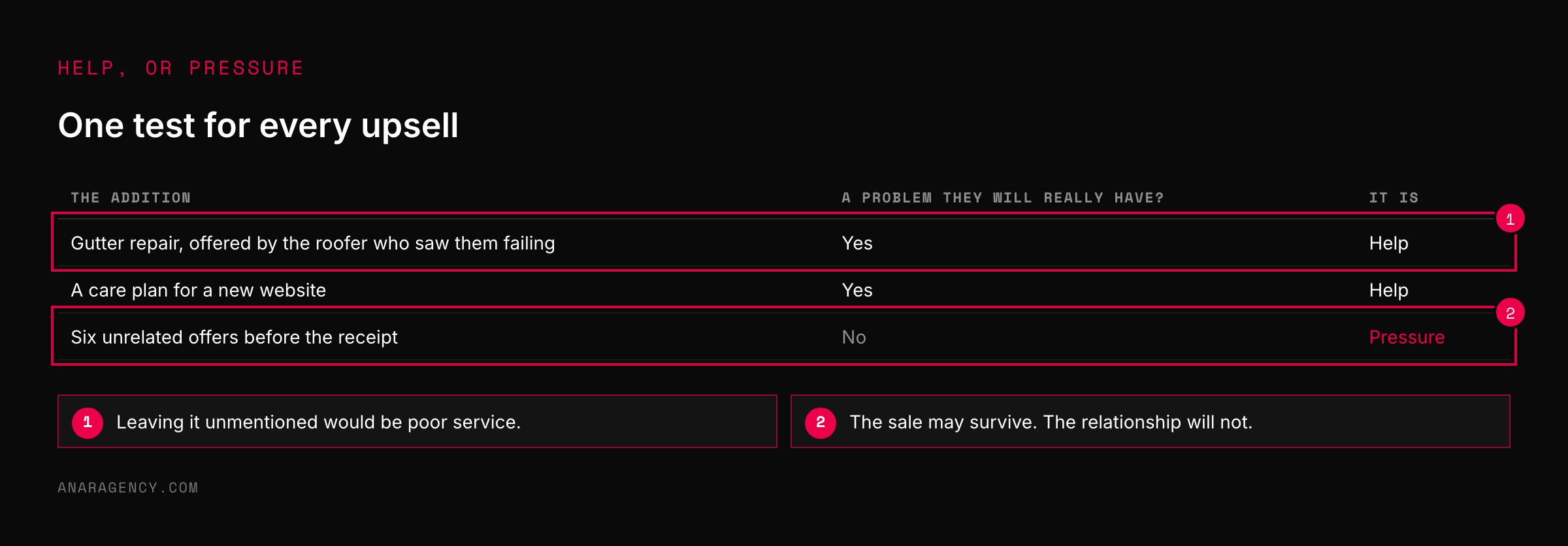
The test is simple. Does the addition solve a problem the customer will really have, because of what they just bought?
If yes, offering it is part of doing the job properly. A roofer who does not mention that the gutters are failing has not done you a favor.
If no, it is pressure, and customers feel it. The first sale may survive. The relationship will not.
Keep the terms clean. State the price and what is included plainly. No pre-ticked boxes.
No additions that renew without the buyer knowing.
And do not hold back the core. The first purchase must work alone. How to present the whole thing without overwhelming a buyer at the till is in checkout CRO, and how the value is framed is in sell outcomes, not deliverables.
What to read next, and why
Diderot effect (encyclopedia entry): The essay, the gown, and the research on how one purchase leads to another.
Complementary good (encyclopedia entry): The economics of things that are bought together.
Upselling (encyclopedia entry): The practice, its forms, and where it goes wrong.
Advertising FAQs: A Guide for Small Business (FTC guide): The rules on stating prices and terms clearly.
So the simple takeaway is this: write down what your customer has to deal with the week after they buy from you. If you do not offer help with it, someone else will.
Questions executives ask
What is an upsell?
An additional or larger offer made to a customer who is buying or has just bought. It works best when it solves a problem created by the first purchase, such as traffic for a new website or upkeep for new equipment.
How do I find upsell ideas for my business?
Ask what your customer has to deal with after buying your main product, and then what comes after that. Each answer is a possible offer. Choose the ones you can deliver well and refer the rest to partners.
When is the best time to offer an upsell?
The first addition is usually best offered right after the customer commits, when they are most willing to complete the job. Others should be offered when the need appears, which may be weeks or months later.
How should an upsell be priced?
Present it as a small extension of the decision already made, such as a monthly difference, instead of a separate purchase with its own full price. State clearly what is included and what it costs.
Are upsells unethical?
Not when they address a real need the customer will have because of what they bought. They become a problem when they are irrelevant, when the first purchase does not work without them, or when terms such as renewals are not clear.

Filip Kovacevic is the founder of Anar Agency in Phoenix. He spent five years running SEO, Meta ads, email, and content for medical practices across the United States, and now does the same work for healthcare, home-service, legal, and professional-service businesses, alongside AI implementation. More from Filip →
Talk it through in 15 minutes
Bring one AI question from this article. We will tell you what we would do, whether or not you hire us.
Book a 15-Min Chat →