Risk-First Buyers: Closing Every Information Gap

Some buyers look at what could be gained first. Others look at what could go wrong first, and only weigh the upside once the risk is answered. Anyone can be either, depending on the purchase and who depends on the outcome.
For a risk-first buyer, every missing piece of information is filled in with the worst case. So close the gaps: who they will deal with, what happens step by step, the full cost, what happens if it goes wrong, and who else has done it. A page that answers those serves both kinds of buyer.
A sales tactic with a name
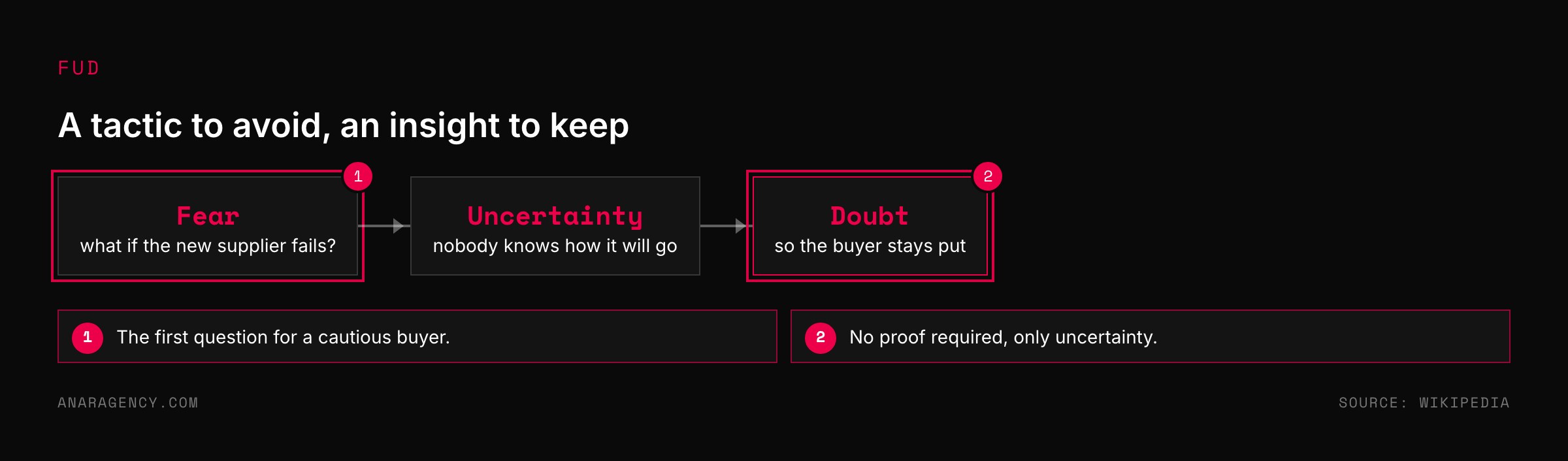
In the computer industry of the 1970s and 1980s, a sales tactic earned a three-letter name: FUD. Fear, uncertainty, and doubt.
The term described what one large company's salespeople were said to instill in customers considering a rival's machines. They did not have to prove the rival was worse. They only had to make switching feel uncertain.
It worked because of who was buying. Corporate buyers were responsible for systems the business depended on. If a new supplier failed, their job and their colleagues' work were at stake.
A buyer like that does not ask what they could gain. They ask what could go wrong, and for whom.
FUD is a tactic to avoid. The insight underneath it is worth keeping. For a large share of buyers, risk is the first question, not the second.
Risk first, or opportunity first
Look at the same offer through two pairs of eyes.
One buyer looks first at the upside. What could this do for me? They notice the result, the speed, the price.
Risk gets a glance afterward.
The other looks first at the downside. What happens if this goes wrong, and who else does it affect? Only when that is answered do they weigh the result.
Psychologists have described the two orientations. In regulatory focus theory one mode is about pursuing gains and the other about preventing losses, and a message tends to land better when it matches the mode.
Which mode a buyer is in depends less on who they are than on the situation. The more people depend on the decision, such as a family, staff, or patients, the more likely the risk question comes first.
Most sales pages are written by opportunity-first people, for opportunity-first readers. Half the audience is left with questions the page never answers.
Some buyers weigh risk before opportunity, especially when others depend on the decision, and they fill every missing fact with the worst case. Close five gaps on the page: who they will deal with, what happens step by step, the full cost including later charges, what happens if it goes wrong, and who else in their position has done it. Target situations, not stereotypes.
Never manufacture fear about competitors. Real information serves both risk-first and opportunity-first buyers.
Every gap is filled with the worst case
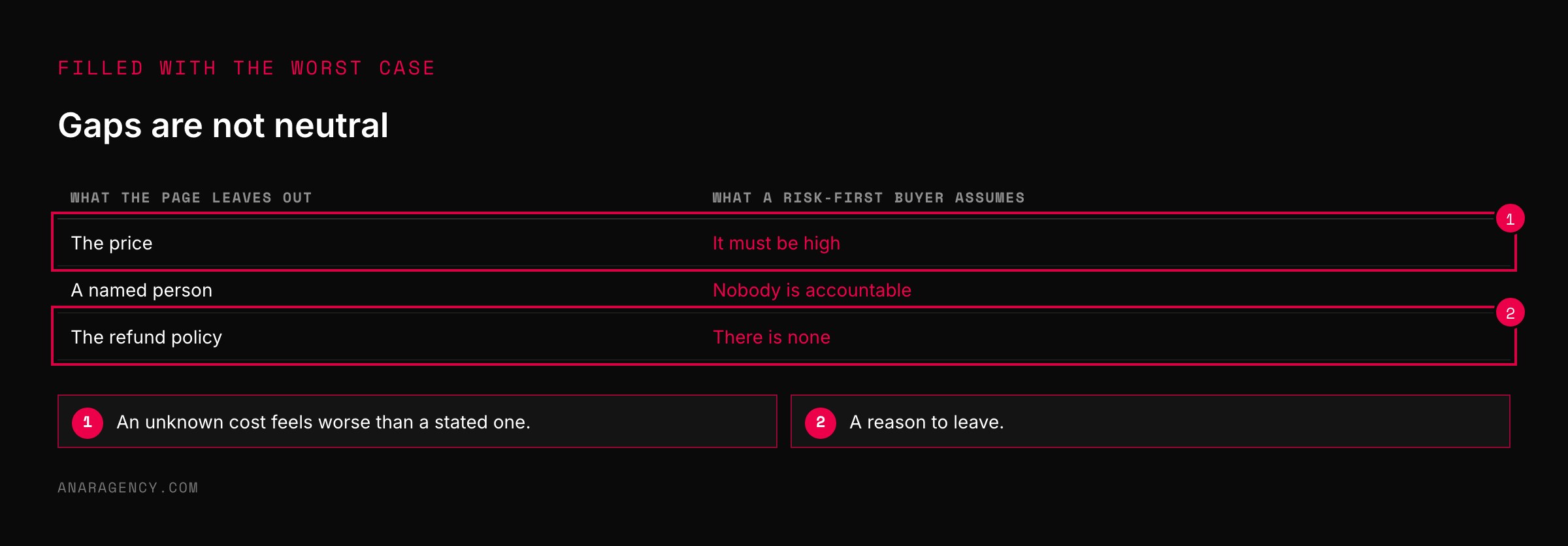
Here is what makes the risk-first buyer different to sell to. They do not skip what you leave out. They fill it in.
No price on the page? It must be high. No name on the about page?
Maybe nobody is accountable. No refund policy? There probably is none.
People are generally more uncomfortable with unknown risks than known ones, a pattern researchers call ambiguity aversion. An unknown cost feels worse than a stated high one.
For the opportunity-first buyer, a gap is a small irritation. For the risk-first buyer, a gap is a reason to leave.
That is why the same page can convert one visitor and lose the next. The page did not change. The buyer's first question did.
The Gap Close: five gaps to answer
Firms that sell well to cautious buyers do not use pressure or scare tactics. They leave nothing to the imagination. We call the method the Gap Close.
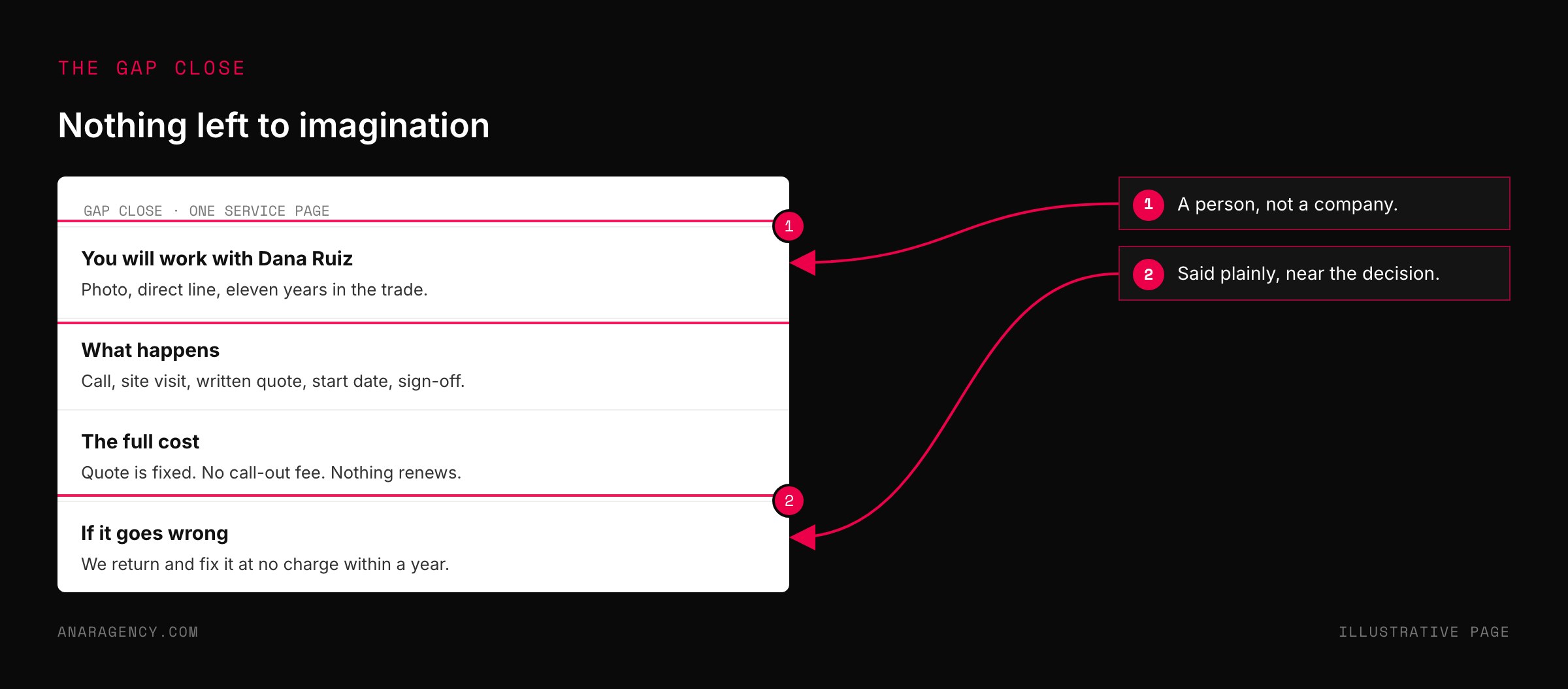
Who exactly will I deal with? A named person, a photograph, a direct phone number. An anonymous company is a risk.
A person is accountable.
What happens, step by step? From the first call to the finished job. A process that is visible is a process that can be judged safe.
What does it cost, all in? Every fee, including what renews or comes later. A total that appears late is the commonest reason buyers walk away, as in checkout CRO.
What if it goes wrong? The refund, the cancellation, the fix. Say it plainly, near the decision point.
Who else has done this? People in a similar position, named, with what happened. The most similar customer reassures more than the most impressive one.
None of these slows an opportunity-first buyer down if it is placed well. They skim past it. The cautious buyer stops and reads.
"Should I target risk-first buyers differently?"
You may be tempted to build separate ads for cautious buyers based on who you think they are. Be careful.
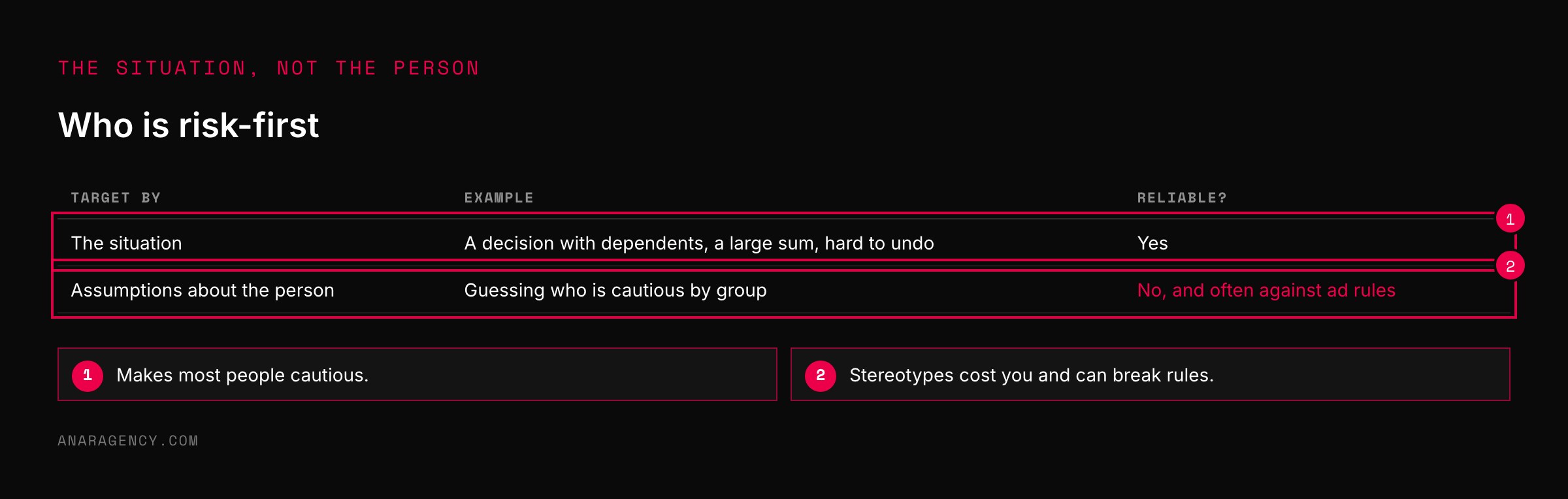
Assumptions about which kinds of people are cautious tend to be stereotypes, and they are wrong often enough to cost you. The same person can be cautious about a medical decision and impulsive about a gadget.
Target the situation, not the person. A purchase with dependents, large sums, or something hard to undo makes most people risk-first.
Ad platforms also restrict targeting and messaging around personal characteristics. Describing the buyer's situation is safer than asserting things about who they are.
And never manufacture fear to make your answer look better. Inventing doubts about competitors is the FUD tactic, and it erodes trust in the whole category, yours included.
Close real gaps with real information. The cautious buyer, once reassured, tends to be loyal, because switching is a risk too. For the wider idea of safety in buying, see the Safe Place Model.
What to read next, and why
Fear, uncertainty, and doubt (encyclopedia entry): The history of the tactic and why to avoid it.
Regulatory focus theory (encyclopedia entry): The research on gain-seeking and loss-preventing orientations.
Ambiguity aversion (encyclopedia entry): Why unknown risks feel worse than known ones.
Risk aversion (encyclopedia entry): The broader economics of preferring certainty.
So the simple takeaway is this: read your sales page as someone with a family depending on the decision. Write down every question it leaves open, and answer each one on the page.
Questions executives ask
How do you sell to risk-averse buyers?
Remove uncertainty. Name the person they will deal with, show the process step by step, state the full cost, explain what happens if something goes wrong, and show people in a similar position who have bought.
What is a risk-first buyer?
A buyer who considers what could go wrong, and for whom, before weighing the potential benefits. It is usually a response to the situation, such as dependents or a large irreversible decision, rather than a fixed personality trait.
Why do cautious buyers leave without asking questions?
Because they fill missing information with the worst case. An absent price reads as expensive and an absent refund policy reads as no refund, so they leave instead of asking.
What is FUD in sales?
Fear, uncertainty, and doubt: a tactic of making buyers uneasy about alternatives rather than proving your own merits. It is associated with computer industry sales in the 1970s and 1980s and is best avoided.
Should I create separate marketing for cautious customers?
Base it on the purchase situation rather than assumptions about types of people, which are often stereotypes. A single page that closes every information gap serves cautious and opportunity-focused buyers alike.

Filip Kovacevic is the founder of Anar Agency in Phoenix. He spent five years running SEO, Meta ads, email, and content for medical practices across the United States, and now does the same work for healthcare, home-service, legal, and professional-service businesses, alongside AI implementation. More from Filip →
Talk it through in 15 minutes
Bring one AI question from this article. We will tell you what we would do, whether or not you hire us.
Book a 15-Min Chat →