Before-Words and After-Words: Which Vocabulary Your Ad Should Use
Ad words come in two sets. Before-words such as why, when, still, and keeps point backward at a problem the reader already has. After-words such as how, what, and get point forward at a result.
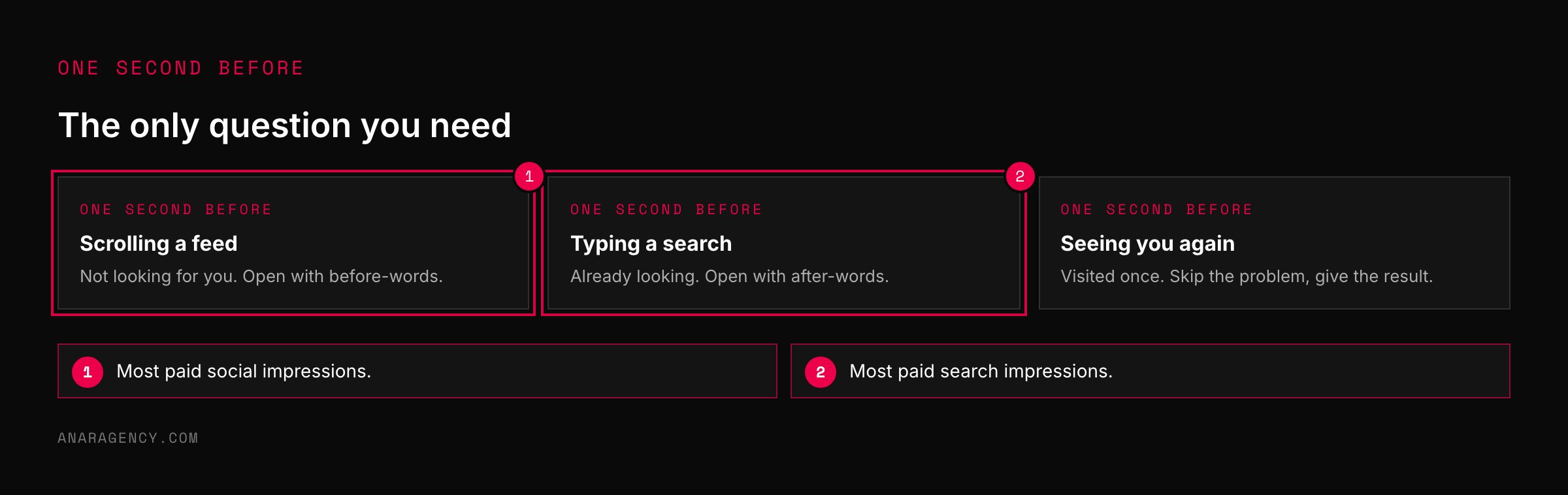
Open with before-words when the reader was not looking for you, which is nearly everyone in a social feed. Open with after-words when they were already looking, which is nearly everyone on a search page. Most ads fail because they speak after-words to people who have not yet noticed the problem.
Two ads for the same roofer
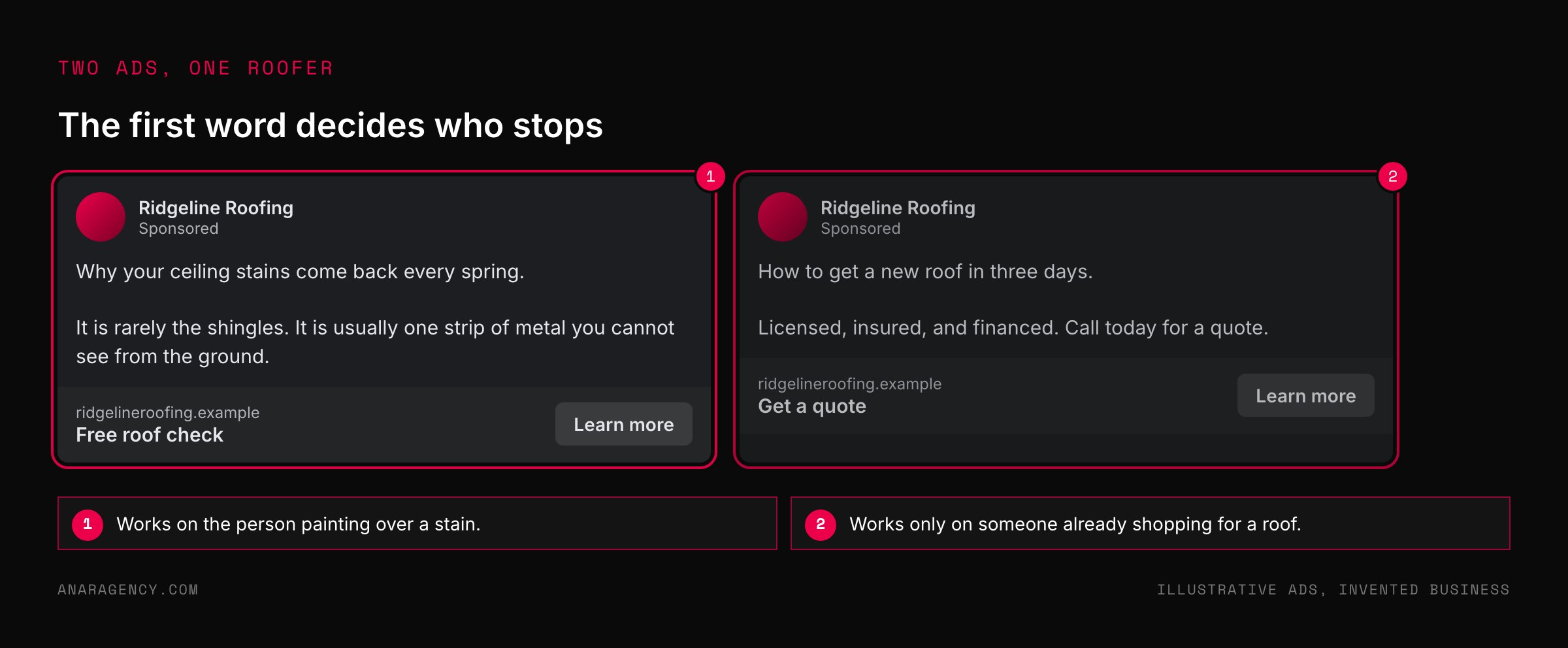
Here are two ads. Same roofer, same price, same town.
The first one opens: "Why your ceiling stains come back every spring." The second opens: "How to get a new roof in three days."
Ask which one is better and most people pick the second. It is clear. It promises something.
It sounds like an ad should sound.
It is also the wrong ad for almost everybody who will see it.
The second ad only works on a person who already knows they need a roof. The first works on the person with a brown ring on the bedroom ceiling who has been painting over it for three years. There are a lot more of the second kind of person.
Before-words and after-words
The difference between those two ads is one word, and it is the first one.
"Why" points backward. It assumes something is already happening and asks the reader to look at it. So do "when," "still," "keeps," and "again."
We call these before-words.
"How" points forward. It assumes the reader wants to go somewhere and offers the route. So do "what," "get," and any promise with a number of days in it.
We call these after-words.
This is not only a copywriter's hunch. Psychologists who study how people think about goals describe the same split. In construal level theory, thinking about why you do something is abstract and big-picture, and thinking about how is concrete and close.
A related body of work, regulatory focus theory, separates people who are trying to avoid a loss from people who are trying to reach a gain, and finds that a message lands better when its framing fits the state the person is in.
The practical version is simple. A person who has not noticed the problem cannot hear a solution. You have to say the before-words first.
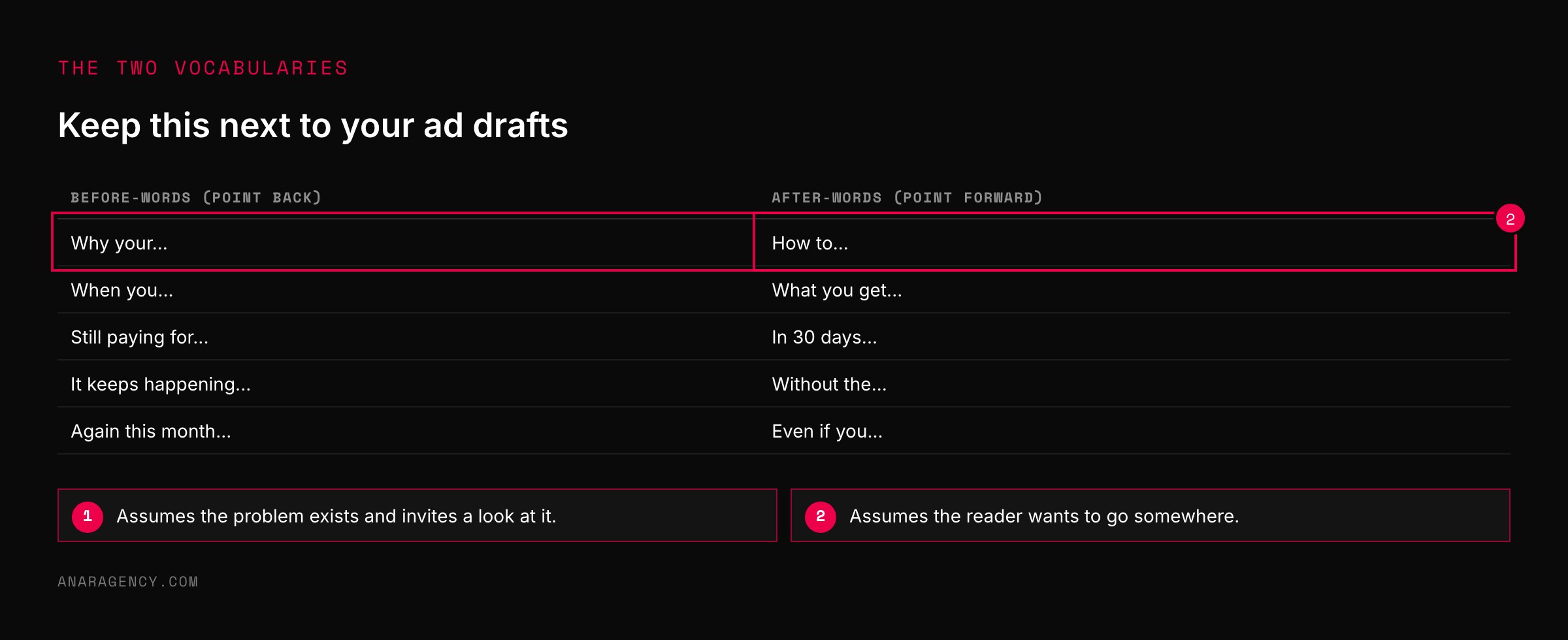
Before-words (why, when, still, keeps, again) point backward at a problem. After-words (how, what, get, a number of days, without) point forward at a result. If the reader was not looking for you, as in a social feed, open with before-words and name the situation, never the person.
If they were already looking, as on a search page or in retargeting, open with after-words. Then turn from the problem to the result to the next step.
The milk nobody was thinking about
The best-known before-word ad in American history is two words long.
In 1993 the California Milk Processor Board had a problem. Milk sales were sliding, and the research showed it was not because people doubted milk. Ninety percent already said it had calcium.
They knew it was good for them.
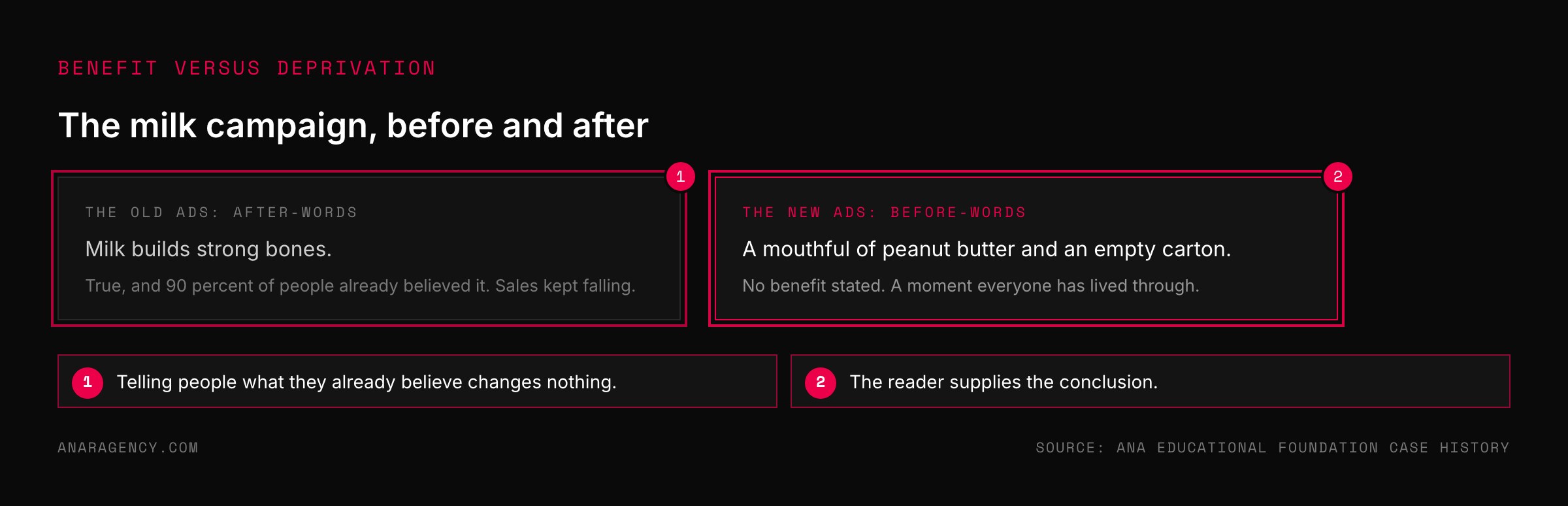
So years of after-word advertising, all about strong bones and healthy bodies, had been telling people something they already believed. It changed nothing.
The agency tried the opposite. They stopped selling the benefit and showed the problem: a mouth full of peanut butter, a plate of cookies, and an empty carton. They called it the deprivation strategy.
"Got Milk?" does not say what milk does for you. It points at a moment you have already lived through. Milk sales in California rose, and the line became one of the most recognized in the country.
Notice what it did not do. It did not explain or argue. It named the before, and people supplied the rest themselves.
Readers Who Were Not Looking: the rule for feeds and search
Here is how to decide which words go first. Ask one question: what was this person doing one second before they saw the ad?
In a feed, they were not looking. Nobody opens Instagram to fix their roof. Meta's own description of how its ad auction works is about showing ads to people likely to be interested, not people who asked.
So a feed ad has to create the recognition first. Lead with before-words.
On a search page, they were already looking. They typed the problem into a box. Telling them they have it wastes the most expensive second in advertising.
Lead with after-words: the result, the time, the proof.
In retargeting, they have heard it once. Someone who visited your page has already been through the before. Give them the after.
This is also why the same ad can win in one place and lose in another. We see owners copy their best Google headline into a Meta ad and wonder why it dies. It was written for someone who was already looking.
Once the reader is nodding, the ad turns. That turn, from the problem to the result to the next step, is the subject of our article on the three-layer ad.
"I do not want to run negative ads."
You may be thinking that leading with the problem means scaring people or making them feel bad. It does not, and there is a hard line you must not cross.
First, the tone. "Got Milk?" was funny. Naming a problem is not the same as rubbing it in.
The reader should feel recognized, not accused.
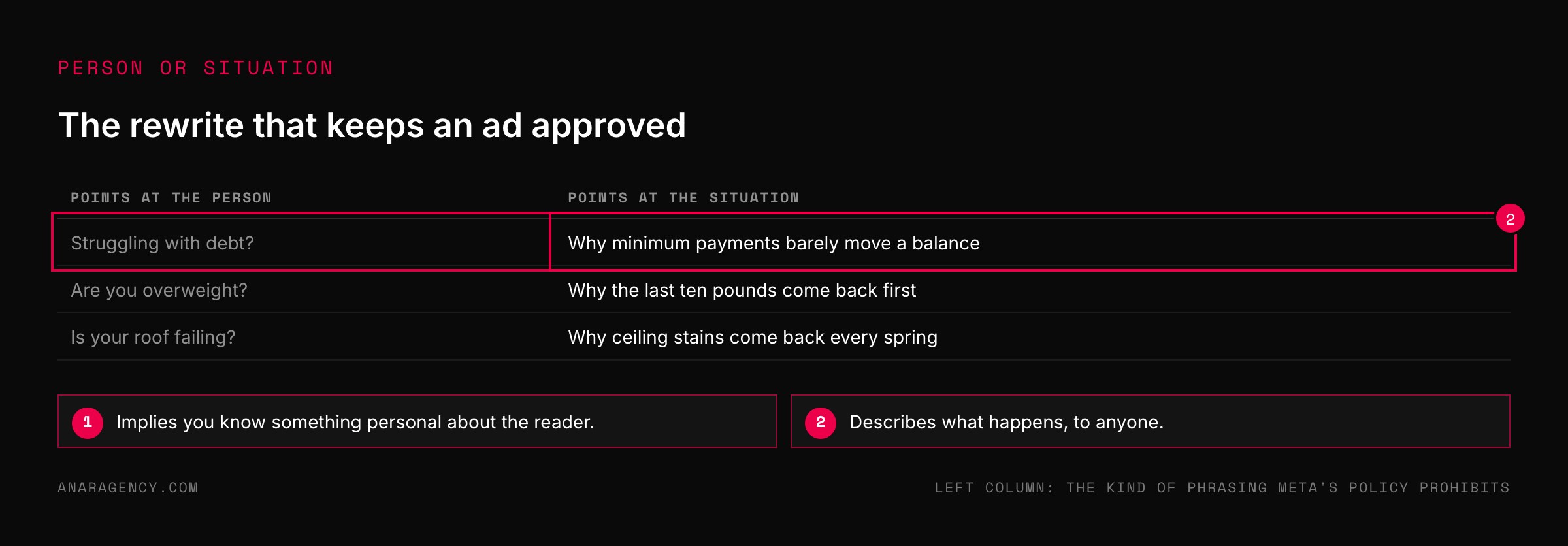
Second, the line. Meta's advertising policy does not allow ads that assert or imply personal attributes of the person reading. Its own examples of what is not allowed include "Do you have diabetes?" and "Are you bankrupt?"
That rule catches a lot of lazy before-word copy. "Struggling with debt?" points at the reader. "Why minimum payments barely move a balance" points at the situation.
The second is allowed, and it is also better writing.
So the test is simple. Describe the thing that happens, not the person it happens to. The ceiling stain, not the homeowner.
The empty carton, not the shopper.
What to read next, and why
The Got Milk case history (case study): The fullest account of how the campaign was planned. Read the part where the client realizes people already believed everything the old ads said.
Meta's Personal Attributes advertising policy (policy): Ten minutes that will save you a rejected ad. The examples are specific.
Construal level theory (encyclopedia entry): The research behind why and how. Dense, but the opening section is enough.
About ad auctions (Meta documentation): How Meta decides who sees what. Useful for understanding why nobody in a feed was looking for you.
So the simple takeaway is this: before you write an ad, ask what the reader was doing a second ago. If they were not looking, start with why. If they were, start with how.
Questions executives ask
What are before-words and after-words in ad copy?
Before-words such as why, when, still, and keeps point backward at a problem the reader already has. After-words such as how, what, and get point forward at a result. Which set opens the ad should depend on whether the reader was already looking for a solution.
Should a Facebook ad start with the problem or the solution?
For cold audiences in a feed, start with the problem, because the reader was not looking for you and has to recognize their own situation first. For retargeting audiences who have already visited your page, start with the solution.
Why does my Google ad copy not work on Meta?
Search copy is written for people who typed the problem and already know they have it, so it leads with the result. People in a social feed were not looking, so the same result-first headline reaches readers who have not yet noticed the problem.
Can I say "Are you struggling with" in a Meta ad?
Be careful. Meta's policy prohibits ads that assert or imply personal attributes of the viewer, and its examples of violations include "Do you have diabetes?" and "Are you bankrupt?" Describe the situation instead of the person: what happens, not who it happens to.
What was the strategy behind the Got Milk campaign?
It was called the deprivation strategy. Research in 1993 showed people already believed milk was healthy, so the campaign stopped selling benefits and showed the moment of running out of milk with food that needs it.

Filip Kovacevic is the founder of Anar Agency in Phoenix. He spent five years running SEO, Meta ads, email, and content for medical practices across the United States, and now does the same work for healthcare, home-service, legal, and professional-service businesses, alongside AI implementation. More from Filip →
Talk it through in 15 minutes
Bring one AI question from this article. We will tell you what we would do, whether or not you hire us.
Book a 15-Min Chat →