Bootstrapped SEO for a Productized Service

A productized service with little money should do two things in search. First, only write for searches it can win. Look at the first page of results for a term.
If every result is a very strong site, skip it. If sites near your own size rank, or a giant ranks with a thin page, go. Second, earn links instead of buying them, by turning dull public data into something useful that others will cite.
Before either, do the arithmetic: searches, times the share you might win, times your conversion rate, times your price.
Public records, made usable
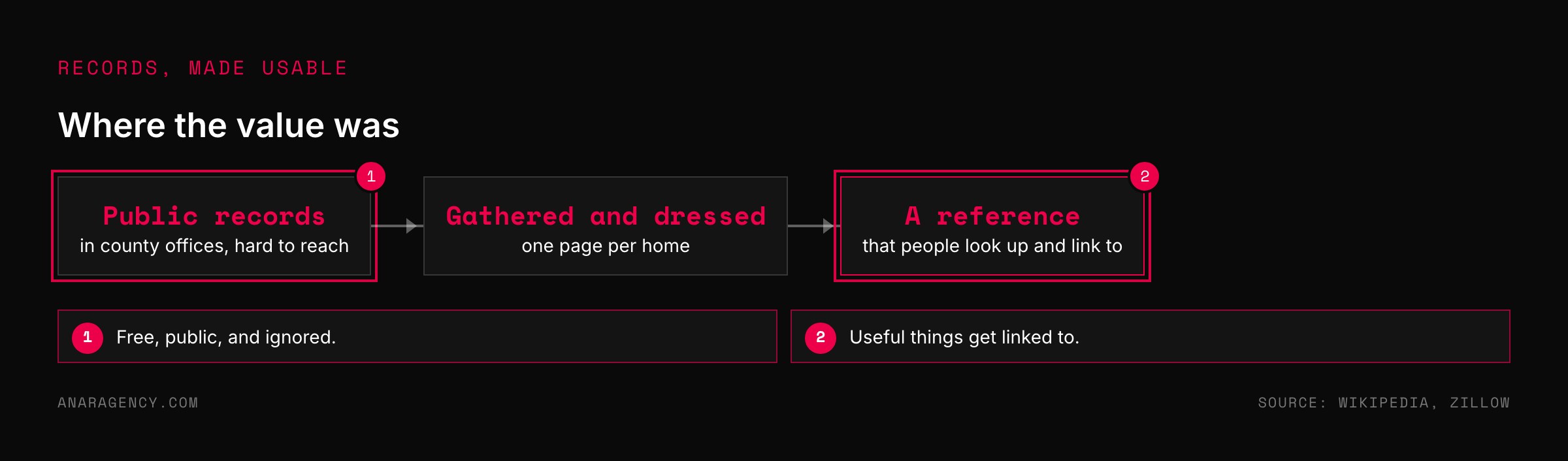
In 2006 a new property website opened to the public. It did something that estate agents had always kept to themselves.
It showed an estimated value for individual homes. The estimate was built from public records, including sales of comparable houses nearby.
None of the underlying information was secret. Sale prices and tax records sat in county offices across the country. Nobody had gathered them and made them easy to look at.
People used it to look up their own home and the ones around it, and it became a standard reference for what a house is worth.
A solo consultant will not build a national property site. The two ideas underneath it are available to a business of any size, and both are free.
The fight you cannot win
The usual way to start with search is to pick the term you most want and write an article about it.
Then nothing happens, for a year. The article is fine. The first page is occupied by sites that have been earning links for two decades.
Search engines weigh a page partly by what points to it, and a new site has almost nothing pointing to it.
Tool makers put numbers on this. Moz calls its score Domain Authority and Ahrefs calls its score Domain Rating. Both run from 0 to 100 and estimate the strength of a site's links.
Note what those pages say about themselves. They are the vendors' own metrics, built to compare sites. Google does not use them.
They are still useful as a rough ruler. If the weakest site on the first page scores 85 and you score 12, write about something else for now.
Before writing for a search term, look at the first page of results. Skip the term if every result is a very strong site. Go if sites near your size rank, or if a strong site ranks with a thin, off-topic page.
Run the arithmetic: searches, times a cautious share, times conversion rate, times price. Earn links by making dull public data or your own numbers useful, on reference pages with no pitch. Never buy links.
Expect six months to a year, and replace any page that brings nothing after a year.
The DA Gate
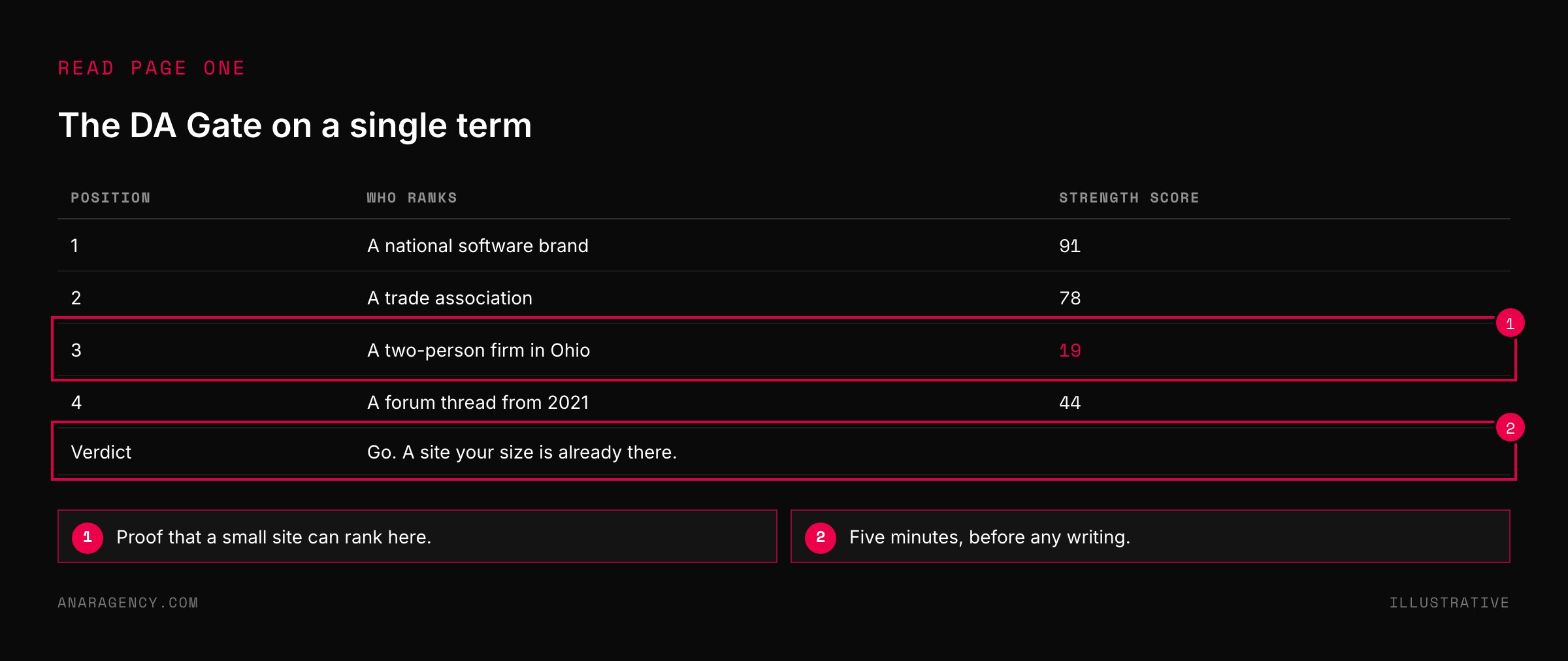
We call the check a DA Gate, and it takes five minutes per term.
Search the term. Look at the ten results, and look up the strength score of each site.
If every result is a giant, skip it. Come back in two years.
If sites near your size already rank, go. Forums, small firms, thin pages. They show the door is open.
If a giant ranks with a neglected page, go. A powerful site sometimes ranks with a short page that is off its main subject. A thorough page built for that exact question can beat it.
Do the arithmetic at the same time. Monthly searches, times a cautious share, times your conversion rate, times your price. A term you can win that is worth forty dollars a month is not a plan.
Winnable terms tend to be longer and more specific, which suits a productized service. "Bookkeeping for dental practices, fixed monthly fee" is a better target than "bookkeeping." How those pages fit together is in hub-and-spoke SEO.
Data Dressers: earning links without a budget
The second idea is how small sites get stronger. A few of them earn links from universities and newspapers without paying anyone. We call them Data Dressers.
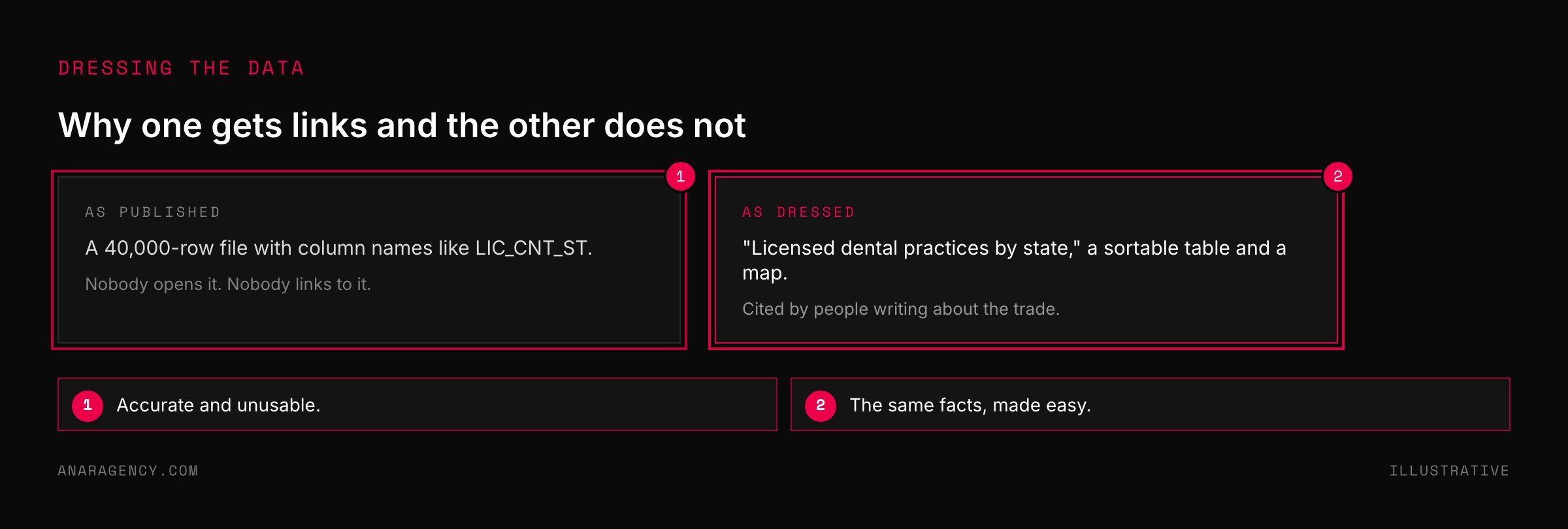
They find dull public data. Government sites publish enormous amounts of it. The US government's open data catalog alone lists hundreds of thousands of datasets, most in forms no ordinary person would open.
They make it presentable. A table people can sort. A map.
A calculator. One page per town or per trade. The work is in the dressing, not the data.
They pick data near their service. A bookkeeper for dentists might publish licensing counts and average practice size by state. It draws exactly the people the service is for.
They do not pitch on that page. It is a reference. People link to references, and they do not link to sales pages.
They publish their own numbers too. Counts from your own work that nobody else has. We explain why those get cited in what AI engines cite.
They keep it honest at scale. Hundreds of near-identical pages built from a spreadsheet can cross into spam. The guardrails are in programmatic SEO guardrails.
"Can I not just buy links?"
You will be offered links for sale within a week of launching a site. The offers are cheap, and they work against you.
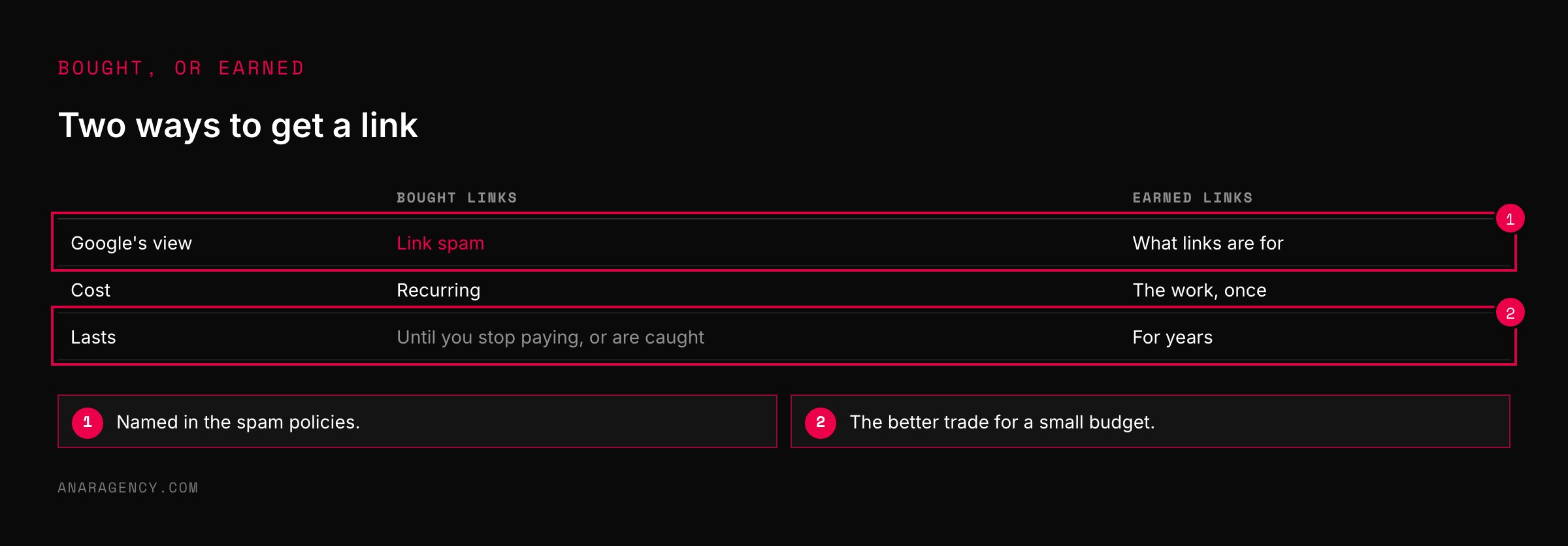
Google's spam policies name buying or selling links for ranking purposes as link spam. A site caught doing it can be demoted or removed from results.
It is also a poor trade for a bootstrapped business. Bought links have to keep being bought. A useful page earns links for years after the work is done.
Be realistic about time. A new site taking the honest route commonly waits six months to a year before search brings steady business. Plan for another source of customers meanwhile.
And set a rule for stopping. If a page has been live for a year, passed the gate, and brought nothing, the term was wrong. Write a different one.
The scores from the tools are a ruler, not a verdict. Small sites outrank large ones every day on specific questions, because the small site answered the question and the large one did not.
What to read next, and why
Zillow (encyclopedia entry): How a site built on public records became the reference for home values.
Domain Authority (Moz): What the score is, how it is calculated, and the maker's own statement of what it is not.
Data.gov (US government): The open data catalog. Browse by topic and look for something near your trade.
Spam policies for Google web search (Google): The rules on link schemes and scaled content, in the search engine's own words.
So the simple takeaway is this: before writing your next article, search the term and look at who is on page one. If none of them is anywhere near your size, pick a narrower question.
Questions executives ask
How do I choose keywords I can actually rank for?
Search the term and examine the first page. If the results are all very strong, established sites, choose a narrower term. If sites similar in size to yours appear, or a large site ranks with a thin page, the term is within reach.
What is Domain Authority, and does Google use it?
Domain Authority is a score from Moz, and Domain Rating is a similar score from Ahrefs. Both estimate the strength of a site's links on a scale of 0 to 100. They are third-party metrics for comparing sites.
Google does not use them in ranking.
How can a small business get backlinks without paying for them?
Publish something others want to cite: public data turned into a clear table, map, or calculator, or original numbers from your own work. Keep that page a reference with no sales pitch.
Is buying backlinks against Google's rules?
Yes. Google's spam policies list buying or selling links to manipulate rankings as link spam, and sites doing it can be demoted or removed from search results.
How long does SEO take for a new service business?
For a new site using legitimate methods, commonly six months to a year before search brings steady enquiries. Plan another source of customers in the meantime, and replace pages that bring nothing after a year.

Filip Kovacevic is the founder of Anar Agency in Phoenix. He spent five years running SEO, Meta ads, email, and content for medical practices across the United States, and now does the same work for healthcare, home-service, legal, and professional-service businesses, alongside AI implementation. More from Filip →
Talk it through in 15 minutes
Bring one AI question from this article. We will tell you what we would do, whether or not you hire us.
Book a 15-Min Chat →