Hub-and-Spoke SEO for Service Businesses: Why Your Blog Does Not Rank

A blog does not rank because Google reads a site as a map of links, and most business blogs have no map. Thirty good posts that do not link to each other look like thirty unrelated pages, each too thin to own its topic. Hub-and-spoke SEO fixes the structure, not the writing: one complete guide per service you sell, five to ten deeper spokes linked up to it and sideways to each other, and every one of them linking down to the page that books the call.
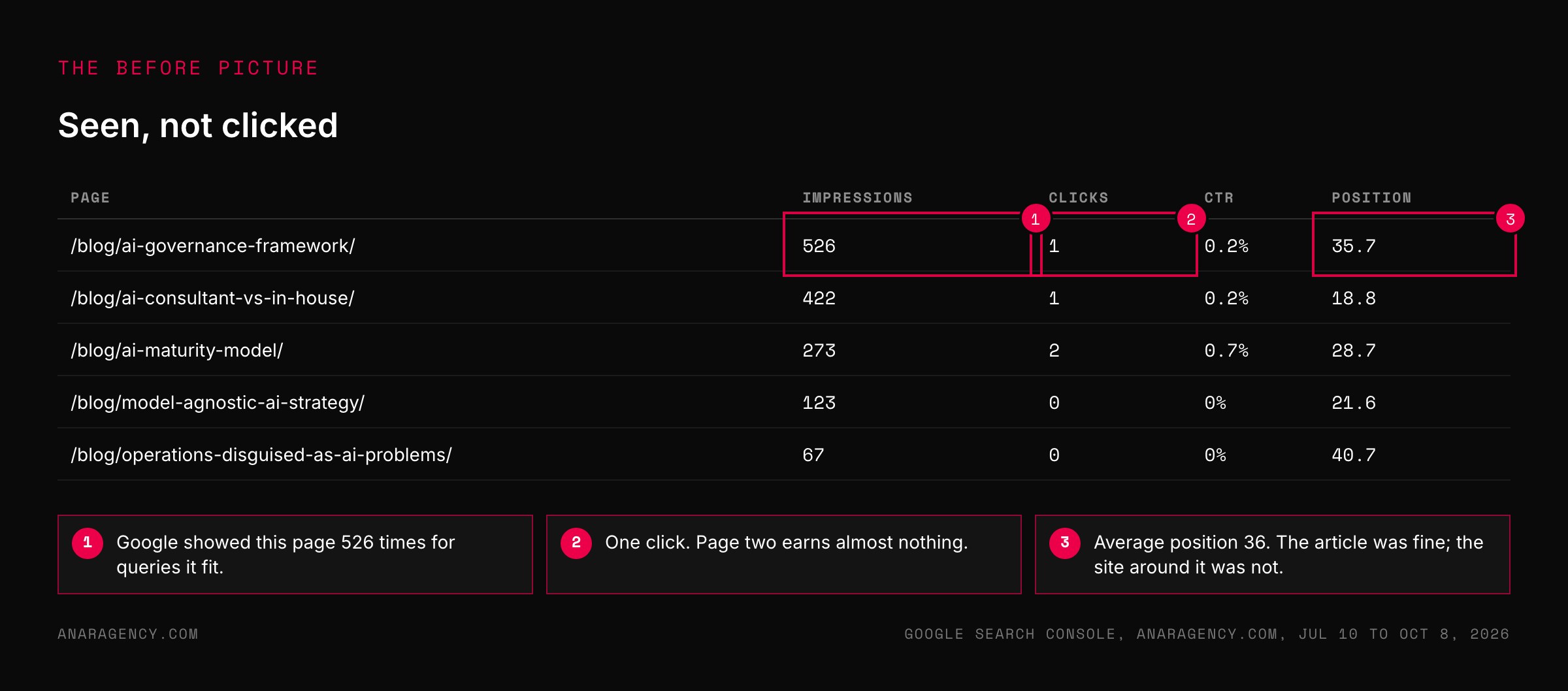
Our own blog sat at positions 19 to 36 with 1,221 impressions and four clicks until we rebuilt it this way.
Why a blog full of good articles can still earn nothing
In July we published eleven articles on AI implementation for business owners. They were long, specific, and cited real sources.
Ninety days later Google Search Console showed the best three had been seen 1,221 times in search results and clicked four times. Average position ran from 19 to 36, which is page two to page four. Page two earns almost nothing, and we had the numbers to prove it.
The articles were not the problem. The site around them was.
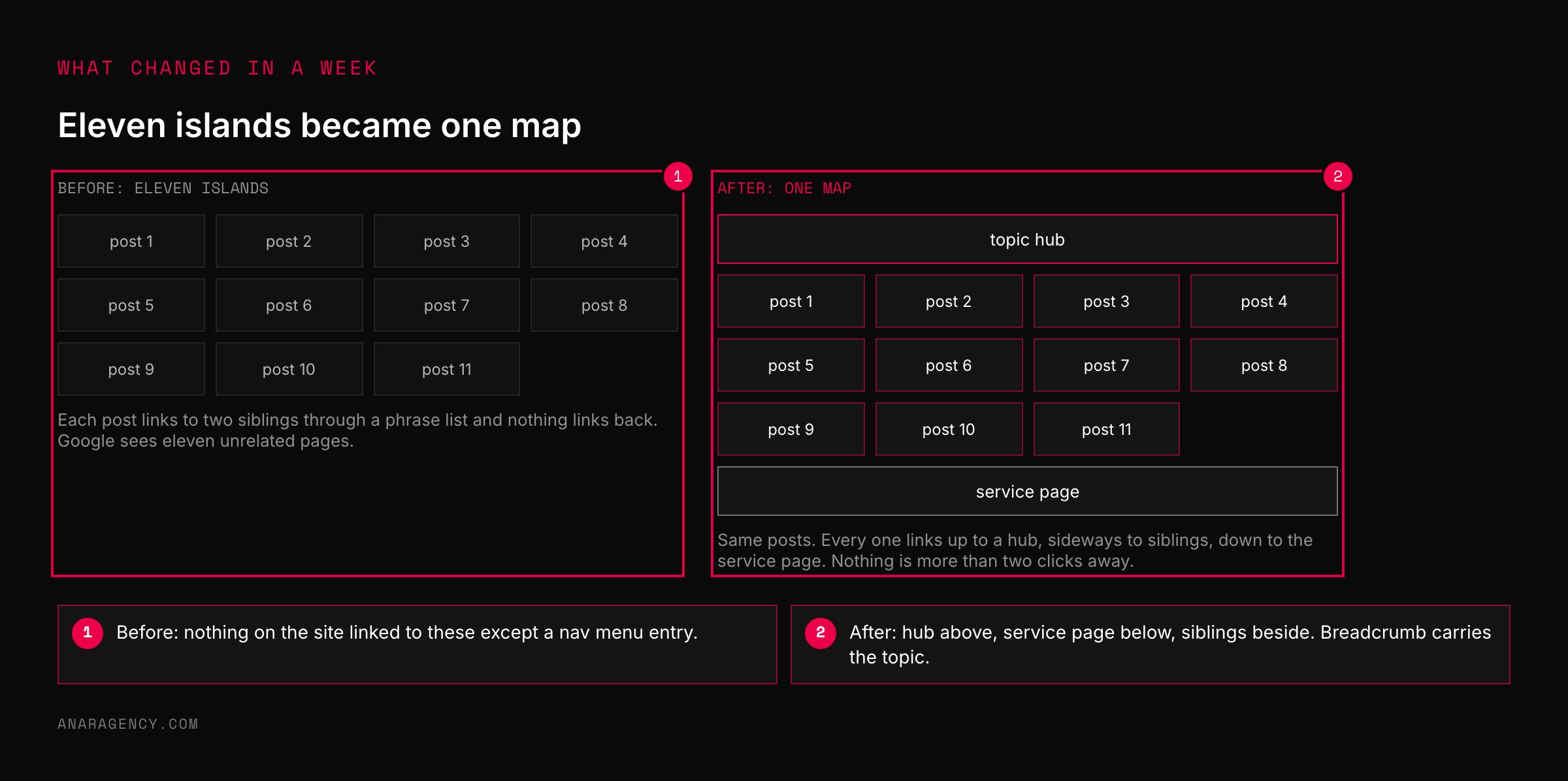
Each one linked to two or three siblings through a short phrase list and to one service page, and nothing on the rest of the site linked back to them except a nav menu entry. There was no hub page that said "this is what we know about AI implementation," no author page that said who wrote them, and no path from a service page down into the articles that supported it. Google saw eleven islands.
That is the normal state of a service-business blog. A post goes up when someone has time, it gets a share on LinkedIn, and it sits. Twelve months later there are forty posts, none of them linked, and the owner concludes that blogging does not work.
It works. Piles do not.
How Google reads a site: links are the map
Google's own description of how search works is blunt about the mechanism: its crawler discovers pages mainly by following links from pages it already knows. A page with no links pointing to it from your own site is hard to find and, once found, hard to place.
The guidance on crawlable links adds the second half: the words inside the link tell Google what the destination page is about.
That second half is what most blogs waste. A "read more" link says nothing. A link that reads "what a Google Ads click costs by industry" says exactly what the page is.
Google's SEO starter guide spends more words on links and site organization than on keywords, and recommends grouping related pages under a logical structure with descriptive anchor text, which is a one-sentence description of hub-and-spoke.
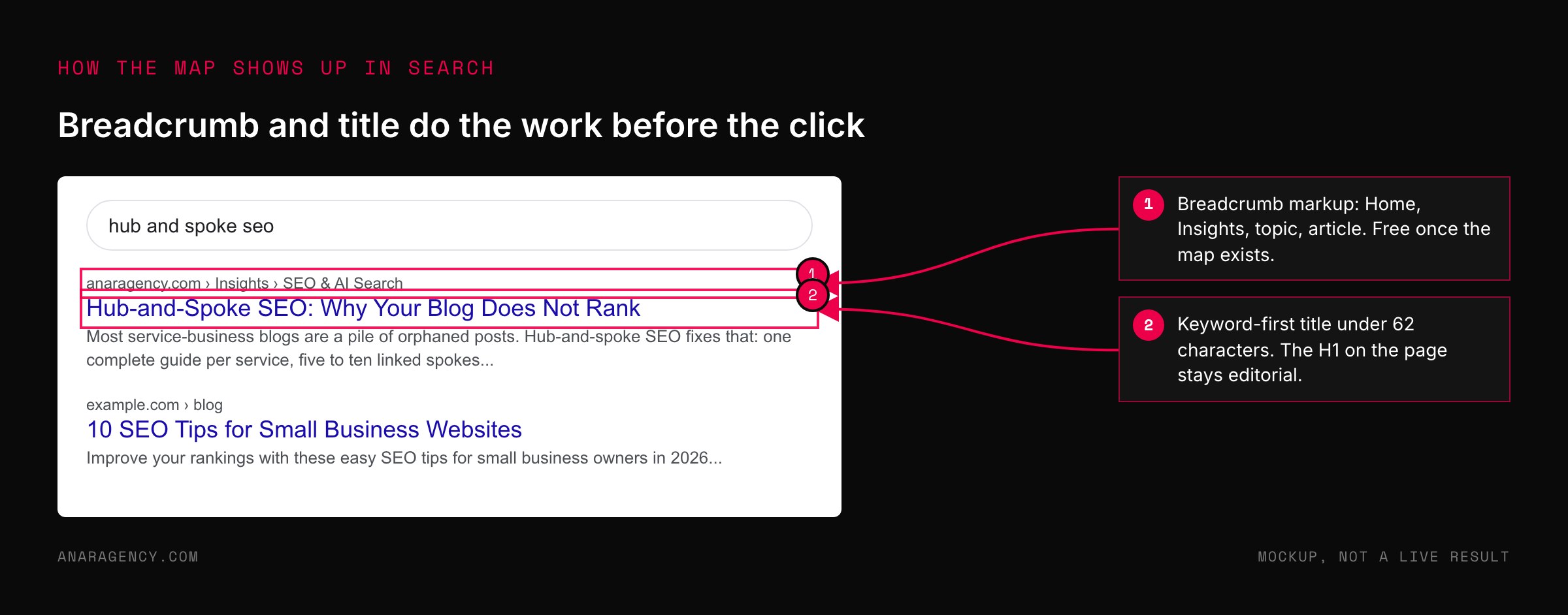
Structure also shows up in how Google displays you. Breadcrumb markup lets a result show Home, then Insights, then the topic, then the article, and a readable URL structure does the same job in the address bar.
Both are free once the map exists, and impossible to fake when it does not.
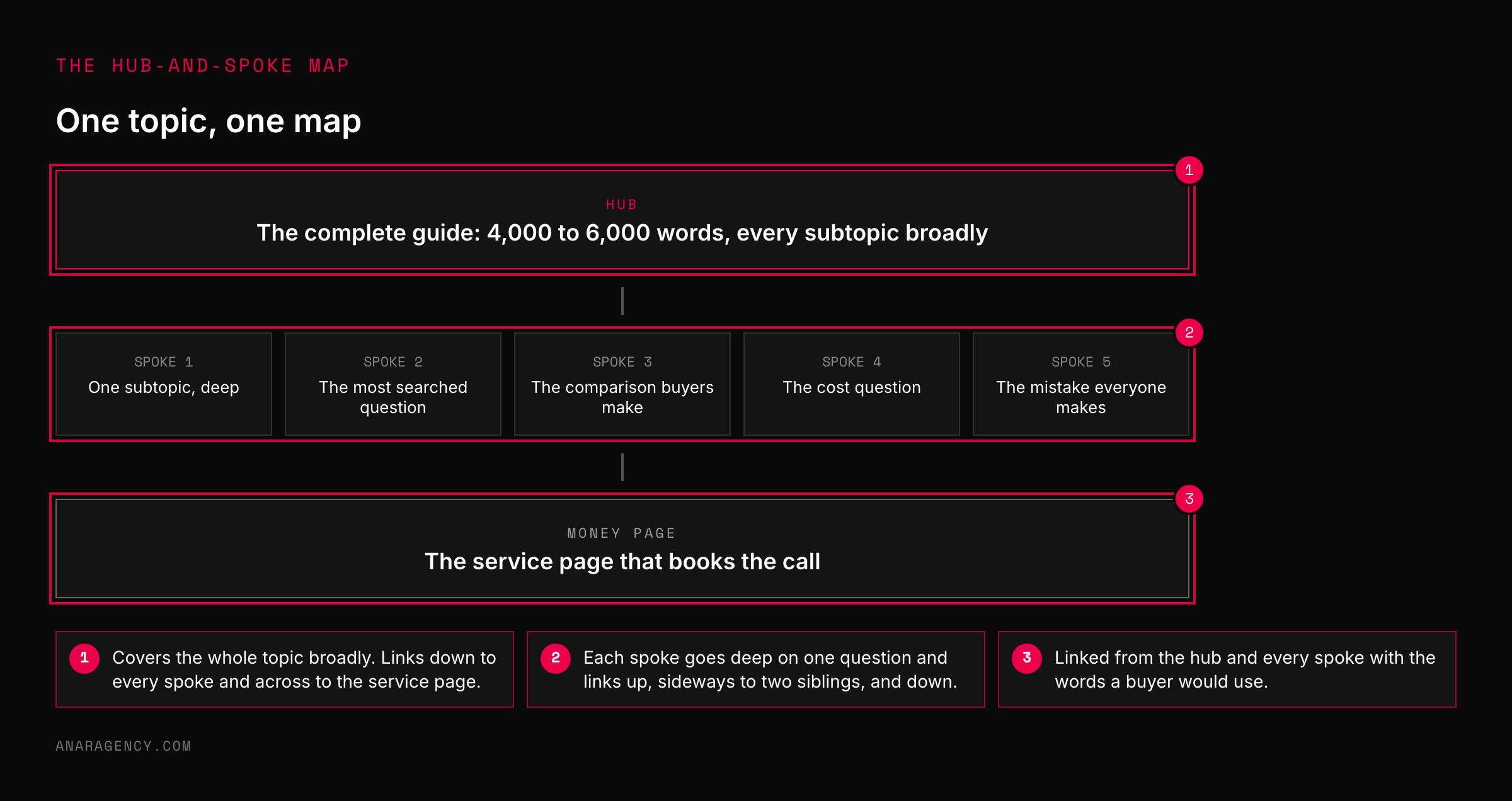
For each service you sell: one hub page that covers the whole topic broadly, five to ten spokes that each cover one subtopic deeply, and one money page that books the call. Every spoke links up to the hub, sideways to two siblings, and down to the money page with descriptive anchor text. The hub links to everything.
No page is more than two clicks from any other. Build three to five maps before you build a hundred posts.
The Hub-and-Spoke Map: one guide, five to ten spokes, one money page
A hub is one complete guide on a topic you sell. Four to six thousand words, covering every subtopic a buyer could ask about at a broad level, without going deep on any of them.
Its job is to be the page Google and a reader both recognize as the place where this topic lives on your site. It links down to every spoke and across to the service page.
A spoke is one subtopic, in depth. The most searched question. The comparison buyers make before choosing.
The cost question. The mistake everyone makes.
Each spoke links up to the hub, sideways to two sibling spokes, and down to the money page, using the words a buyer would type. Five to ten spokes per hub is plenty, and the map in the figure above has five.
The money page is the service page that books the call. It gets linked from the hub and from every spoke, and it links back to the hub so a buyer who arrives ready can still find the proof.
The rule that makes the map work is simple to check: no page in the cluster is more than two clicks from any other. If a spoke can only be reached from the blog index, it is an orphan with extra steps.
Build three to five of these maps, one per thing you sell, before you build a hundred posts. Our own blog now runs twelve topic hubs that mirror what we do for clients: paid ads, SEO and AI search, conversion, offers, email, sales, and so on.
Every article carries its topic in the breadcrumb, links to its hub, and links to the service page for that topic. The eleven islands became one map in a week, and the writing did not change.
4,000 to 6,000 words. Covers every subtopic at a broad level. Links down to every spoke and across to the service page.
One subtopic, in depth
The most searched question
The comparison buyers make
The cost or pricing question
The mistake everyone makes
Linked from the hub and from every spoke with the words a buyer would use. This is the page that books the call.
Build order for a service business
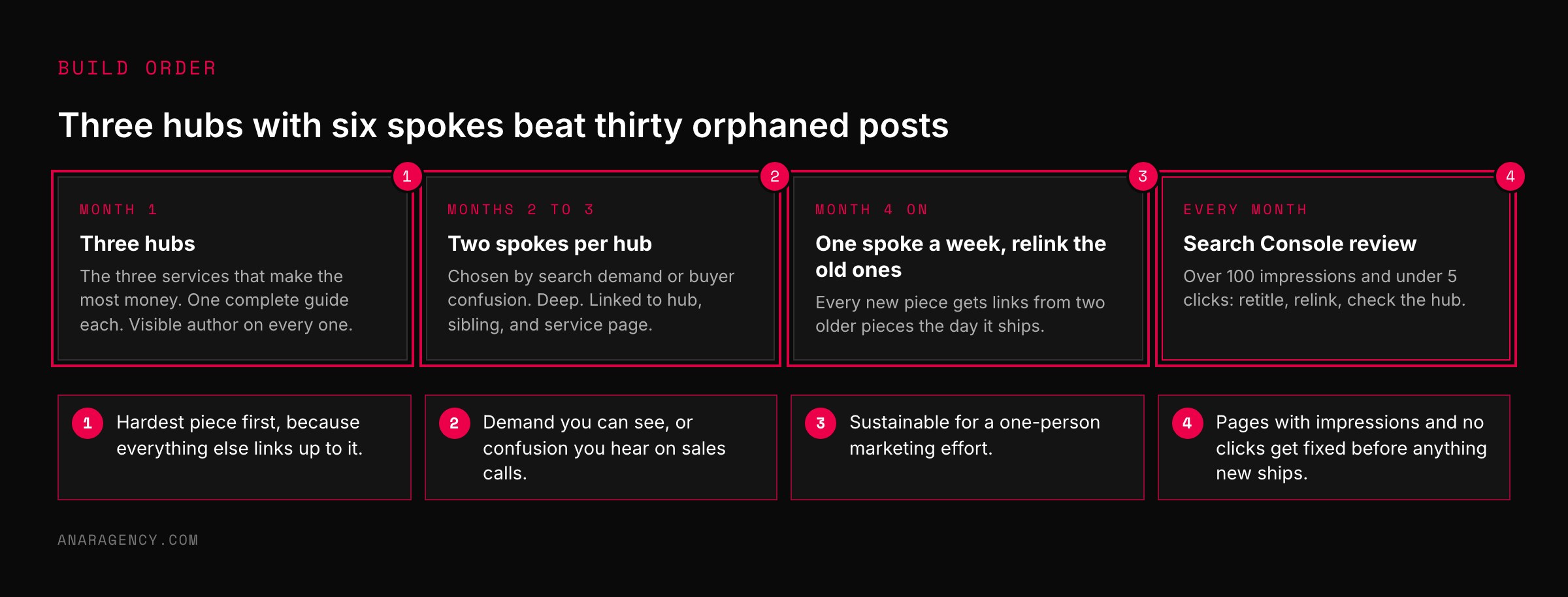
Start with the three services that make the most money, not the three topics that are easiest to write. Write the complete guide for each one first.
If that sounds backward, because a 5,000-word guide is the hardest piece, consider what it does. It establishes that your site has a home for the topic. It gives every future spoke something to link up to.
And it is the single page most likely to earn a link from somewhere else.
A site starting from zero with only a service page gets more from one deep guide than from ten short posts.
Then write two spokes per hub, chosen by one of two tests: real search demand you can see in Keyword Planner or Search Console, or real buyer confusion you hear on sales calls. Both are better than guessing. Each spoke goes deep on one question and links to its hub, its sibling, and the money page.
After that, one spoke a week is a pace a one-person marketing effort can hold, and every new spoke should pick up links from at least two older pages the same day it ships.
Keep a visible author on every page. Google's helpful content guidance asks, in so many words, whether it is self-evident who wrote the content and whether the byline leads to more information about them.
A real name, a photo, and a dedicated author page marked up with profile page structured data cost an afternoon and turn a blog into a body of work by a person.
Authority, the author, and the 90-day clock
Google judges whether to trust a page on what it calls E-E-A-T: experience, expertise, authoritativeness, and trust. The 2022 update added the first E, experience, because first-hand knowledge separates a page written by someone who did the thing from a page assembled from other pages.
The full search quality rater guidelines run to more than 160 pages, and the sections on who is responsible for a site and who wrote its content are the ones a service business should read.
For a business that sells health, legal, or financial services, the bar is higher. Google applies extra scrutiny to pages that can affect someone's money or wellbeing, and a site in those categories hits a ceiling until it shows who is behind the content and why they are qualified.
The fix is not clever. Author pages, credentials where they exist, consistent descriptions across LinkedIn and other profiles, and outbound citations to sources a reader can check.
Then wait. Structural changes take roughly a quarter to show in rankings, because Google has to recrawl, reassess, and gather fresh click signals on the new map. Our rebuild shipped in October, and we expect to read the result in January, not next week.
Anyone promising that a structural SEO change will show in rankings in two weeks is describing a different mechanism than the one Google documents.
How to measure it in Search Console
Search Console is free and shows the two numbers that matter for every page: how often it appeared in results, and how often it was clicked.
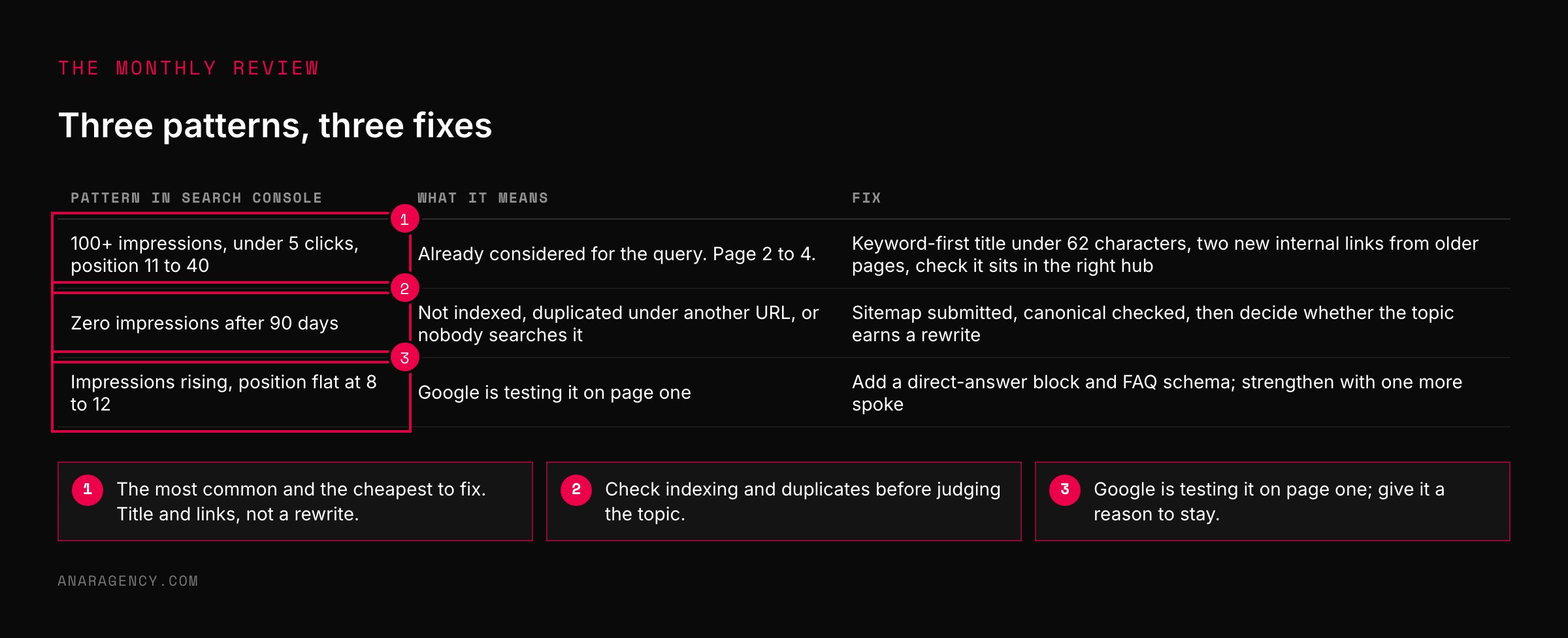
The pattern to look for first is the one our blog showed: high impressions, near-zero clicks, position 11 to 40. Those pages are already being considered for the query. They need links and a better title, not a rewrite.
Set a monthly review. Pull impressions, clicks, and position by page. Any page with more than 100 impressions and fewer than five clicks gets three things: a keyword-first title under 62 characters, two new internal links from older pages, and a check that it is in the right hub.
Any page with zero impressions after 90 days is either not indexed, duplicated under another URL, or about something nobody searches for. Google's guide to consolidating duplicate URLs covers the second case, and an XML sitemap submitted in Search Console covers the first.
One more reason to build the map now. Google's guidance on AI features in Search says the same fundamentals apply to AI Overviews and AI Mode as to ordinary results: helpful content, crawlable structure, and clear authorship.
A hub-and-spoke map with a named author is what an answer engine can cite. A pile is not.
Questions executives ask
Why is my blog not ranking on Google?
Most often because the posts are orphans: nothing on your site links to them except the blog index, they do not link to each other, and there is no hub page that tells Google where the topic lives on your site. Fix the structure before rewriting the content. Pages with impressions and no clicks in Search Console are the first to work on.
What is hub-and-spoke SEO?
A site structure where one complete guide (the hub) covers a topic broadly, several deeper articles (the spokes) each cover one subtopic, and all of them link to each other and to the service page you sell. It gives Google a map of what your site knows and gives readers a path from any question to the page that books the call.
How many blog posts does a service business need?
Fewer than you think, linked better than you think. Three to five hubs, each with five to ten spokes, covers most service businesses. Thirty well-linked pages outrank a hundred orphaned ones, and take a third of the writing.
How long does hub-and-spoke SEO take to work?
Expect roughly a quarter before a structural change shows in rankings, because Google has to recrawl the site, reassess the pages, and gather new click data. Measure monthly in Search Console; judge after 90 days.
Does the author page actually matter for SEO?
Google's own guidance asks whether it is clear who wrote the content and whether the byline leads to more information about them. A real author page with a photo, background, and profile page markup is one of the cheapest trust signals a small business can add, and it matters most for health, legal, and financial topics.

Filip Kovacevic is the founder of Anar Agency in Phoenix. He spent five years running SEO, Meta ads, email, and content for medical practices across the United States, and now does the same work for healthcare, home-service, legal, and professional-service businesses, alongside AI implementation. More from Filip →
Talk it through in 15 minutes
Bring one AI question from this article. We will tell you what we would do, whether or not you hire us.
Book a 15-Min Chat →