What AI Answer Engines Actually Cite: We Checked 4,243 Citations
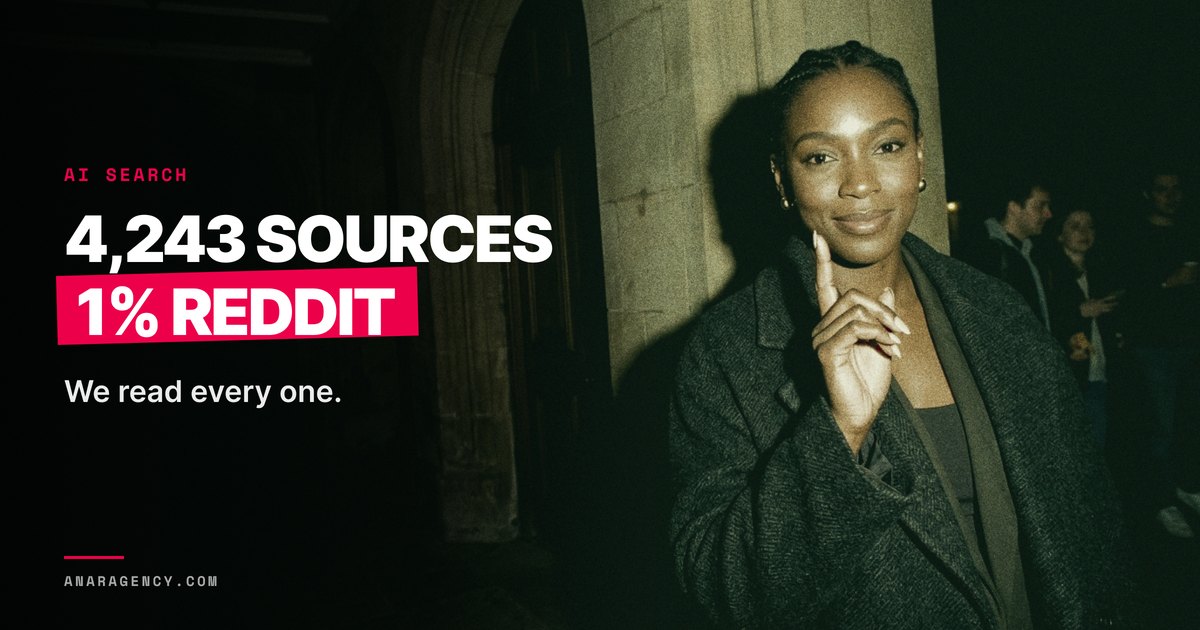
In the big public studies, Wikipedia, Reddit, and YouTube are among the most cited sources in AI answers. In our own test of business questions, they barely appeared. We asked four AI engines 33 questions a buyer would ask and read all 4,243 sources they cited: 65 percent were ordinary company and publisher pages, 26 percent were "best of" and comparison posts, 7 percent were directories, and Reddit was 1 percent.
What an engine cites depends on the question, so the only reliable move is to map the citations for your own questions and go where they already are.
Everyone told us it was Reddit
If you have read anything about getting quoted by AI this year, you have read this advice: the engines love Reddit and YouTube, so go post there.
We believed it. We were about to plan around it.
Then we did the boring thing and checked. We asked four AI engines the questions our buyers actually ask, and we read every source they gave back.
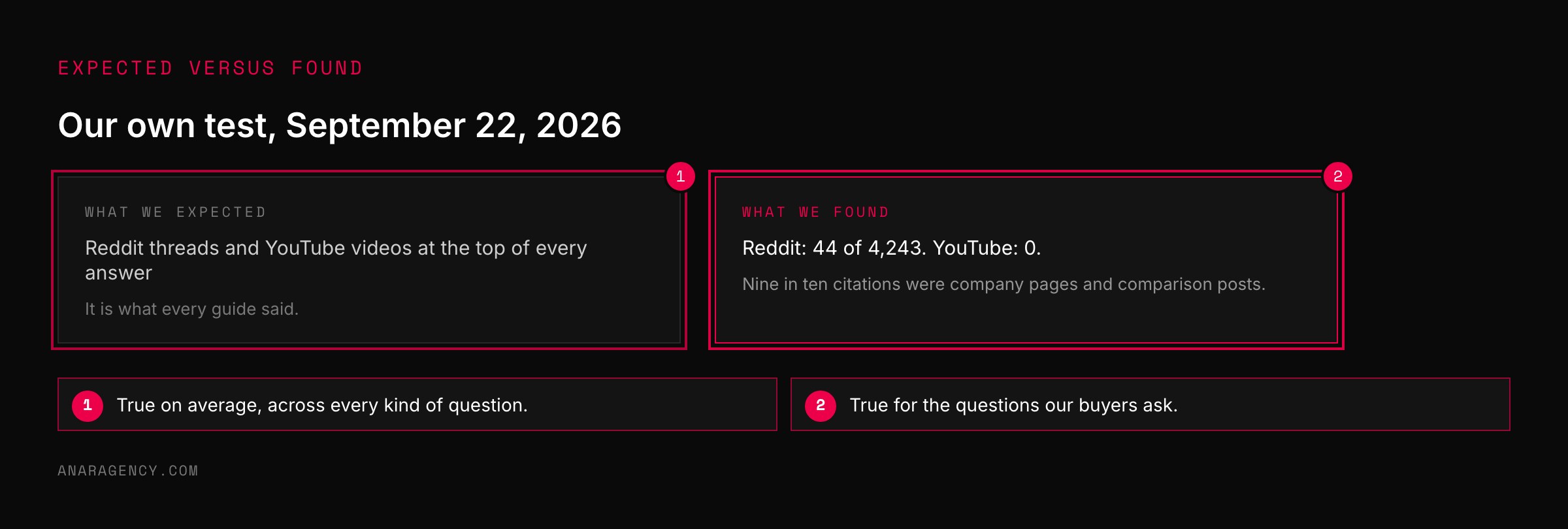
Reddit was 44 citations out of 4,243. One percent.
YouTube was zero.
What the big studies say, and why they are not wrong
The advice did not come from nowhere. Large studies of AI citations keep finding the same famous names at the top.
Pew Research Center looked at Google's AI summaries and found that Wikipedia, YouTube, and Reddit together made up 15 percent of the sources listed. Profound's analysis found Wikipedia was ChatGPT's single most cited source, at 7.8 percent of its citations.
A 2026 synthesis of nine public datasets by 5W put Reddit at an estimated 46.7 percent of Perplexity's top-ten source share.
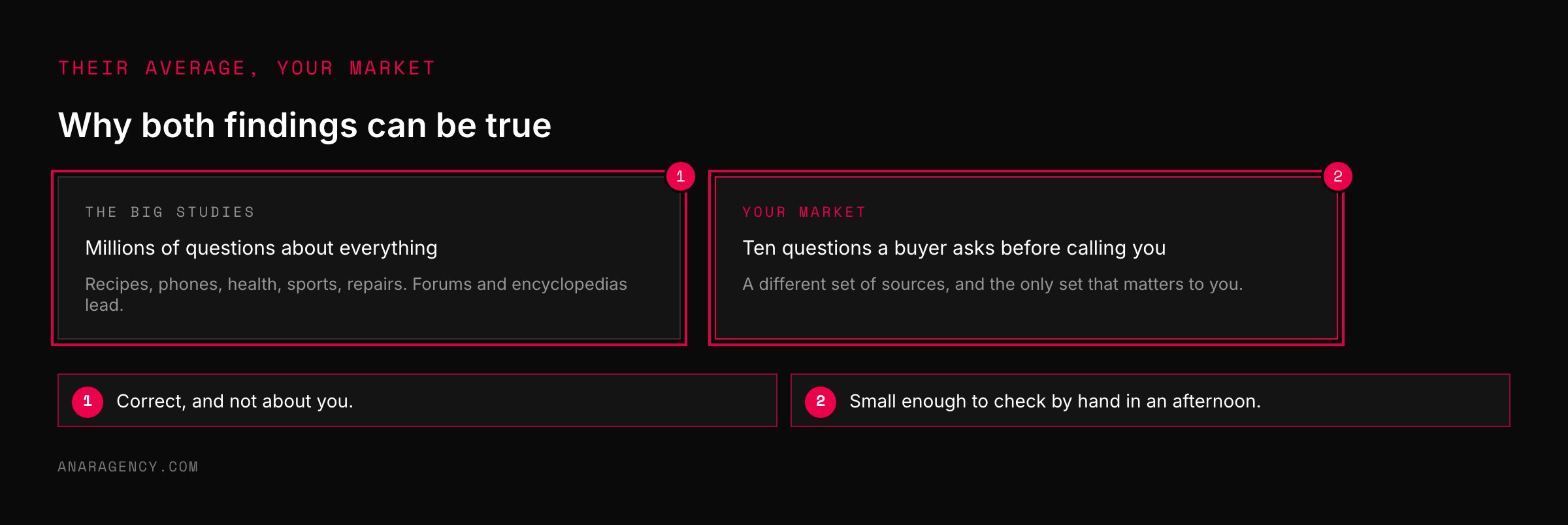
Those studies are measuring millions of questions about everything: recipes, phones, health, sports, how to fix a faucet. For that mix, forums and encyclopedias really are the top sources.
But you do not sell to everyone asking everything. You sell to a few people asking a few specific questions. And an average across all questions tells you very little about yours.
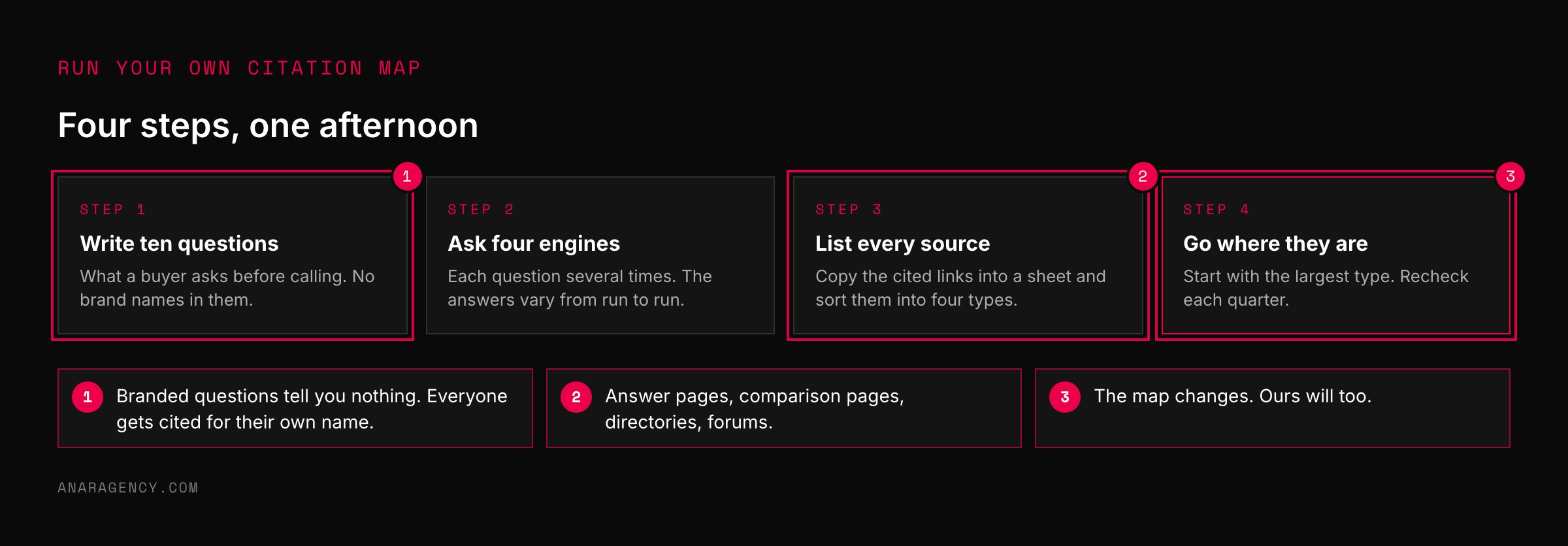
Write the ten questions your buyers ask before they call. Ask each one of ChatGPT, Perplexity, Claude, and Google several times. List every source the answers cite and sort them into four types: answer pages, comparison pages, directories, and forums.
The largest type is where to be first. Recheck every quarter, because engines change what they favor. In our market the map was 65 percent answer pages, 26 percent comparisons, 7 percent directories, 1 percent forums.
What we found in our own market
Here is exactly what we did, so you can judge it. On September 22, 2026, we asked ChatGPT, Perplexity, Claude, and Grok 33 questions with no brand names in them. Questions like how much a med spa marketing agency costs, and how to stop employees from using unapproved AI tools.
We asked each one several times. That gave us 409 answers, citing 4,243 sources across 944 different websites. Then we sorted every source into a type.
Two thirds were ordinary company and publisher pages. 2,776 citations, 65.4 percent. Agency blogs, software company guides, trade publications.
The kind of page you could write.
A quarter were "best of" and comparison posts. 1,083 citations, 25.5 percent. Pages titled along the lines of the best agencies for a trade, usually published by a company in that trade.
Directories were small but steady. 282 citations, 6.6 percent, mostly review and listing sites, and mostly on "who is the best" questions.
The famous sources were nearly absent. Reddit, 44. Government, university, and Wikipedia pages together, 37.
LinkedIn, 21. YouTube, none.
This is one test, in two business markets, on one day. The sorting rules are ours, and a different sorter would draw some lines differently. It does not overturn the big studies.
It shows they do not describe every market.
The engines do not agree with each other
The second surprise was how different the four engines were.
They cite very different amounts. Perplexity averaged 20.3 sources per answer. ChatGPT averaged 3.9, and gave no sources at all in 27 of its 131 answers.
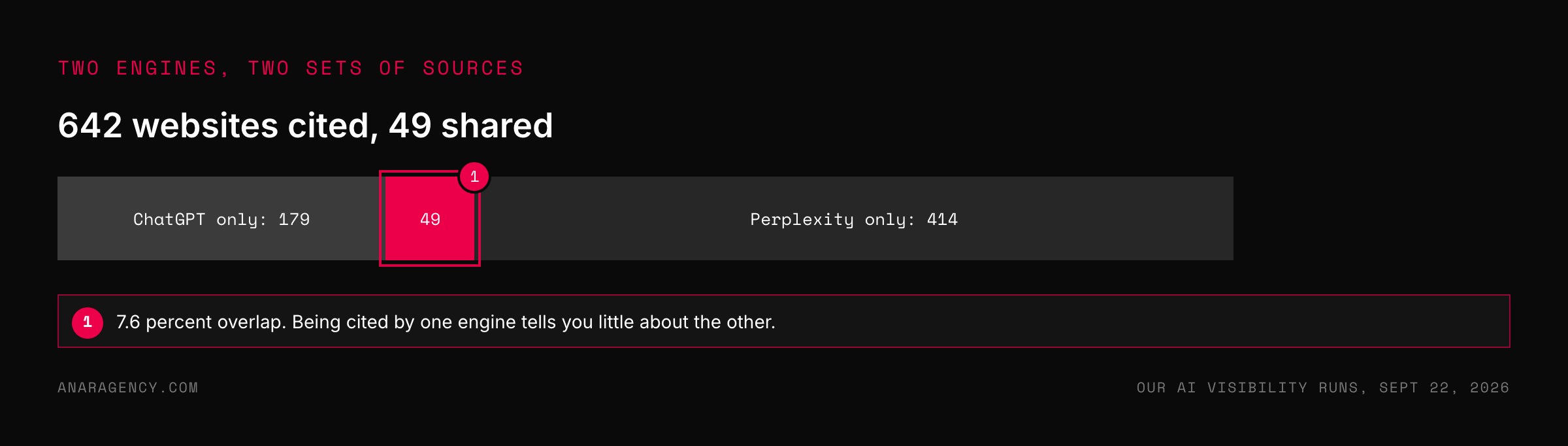
They cite different sites. ChatGPT and Perplexity together cited 642 different websites in our test. Only 49 of those were cited by both.
That is 7.6 percent.
The 5W synthesis found almost the same thing at far larger scale: only about 11 percent of domains were cited by both ChatGPT and Perplexity.
And they change their minds. The same synthesis reports that ChatGPT's share of citations going to Reddit fell from about 60 percent to about 10 percent in a single month, September 2025.
So any plan built on one platform's favorite source is built on sand. The thing that held steady across all four engines in our test was plainer: they quoted pages that answered the question.
"So I should write a best-of list with my company at number one."
You may be looking at that 26 percent and thinking the move is obvious. Write the list, put yourself on top.
People are doing exactly that, which is why the lists get cited. It works for now. We would still be careful, for two reasons.
First, Google has told site owners what it thinks of content made mainly to manipulate results. Its guidance asks whether a page exists to help the person reading it or mainly to pull in search visits. A list that exists only to crown its author fails that question.
Second, the engines changed their taste for Reddit in one month. A source type that is rewarded today because it is easy to game is the first thing they will learn to discount.
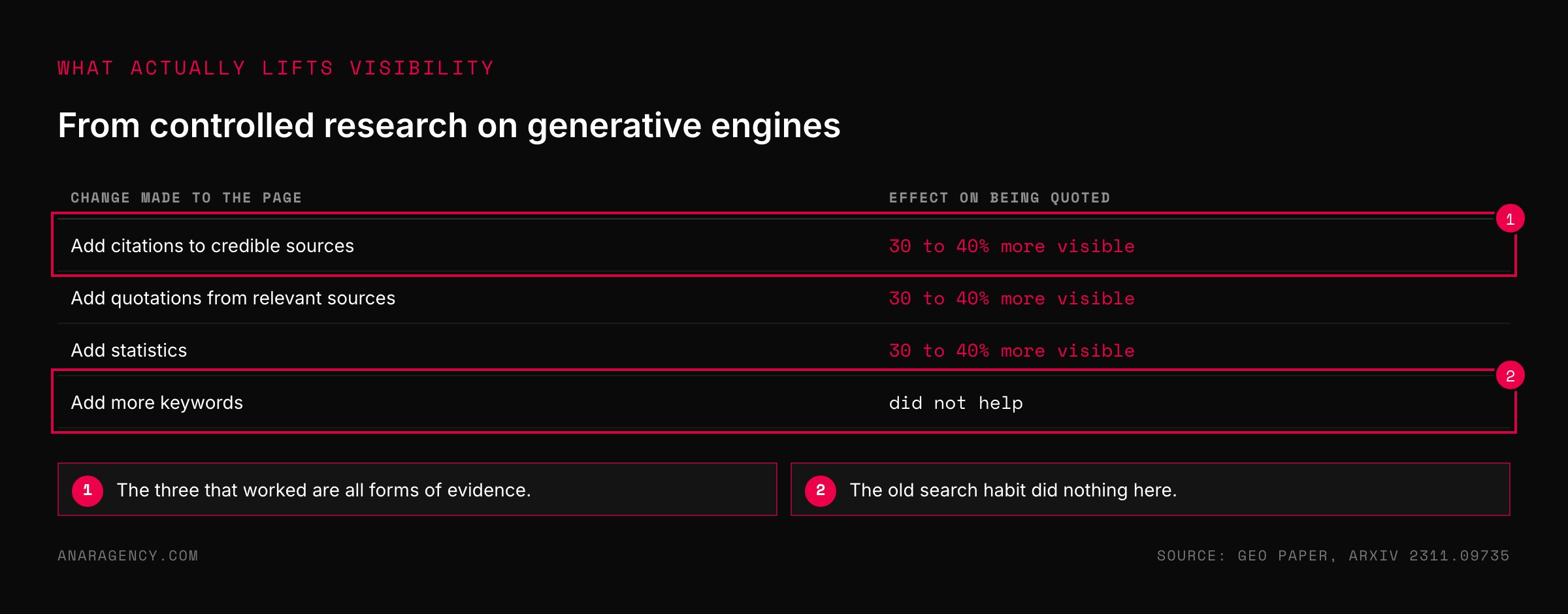
What does hold up has been tested. Researchers at Princeton and other universities tried several ways of rewriting pages to see which made AI engines quote them more. Adding citations, adding quotations from relevant sources, and adding statistics worked best, lifting visibility by 30 to 40 percent.
Stuffing in keywords did not help. So the durable version of the best-of page is a fair comparison with real numbers and sources, which is harder to write and harder to dismiss.
What to read next, and why
GEO: Generative Engine Optimization (research paper): The only controlled test we know of. Read the table of which tactics worked.
AI Platform Citation Patterns (analysis): The large-scale picture, by engine. Read it knowing it is an average across every kind of question.
The State of AI Citations 2026 (report): Useful for one thing above all, which is showing how unstable these rankings are.
AI features and your website (Google documentation): Google's own statement that there is no special markup for its AI answers. The basics are the method.
So the simple takeaway is this: do not take anyone's word for what AI engines cite, including ours. Ask your own ten questions, read the sources, and be there.
Questions executives ask
What sources do AI answer engines cite most?
It depends on the questions. Large studies across all topics find Wikipedia, Reddit, and YouTube near the top. In our own test of 33 business questions, 65 percent of 4,243 citations were ordinary company and publisher pages, 26 percent were comparison posts, 7 percent were directories, and Reddit was 1 percent.
Do ChatGPT and Perplexity cite the same websites?
Mostly not. In our test the two engines cited 642 different websites between them and only 49, or 7.6 percent, appeared in both. A 2026 synthesis of public datasets by 5W found about 11 percent overlap at much larger scale.
How do I get my business cited by AI engines?
Find out what they already cite for your questions, then be there. Ask your buyers' questions of several engines, list the sources, and sort them by type. In controlled research, adding citations, quotations, and statistics to a page raised its visibility in AI answers by 30 to 40 percent, while keyword stuffing did not help.
Should I post on Reddit to get cited by AI?
Test your own market first. Reddit is a leading source in broad studies, but it was 1 percent of citations in our business-question test, and one report found ChatGPT's share of Reddit citations fell from about 60 percent to about 10 percent in a single month. Do not build a plan on one platform's current favorite.
Is there special markup to appear in Google's AI answers?
No. Google's documentation says the same fundamentals that apply to ordinary search results apply to its AI features, and that no special optimization is required.

Filip Kovacevic is the founder of Anar Agency in Phoenix. He spent five years running SEO, Meta ads, email, and content for medical practices across the United States, and now does the same work for healthcare, home-service, legal, and professional-service businesses, alongside AI implementation. More from Filip →
Talk it through in 15 minutes
Bring one AI question from this article. We will tell you what we would do, whether or not you hire us.
Book a 15-Min Chat →