Google Search vs AI Assistants: Where Buyers Actually Ask the Question

Buyers ask in both places, and the split depends on the topic, not on the year. Google still handled about 373 times as many searches as ChatGPT in 2024. But in our own data, one business topic was asked of AI assistants 3.4 times as often as it was searched on Google, while another was searched eleven times as often as it was asked.
The useful number is the Ask-Ratio: AI asks divided by Google searches, per topic. It tells you whether to build a page that wins a list, a page that wins an answer, or one page that does both.
Two true stories that sound like they cannot both be true
Here are two things you have been told this year. Search is dying because everyone asks AI now. And search is fine because Google is bigger than ever.
Both come with numbers. Both numbers are real.
So the question is not which story is right. It is which one is right for the thing you sell, and that turns out to be something you can measure.
We measured it for four topics we write about. One of them surprised us enough that it changed what we build.
The big numbers: Google is still enormous
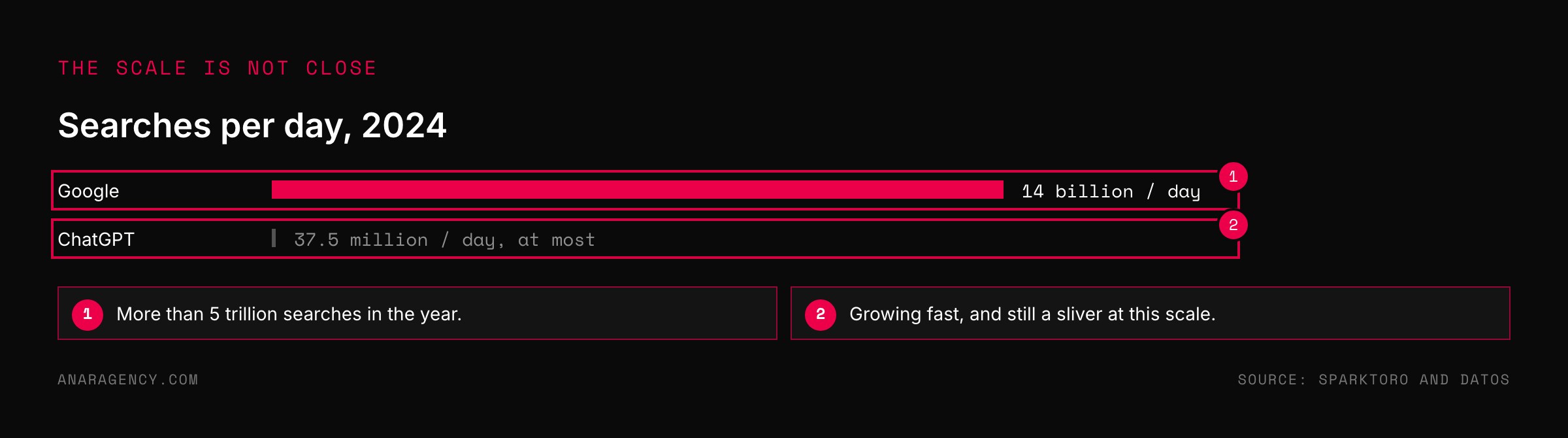
Start with scale, because the scale is not close.
SparkToro and the data firm Datos estimated that Google handled more than 14 billion searches a day in 2024. They put ChatGPT at 37.5 million search-like prompts a day at the very most. That is about 373 to 1.
ChatGPT is not small. OpenAI reports 700 million people use it every week. But a prompt is not always a search.
People also go there to write, plan, and fix things.
So if you sell something people look up with a short phrase, the people are still on Google. Anyone telling you to drop search for AI is reading the headline and skipping the arithmetic.
Here is the part that stings, though. Being on Google is worth less than it was.
For each topic you sell around, divide monthly AI assistant asks by monthly Google searches. Under 0.2 it is a search topic: build to win the list, with the query in the title, links in, and a higher position. Between 0.2 and 1.0 it is both: one strong page must rank and be quotable.
Over 1.0 it is an asked topic: lead with a direct answer, use your own numbers, and cite sources so an engine can quote you. Measure per topic and recheck twice a year.
Google itself is turning into an answer engine
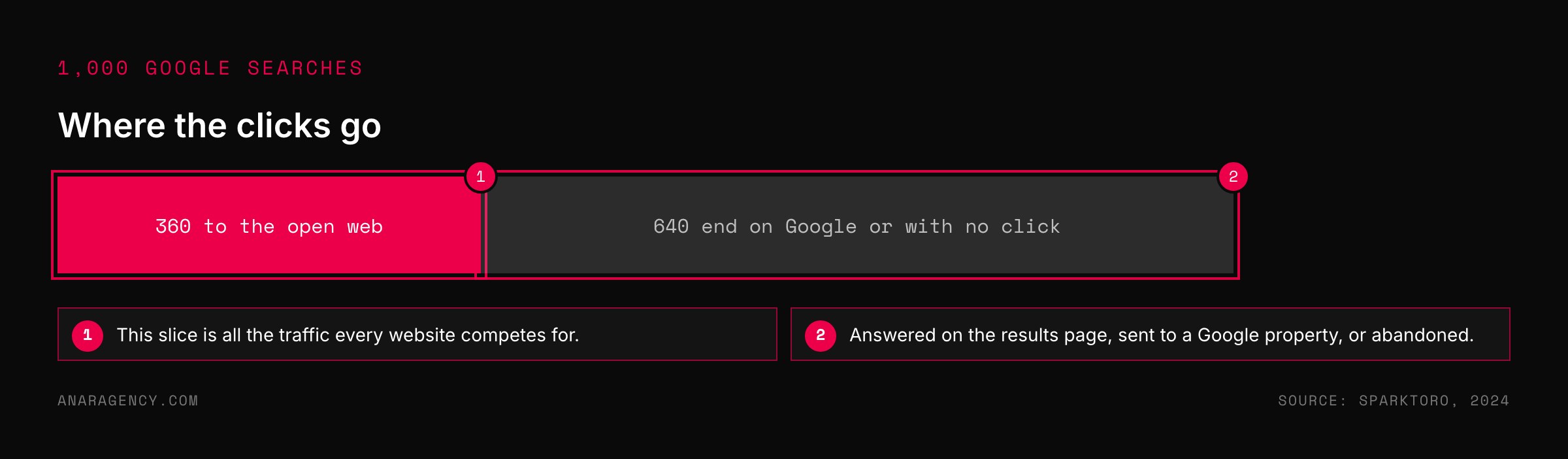
Most searches already end without a click to a website. SparkToro's 2024 study found that for every 1,000 Google searches in the United States, only 360 clicks went to the open web. The rest ended on Google or went nowhere.
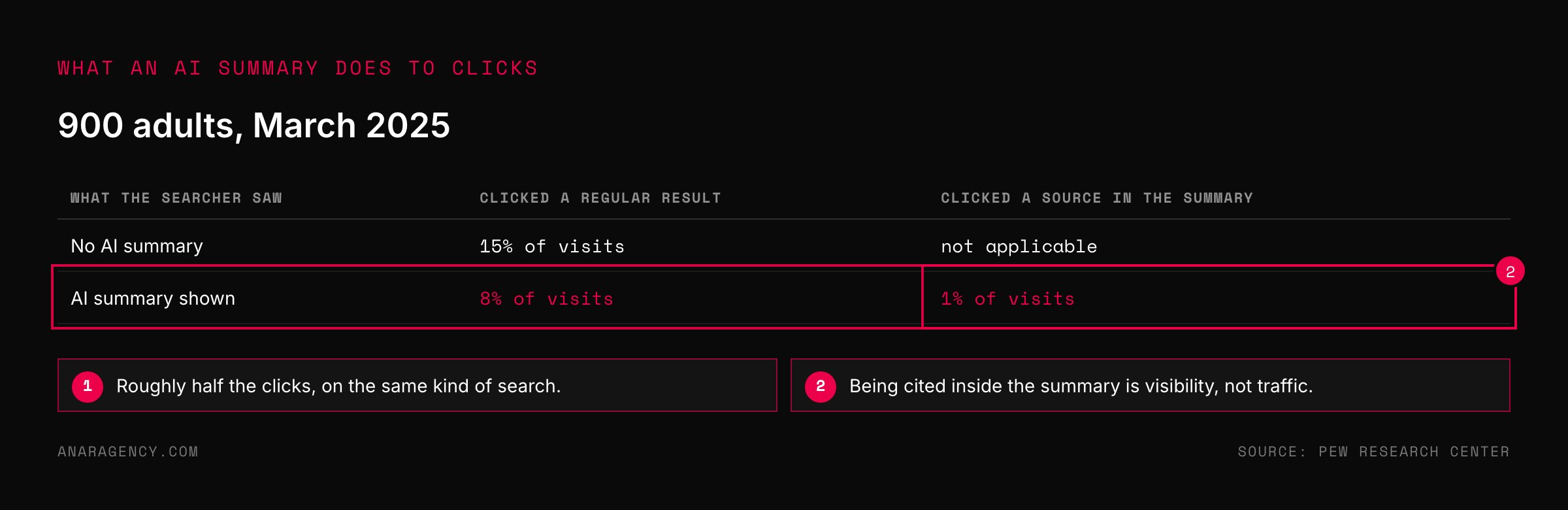
AI summaries cut the clicks roughly in half. Pew Research Center tracked 900 adults and found that 58 percent ran at least one search in March 2025 that produced an AI summary. When a summary appeared, they clicked a regular result in 8 percent of visits.
Without one, 15 percent.
Almost nobody clicks the sources inside the summary. In the same study, people clicked a link inside the AI summary in 1 percent of visits. Ahrefs found that AI Overviews now cut clicks to the top-ranked page by 58 percent.
So the split is not Google against AI. Google is both now. The real split is between questions that end in a list of links and questions that end in an answer, and the second kind is growing inside Google too.
Google's own guidance says the same basics apply to its AI features as to ordinary results. There is no separate trick. There is only whether your page is the kind that gets quoted.
The Ask-Ratio: our own four topics
Big averages hide the thing you need. So we pulled two numbers for four topics we cover: how often each is searched on Google in a month, and how often it is asked of AI assistants.
Divide the second by the first and you get what we call the Ask-Ratio.
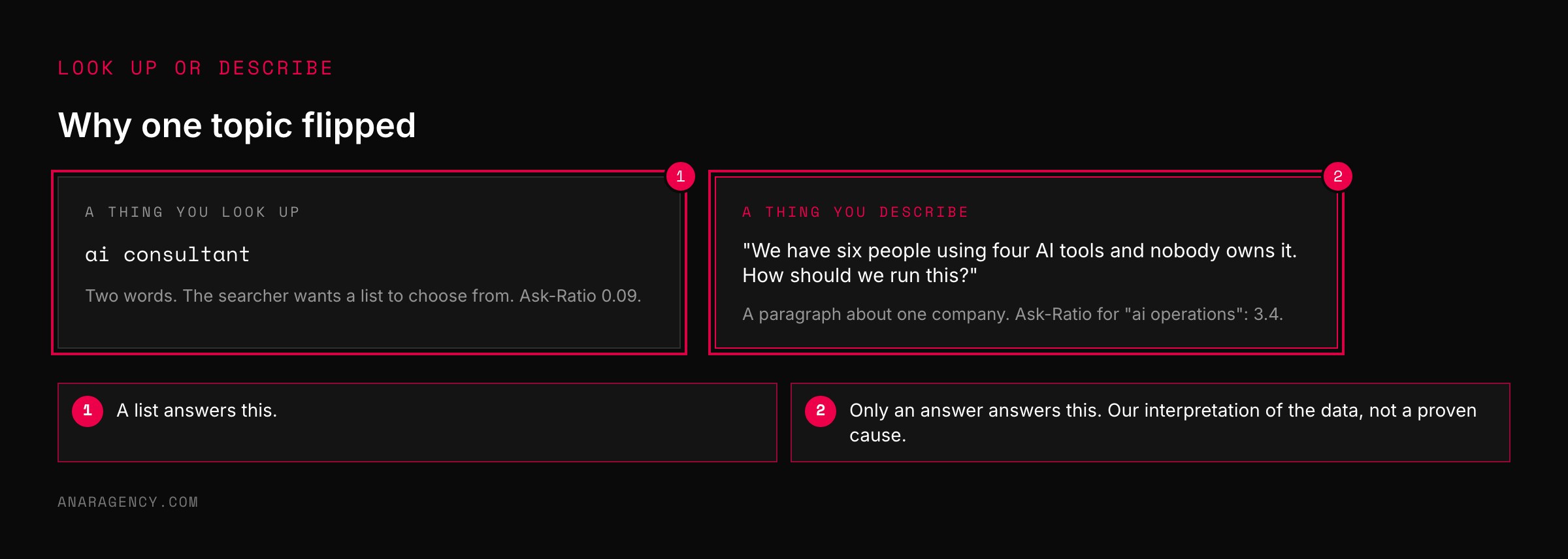
"AI consultant" is a search topic. 8,100 Google searches a month against 717 AI asks. Ratio 0.09.
People want a list of firms, and a list is what a search page gives.
"AI transformation" and "AI compliance" are mixed. Ratios of 0.32 and 0.44. For every three people searching, one more is asking a machine.
"AI operations" flipped. 320 Google searches a month against 1,079 AI asks. Ratio 3.4.
More than three people ask an assistant for every one who searches.
Why that one? Our read is that it is not a thing you look up. It is a thing you describe.
Nobody types two words when the real question is a paragraph about their own company. That is our interpretation, not something the data proves.
These are estimates from one data provider for one month, and four topics are not a study. They are enough to show the split is real and that it runs by topic.
"We are invisible in AI anyway, so why bother?"
You may be thinking that the answer engines only quote the giants. We wondered the same thing, so we tested it on ourselves.
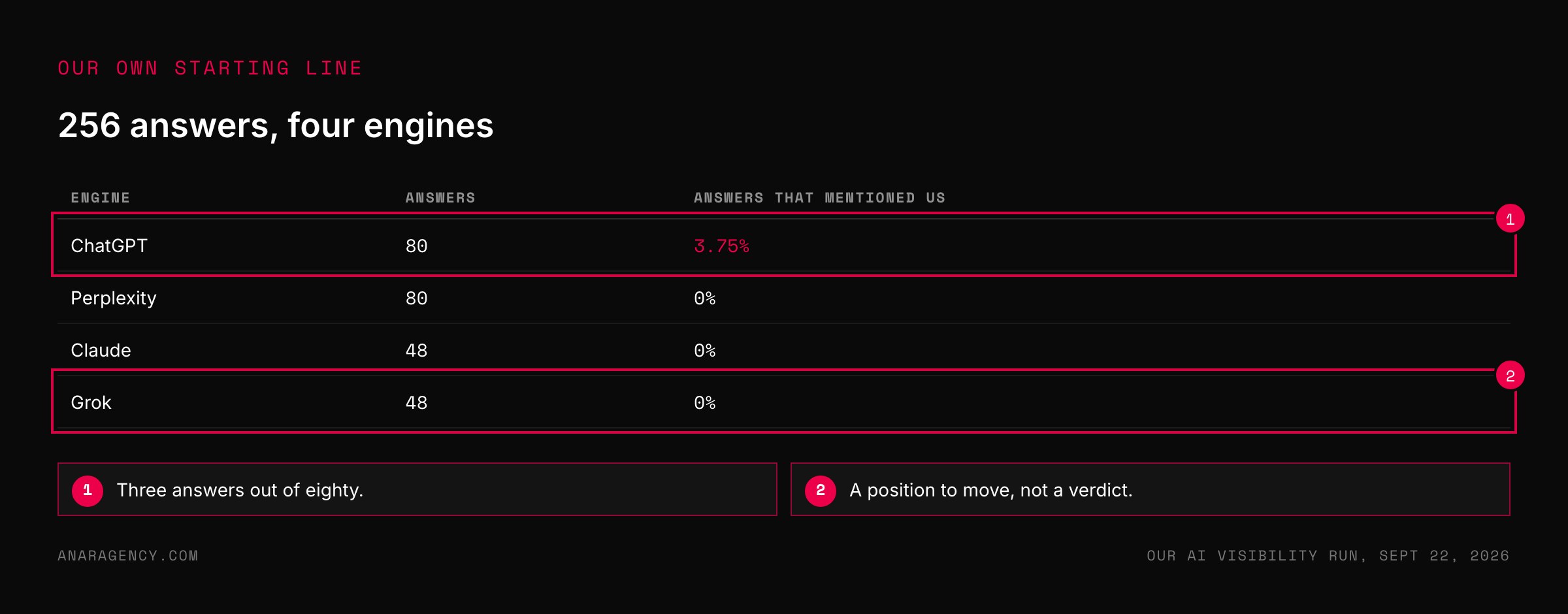
In September we asked four AI engines 16 questions a buyer in our market would ask, several times each. That produced 256 answers.
ChatGPT mentioned us in 3.75 percent of its answers. Claude, Perplexity, and Grok mentioned us in none. That is our real starting line, and we would rather publish it than pretend.
But here is what the same test showed. The engines were not only quoting giants. Most of what they cited was ordinary company websites and "best of" lists.
We break that down in what AI answer engines actually cite.
So being absent is not a verdict. It is a position, the same way page four of Google is a position. And the work that moves it is mostly the work that moves you up in search, which we cover in the Page-2 Problem.
What to read next, and why
Google Search Grew 20%+ in 2024; receives ~373X more searches than ChatGPT (research): The clearest size comparison available, with the math shown.
2024 Zero-Click Search Study (research): Where the clicks go after a Google search. The answer is mostly nowhere.
Pew Research Center on AI summaries (research): Real browsing behavior from 900 people. The 1 percent figure for clicks on cited sources is the one to remember.
How people are using ChatGPT (study): What people actually do in a chat window. Useful for seeing how little of it looks like old-fashioned search.
So the simple takeaway is this: do not ask whether your buyers use Google or AI. Ask it one topic at a time. Then build the page that topic calls for.
Questions executives ask
Is ChatGPT replacing Google search?
Not by volume. SparkToro and Datos estimated Google handled more than 14 billion searches a day in 2024 against at most 37.5 million search-like prompts a day on ChatGPT, about 373 to 1. What is changing faster is Google itself, which now answers many searches with an AI summary.
Do people click links in Google's AI summaries?
Rarely. Pew Research Center found that users clicked a link inside an AI summary in 1 percent of visits, and clicked a traditional result in 8 percent of visits when a summary appeared, compared with 15 percent when it did not.
What is the Ask-Ratio?
It is our name for monthly AI assistant asks divided by monthly Google searches for one topic. In our July 2026 data, "ai consultant" had a ratio of 0.09 and "ai operations" had a ratio of 3.4, which means the first is still a search topic and the second is asked of AI assistants far more often than it is searched.
Should a small business optimize for AI search or Google?
Both, by topic. Google's guidance says the same fundamentals apply to its AI features as to ordinary results, so one well-built page can serve both. Check where each of your topics is asked, then decide whether the page mainly needs to rank in a list or be quotable as an answer.
What percentage of Google searches end without a click?
SparkToro's 2024 study found that for every 1,000 Google searches in the United States, only 360 clicks went to the open web. The remainder ended without a click or stayed on Google's own properties.

Filip Kovacevic is the founder of Anar Agency in Phoenix. He spent five years running SEO, Meta ads, email, and content for medical practices across the United States, and now does the same work for healthcare, home-service, legal, and professional-service businesses, alongside AI implementation. More from Filip →
Talk it through in 15 minutes
Bring one AI question from this article. We will tell you what we would do, whether or not you hire us.
Book a 15-Min Chat →