Enterprise AI Agents: What They Are and When They Pay
An AI agent is a model that decides its own next step and uses tools, such as search, files, or business systems, until a task is finished. That differs from a chatbot, which only answers, and a workflow, which follows steps set in advance. Agents pay when two things are true: the work comes in high volume with a clear definition of done, and mistakes are cheap or get caught before they cause harm.
Most business problems need a workflow, not an agent. Gartner predicts over 40 percent of agentic AI projects will be cancelled by the end of 2027.
Seven hundred people, one month
In February 2024 a payments company called Klarna published a set of numbers about its new AI assistant.
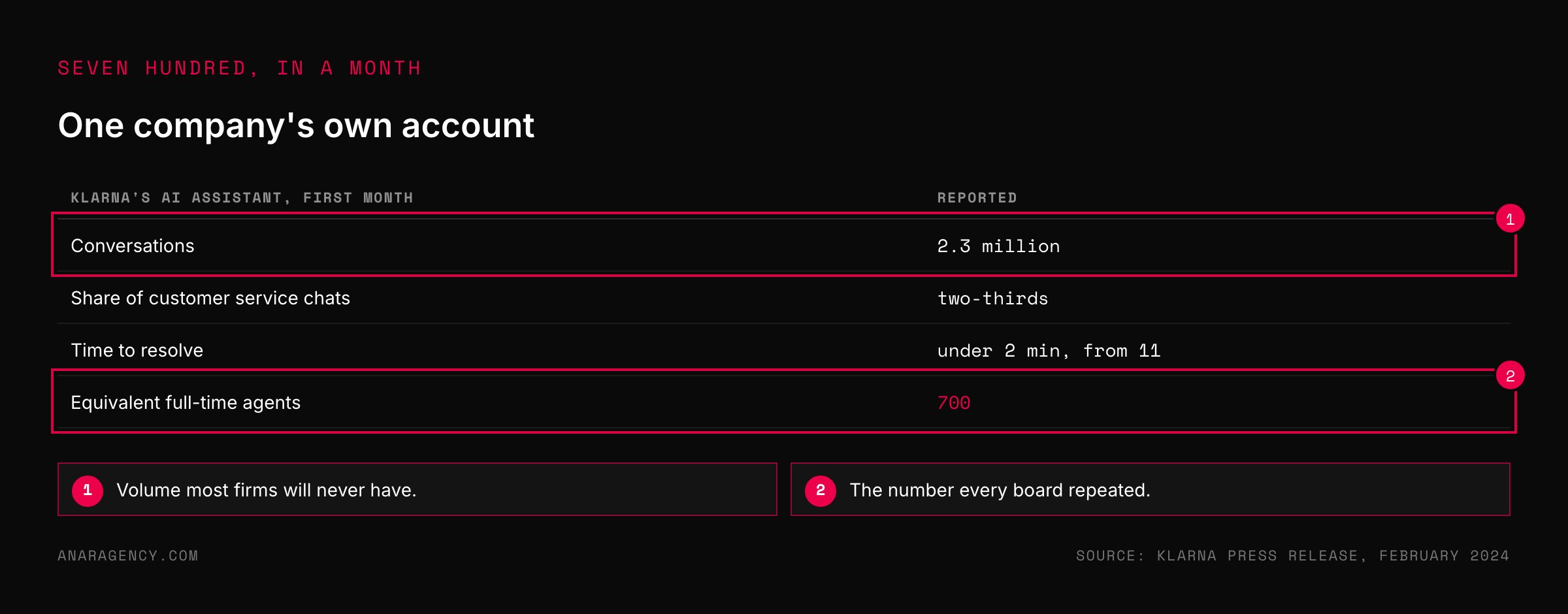
In its first month, the assistant had 2.3 million conversations, two-thirds of the company's customer service chats. Klarna said that was the work of 700 full-time agents.
Customers got answers in under 2 minutes, where it had taken 11. Repeat enquiries fell by 25 percent. The company estimated 40 million dollars in added profit for the year.
It became the most quoted AI case study in business. Every board asked where its own 700 were.
Read it again and notice what kind of work it was. Millions of similar questions, with a clear right answer, where a wrong one could be corrected by the next message. Remember those three features.
The other number
Sixteen months later the research firm Gartner published a prediction.
Over 40 percent of agentic AI projects will be cancelled by the end of 2027, it said, because of rising costs, unclear business value, or inadequate risk controls.
Its analyst described most current projects as early experiments driven by hype and often misapplied.
Gartner also named a practice it called agent washing: vendors relabeling existing chatbots and automation tools as agents. It estimated that only about 130 of the thousands of vendors claiming agentic AI were the real thing.
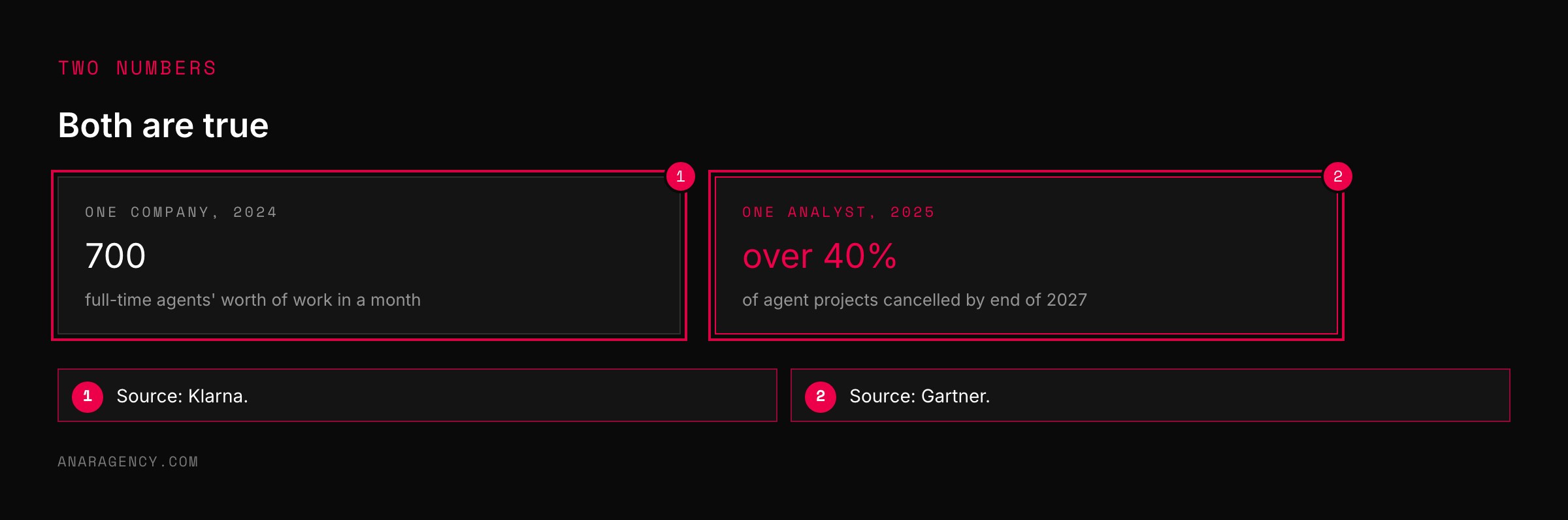
So one company reports the work of 700 people, and an analyst expects four in ten projects to be scrapped. Both are describing the same technology. The difference is where it was pointed.
An agent is a model that chooses its own steps and uses tools until a task is done. A workflow follows steps set in advance and suits most business work. An agent pays when the work has high volume and a clear definition of done, and when mistakes are cheap or caught before they matter.
Fix the process first, measure cost per resolved case, name one owner, and ask any vendor what the product does unprompted, what it can change, and how you will know when it is wrong.
What an agent is
The word is used loosely, so here are three things that all get sold under it.
A chatbot answers questions. It may be very good. It takes no action in your systems.
A workflow is a fixed sequence of steps with a model doing some of them. Read the email, classify it, draft a reply, send it for approval. The path was decided by a person in advance.
An agent decides its own path. It is given a goal and a set of tools, and it chooses what to do next, looks at the result, and continues until it judges the job done.
That distinction comes from Anthropic's engineering guidance, which separates workflows, where models follow predefined paths, from agents, where models direct their own process. Its advice is to use the simplest thing that works and add autonomy only when it is needed.
That advice is worth more than most vendor pitches. A workflow is cheaper, faster, and easier to check. Choose an agent when the steps cannot be listed ahead of time.
What surrounds the model matters as much as the model, which we cover in what an agent harness is.
Finish-Line Firms: when an agent pays
The companies getting a return from agents did not start with the technology. They started with a piece of work that had a finish line. We call them Finish-Line Firms.
They pick volume. Thousands of similar cases a month. An agent that saves ten minutes on a task done twice a year saves twenty minutes.
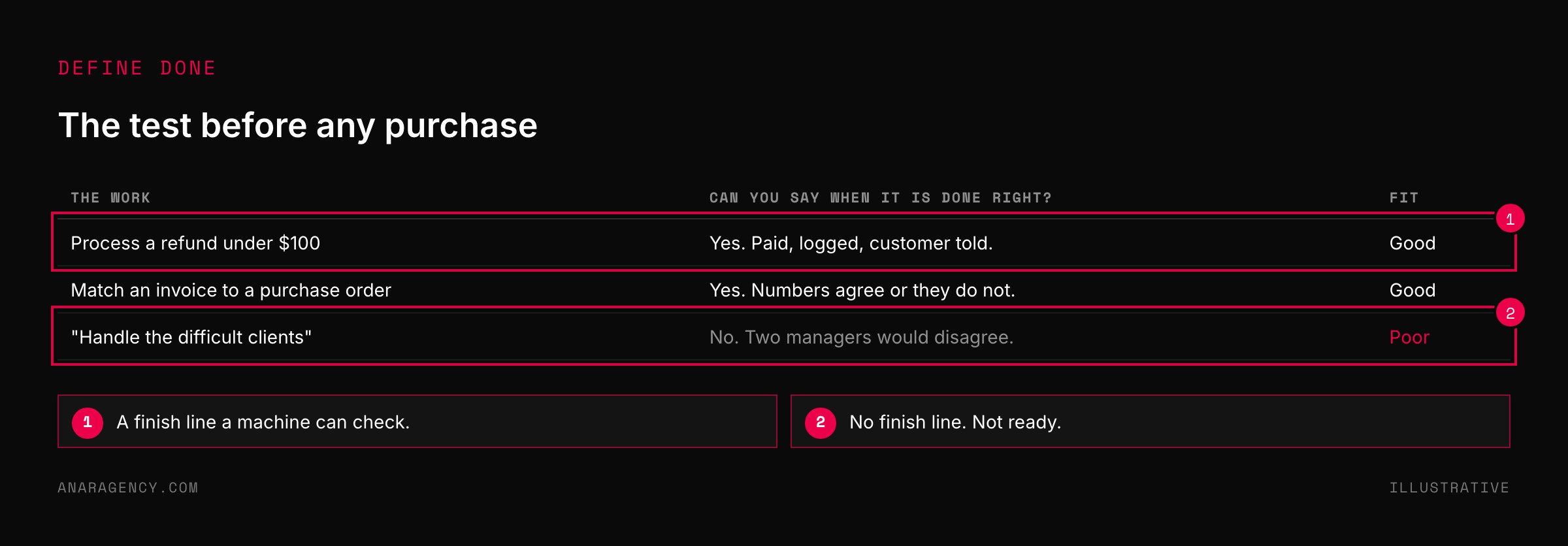
They can define done. A refund processed. A ticket resolved.
An invoice matched. If two of your own staff would disagree on whether a case was handled well, an agent cannot be judged either.
They make mistakes cheap. Either the action can be undone, or a person approves it before it becomes final. Agents are wrong some of the time, and the design assumes it.
They fix the process first. If nobody can describe how the work is done today, automating it produces confusion at higher speed. See operations problems disguised as AI problems.
They measure cost per case. Not the license. What each resolved case costs in model usage against what it cost before.
The method is in controlling AI token spend.
They name an owner. One person answers for what the agent does. We explain why in who owns AI.
"We are not Klarna. Is this for us?"
You may run a firm of forty people and wonder whether any of this applies. The test is the same at any size, and a smaller firm passes it less often.
You probably do not have millions of similar cases. You may have a few hundred of something each month: enquiries, quotes, invoices, appointment changes.
For most of those, a workflow is the right tool. A fixed sequence with a model at two or three steps and a person approving the result. It is not an agent and does not need to be.
Be careful with the headline case too. It was one company's own account of one month, and customer service is close to the ideal use. Results elsewhere will be smaller.
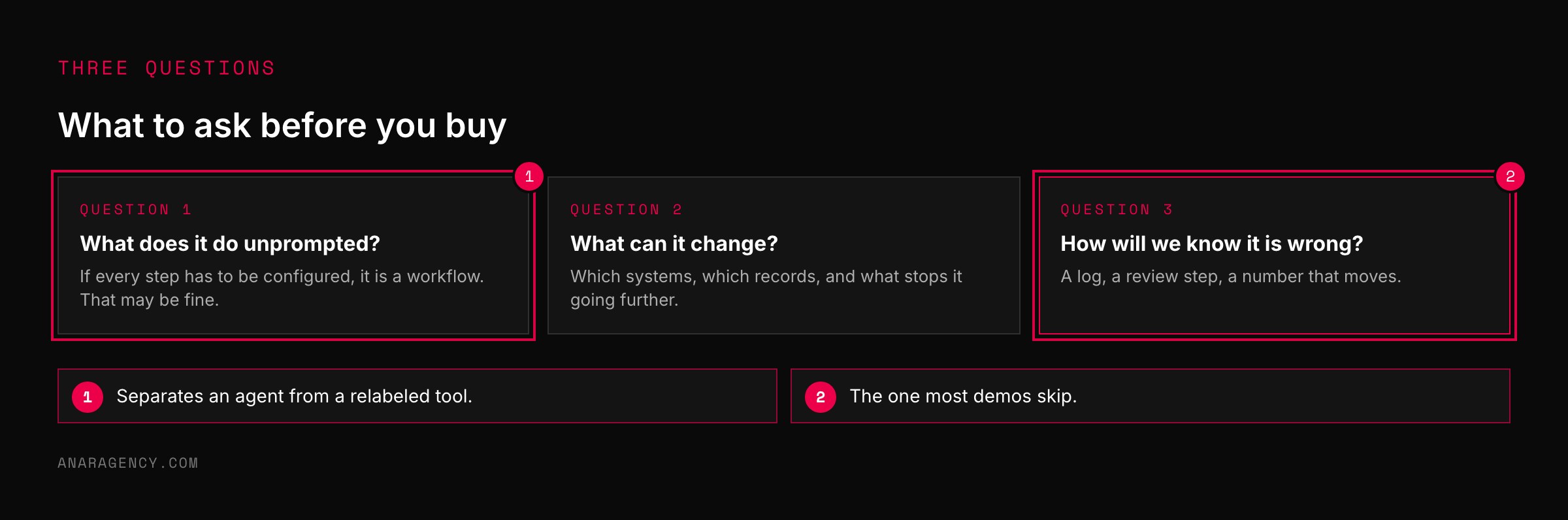
Ask a vendor three questions. What does it do without being told each step? What can it change in our systems, and how is that limited?
How will we know when it is wrong?
For a structured way to think about that last one, the US standards body's AI Risk Management Framework is free and readable. Our own checklist for judging a product is in how to evaluate AI agents.
What to read next, and why
Klarna AI assistant press release (company announcement): The original numbers. Read it as a best case from the party with most reason to be pleased.
Gartner on agentic AI project cancellations (analyst press release): The prediction, the reasons, and the term agent washing.
Building effective agents (engineering guide): The clearest plain-language account of workflows versus agents, from a company that builds the models.
AI Risk Management Framework (NIST): A government framework for thinking about what can go wrong and who answers for it.
So the simple takeaway is this: before asking which agent to buy, find the piece of work with the most volume and the clearest finish line. If you cannot find one, you do not need an agent yet.
Questions executives ask
What is an enterprise AI agent?
A system in which an AI model is given a goal and access to tools, such as search, files, or business software, and decides its own sequence of actions until the task is complete. It differs from a chatbot, which only answers, and from a workflow, which follows predefined steps.
What is the difference between an AI agent and a workflow?
In a workflow, people decide the steps in advance and a model performs some of them. In an agent, the model decides what to do next based on what it finds. Workflows are cheaper and easier to check, so they are the better choice whenever the steps are known.
When do AI agents pay off for a business?
When the work arrives in high volume, has a clear definition of done, and mistakes are either reversible or reviewed by a person before they take effect. Without those conditions, costs tend to exceed the value.
Why do AI agent projects fail?
Gartner attributes expected cancellations to escalating costs, unclear business value, and inadequate risk controls. In practice the common causes are automating a process nobody has defined and choosing an agent where a simpler workflow would do.
What is agent washing?
Gartner's term for vendors rebranding existing products, such as chatbots and robotic process automation, as AI agents without substantial agentic capability. It estimated that only about 130 of thousands of agentic AI vendors were genuine.

Filip Kovacevic is the founder of Anar Agency in Phoenix. He spent five years running SEO, Meta ads, email, and content for medical practices across the United States, and now does the same work for healthcare, home-service, legal, and professional-service businesses, alongside AI implementation. More from Filip →
Talk it through in 15 minutes
Bring one AI question from this article. We will tell you what we would do, whether or not you hire us.
Book a 15-Min Chat →