How a Small Firm Gets a Google Knowledge Panel
A knowledge panel is the information box Google shows for a person, company, or brand it recognizes as a distinct entity. You cannot create or request one. Google generates it automatically when it has consistent, corroborated information from sources it trusts.
A small firm improves its chances by keeping one clear home page about itself, using the same description everywhere, linking its profiles to its site and back, adding Organization or Person structured data, and earning mentions on sites it does not own. If a panel appears, you can verify yourself and suggest changes. A local Business Profile is a different box.
Things, not strings
In May 2012 Google announced a change to how its search engine understood the world.
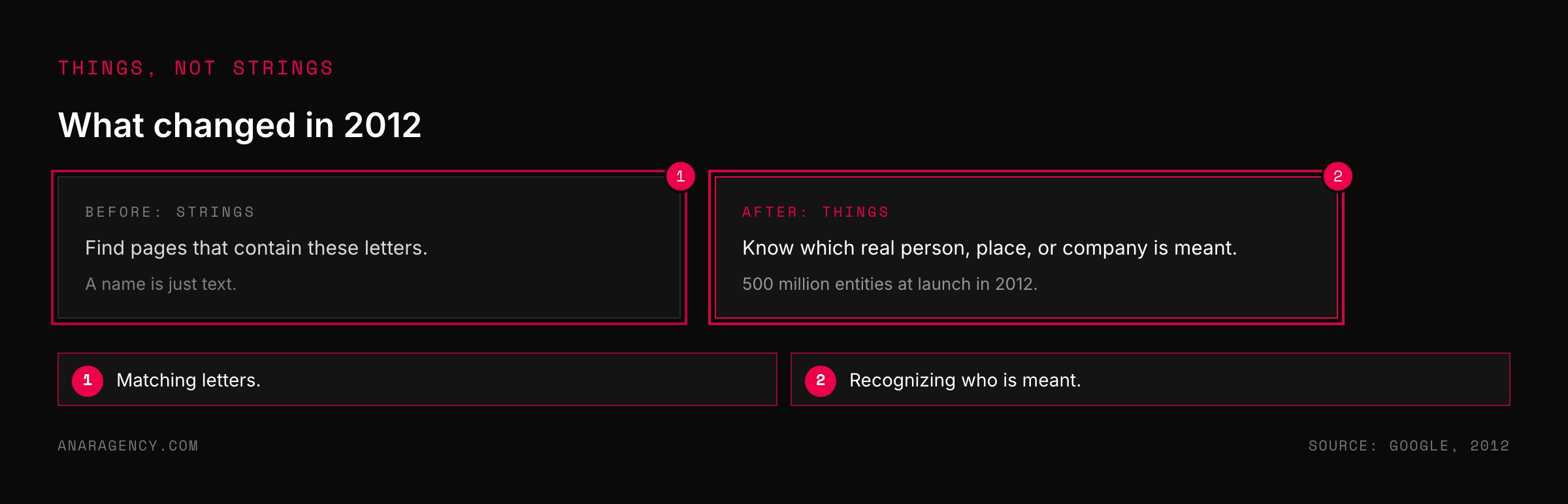
Until then, a search was mostly a matter of matching text. The engine looked for pages containing the same string of letters you typed.
The announcement introduced what Google called the Knowledge Graph. Its phrase for the idea was "things, not strings."
The search engine would hold a model of real things: people, places, companies, books. It launched with more than 500 million of them and more than 3.5 billion facts about how they relate.
The box that sometimes appears beside search results, with a name, a description, and a few facts, is the visible part of that model. For a business, the question is how to become one of the things.
Two boxes people confuse
Before going further, separate two things that look alike.
A Business Profile is the box with a map pin, opening hours, reviews, and a call button. You create it and verify it yourself. Any firm with a location or a service area should have one, and it takes about a week.
A knowledge panel is about an entity as such: a person, an organization, a brand. Google's own explanation says these panels are generated automatically from information across the web.
You cannot create one, and you cannot ask for one. It appears when Google's systems are confident enough about who or what you are.
Most local firms that say they want a knowledge panel actually need a complete Business Profile. Do that first. It is free and the effect is immediate.
The knowledge panel matters for a different reason. It is the sign that search engines, and the AI systems built on similar data, can identify you without confusion.
A knowledge panel is generated by Google when it is confident you are a distinct entity. It cannot be created or requested. Six steps raise the odds: one clear home page about you, one description used word for word everywhere, profiles linked to your site and back, Organization or Person structured data with sameAs links, mentions on sites you do not own, and verification once a panel appears.
A local Business Profile is separate and should be completed first. Nobody can sell you a panel, and a self-written Wikipedia page is usually deleted.
How a machine decides you exist
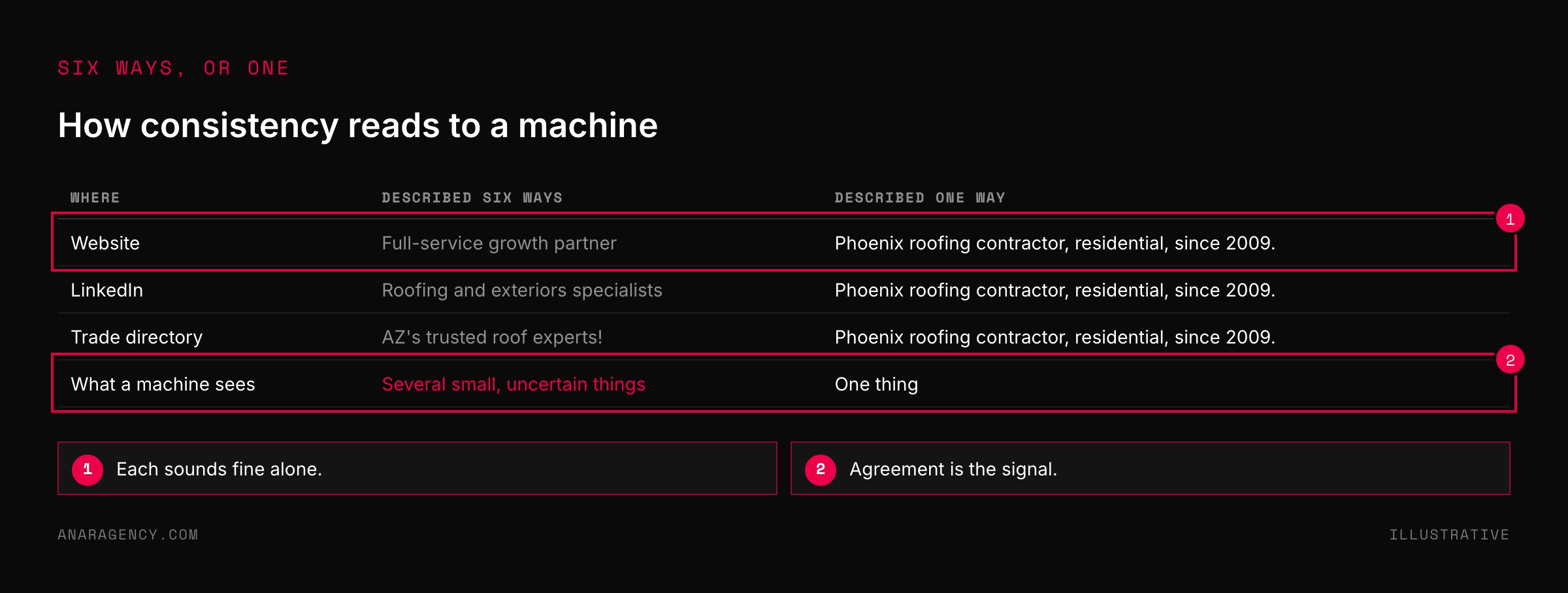
Think about what the search engine has to do. It finds a name on a thousand pages. Are those the same entity, or four different ones?
It becomes confident when the pieces agree. The same name, the same description, the same address, the same people, on source after source.
It becomes more confident when sources it already trusts say so, and when those sources point to each other.
So this is a problem of consistency and corroboration. A firm that describes itself six ways on six sites looks like six small things.
This is close to what we describe in the E-E-A-T checklist: a stranger, or a machine, should be able to check who you are.
Entity Builders: the Knowledge Panel Path
Small firms and solo professionals do get panels. The ones that do have made themselves easy to recognize. We call them Entity Builders.
1. One home. A page on your own site that says plainly who you are, what you do, where, and since when.
For a person, a domain in your own name is the strongest home.
2. One description. Two sentences, used word for word on every profile.
This is the one place where repeating yourself exactly is the right thing to do.
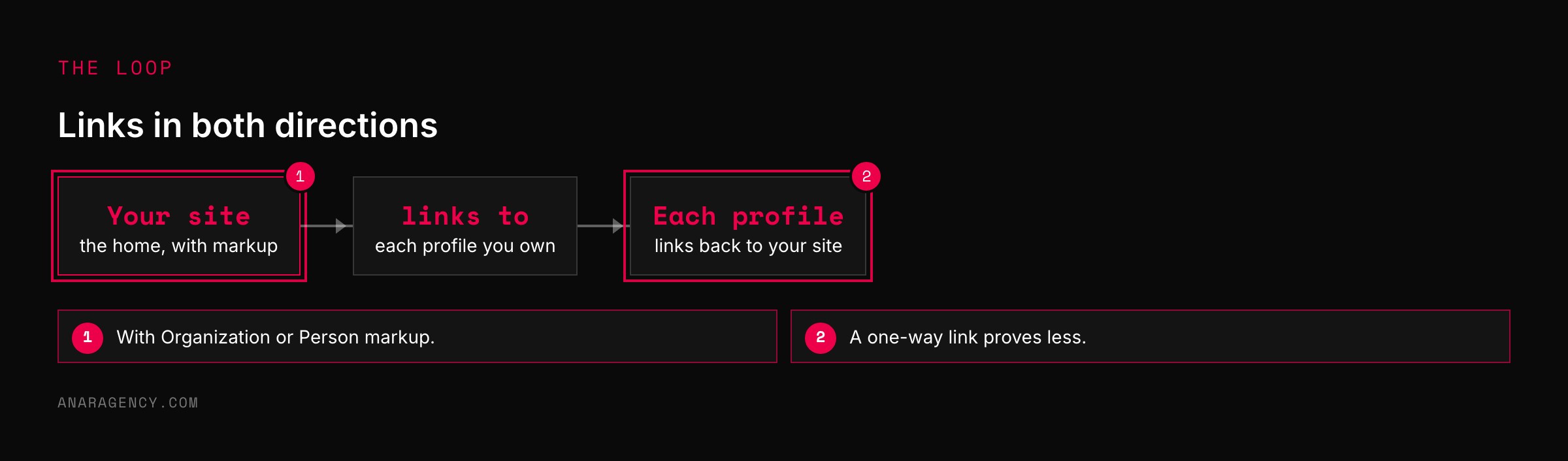
3. Linked profiles, both ways. Each profile links to your site.
Your site links to each profile. The loop is what ties them together.
4. Markup. Add Organization structured data to your home page, or Person data to an author page, and list your profiles using the sameAs property.
It states in machine-readable form what the links imply.
5. Other people's words. Mentions on sites you do not own: trade directories, local press, association listings, interviews.
This is the step that decides the outcome, and it cannot be hurried.
6. Claim it. If a panel appears, Google lets the entity's representative get verified and suggest changes.
Suggestions are reviewed. You gain influence, not control.
"Can I just create a Wikipedia page?"
This is the first idea most people have, and it usually ends badly.
Wikipedia and its sister database have notability standards. Wikidata's policy asks that an item be clearly identifiable and supported by serious public references. Wikipedia's bar is higher.
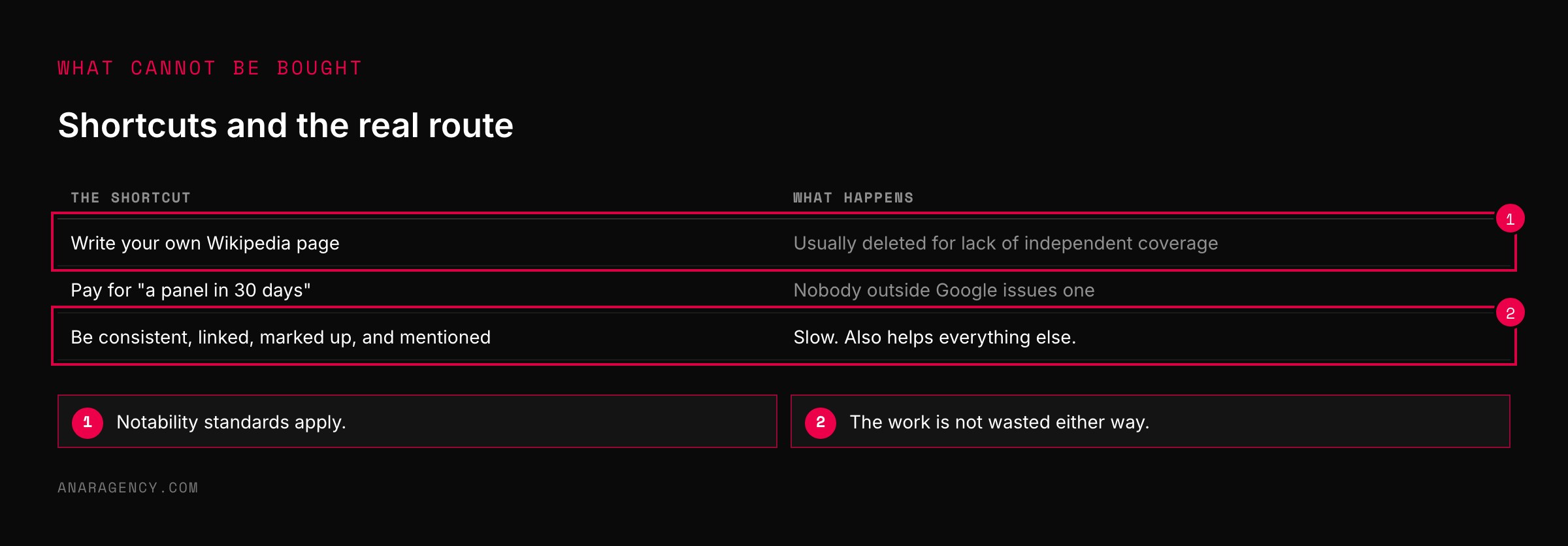
A page written by a firm about itself, with no independent coverage, tends to be deleted. Paying someone to write it does not change the rule and can make matters worse.
The same goes for services that promise a panel in thirty days. Nobody can promise it, because nobody outside Google issues one.
What you can do is the dull work. Be consistent, be linked, be marked up, and earn real mentions. Then wait.
For a small firm it is commonly a matter of months, and for some it never happens.
That is acceptable, because the work is not wasted. The same consistency helps your Business Profile, your rankings, and whether AI assistants name you, which we look at in what AI engines cite.
What to read next, and why
Introducing the Knowledge Graph: things, not strings (Google blog): The 2012 announcement. Short, and it explains the whole idea.
About knowledge panels (Google Help): Where the information comes from and what you can and cannot change.
Organization structured data (Google Search Central): The markup that tells a search engine who you are.
Wikidata: Notability (Wikidata policy): The standard an entry has to meet, in the project's own words.
So the simple takeaway is this: write two sentences that describe your firm, and put those exact two sentences on your site and every profile you own. That is the first step and it costs nothing.
Questions executives ask
How do I get a Google knowledge panel?
You cannot request one. Google generates panels automatically for entities it recognizes. You improve the odds by keeping consistent information about yourself across your site and profiles, linking them together, adding structured data, and earning mentions on independent sites.
What is the difference between a knowledge panel and a Business Profile?
A Business Profile is the local listing with map, hours, and reviews that a business creates and verifies itself. A knowledge panel is an automatically generated box about an entity such as a person, company, or brand.
Can I pay someone to get me a knowledge panel?
No one outside Google issues knowledge panels, so no service can guarantee one. Legitimate help consists of the same work you can do yourself: consistency, structured data, and earning genuine coverage.
How long does it take to get a knowledge panel?
There is no set time. The steps within your control take about a week. Earning independent mentions takes months, and some small entities never receive a panel.
Can I edit my knowledge panel?
Once a panel exists, a representative of the entity can be verified by Google and suggest changes. Google reviews suggestions and decides whether to apply them.

Filip Kovacevic is the founder of Anar Agency in Phoenix. He spent five years running SEO, Meta ads, email, and content for medical practices across the United States, and now does the same work for healthcare, home-service, legal, and professional-service businesses, alongside AI implementation. More from Filip →
Talk it through in 15 minutes
Bring one AI question from this article. We will tell you what we would do, whether or not you hire us.
Book a 15-Min Chat →