Programmatic "AI for [Industry]" Pages Without a Google Penalty

Building many similar pages from a template is not against Google's rules. Building many pages that exist mainly to rank, and add nothing for the reader, is. Google's scaled content abuse policy applies whether a person or an AI wrote the pages, and its doorway policy names pages that are substantially similar and built to catch search queries.
The practical line is five tests per page: real search demand, a swap test, at least three facts that belong only to that industry, a click path from a hub, and no indexing until it passes.
The temptation, with numbers on it
Here is a plan that looks like free money. People search for "AI for law firms" 3,760 times a month in the United States. For real estate, 1,920.
For accounting firms, 1,920.
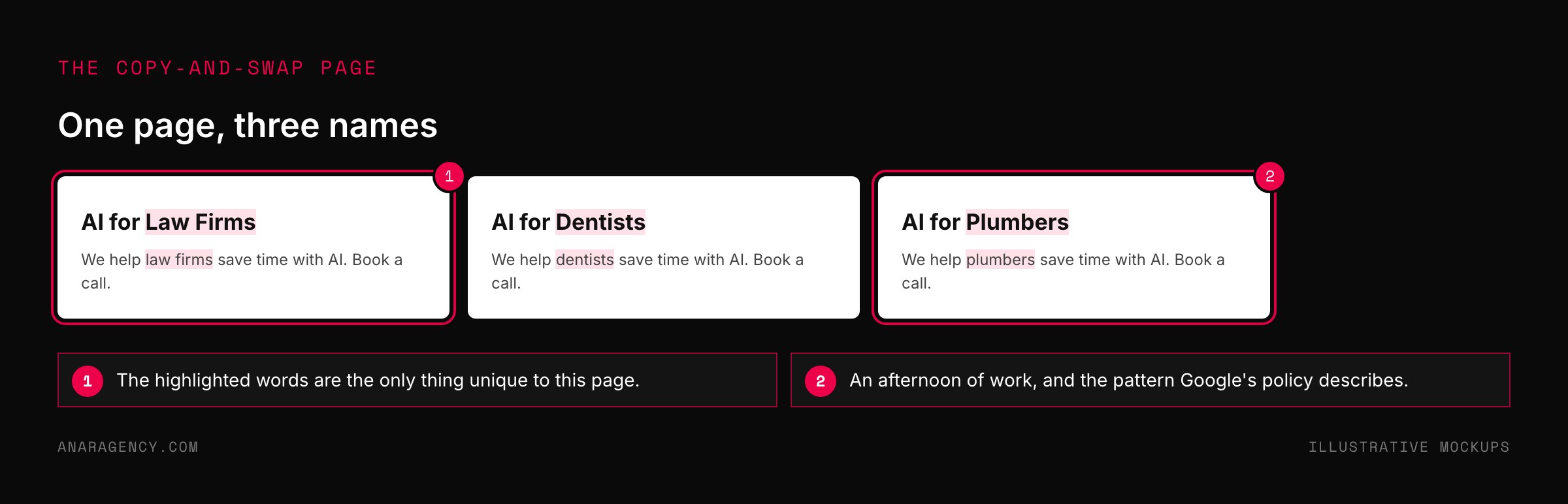
You already have a page about what you do. So you copy it eleven times, swap the industry name, and wait for the traffic.
With an AI model, that is an afternoon of work. That is exactly why Google wrote a policy about it.
We have skin in this one. We sell AI implementation and we have pages for law firms and for accounting firms. So we had to work out where the line is before we built a third.
What Google's two policies actually say
Two of Google's spam policies apply here, and they are short enough to read in full.
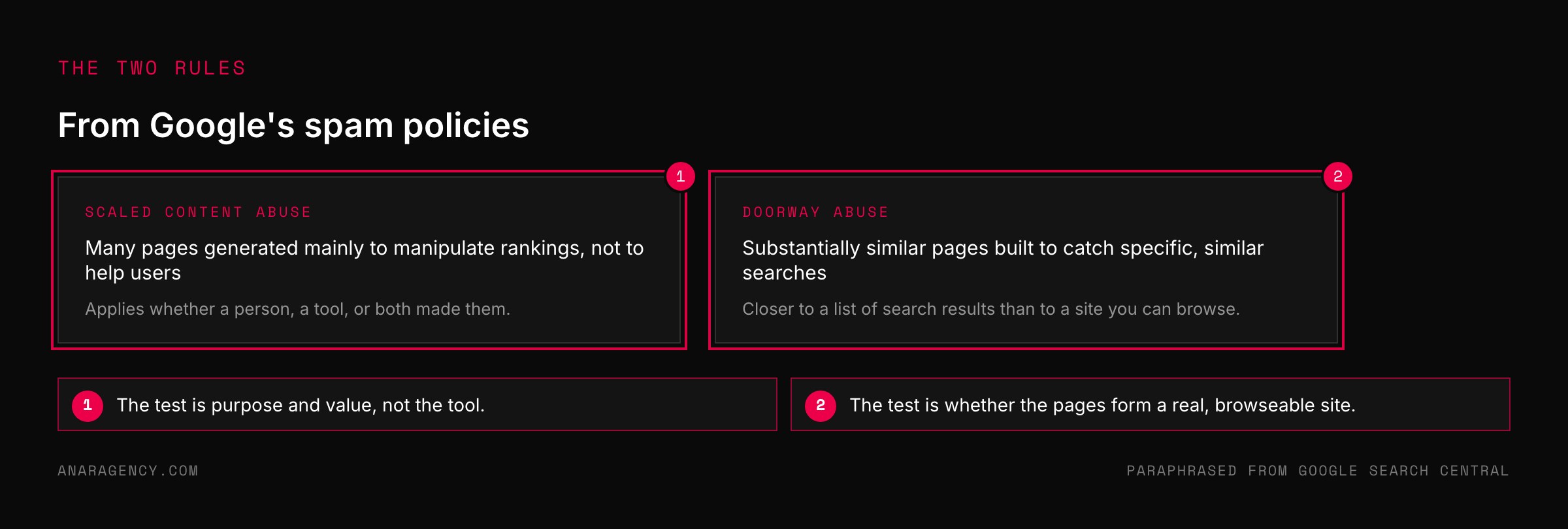
Scaled content abuse. Google defines it as generating many pages for the primary purpose of manipulating search rankings and not helping users. The first example on its list is using generative AI tools to generate many pages without adding value for users.
Note what the definition turns on. It is not the tool and it is not the number of pages. Google said when it introduced the policy that it applies whether content is produced through automation, human effort, or a mix.
The test is purpose and value.
Doorway abuse. This is the older rule. It covers pages created to rank for specific, similar queries that lead users to pages less useful than the final destination.
One listed example is creating substantially similar pages that are closer to search results than to a clearly defined, browseable hierarchy.
Read that last phrase again, because it describes the eleven-copy plan exactly. Pages that look like a list of search queries, not like a site somebody organized.
Five tests, run on each page before it is indexed. Demand: there is measurable search demand for this exact page. Swap: replace the industry name, and few or no sentences still read as true.
Own facts: at least three things on the page are true only for this industry. Path: the page can be reached from a hub in two clicks or fewer. Hold: any page that has not passed the first four stays noindexed.
Named Pages: what the programmatic pages that survive have in common
Some sites run thousands of template-built pages and have for years. They are not getting away with something.
Their pages do three things the copy-and-swap page does not. We call them Named Pages, because each one is about a specific named thing and could not be about anything else.
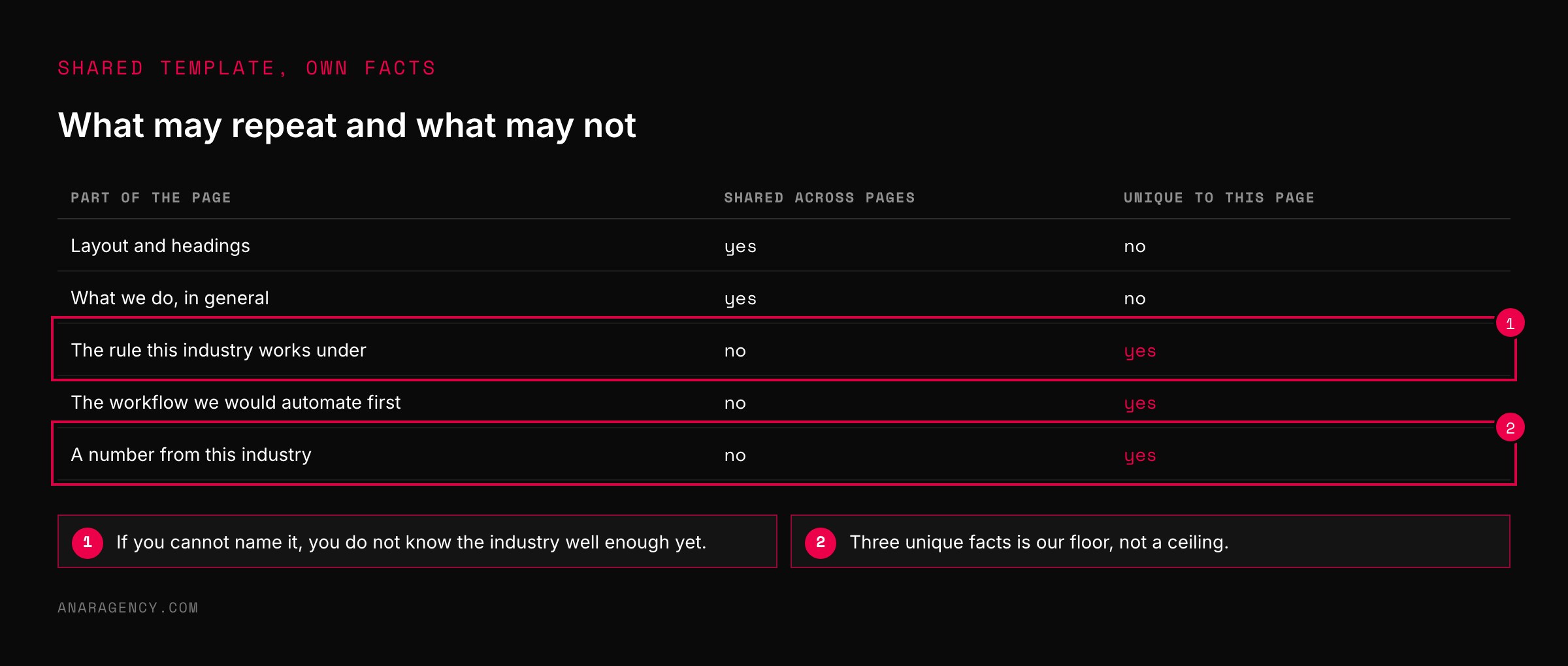
Every page holds something only it could hold. Think of a flight page for one route, with that route's prices. Or a software page for one pairing of two apps, listing what that exact pairing can do.
The template is shared. The facts are not.
They sit in a place you can browse to. You can reach the page by clicking from a category, without ever using a search engine. That is the hierarchy Google's doorway policy is asking about.
They exist because someone needs them. The demand comes first and the page second. That is the opposite of generating every combination a keyword tool can list.
Google drew this line in public in March 2024. It announced a change to its ranking systems and said it expected the work to reduce low-quality, unoriginal content in results by 40 percent. It later updated that figure to 45 percent.
So this is not a rule that sits unenforced in a help document. It is one Google has measured itself against.
Programmatic Guardrails: five tests per page
Here is the method we now use on our own industry pages. Five tests, run on each page, not on the template.
The demand test. Is there measurable search demand for this exact page? In our data, law firms, real estate, and accounting had it.
Several industries with large ad budgets, including med spas and plastic surgery, had none we could measure. Those buyers exist. They just do not search this way, so a search page for them is a page for nobody.
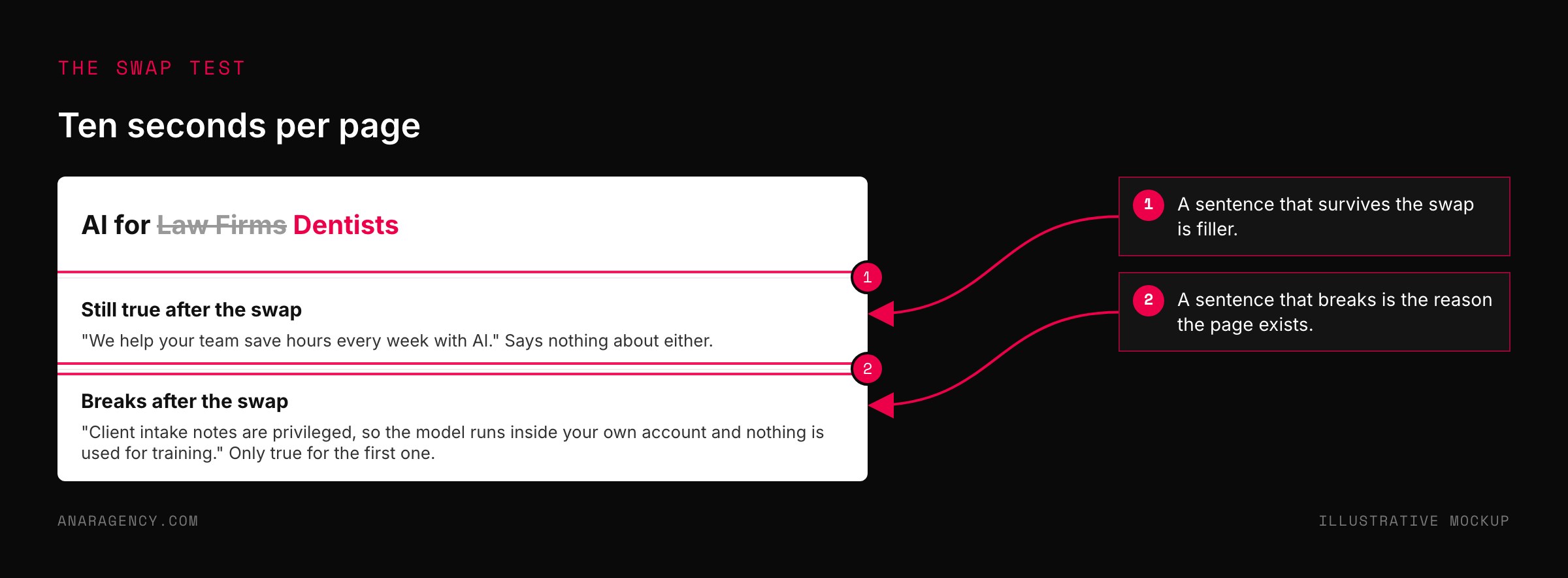
The swap test. Replace the industry name with a different one and read the page. Every sentence that is still true is a sentence that says nothing about either industry.
A page where most sentences survive the swap is a doorway.
The own-fact test. The page needs at least three things that are true only for this industry. For law firms that might be confidentiality duties, the intake workflow, and how matters are billed.
If you cannot name three, you do not know the industry well enough to publish the page.
The path test. A visitor should be able to click to the page from a hub in two clicks or fewer. We covered that structure in our hub-and-spoke article.
The hold test. Until a page passes the first four, keep it out of Google with a noindex rule. Google's policy page says the same: if you host content like this, exclude it from Search.
"But my competitors have five hundred of these pages and they rank."
You may be looking at a competitor with a page for every city and every trade and thinking the rules clearly are not enforced. Some of those pages do rank, today.
We cannot see inside Google, so we will not tell you when or whether a given site gets hit. What we can tell you is what you are betting.
If the pages are thin and Google's systems catch up, the cost is not only those pages. Google's guidance asks whether content looks mass-produced so that individual pages do not get much attention or care, and that judgment is about a site, not one page.
There is also a plainer argument. A buyer who lands on a page that could have been about anyone does not call. Even when the copy-and-swap page ranks, it does not sell.
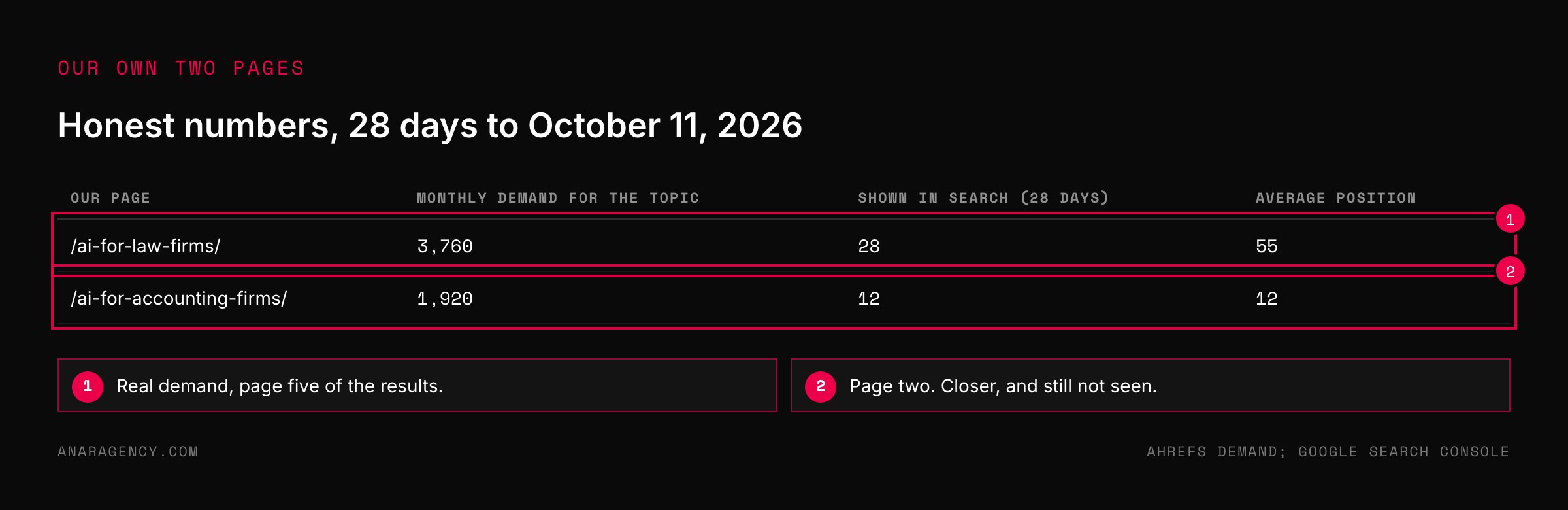
Our own numbers keep us humble here. In the last 28 days our law firm page was shown 28 times at an average position of 55, and our accounting page 12 times at position 12. Two pages, built by hand, and barely visible yet.
Eleven thin ones would not have fixed that.
And Google's note on AI content is not a ban. It says AI is useful for research and structure. Use it to draft, then add the three facts only you know.
What to read next, and why
Spam policies for Google web search (Google documentation): Read the scaled content abuse and doorway sections. Together they are under 300 words, and they are the whole rulebook for this topic.
What web creators should know about our March 2024 core update and new spam policies (Google blog): The questions and answers on AI content settle most arguments.
Guidance on using generative AI content (Google documentation): Short. It says what AI is fine for and where it crosses the line.
Consolidate duplicate URLs (Google documentation): For when you already have near-identical pages and need to fold them into one.
So the simple takeaway is this: a template is fine and a copy is not. If you can swap the industry name and the page still reads as true, you have not written a page yet.
Questions executives ask
Is programmatic SEO against Google's rules?
Not by itself. Google's scaled content abuse policy targets generating many pages for the primary purpose of manipulating rankings without helping users. Template-built pages that each hold unique, useful information and sit in a browseable site structure are a long-standing, accepted practice.
What is scaled content abuse?
It is Google's term for generating many pages mainly to manipulate search rankings and not to help users. Google's examples include using generative AI tools to generate many pages without adding value. The policy applies whether the pages were made by automation, by people, or by both.
What is a doorway page?
A page created to rank for specific, similar search queries that leads users to something less useful than the final destination. Google's examples include substantially similar pages that are closer to a list of search results than to a clearly defined, browseable hierarchy.
How many industry pages can I safely build?
There is no safe number, because the policy is about purpose and value, not count. Build a page for each industry where there is real search demand and where you can state at least three facts that are true only for that industry. Keep any page that cannot pass that test out of the index.
Can I use AI to write industry landing pages?
Yes. Google's guidance says generative AI is useful for research and for adding structure to original content. It also says to fact-check AI output before publishing and warns that generating many pages without adding value may violate the scaled content abuse policy.

Filip Kovacevic is the founder of Anar Agency in Phoenix. He spent five years running SEO, Meta ads, email, and content for medical practices across the United States, and now does the same work for healthcare, home-service, legal, and professional-service businesses, alongside AI implementation. More from Filip →
Talk it through in 15 minutes
Bring one AI question from this article. We will tell you what we would do, whether or not you hire us.
Book a 15-Min Chat →