E-E-A-T for Agencies and Consultants: What Google Actually Checks

E-E-A-T stands for experience, expertise, authoritativeness, and trust, and Google says plainly that it is not a ranking factor by itself. It is a description of what Google's systems try to reward: pages where a stranger can tell who wrote this, how they know, and why it was written. For an agency or consultant, that comes down to twelve things anyone can verify, from a real name and author page to your own dated numbers.
Trust is the letter that counts, and the other three are ways of earning it.
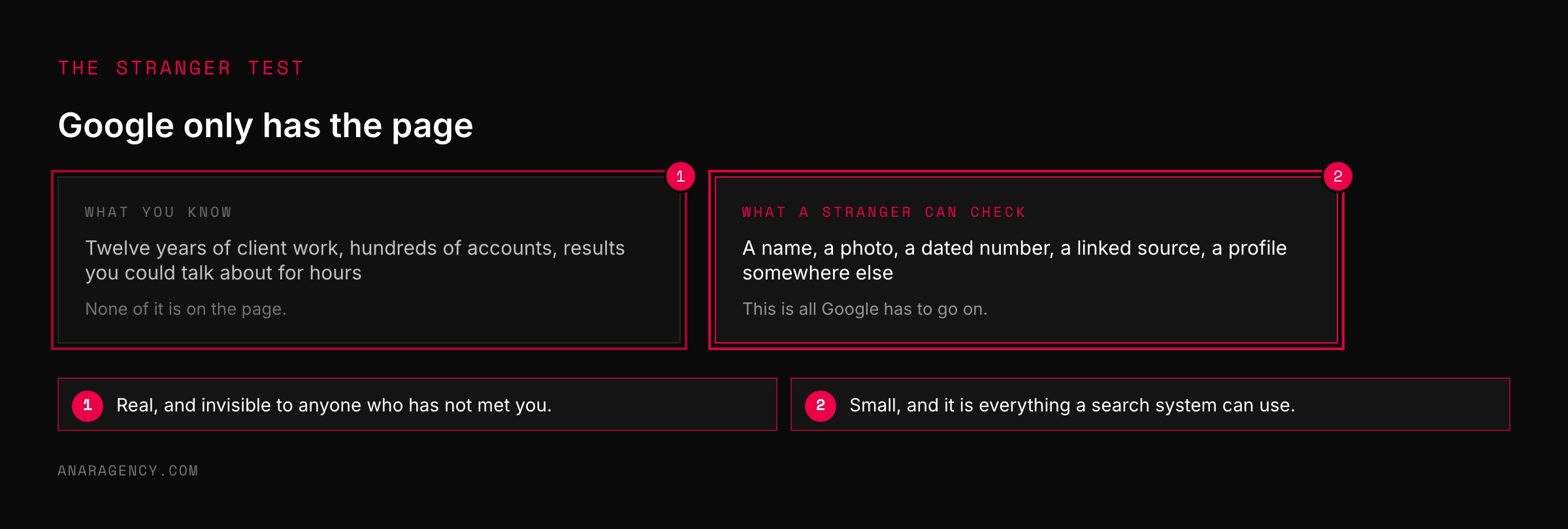
Google has never met you
Google cannot shake your hand. It cannot sit in on a client call or watch you fix an account.
All it has is the page. So everything Google says about quality comes down to one question: can a stranger tell that this page is safe to believe?
That is what E-E-A-T is. It is four words for the things a stranger checks before trusting someone: experience, expertise, authoritativeness, and trust.
Most of what is sold as E-E-A-T work misses this. There is no score. There is no plugin.
Google's own guidance says it in one line: E-E-A-T itself is not a specific ranking factor.
What Google's systems do is use a mix of signals to find pages that show those four things. Your job is not to raise a number. It is to make the checkable things on your site checkable.
What the four letters mean, in Google's words
Until December 2022 there were three letters. Google added the first E, for experience, to separate a page written by someone who did the thing from a page assembled out of other pages.
Google is specific about the order of importance. Of the four, trust is the most important. The others contribute to trust, and a page does not have to show all of them.
It is also specific about who uses the idea. Human reviewers called search quality raters score results against a public set of guidelines. Those raters cannot move your page up or down.
Google compares their feedback to the comment cards a restaurant collects from diners. The cards do not cook the food. They tell the kitchen whether it is working.
One more thing sits on top. For topics that can affect a person's health, money, or safety, Google's systems give more weight to these signals. It calls those topics Your Money or Your Life.
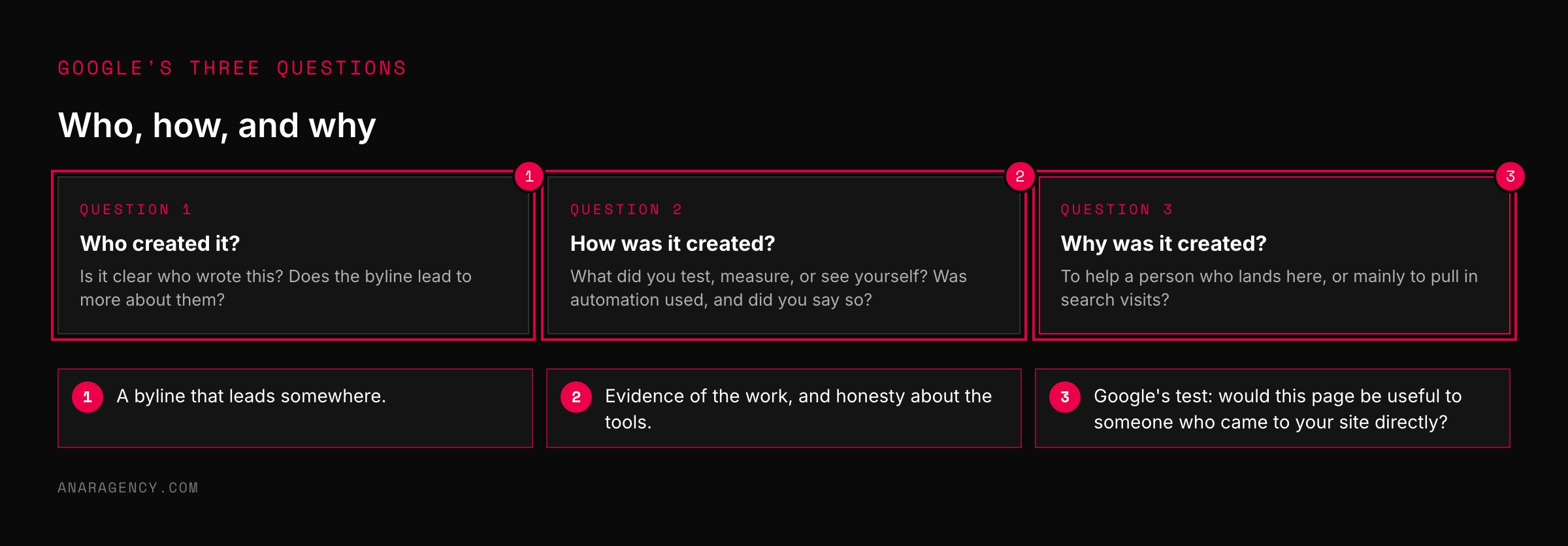
Twelve things a stranger can verify, four under each of Google's three questions. Who: a real name, a photo, an author page, matching profiles elsewhere. How: your own dated data, your own screenshots or figures, a line on how the piece was made, a source for every number.
Why: the answer comes before the pitch, the reader gains something even if they never hire you, real contact details, and visible dates. Run it on your three most important pages first.
Trusted Strangers: what the sites that pass have in common
Some small sites get believed by Google faster than sites ten times their size.
They are not gaming anything. They do three plain things, and each one lines up with a question Google tells you to ask about your own content: who, how, and why. We call these sites Trusted Strangers.
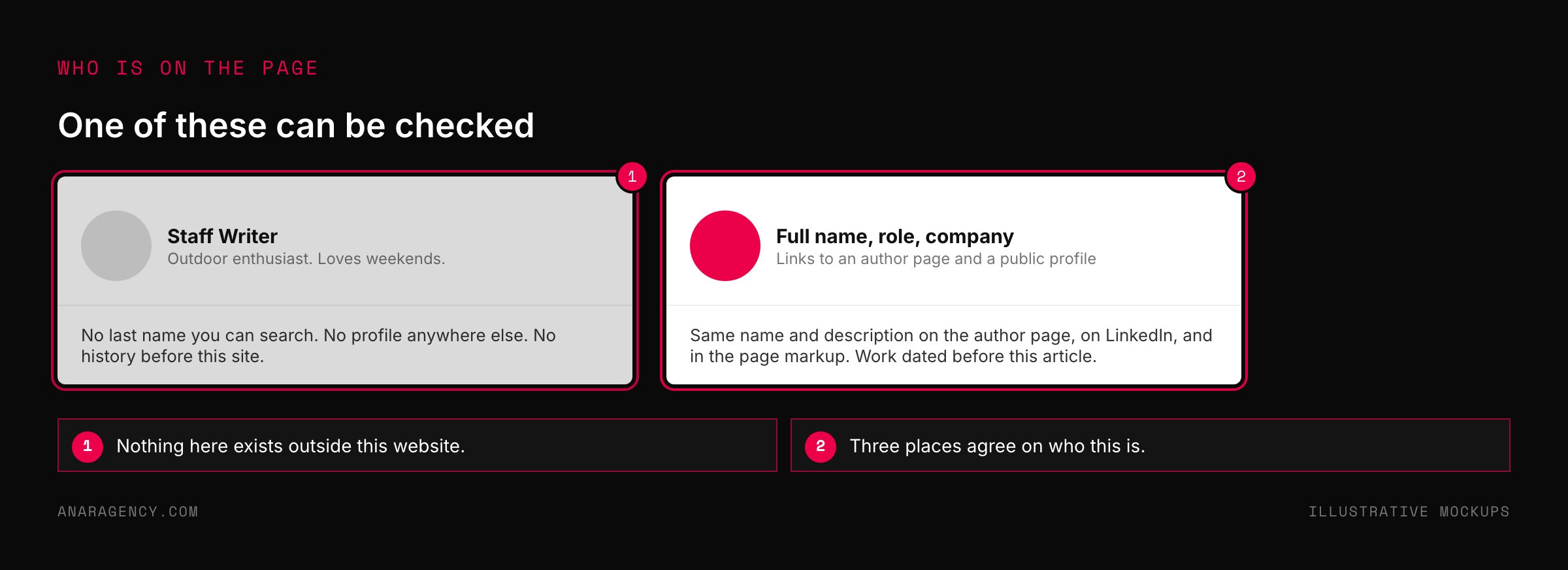
They put a real person on the page. Google strongly encourages accurate bylines and says a byline should lead somewhere a reader can learn more. The fastest way to see why is to look at a company that faked it.
In November 2023, the news site Futurism reported that Sports Illustrated had published product reviews under writers who did not appear to exist. One was named Drew Ortiz. His headshot was for sale on a site that sells AI-generated faces.
After reporters asked about him, the authors vanished from the site. The magazine said a third-party company had produced the articles and that it was ending the relationship. Seventy years of reputation, and the story of that month was a writer who was never born.
Google now names this directly. Its guidance says that fabricating creator profiles, with AI-generated headshots, made-up names, or false credentials, is a form of deception that makes a page untrustworthy.
They show how they know. A claim with your own number, your own screenshot, and a date on it is something only you could have written. That is the experience letter, and it is the one a competitor cannot copy.
They can be looked up somewhere else. The same name, the same role, and the same company description on LinkedIn, on a profile page, and in the site's own markup. Google documents the markup for author profile pages, for the organization, and for the article itself.
The E-E-A-T Checklist
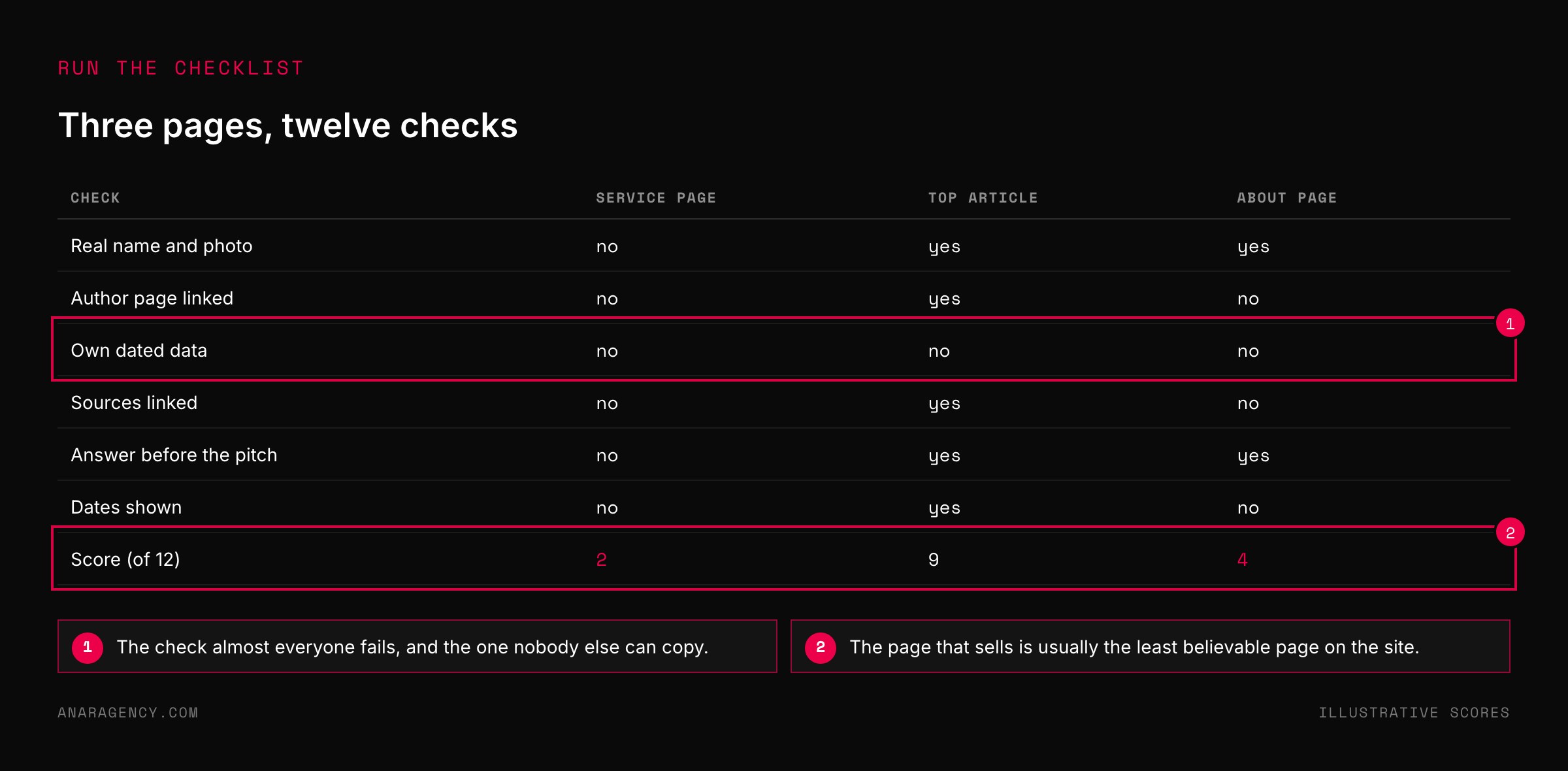
Here is the whole thing on one page. Twelve checks, four under each of Google's three questions.
Run it on your three most important pages, not on the whole site. Those are the pages a buyer reads before they call, and they are the ones Google has the most reason to judge.
Most agency sites we look at score four or five out of twelve. They have a logo where the author should be, no dates, no sources, and a claim of expertise with nothing a stranger could verify.
The fixes are small. An author page takes an afternoon. Dating your numbers takes a minute each.
Linking a source takes less.
Our own site failed several of these in July. Eleven articles went up with a company byline and few sources, and ninety days later they had been shown 1,745 times in search and clicked five times. We tell that story in our piece on hub-and-spoke SEO.
"That is for doctors and banks, not for a marketing consultant."
You may be thinking the high bar is for medical sites and lenders. It is higher for them. It is not zero for you.
Think about what a consultant's page actually does. It tells an owner how to spend twenty thousand dollars a month on ads, or which software to bet the company on. That is advice about money.
Whether Google's systems treat a given marketing page as a money topic is not something we can see from outside. What we can see is that the guidance for everyone is the same three questions.
There is a second objection, and it is about AI. Many agencies now draft with it, and they worry that alone is a mark against them.
It is not. Google's guidance on generative AI content says AI can be useful for research and structure. What breaks the spam policies is using it to generate many pages without adding value for users.
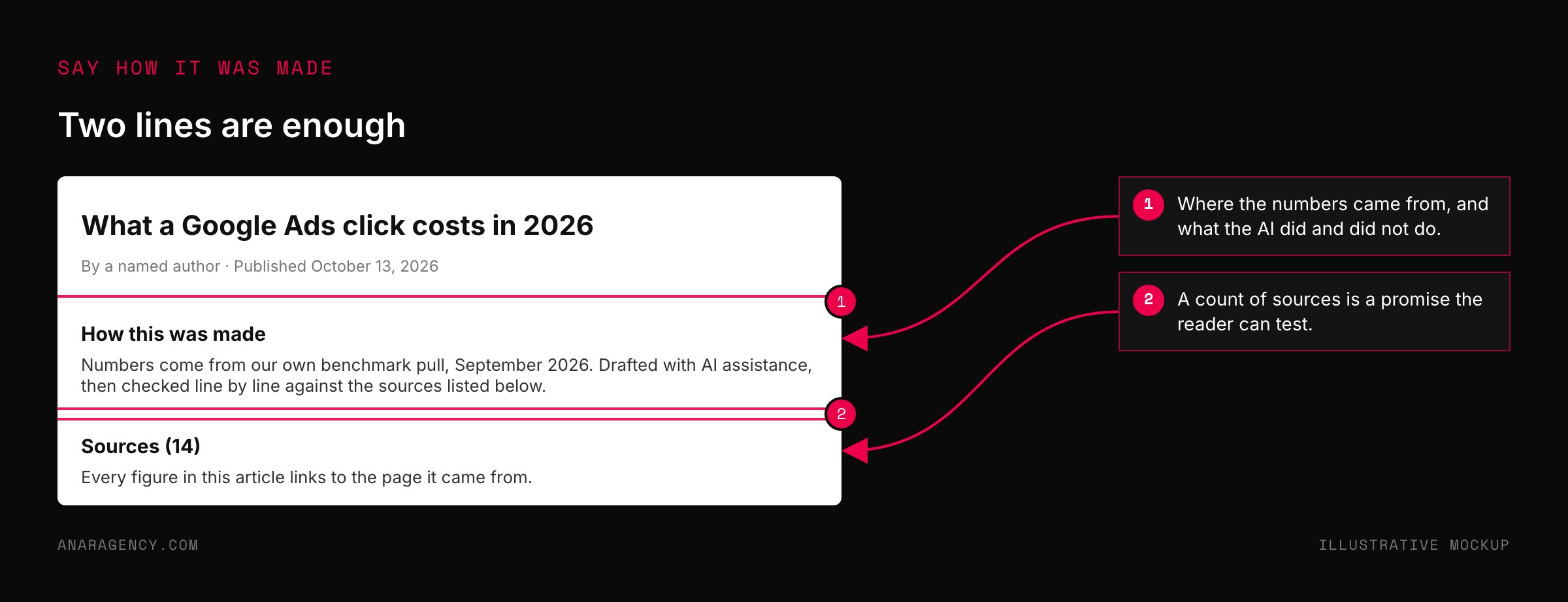
The same guidance says to check every AI draft for accuracy, and to tell readers how a piece was made when they would reasonably wonder. So use the tool, add what only you know, check the facts, and say so.
What to read next, and why
Creating helpful, reliable, people-first content (Google documentation): The single most useful page Google has published on this. The Who, How, and Why section is the checklist's skeleton.
Search Quality Evaluator Guidelines (PDF): Long. Read only the parts on trust and on low-quality pages. It is the closest thing to seeing how a reviewer thinks.
Sports Illustrated Published Articles by Fake, AI-Generated Writers (news): Ten minutes on what happens when the Who is invented.
Profile page structured data (Google documentation): The markup for an author page. Hand it to whoever builds your site.
So the simple takeaway is this: E-E-A-T is not something you add to a page. It is whether a stranger can check who you are, how you know, and why you wrote it. Make those three things checkable and the letters take care of themselves.
Questions executives ask
Is E-E-A-T a Google ranking factor?
Not by itself. Google's guidance says E-E-A-T is not a specific ranking factor. Its systems use a mix of signals to identify content that shows experience, expertise, authoritativeness, and trust, and they give those signals more weight on topics that affect health, money, or safety.
What does E-E-A-T stand for?
Experience, expertise, authoritativeness, and trust. Google added the first E, experience, in December 2022. Google says trust is the most important of the four and that the other three contribute to it.
How do I improve E-E-A-T on my website?
Make the checkable things checkable. Put a real name and photo on every article, link the byline to an author page, show your own dated numbers and screenshots, link a source for every statistic, answer the question before you sell, and show dates and contact details. Start with the three pages buyers read before they call.
Does AI-written content hurt E-E-A-T?
Using AI is not against Google's guidance. Generating many pages without adding value is, under the scaled content abuse policy. Google asks that AI-assisted content be checked for accuracy and that readers be told how it was made when they would reasonably wonder.
Inventing authors with AI headshots or fake credentials is named as deception.
Do search quality raters affect my rankings?
No. Google says raters have no control over how pages rank and their ratings are not used directly in ranking. Their feedback is used to check whether Google's systems are producing good results.

Filip Kovacevic is the founder of Anar Agency in Phoenix. He spent five years running SEO, Meta ads, email, and content for medical practices across the United States, and now does the same work for healthcare, home-service, legal, and professional-service businesses, alongside AI implementation. More from Filip →
Talk it through in 15 minutes
Bring one AI question from this article. We will tell you what we would do, whether or not you hire us.
Book a 15-Min Chat →