Model-Agnostic by Design: Big AI Bets Without Vendor Lock-In
Model-agnostic does not mean using every model. It means you can swap your primary model in weeks without rewriting your workflows. You get there by owning your harness, your prompts, your evaluation sets, and your data pipelines, and treating the model itself as a part behind an interface.
Do that and every price war and every new release works in your favor.
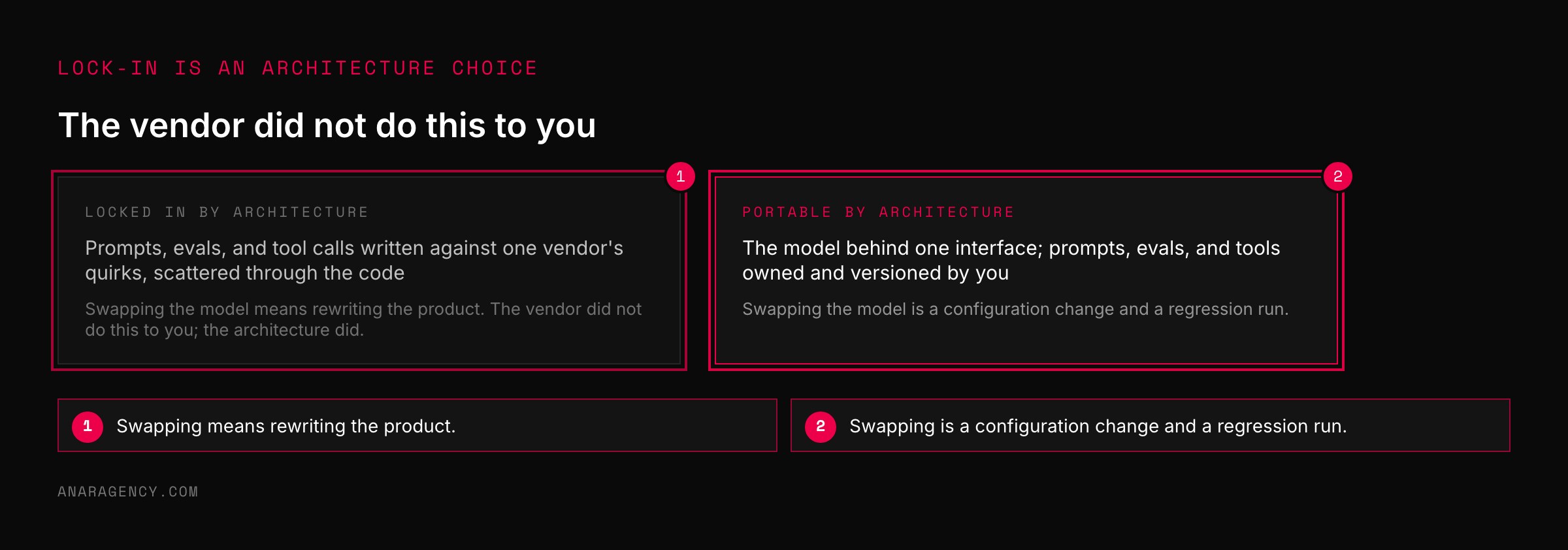
Lock-in is an architecture choice, not a vendor behavior
Teams do not get locked in because a vendor trapped them. They get locked in because they built their workflows directly against one vendor's proprietary features, formats, and platform services.
Every convenience feature you adopt raw, such as vendor-specific memory, hosted agents, and proprietary file stores, is one strand of rope. Each one is trivial. Together they bind.
The frontier has changed leaders repeatedly in three years, on price as much as on capability. So the value of staying portable is not hypothetical. It is the ability to capture each leap and each price war within weeks instead of quarters.
What to own, what to rent
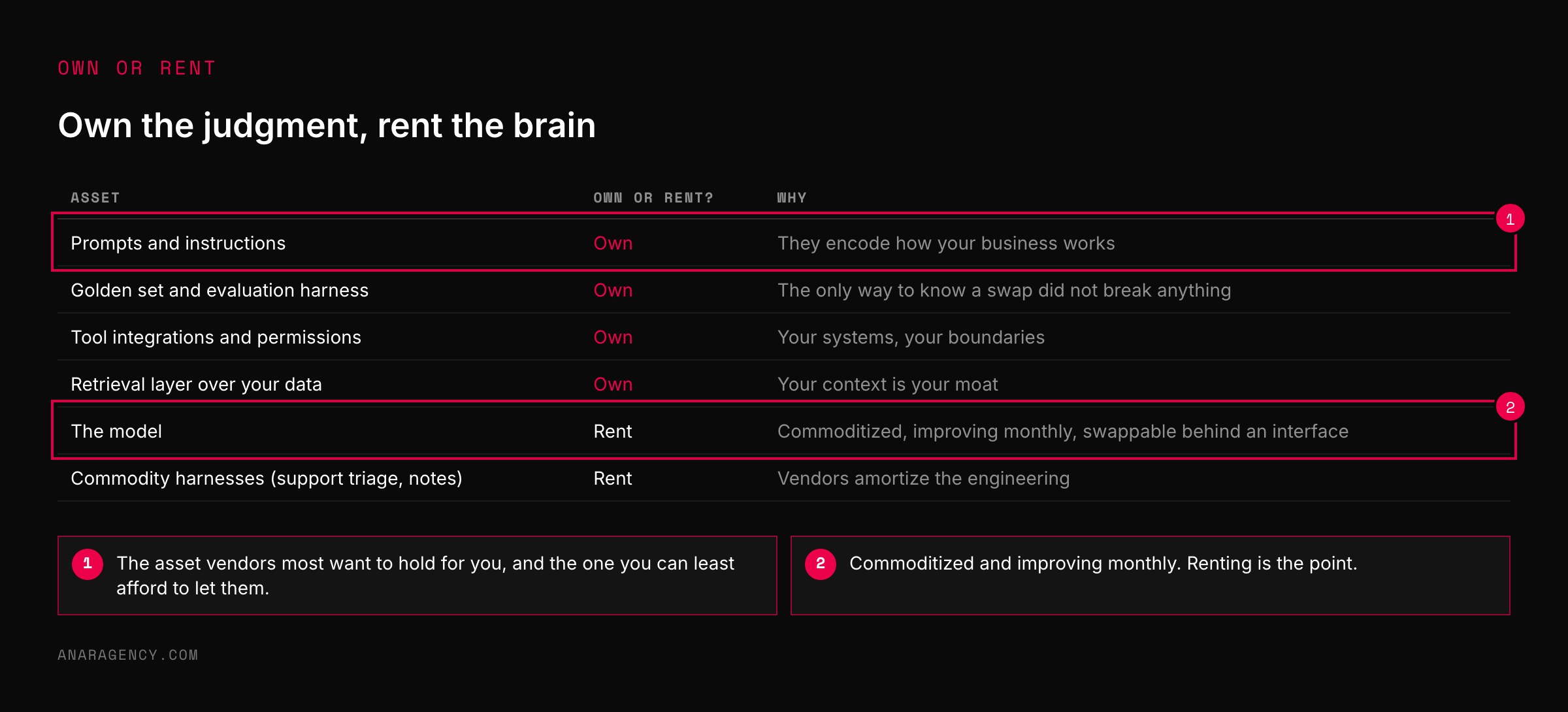
Own four things and rent one.
Own the harness: tool definitions, permissions, guardrails, recovery logic, written against your own interface with the model as a swappable part behind it.
Own the prompts and context: versioned in your repository like code, not living inside a vendor console.
Own the evaluation sets: your golden cases are precisely what makes switching cheap, because a candidate model earns its place in an afternoon of tests instead of a quarter of anxiety.
Own the data pipelines: retrieval, embeddings storage, and logs in systems you control.
Rent the intelligence: the model API itself. Keep the switching cost low on purpose, because that low cost is your negotiating leverage at every renewal.
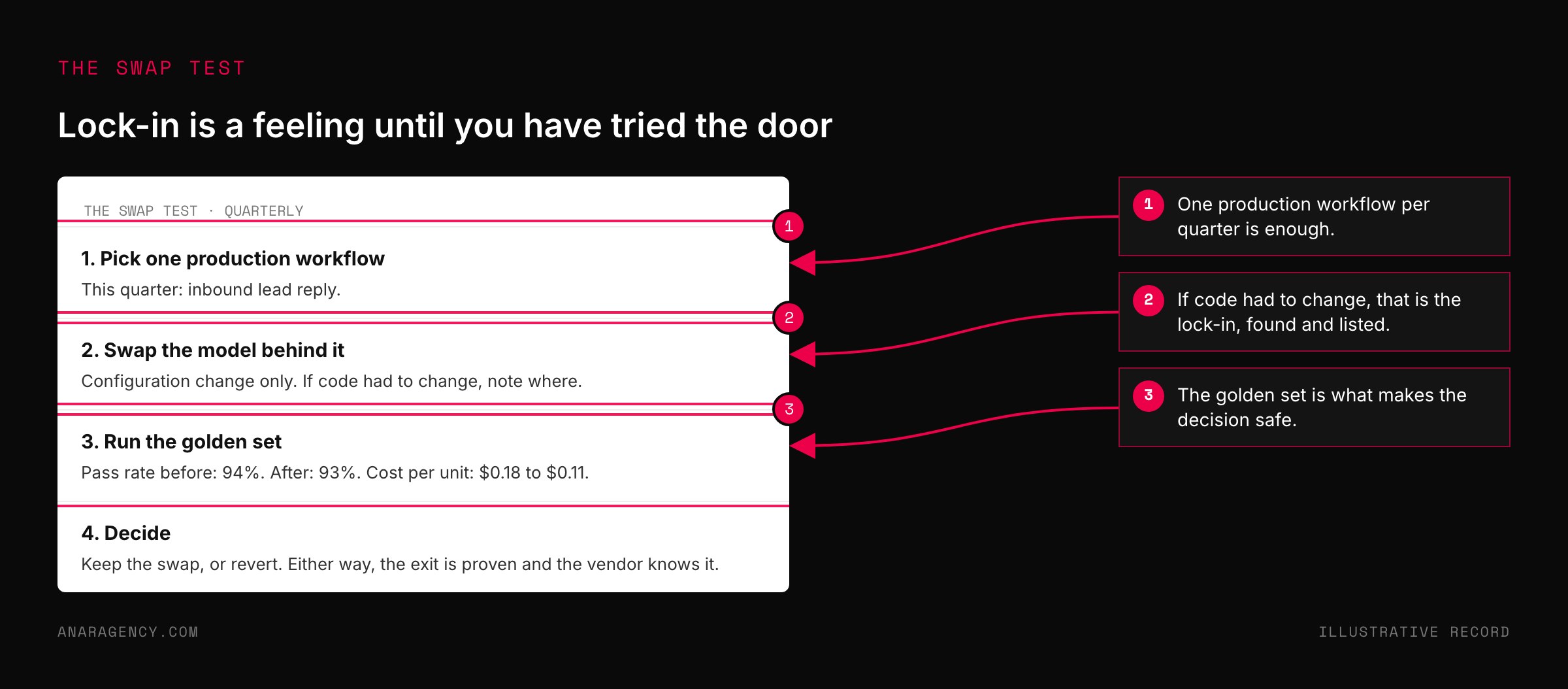
Once a quarter, price the question honestly: if our primary model vendor doubled prices tomorrow, how many weeks and dollars to move? If the answer exceeds one quarter of engineering, identify which owned layer has leaked into vendor coupling (harness, prompts, evals, data) and pull it back. The number is your lock-in, measured.
Multi-model in practice: routing, not collecting
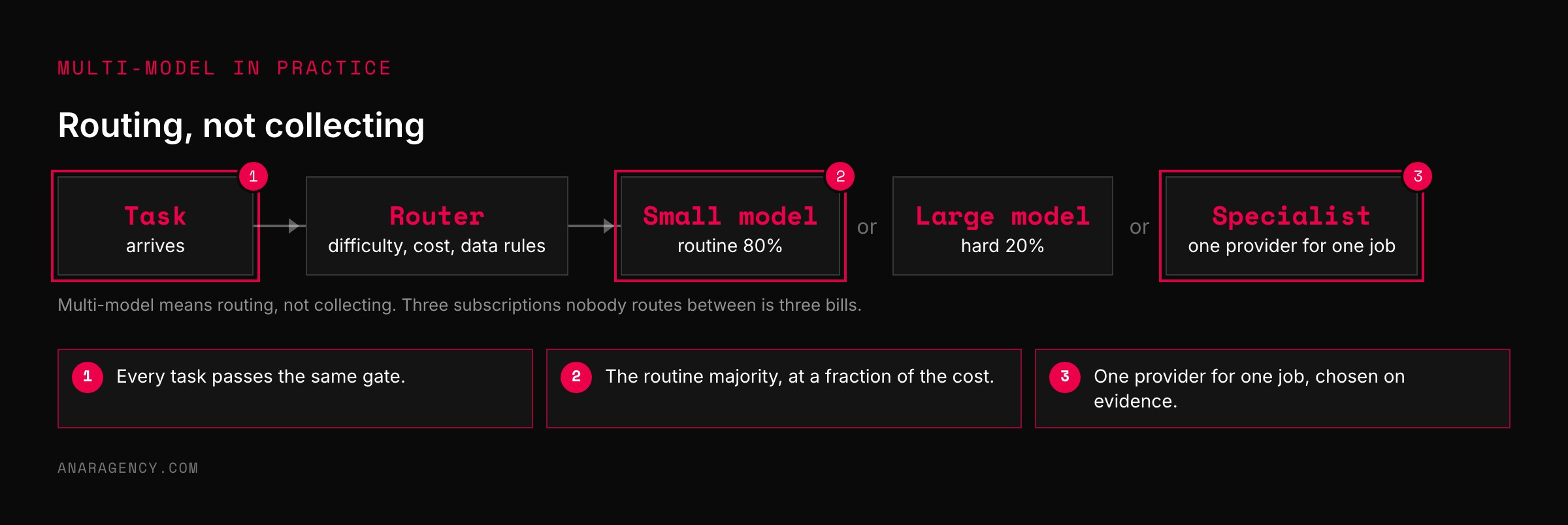
A practical multi-model setup is boring. One primary model family for most work. One secondary kept warm through your evaluation suite.
Cheap, fast models for high-volume, low-stakes tasks. And routing rules that assign work by cost and stakes.
The goal is not variety for its own sake. It is a live, tested alternative, which turns every vendor negotiation and every outage from a crisis into a routing change.
Run the secondary against your golden sets every month. An alternative you have never tested is a slide, not a strategy.
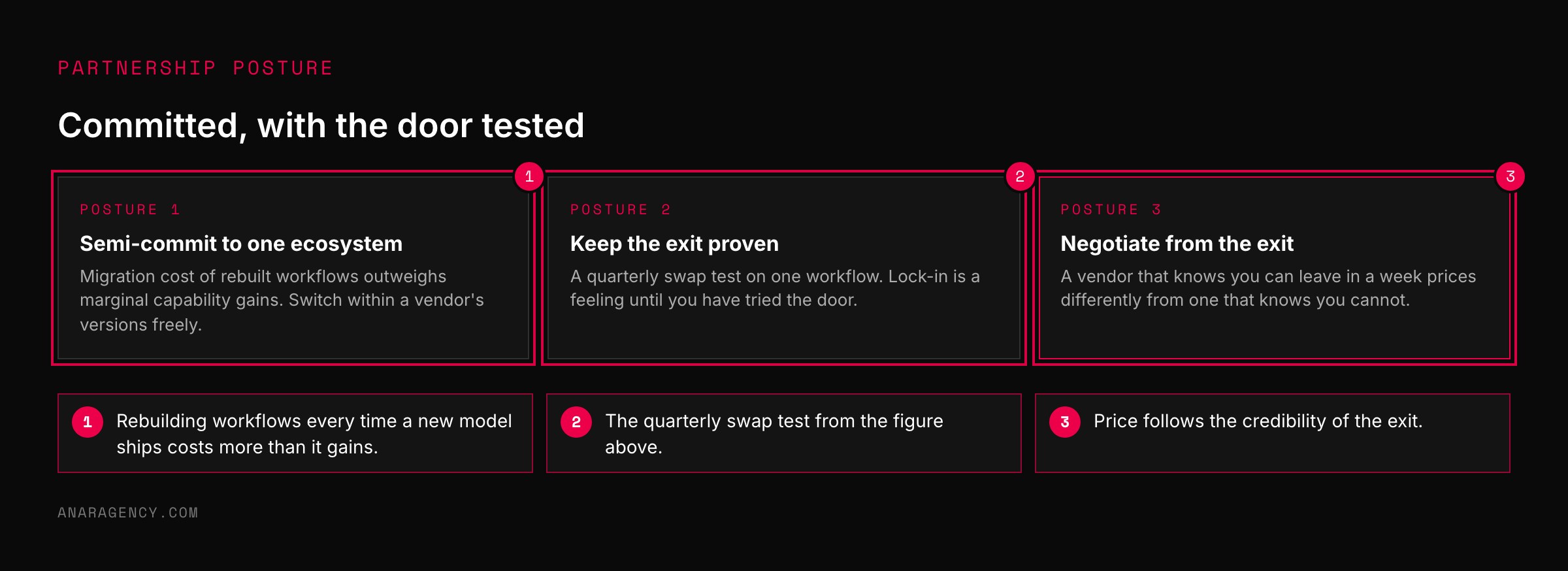
Partnership posture for a moving frontier
Structure vendor relationships so you can reverse them. Enterprise terms with training exclusion and data deletion. Contract lengths matched to the pace of the frontier: annual, not five-year.
Commercial commitments tied to per-unit prices, not platform exclusivity.
Take partner programs and credits where they are free. Decline them where they require you to tangle your architecture into theirs.
The strong version of partnership is real relationships with two or three labs, while you own every layer that would make leaving any one of them expensive. You can be a good partner and still keep the door tested.
Door Testers: what portable companies have in common
Some companies change AI models the way you change a tire. Annoying, quick, and nobody calls a meeting.
They did not pick a better vendor than you did. They built three habits that make the vendor matter less. We call these companies Door Testers, because they know the exit works before they need it.
They treat the leaderboard as weather. At the end of 2023, OpenAI held 50 percent of enterprise model usage, according to Menlo Ventures. By the middle of 2025 that share was 25 percent, Anthropic led with 32 percent, and Google had climbed to 20.
The leader lost half its share in about eighteen months. Nobody who signed a contract in 2023 could have called that. So Door Testers do not try to call it.
They plan to be wrong about who is best.
They read the retirement page before the pricing page. Every model you build on has an end date, and the vendors say so in writing. OpenAI's deprecation policy promises at least six months of notice for its standard models, and as little as two weeks for preview models.
Anthropic's policy promises at least 60 days. Read those numbers again. You are going to migrate whether you like the vendor or not, because the model under your workflow will be switched off.
The only choice you have is whether that migration is an afternoon or a quarter.
They can switch, and mostly they do not. In the same Menlo data, only 11 percent of teams changed providers in the past year, while 66 percent moved to a newer model from the vendor they already had. Portability is not a hobby of hopping vendors.
It is leverage you hold and rarely spend.
"Only 11 percent switch. So why bother?"
You may be looking at that number and thinking portability is a solution to a problem almost nobody has. Look at the other number.
Two thirds of teams upgraded to a newer model in a year. Every one of those upgrades is a swap. New model, same prompts, and a real chance that something which worked last month now works a little differently.
A team with golden cases and one clean interface does that swap in an afternoon and knows what changed. A team without them finds out from customers. Staying with your vendor does not excuse you from the Swap Test.
It schedules it for you.
And the pull toward lock-in is getting stronger, not weaker. Andreessen Horowitz's survey of 100 enterprise technology leaders found 37 percent now run five or more models, up from 29 percent, and also that more complex AI workflows are pushing switching costs higher.
Both things are true in the same companies. They use more models and find each one harder to leave. The fix is the same one this article opened with: own the harness, the prompts, the tests, and the data, and rent the rest.
What to read next, and why
2025 Mid-Year LLM Market Update (report): The market share chart is the single best argument against a five-year model contract.
OpenAI's deprecations page (documentation): Not exciting, and that is the point. Find the model you run on and write its shutdown date in your calendar.
How 100 Enterprise CIOs Are Building and Buying Gen AI in 2025 (survey): Read the section on switching costs. It is big companies describing the trap as they walk into it.
Model Context Protocol introduction (documentation): An open standard for connecting models to tools. Building your tools against a standard instead of one vendor's format is a cheap piece of portability.
So the simple takeaway is this: you will change models, because the one you use today has an end date. Test the door now, while nothing is on fire.
Questions executives ask
How do we avoid AI vendor lock-in?
Own the harness, prompts, evaluation sets, and data pipelines; treat the model as a swappable component behind your own interface; and keep a tested secondary model warm. Lock-in is measured by your answer to the swap test, not by your contract.
Should we use multiple AI models?
Use one primary family for most work, a secondary validated monthly against your golden sets, and cheap models for high-volume low-stakes tasks. Multi-model means a live alternative and routing rules, not a collection.
Are long-term AI vendor contracts a good idea?
Match contract length to the frontier's pace: annual terms with training exclusion, deletion rights, and per-unit pricing. Discounts that require architectural exclusivity usually cost more than they save within eighteen months.
How much notice do AI vendors give before retiring a model?
It varies and it is published. OpenAI's deprecation policy promises at least six months for generally available models and as little as two weeks for preview models. Anthropic promises at least 60 days for publicly released models.
Either way, the model under a workflow will eventually be switched off, so migration is a certainty to plan for.
Do companies actually switch AI model providers?
Rarely across vendors, constantly within them. Menlo Ventures found only 11 percent of teams changed providers in a year, but 66 percent upgraded to a newer model from their existing vendor. Each upgrade is a model swap that needs the same regression testing a vendor change would.

Filip Kovacevic is the founder of Anar Agency in Phoenix. He spent five years running SEO, Meta ads, email, and content for medical practices across the United States, and now does the same work for healthcare, home-service, legal, and professional-service businesses, alongside AI implementation. More from Filip →
Talk it through in 15 minutes
Bring one AI question from this article. We will tell you what we would do, whether or not you hire us.
Book a 15-Min Chat →