One Article, Twenty Pieces

Write one complete article first, then cut everything else from it. A single article with a clear claim, a reason, a story, and a method yields about twenty pieces: a checklist from the how-to section, a short email series, a video, one long social post, several medium and short ones, a handful of ad versions, a landing page, and a timely email. Each piece carries one part of the article, not a summary of all of it.
Nothing after the article is written from scratch, which is what makes a steady publishing schedule possible for a small team.
A novel in nineteen parts
In 1836 a young reporter named Charles Dickens was hired to write captions for a set of sporting pictures. He turned the job into a story.
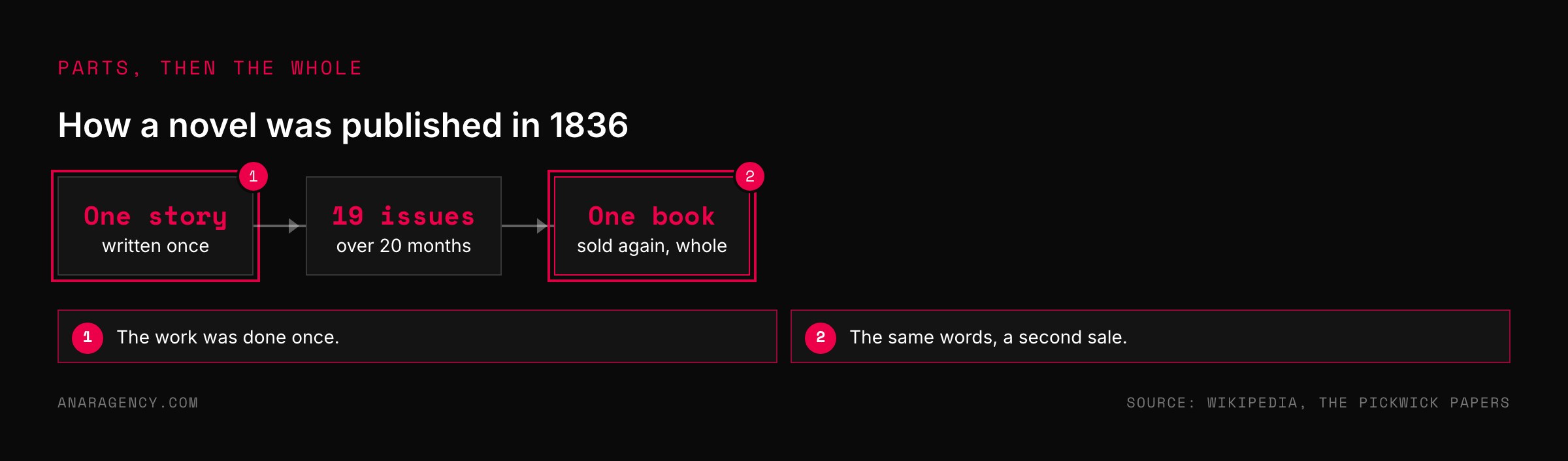
It did not come out as a book. It was published in 19 issues over 20 months, sold one part at a time.
Only after the last part appeared was the whole thing bound and sold again as a novel, The Pickwick Papers.
The serial made him famous and, by the account of literary historians, made that way of publishing popular.
One piece of work, sold in many pieces and then sold whole. Publishers have understood this for nearly two centuries. Most businesses still write each post from a blank page.
Why writing from scratch fails
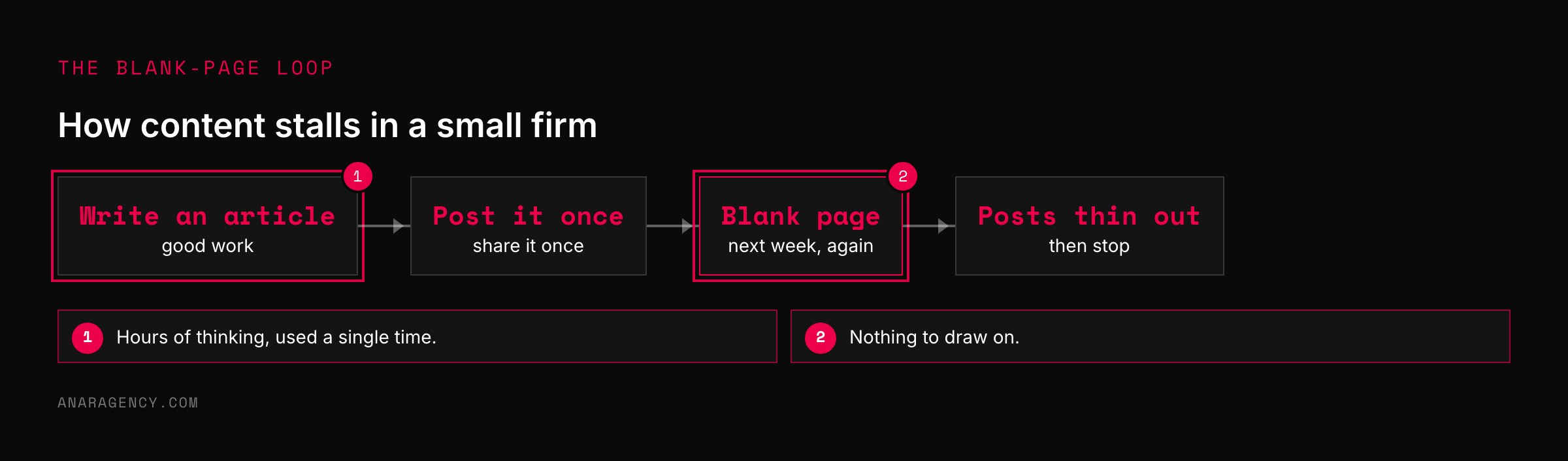
Here is how content usually goes in a small firm. Someone writes a good article. It is posted once, shared once, and never touched again.
Next week there is a blank page and no article. So the posts get thinner, then stop.
The article was not the problem. Treating it as one piece was.
A solid article already holds a claim, the reason for it, a story that shows it, and a method. Those are four different things, and each can stand alone.
Technical writers have a name for building many outputs from one master source: single-source publishing. Write it once, keep it in one place, and generate the manual, the help page, and the quick card from it.
The same discipline works for marketing. The article is the source. Everything else is a cut.
Write one complete article first. Cut everything else from it across four levels: the article; long cuts (a checklist, an email series, a video); short cuts (one long post, three medium, four short, ad versions, a landing page); and timely cuts (a broadcast email, a longer video). Give each piece one part of the article, rewrite its opening for where it will appear, cut on the same day, spread the pieces over a month, and point each back to the article.
Judge every cut on whether it helps by itself.
One-to-Twenty: the four levels
We sort the cuts into four levels, by how much of the article each one uses.
Level 1 is the article. The whole argument, written first and written properly. If it is weak, twenty weak pieces follow.
Level 2 is the long cuts. A checklist or small tool lifted from the how-to section. A series of five or so emails, one per section.
One video that tells the main story.
Level 3 is the short cuts. One long post. Three medium posts.
Four or so short ones, each a single bold sentence. Three to five versions of an ad. The landing page those ads point to.
Level 4 is the timely cuts. One email to the whole list that ties the idea to something happening this week. A longer video if the offer needs one.
Count them and you get about twenty. The number is a guide, not a quota. A thin subject may give eight good pieces and that is fine.
The rule that matters is the order. Article first. Nothing after it starts from a blank page.
Butchers, Not Bakers: how the cuts are made
Some small teams publish every day and never seem short of material. They are not baking twenty loaves. They are cutting one animal well.
We call them Butchers, Not Bakers.
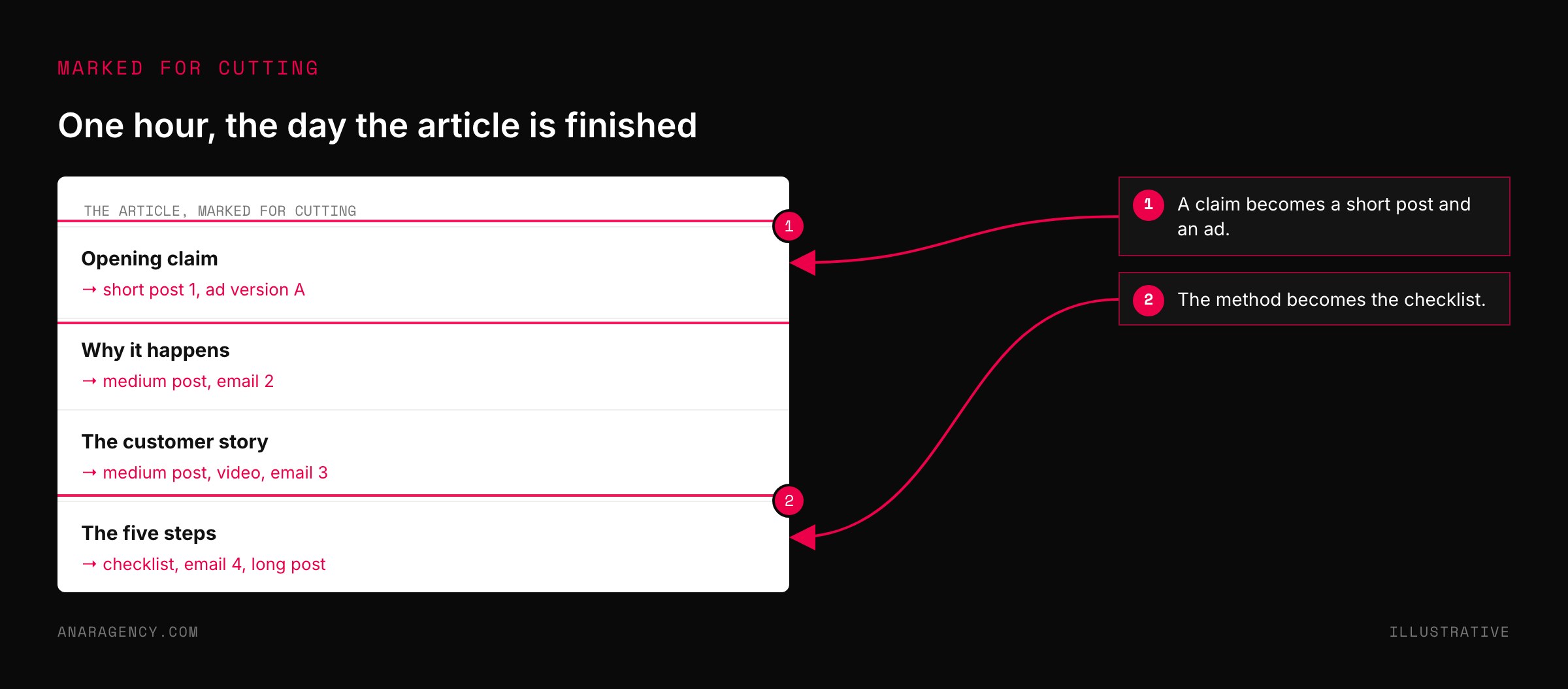
They give each piece one part. A short post carries a claim. A medium post carries a reason, or a story.
The checklist carries the method. None tries to shrink the whole article into a paragraph.
They rewrite for the place. The same idea reads differently in an inbox, a feed, and a search result. The point stays.
The opening line and the length change. See the Six Openings for how.
They cut the same day. While the article is fresh, they mark it up: these four sentences are short posts, this section is email three. An hour then saves a week later.
They spread it out. Twenty pieces is a month of publishing, not a day. Mix the lengths as you go, as we describe in the rise-and-fall cadence.
They point everything home. Each piece links back to the article or to the checklist. Twenty roads, one destination.
Once the cuts exist, a returning idea is easy. A piece that did well in spring can go out again in autumn with a new first line, and most of the audience will be seeing it for the first time.
"Will search engines punish me for repeating myself?"
You may have heard that duplicate content is penalized. The fear is larger than the facts, and it is worth getting right.
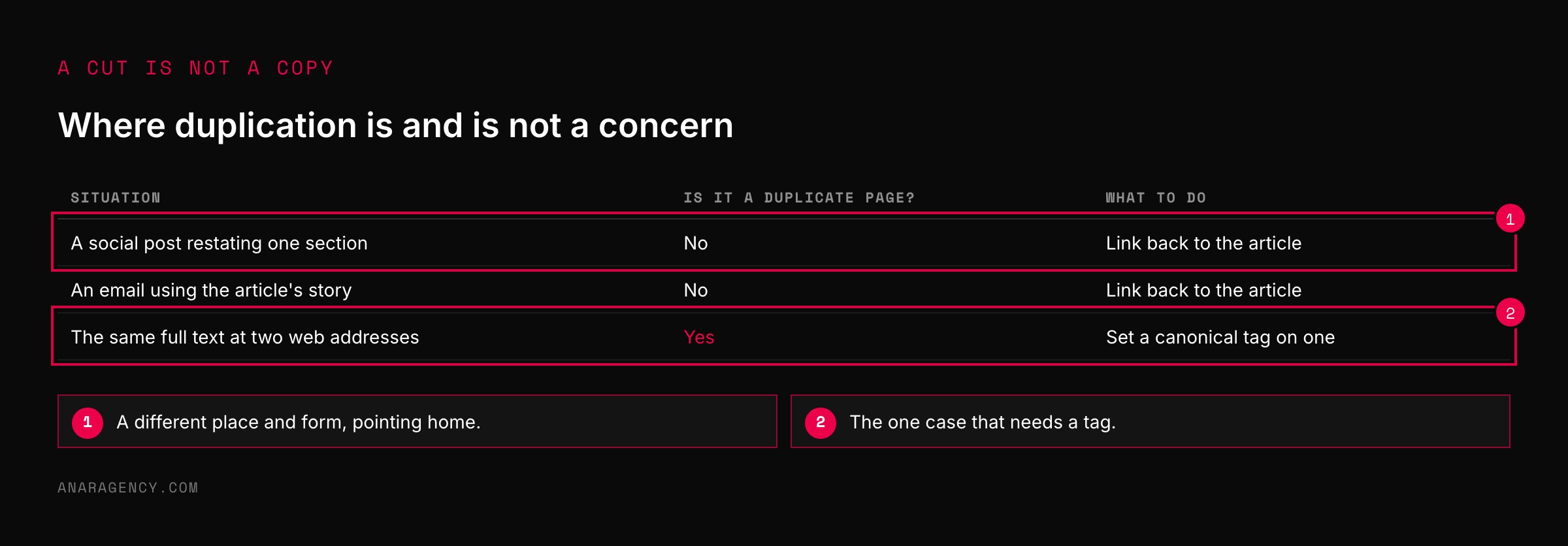
A post on a social network that restates part of your article is not a copy of your page. It lives elsewhere, in a different form, and sends people back.
The real case is the same full text at more than one web address. For that, Google's guidance is to tell it which address is the main one, using a canonical tag. That is a housekeeping step.
The larger risk is quality. Twenty pieces that say nothing are worse than one that says something. Google's advice on helpful content asks whether a page was made for people or to fill a slot.
So the test for each cut is the same as for the article. Would a reader be glad they saw this one piece, with no other context?
And repeating a point to an audience is a feature. Most followers see a small share of what you post, so the tenth mention is someone's first.
What to read next, and why
The Pickwick Papers (encyclopedia entry): How a novel sold in parts changed publishing.
Single-source publishing (encyclopedia entry): The technical writer's method for producing many formats from one master.
Consolidate duplicate URLs (Google documentation): What duplication means to a search engine and how to handle it.
Creating helpful, reliable, people-first content (Google guidance): The quality questions to put to every piece, long or short.
So the simple takeaway is this: take your best article, print it, and mark twenty places to cut. You have a month of content and you have not written a new word.
Questions executives ask
What is content repurposing?
Turning one piece of content into several pieces for different places. A single article can supply social posts, emails, a checklist, a video, and ads, each carrying one part of the original instead of repeating all of it.
How many pieces of content can one blog post produce?
A complete article with a claim, a reason, a story, and a method yields about twenty: a checklist, around five emails, a video, eight or so social posts of mixed length, several ad versions, a landing page, and a timely email.
Does repurposing content hurt SEO?
Social posts and emails that restate parts of an article are not duplicate pages. If the same full text appears at more than one web address, use a canonical tag to indicate the main version. The larger concern is whether each piece is useful.
What should I write first when planning content?
The full article. It forces the thinking and holds every part the other pieces need. Starting with short posts produces fragments with no source to draw on.
How do I avoid boring my audience with repeats?
Give each piece a different part of the idea and a different opening line, and spread them across several weeks. Most followers see only a fraction of what you publish, so repetition of a point is rarely noticed.

Filip Kovacevic is the founder of Anar Agency in Phoenix. He spent five years running SEO, Meta ads, email, and content for medical practices across the United States, and now does the same work for healthcare, home-service, legal, and professional-service businesses, alongside AI implementation. More from Filip →
Talk it through in 15 minutes
Bring one AI question from this article. We will tell you what we would do, whether or not you hire us.
Book a 15-Min Chat →