Why Posting Volume Should Rise and Fall

Post on a pattern that changes, not one that stays flat. Anything repeated in the same form gets tuned out, and that includes posts of the same length at the same hour. Vary the size in a wave: one short post, two or three medium ones, then one long one, and repeat.
Vary the volume too, with busier weeks around something worth saying and quieter ones between. Keep showing up, since silence loses the audience. But let the shape rise and fall, because the change is what gets noticed.
What a sea slug knows
In the 1960s a neuroscientist named Eric Kandel began studying a large sea slug with a simple reflex. Touch it and it pulls in its gill.
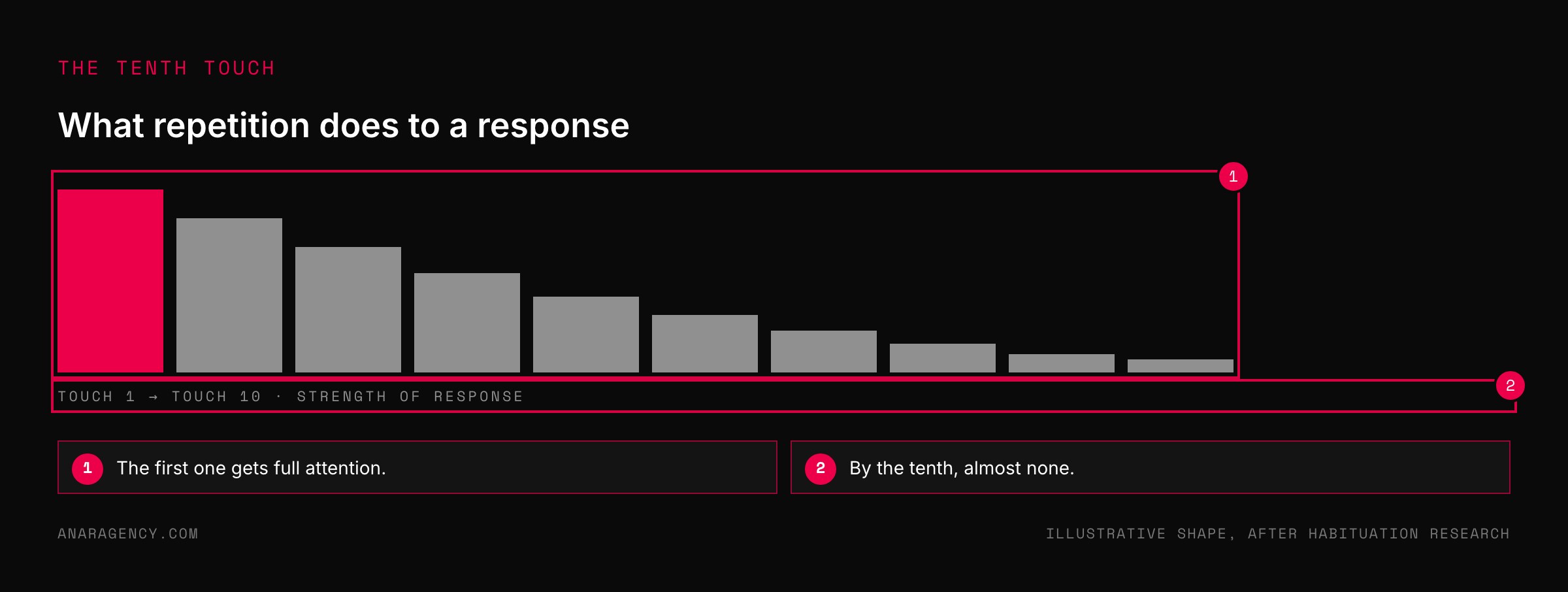
Touch it again the same way, and again, and the response weakens. After enough repeats the slug barely reacts.
Nothing is wrong with it. It has learned that this touch does not matter. The work on that reflex helped earn Kandel a Nobel Prize in 2000.
The name for it is habituation, and it is among the oldest and most widespread forms of learning. Nearly every animal with a nervous system does it, people included.
It is a good thing. It is how you stop hearing the refrigerator. It is also what happens to your Tuesday post.
The cost of a flat schedule
Most advice on posting says the same thing. Pick a schedule and never break it. Same days, same time, same format.
The first half of that is sound. An audience that never hears from you forgets you.
The second half works against you. A post that arrives in the same shape at the same hour becomes part of the background, like the refrigerator.
Web researchers documented this on pages long ago. Eye-tracking studies of banner blindness found that people learn where ads usually sit and stop looking there at all.
A feed is no different. If every post from you is four hundred words with a list in the middle, the reader has learned your outline. They scroll past the outline.
There is a second cost to always posting long. Readers save a long piece to read later, and later rarely comes.
Anything repeated in the same form gets tuned out. Keep showing up, and change the shape. Vary length in a wave: one short post, two or three medium, one long, then repeat.
Vary volume: more in weeks with real news, less between, never silent. Place the long piece after short ones that raised its subject. There is no published best frequency, so start at two to four posts a week and test against your own replies and profile visits per post.
Advertisers already do this
People who buy television time worked this out decades ago.
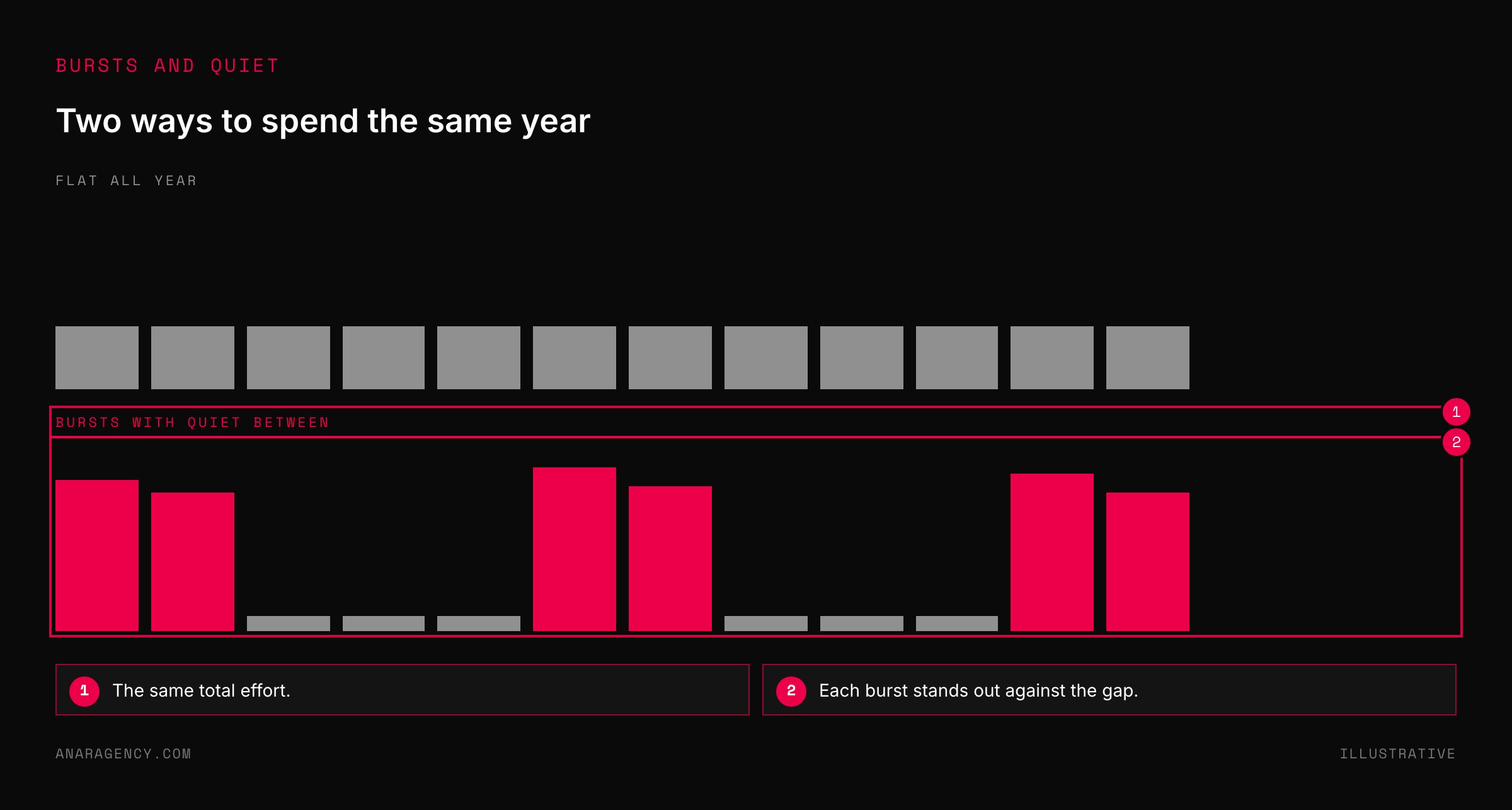
They rarely run a campaign at the same weight all year. A common approach is flighting: periods of advertising separated by periods of none.
A variation keeps a low level running all the time and adds heavier bursts on top.
Part of the reason is budget. Part is attention. A burst is noticed because it stands out against the quiet before it.
The same logic works for posting, and it costs nothing. A week in which you say a lot is noticed because the week before was light.
Wave Posters: the Rise-and-Fall Cadence
Some accounts hold attention for years without posting more than anyone else. Their output moves. We call the people behind them Wave Posters.
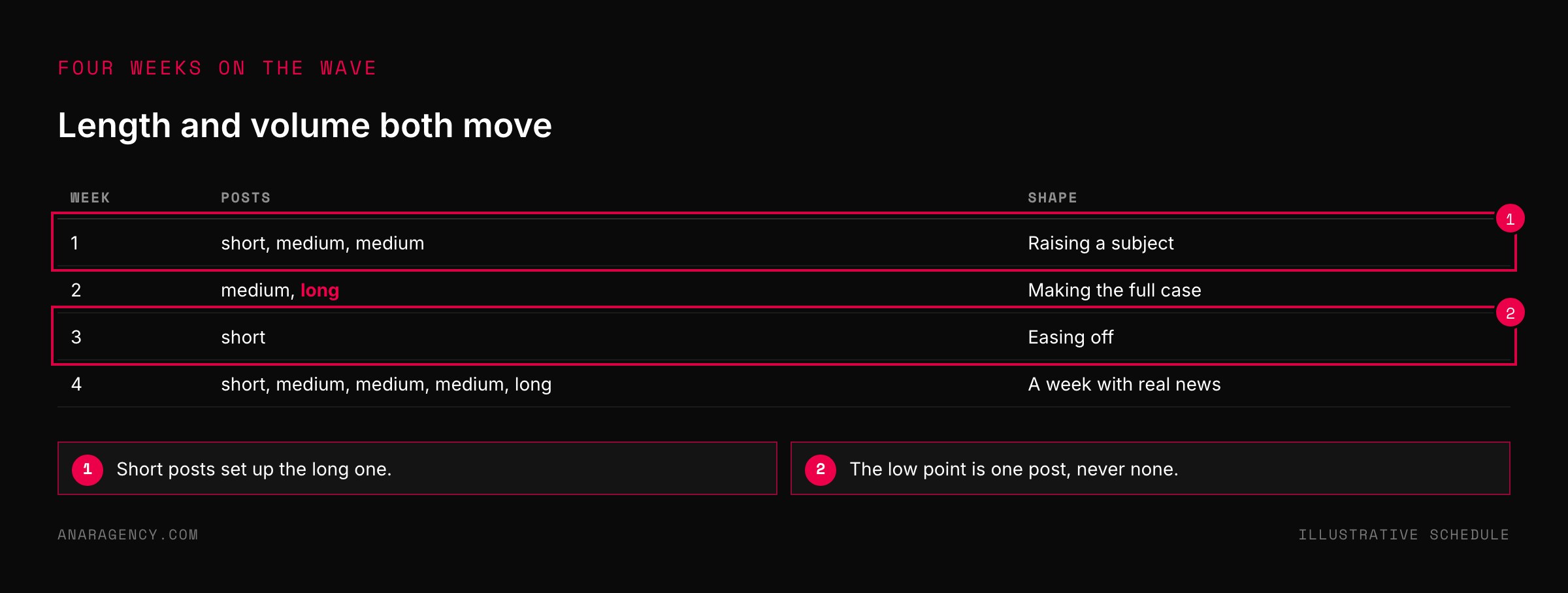
They vary the length. One short post, a single observation in two or three lines. Then two or three medium ones, each an idea with its reason.
Then one long piece with the full argument. Then short again.
They vary the volume. When there is something worth saying, a launch, a finding, a change in the trade, they post more for a week. Then they ease off.
They never go silent. The low part of the wave is one or two short posts in a week. A gap of a month sends an audience elsewhere.
They place the long piece on purpose. It follows the short ones that raised the subject. By the time it arrives, readers have a reason to give it ten minutes.
One short, two or three medium, one long is our working pattern, not a tested constant. What matters is that the reader cannot predict the next post from the last.
What goes in each post is a separate question, covered in the Six Openings.
"So how often should I post?"
You may want a number. We do not have an honest one to give, and we distrust anyone who does.
The major platforms do not publish a best frequency. The figures passed around are averages of other people's accounts in other trades.
Here is what we can say. Post often enough that a regular reader sees you most weeks, and no more often than you have something true to say.
For a one-person service business that is usually two to four posts in a normal week, and more in a week with real news. That is a starting point to test, not a finding.
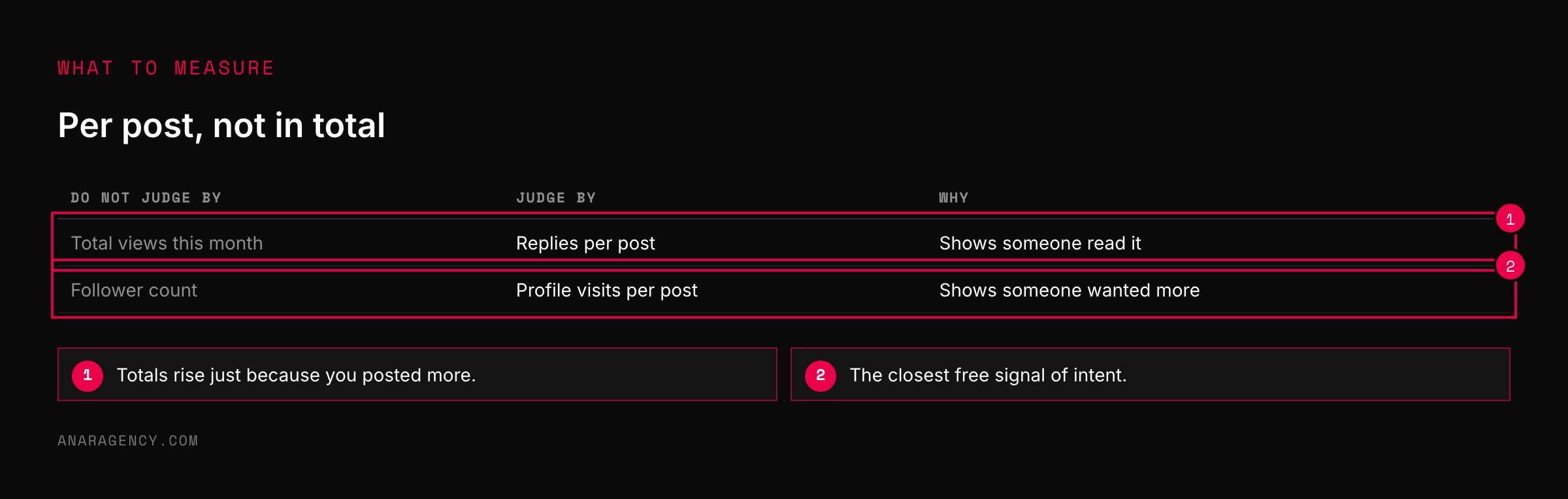
Then measure your own account. Compare a month of flat posting with a month on the wave, and look at replies and profile visits per post instead of total views.
And keep the larger pattern in mind. Most of what you post should teach, with an offer only now and then. A feed that is all asks is tuned out for a different reason, which is why we favor giving first.
What to read next, and why
Habituation (encyclopedia entry): The research on why repeated, unchanging things stop getting a response.
Eric Kandel (encyclopedia entry): The scientist and the sea slug. A clear account of how the simplest learning works.
Flighting (advertising) (encyclopedia entry): How advertisers schedule in bursts and why.
Banner Blindness Revisited (usability research): Eye-tracking evidence that people stop looking where they expect the same thing.
So the simple takeaway is this: look at your last ten posts. If they are all about the same length, make the next one a third of that, and the one after it three times as long.
Questions executives ask
How often should a business post on social media?
No platform publishes a best frequency. A reasonable starting point for a small service business is two to four posts in a normal week, more when there is real news. Then test against your own results per post.
Is it better to post consistently or to vary it?
Be consistent about showing up and varied in form. An audience forgets an account that goes quiet, but posts that always arrive in the same length and format at the same time become background and get scrolled past.
How long should social media posts be?
Mix lengths. Short posts are read in the feed, medium posts carry one idea with a reason, and an occasional long post makes the full case. A wave of one short, two or three medium, and one long keeps readers from predicting the next.
What is flighting in advertising?
A scheduling approach in which advertising runs in bursts separated by periods with little or none. A related method keeps a low continuous level and adds heavier bursts. Both rely on a burst standing out against a quieter period.
Why did my engagement drop even though I post every day?
One likely cause is habituation. If every post has the same structure and length, regular readers learn the pattern and stop paying attention. Changing the size and rhythm of posts often restores response.

Filip Kovacevic is the founder of Anar Agency in Phoenix. He spent five years running SEO, Meta ads, email, and content for medical practices across the United States, and now does the same work for healthcare, home-service, legal, and professional-service businesses, alongside AI implementation. More from Filip →
Talk it through in 15 minutes
Bring one AI question from this article. We will tell you what we would do, whether or not you hire us.
Book a 15-Min Chat →