The Hook Is Change: Why News Is the Oldest Content Engine
News holds attention because it reports change, and people are built to notice change. A good hook is a small piece of news about the reader's world: something recent, close to them, that affects their money, time, or risk, ideally with an element of surprise. A small business can find news every week in rule changes, price movements, its own numbers, and the seasons of its trade.
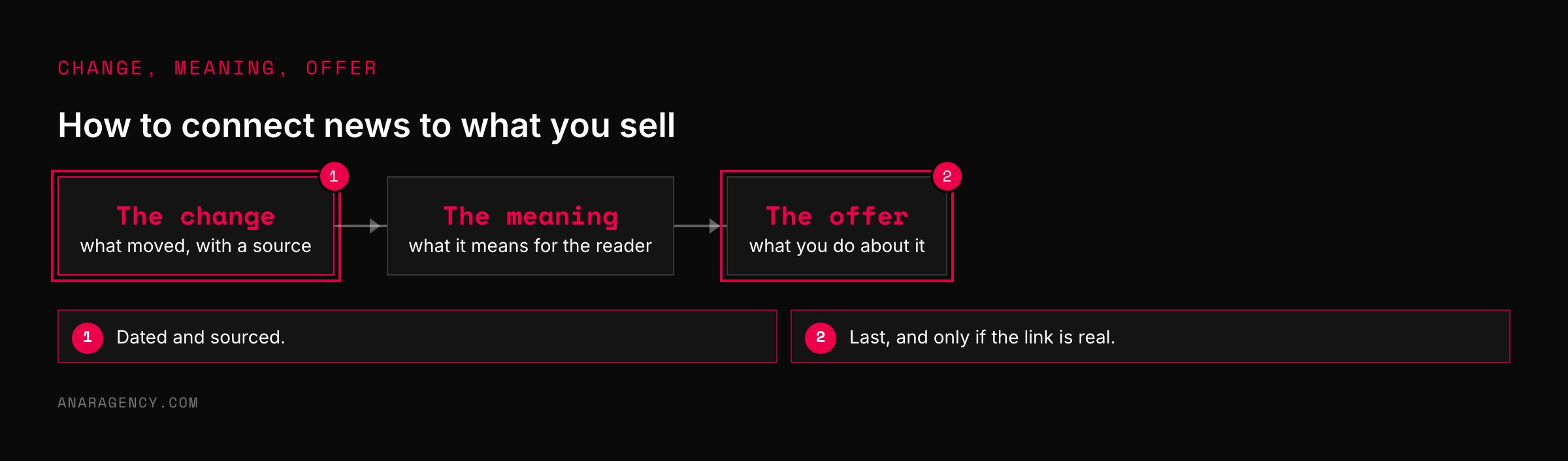
Lead with the change, explain what it means for the reader, then connect it to what you offer. The news has to be real and the connection has to be honest.
Notices in the Forum
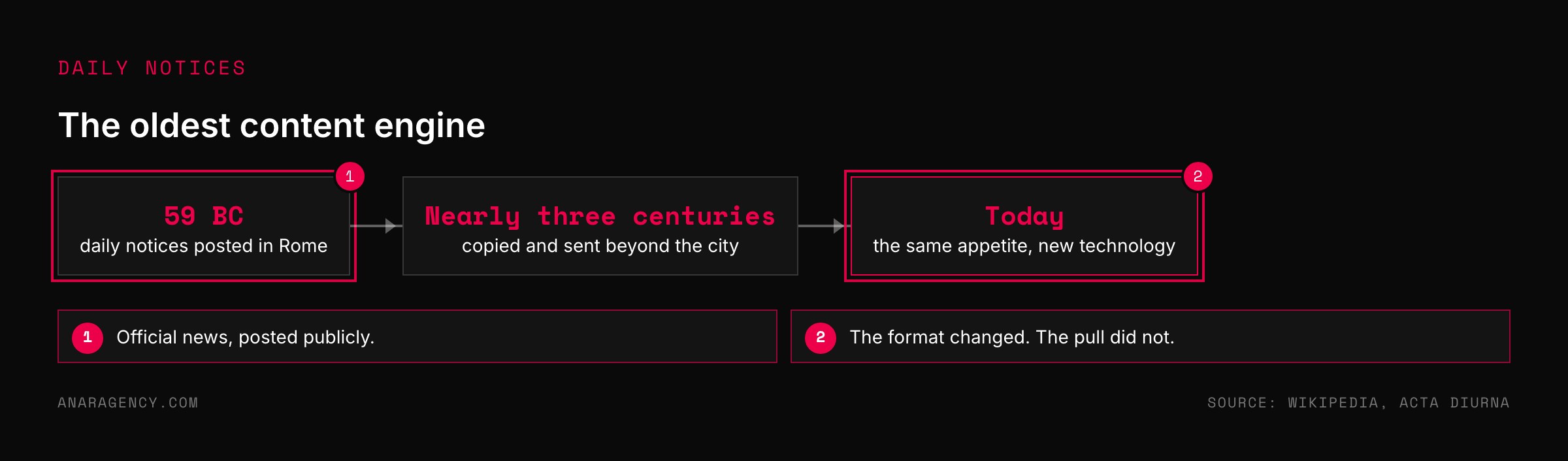
In 59 BC the Roman government began posting daily notices in public places. They reported official business, court decisions, and notable events in the city.
The notices, known as the Acta Diurna, continued for nearly three centuries. Copies were made and sent to people outside Rome who wanted to know what was happening.
People gathered to read them because they reported what had changed since yesterday.
Newspapers, broadcasts, and news feeds are later versions of the same thing. The technology changed every century. The appetite did not.
For two thousand years, the reliable way to hold a stranger's attention has been to tell them something new about their world.
Why change is the hook
People are built to notice change. A sudden movement or sound turns the head before anyone decides to look, a reflex known as the orienting response.
Things that stay the same fade into the background. A problem a business owner has lived with for years is invisible to them, however costly.
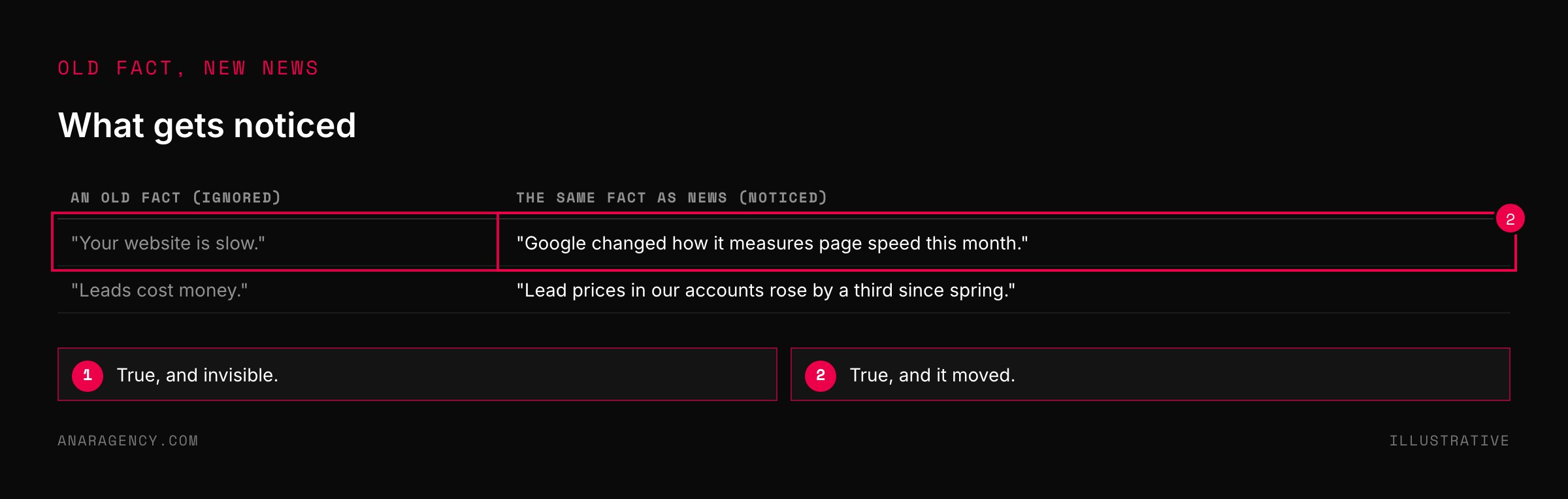
So the same fact can be ignored or seized on depending on how it is framed. "Your website is slow" is an old fact. "Google changed how it measures page speed this month" is news.
That is why the strongest hooks are small pieces of news. They announce that something has moved, and invite the reader to find out what it means for them.
We covered the broader idea in hooks that work and the unaware majority. This article is about the supply: where the news comes from.
People notice change, so the strongest hooks are small pieces of news. Check a candidate against four news values: recent, close to the reader, affecting their money, time, or risk, and unexpected. Find news weekly in rule changes, price movements, your own numbers, and the seasons of your trade.
Lead with the change, explain what it means for the reader, then connect it to what you offer. Avoid tragedies and politics, keep the news accurate and sourced, and do not force a connection.
What makes something news
Journalism researchers have studied how editors decide what is worth reporting. Their lists are known as news values. Several of them translate directly into hooks.
It is recent. This week, this month, this season. A change from five years ago is history.
It is close. The reader's town, trade, or customers. National news matters to a local firm only when it lands locally.
It matters. It changes the reader's money, time, or risk. Interesting is not enough.
It is unexpected. It reverses what people assumed. "The cheapest leads cost the most" carries more pull than "leads cost money."
A hook with two or more of these is worth leading with. A hook with none is an announcement.
Newsrooms of One: a weekly supply
Some small firms publish something timely every week without a newsroom. They have a short list of places to look. We call them Newsrooms of One.
They watch the rules. Regulations, platform policies, tax changes, licensing. Every rule change is news to someone who has to comply with it.
They watch prices. What materials, ads, labor, or insurance cost now against a year ago. Price changes are news to every buyer.
They report their own numbers. A firm might write: "Across the accounts we manage, evening enquiries rose this quarter." Nobody else has that news, which makes it valuable.
They use the season. What happens to their customers every year at this time. The first cold week.
Tax season. The summer quiet. Predictable, and still news to the person living it.
They connect, then offer. The change first. What it means for the reader second.
What you do about it third. A piece that jumps straight from news to sales pitch reads as opportunism.
"Is jumping on the news not tasteless?"
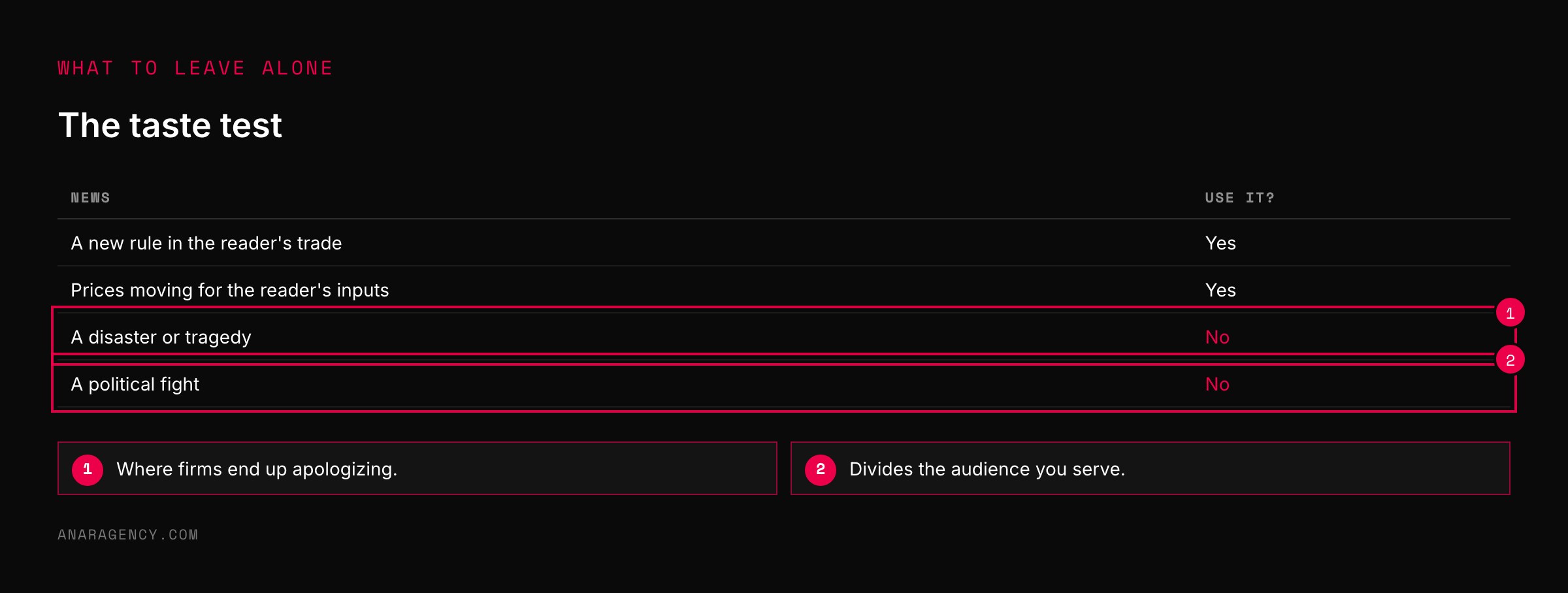
It can be. Attaching a sales message to a tragedy, a disaster, or a political fight is how firms end up apologizing in public. Leave those alone.
The news that works for a small business is usually far less dramatic. A rule changed. A price moved.
A season started. Nobody is hurt by you explaining what it means.
Keep the news accurate. Link to the source, give the date, and do not overstate it. A hook built on a misreported change damages trust the moment a reader checks.
Keep the connection honest. If the news does not really bear on what you sell, do not force it. Readers notice a stretched link.
And remember that timely content dates. Google's guidance asks whether content provides original information, reporting, or analysis. Your own commentary on a change does.
A rewrite of someone else's headline does not.
The firms that do this well end up being the people their customers expect to hear the news from first.
What to read next, and why
Acta Diurna (encyclopedia entry): Rome's daily public notices, from 59 BC.
News values (encyclopedia entry): The criteria journalists use to decide what is newsworthy.
Orienting response (encyclopedia entry): The reflex that turns attention toward change.
Creating helpful, reliable, people-first content (Google guidance): What counts as original reporting and analysis.
So the simple takeaway is this: write down one thing that changed in your customers' world this month. Lead your next post with it, then explain what it means for them.
Questions executives ask
How do you write a good hook?
Lead with something that has changed in the reader's world, recently and close to them, that affects their money, time, or risk. A surprising change works best. Then explain what it means for them before mentioning what you offer.
Why does news make good marketing content?
People are built to notice change, and news is a report of what changed. A timely piece about a new rule, price, or trend in the reader's trade holds attention far better than a description of something that has always been true.
Where can a small business find news to write about?
In rule and policy changes affecting customers, movements in prices they pay, patterns in your own work this month, and recurring seasonal events in your trade. Each is news to the people it affects.
What are news values?
The criteria journalists use to judge whether something is worth reporting. Common ones include timeliness, proximity, impact, and the unexpected. A marketing hook with two or more of them is usually strong.
Is newsjacking appropriate for a small business?
Commenting on relevant, non-tragic news in your field is useful to customers. Avoid attaching sales messages to disasters, tragedies, or political conflict, keep the facts accurate and sourced, and only connect news to your offer when the link is real.

Filip Kovacevic is the founder of Anar Agency in Phoenix. He spent five years running SEO, Meta ads, email, and content for medical practices across the United States, and now does the same work for healthcare, home-service, legal, and professional-service businesses, alongside AI implementation. More from Filip →
Talk it through in 15 minutes
Bring one AI question from this article. We will tell you what we would do, whether or not you hire us.
Book a 15-Min Chat →