The Page-2 Problem: 1,745 Impressions, 5 Clicks, and What We Changed

A page that Google shows on page two or lower is seen in the data and invisible in real life. Our eleven articles were shown 1,745 times in 90 days and clicked 5 times, because they ranked between positions 18 and 35. One large study found that fewer than 1 percent of searchers click anything on the second page.
The fix is not more articles. It is five steps on the pages Google already shows: find them, retitle them, link to them, deepen them, and wait a quarter.
1,745 times seen. 5 times clicked.
In July we published eleven articles about putting AI to work inside a company. They were careful and specific, and we were proud of them.
Ninety days later we opened Google Search Console and looked at what had happened. Google had shown those articles 1,745 times. People had clicked them 5 times.
That is one click for every 349 times we appeared.
The whole site told the same story. In those 90 days it was shown 7,225 times and clicked 67 times, and 44 of those clicks went to the homepage. Take the homepage out and the rest of the site earned 23 clicks in three months.
The easy conclusion is that the articles were bad or that nobody wanted them. Both were wrong. People were searching for exactly these topics.
Google was matching us to those searches. We were just standing in the wrong place when it happened.
The Page-2 Problem
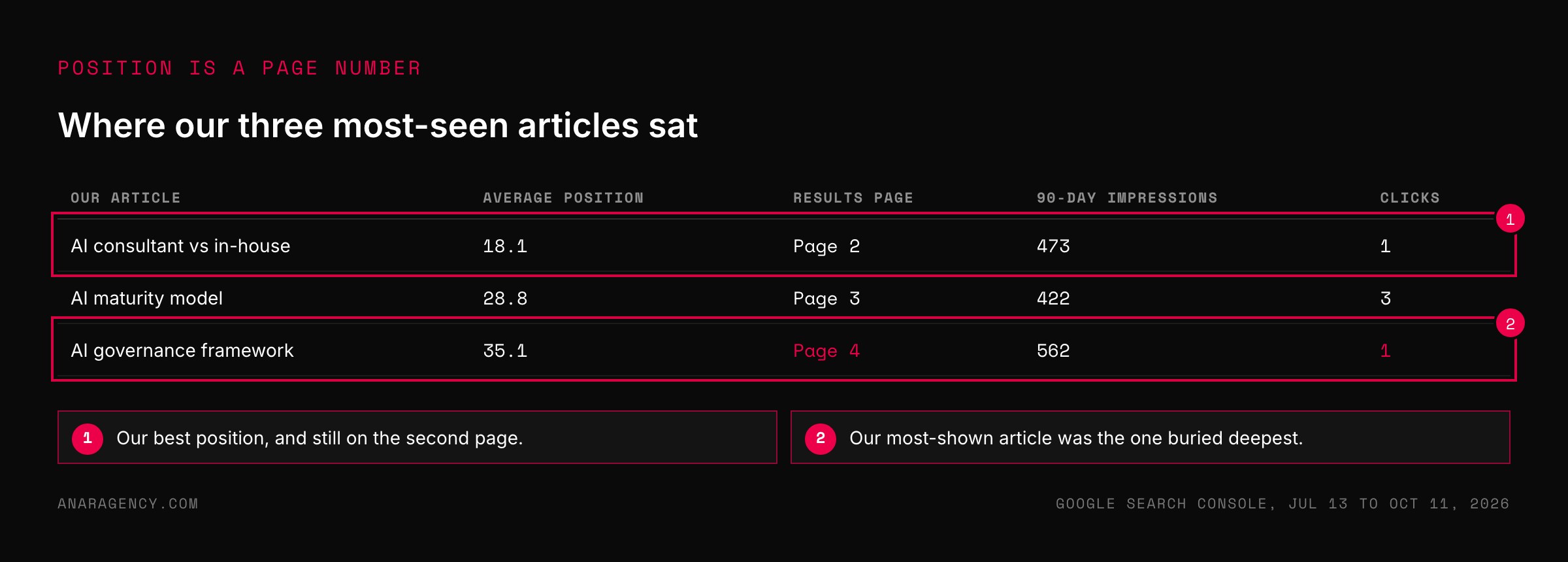
Here is where we were standing. Our most-seen article ranked at an average position of 35. The next two sat at 18 and 29.
Ten results fit on a page. So position 18 is page two, position 29 is page three, and position 35 is page four.
An impression on page four is a strange thing. Google counts it when your link appears on a results page the searcher loaded. It does not mean anyone saw it.
Google's own definition is about the link being present, not about a person reading it.
We call this the Page-2 Problem. Your reports say you are visible. The searcher never knew you existed.
The worst part is how it feels from the inside. The impressions go up every month, so it looks like progress. It is a number rising on a page nobody visits.
Five steps on pages Google already shows. One: in Search Console, list every page with over 100 impressions and under five clicks in 90 days. Two: rewrite each title so the searcher's words come first, under 62 characters.
Three: add two or more internal links to each from pages that already rank. Four: deepen any page that answers less than the results above it. Five: show the real updated date, resubmit the sitemap, and judge it after 90 days, not before.
Why page two pays almost nothing
Three pieces of outside research say the same thing from different sides.
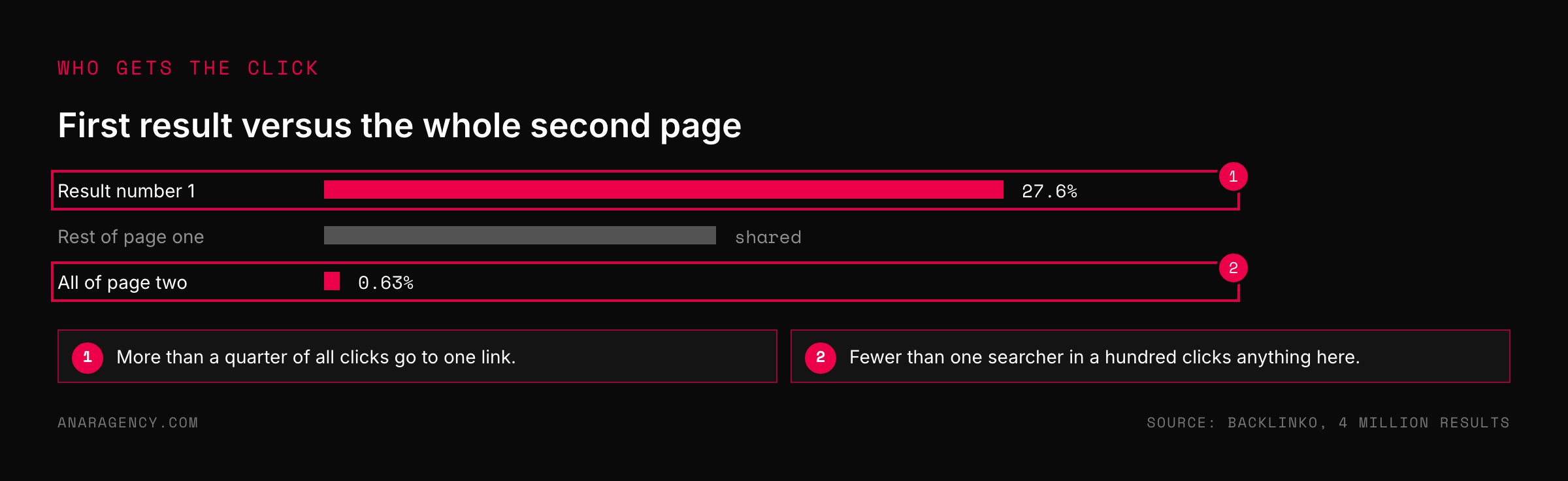
The first result takes more than a quarter of the clicks. Backlinko analyzed 4 million Google search results and found the top organic result gets 27.6 percent of all clicks. Everything below it shares what is left.
Page two gets less than one click in a hundred. The same study found that only 0.63 percent of searchers clicked on something from the second page. Not 6 percent.
Zero point six three.
Even page one is shrinking. When Google puts an AI summary at the top, people click less. Pew Research Center watched the browsing of 900 adults and found they clicked a regular result in 8 percent of visits when an AI summary appeared, against 15 percent when it did not.
Ahrefs measured the same thing on 300,000 keywords and found AI summaries cut clicks to the top-ranked page by 34.5 percent. In its later update, the drop had grown to 58 percent.
Put those together. Position one is worth less than it used to be, and page two was already worth almost nothing. Our own data fits.
Queries where we ranked between 21 and 50 produced 2,012 impressions and not one click.
What we changed: the Page-2 Playbook
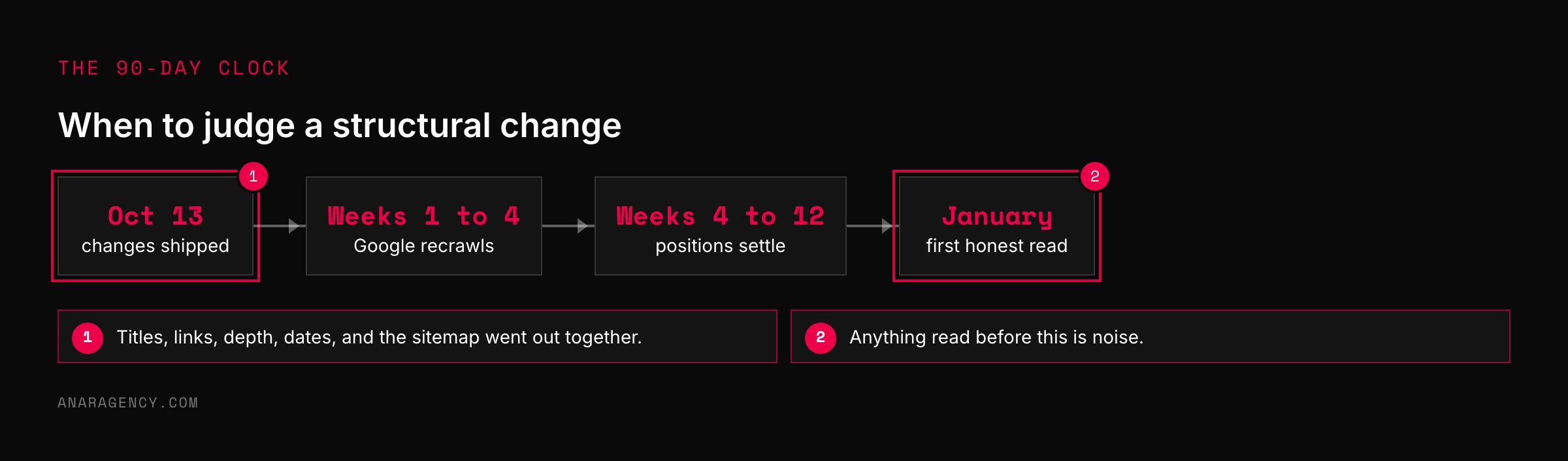
We did not write our way out. On October 13 we ran five steps on pages Google was already showing.
We found the seen-not-clicked pages. Three articles carried most of the impressions. Those went first.
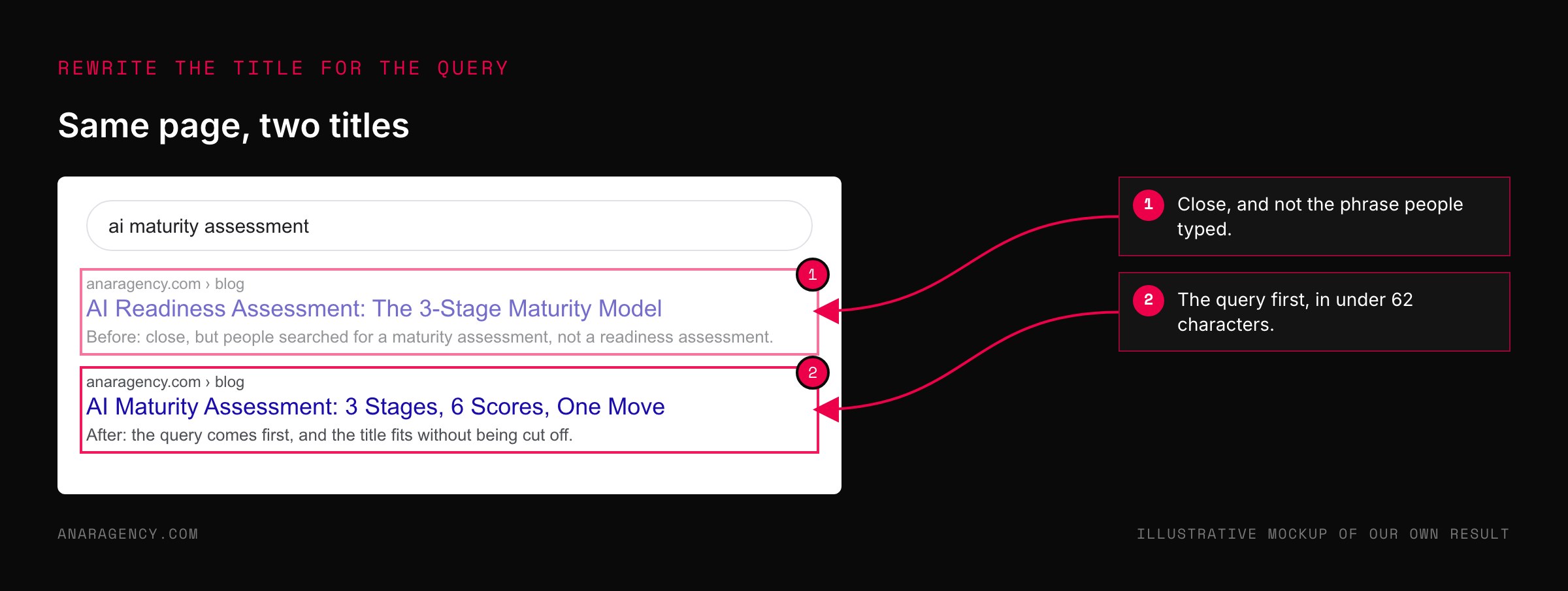
We rewrote the titles for the search. The top query for one article was "ai maturity assessment." Our title led with "AI readiness assessment."
Google builds the blue link mostly from your title, so we put the searcher's words first and kept it under 62 characters.
We linked to them. Every article now sits in a topic hub, links to its neighbors in the text, and is linked from the service pages. Google finds and understands pages through links, and ours had almost none.
The full method is in our hub-and-spoke article.
We deepened the thin ones. Eight of the eleven had four sections and few sources. Each now has seven sections, real named cases, and twelve or more linked sources.
We dated them honestly and resubmitted. The pages keep their July publish date and show an updated date of October 13. Then we resubmitted the sitemap in Search Console.
We do not know yet whether it worked. That is the honest state of things, and we will not have a real answer before January.
"So just publish more."
You may be thinking the answer to low traffic is more content. It is the most common advice in this business, and for a site in our position it is backwards.
We had eleven articles being shown and not clicked. Writing the twelfth would have added one more page to the same pile, with the same weak titles and the same missing links.
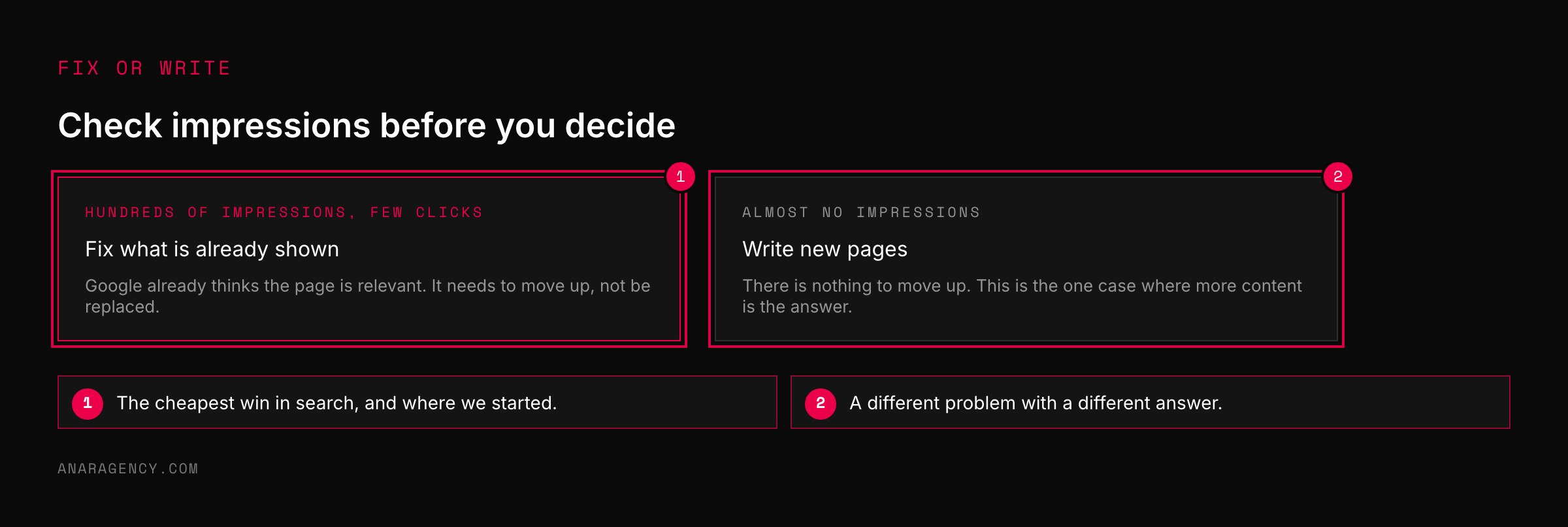
The pages Google already shows are your cheapest wins. Google has decided they are relevant. They only need to move up a page, and moving from position 18 to position 8 is a smaller job than getting a brand-new page from nowhere to position 8.
There is one case where more content is right. If Search Console shows you almost no impressions at all, you do not have a Page-2 Problem. You have a nothing-to-rank problem, and you need pages.
So look before you write. The number that decides it is impressions, and it takes two minutes to check.
What to read next, and why
We Analyzed 4 Million Google Search Results (study): The source of the 27.6 percent and 0.63 percent figures. The chart of clicks by position is worth showing to anyone who thinks page two is close enough.
Pew Research Center on AI summaries and clicks (research): Short, careful, and based on real browsing instead of a survey.
Google's guide to title links (documentation): How Google decides what your blue link says. Read it before you rewrite a single title.
What are impressions, position, and clicks? (Search Console help): The definitions. Once you read how an impression is counted, a big impression number stops being comforting.
So the simple takeaway is this: being shown is not being seen. Before you write anything new, find the pages Google already shows on page two, and move those.
Questions executives ask
Why do I have impressions but no clicks in Search Console?
Usually because the page ranks on page two or lower. Google counts an impression when your link appears on a results page the searcher loaded, even if they never scrolled to it. One study of 4 million results found only 0.63 percent of searchers click anything on the second page.
How much traffic does page two of Google get?
Very little. Backlinko's analysis of 4 million Google search results found that 0.63 percent of searchers clicked a result on the second page, while the first organic result alone received 27.6 percent of clicks.
How do I move a page from page two to page one?
Work on the page Google already shows. Rewrite the title to match the query people actually typed, add internal links to it from pages that already rank, deepen it where it answers less than the pages above it, show an honest updated date, and resubmit your sitemap. Then give it about 90 days.
Should I write more content or fix old content?
Check impressions first. If existing pages have hundreds of impressions and almost no clicks, fix those, because Google already considers them relevant. If the site has almost no impressions at all, there is nothing to move up, and new pages are the right work.
Do AI Overviews reduce clicks?
The measured evidence says yes. Pew Research Center found users clicked a traditional result in 8 percent of visits when an AI summary appeared, against 15 percent without one. Ahrefs found AI Overviews reduced clicks to the top-ranking page by 34.5 percent, and by 58 percent in a later update.

Filip Kovacevic is the founder of Anar Agency in Phoenix. He spent five years running SEO, Meta ads, email, and content for medical practices across the United States, and now does the same work for healthcare, home-service, legal, and professional-service businesses, alongside AI implementation. More from Filip →
Talk it through in 15 minutes
Bring one AI question from this article. We will tell you what we would do, whether or not you hire us.
Book a 15-Min Chat →