YouTube Ads: A Five-Beat Script and the Two Numbers That Tell You What Broke
A skippable YouTube ad has five seconds before the viewer can leave, and with cost-per-view bidding you pay only when someone watches 30 seconds or interacts. So write it in five beats: a hook in the first five seconds, an expansion to 30, proof to about a minute, the offer around 90 seconds, and a close that asks again. Then watch two numbers.
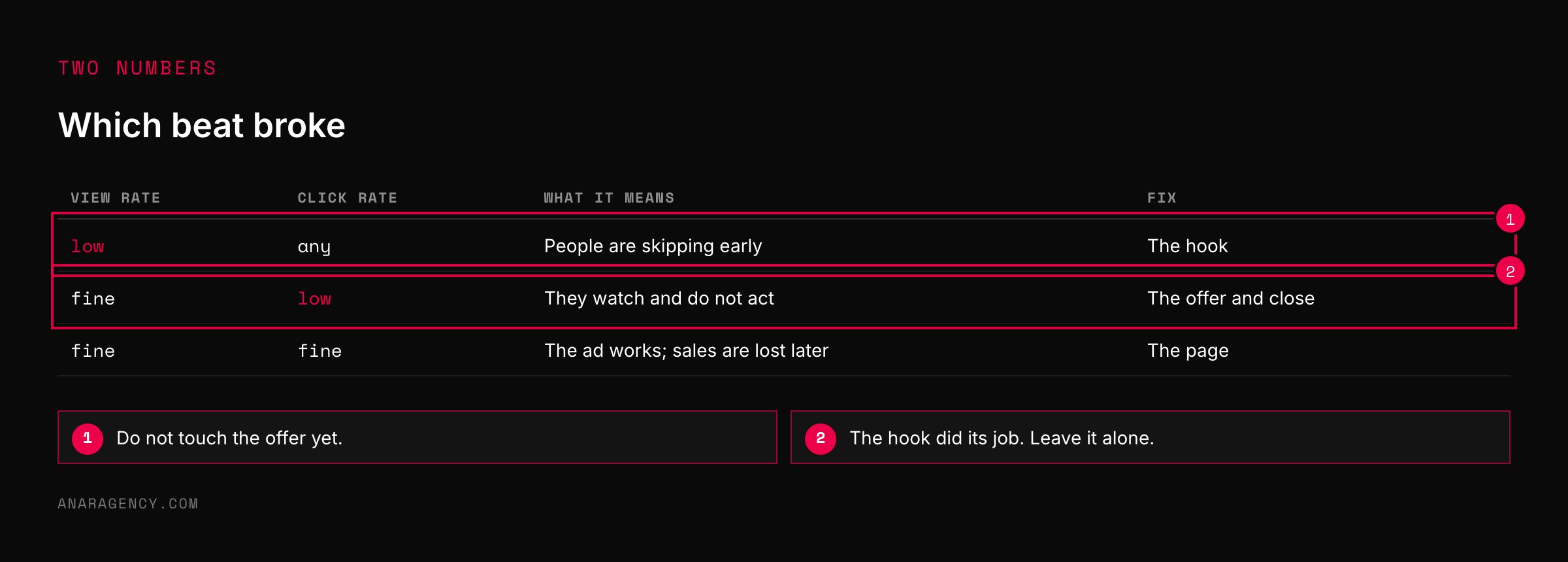
A low view rate means the hook failed. A good view rate with a low click rate means the offer failed. Fix only the beat the numbers point to.
The most honest ad format there is
Every other ad pretends you want to see it. A YouTube ad puts a countdown on the screen and tells you exactly when you can leave.
Five seconds. Then a button that says skip.
Most advertisers treat that button as the enemy. It is the best thing about the format.
It tells you, to the second, where your ad has to earn its keep. And it changes what you pay for, in a way that should change how you write.
What the skip button does to your bill
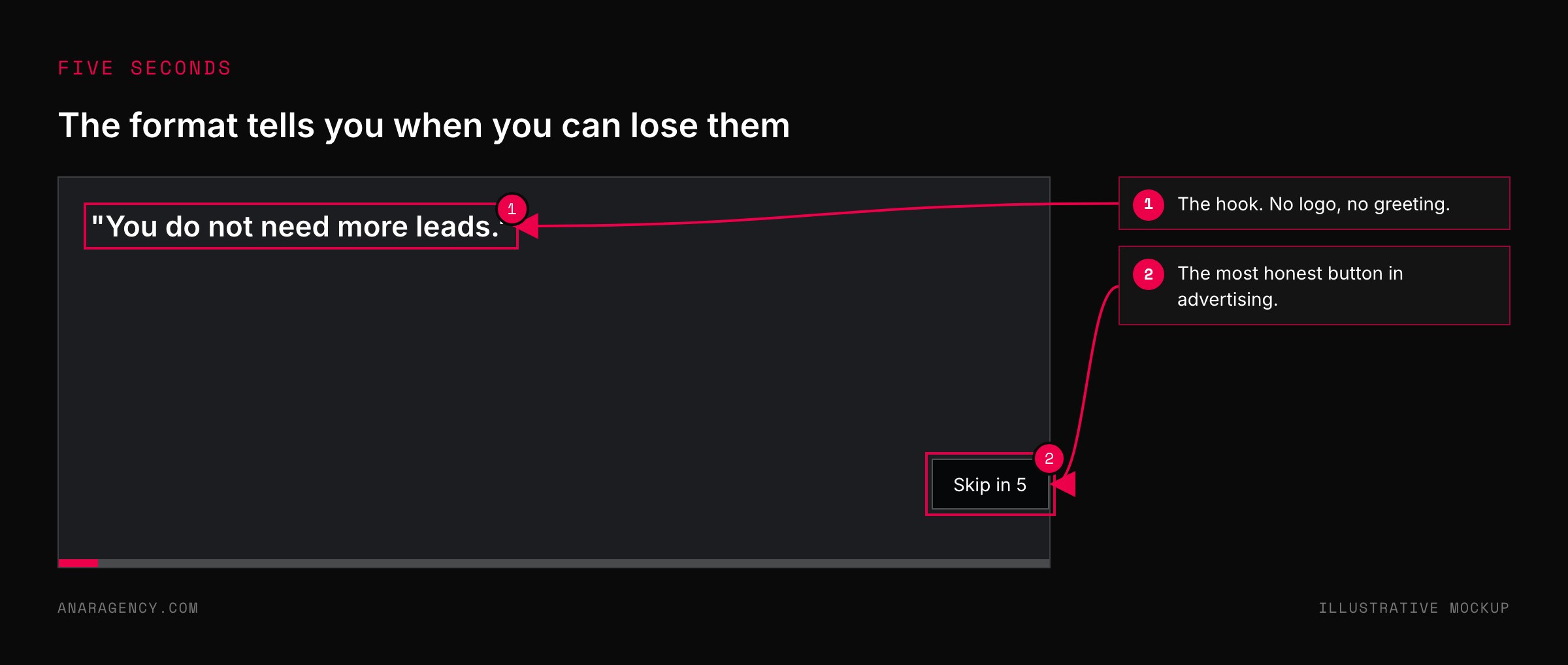
Here are the rules, from Google. On a skippable in-stream ad, the viewer can skip after 5 seconds.
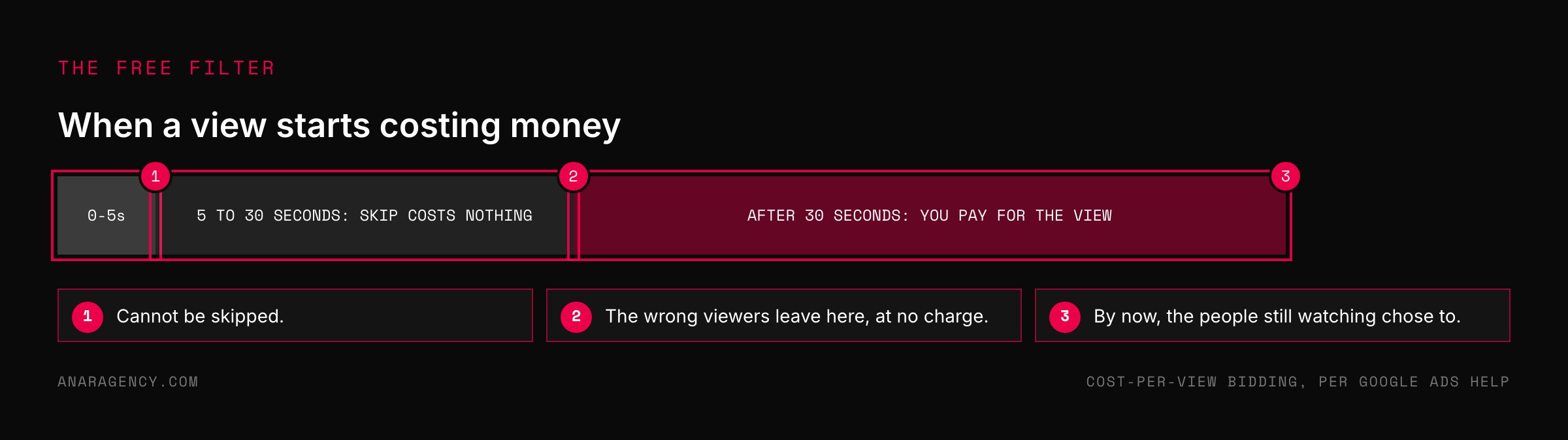
With cost-per-view bidding, you pay when a viewer watches 30 seconds of your video, or the whole thing if it is shorter, or interacts with it. Whichever comes first.
Read that again slowly. Someone who watches four seconds and skips costs you nothing under that bidding type. Someone who watches 29 seconds and skips costs you nothing.
So the first 30 seconds are a filter you do not pay for. The people who are not interested remove themselves, for free.
That is the opposite of how most people write video ads. They try to keep everyone. The better move is to make the first five seconds so clear about who this is for that the wrong people leave, and the right ones lean in.
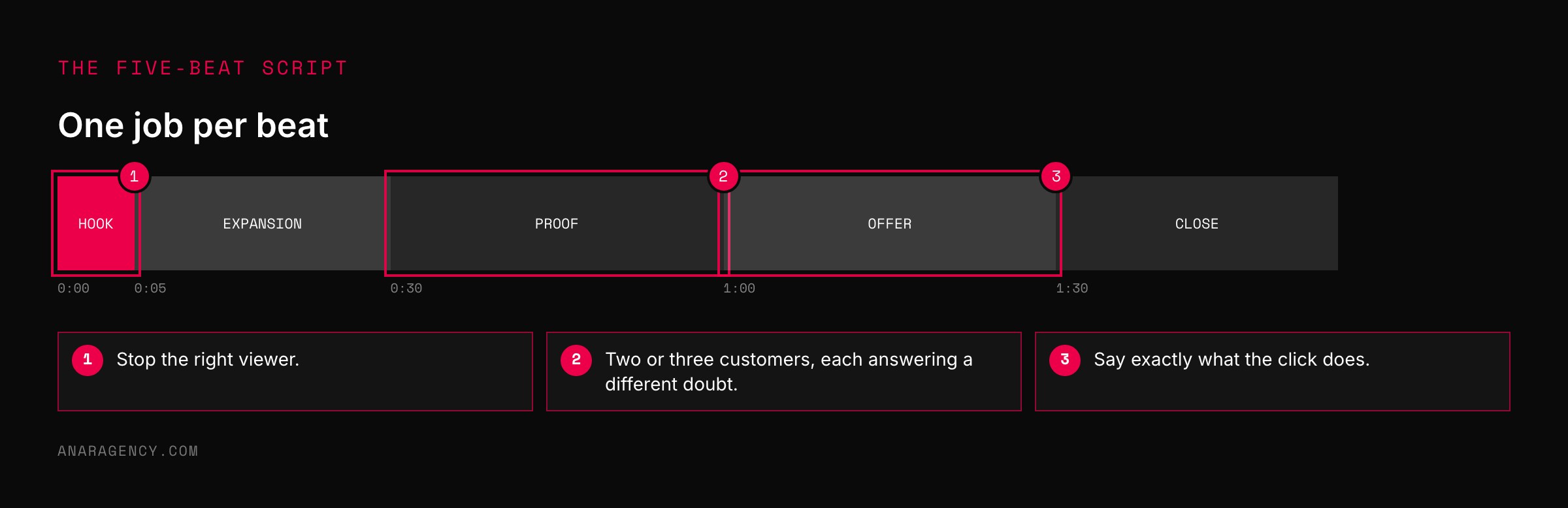
Beat one, the hook, 0 to 5 seconds: one line that challenges a belief or names the viewer's situation. Beat two, the expansion, to 30 seconds: make it concrete. Beat three, the proof, to about a minute: who you are and two or three customers answering different doubts.
Beat four, the offer, around 90 seconds: what happens on the click. Beat five, the close: ask again with a true reason. Test one beat at a time, starting with the hook.
Low view rate means fix the hook. Good view rate and low click rate means fix the offer.
The Five-Beat Script
Here is the shape we write to. Five beats, each with one job.
Beat one, the hook. Five seconds. One line that cuts against something the viewer believes, or describes their situation precisely.
No logo animation. No "hi, my name is." Those five seconds are the most expensive real estate you own.
Beat two, the expansion. From five seconds to thirty. Make the hook concrete with a number, a picture, or a quick example.
The goal is to make them think, because a viewer who is thinking has stopped reaching for the skip button.
Beat three, the proof. From thirty seconds to about a minute. One sentence on who you are.
Then two or three real customers, each one answering a different doubt. Three people saying the same thing is one testimonial repeated.
Beat four, the offer. Around the ninety-second mark. Say what happens when they click and what they will have afterward.
Be literal.
Beat five, the close. Ask again, with a true reason to act now.
Google's own research lands in a similar place. It calls its guidelines the ABCDs: attention, branding, connection, and direction. Google says ads that follow them can deliver as much as a 30 percent lift in short-term sales likelihood and a 17 percent lift in long-term brand contribution.
Test one beat at a time
Once you have a script, the temptation is to shoot five completely different ads and see which wins. You will get a winner and no idea why.
The cheaper way is to change one beat.
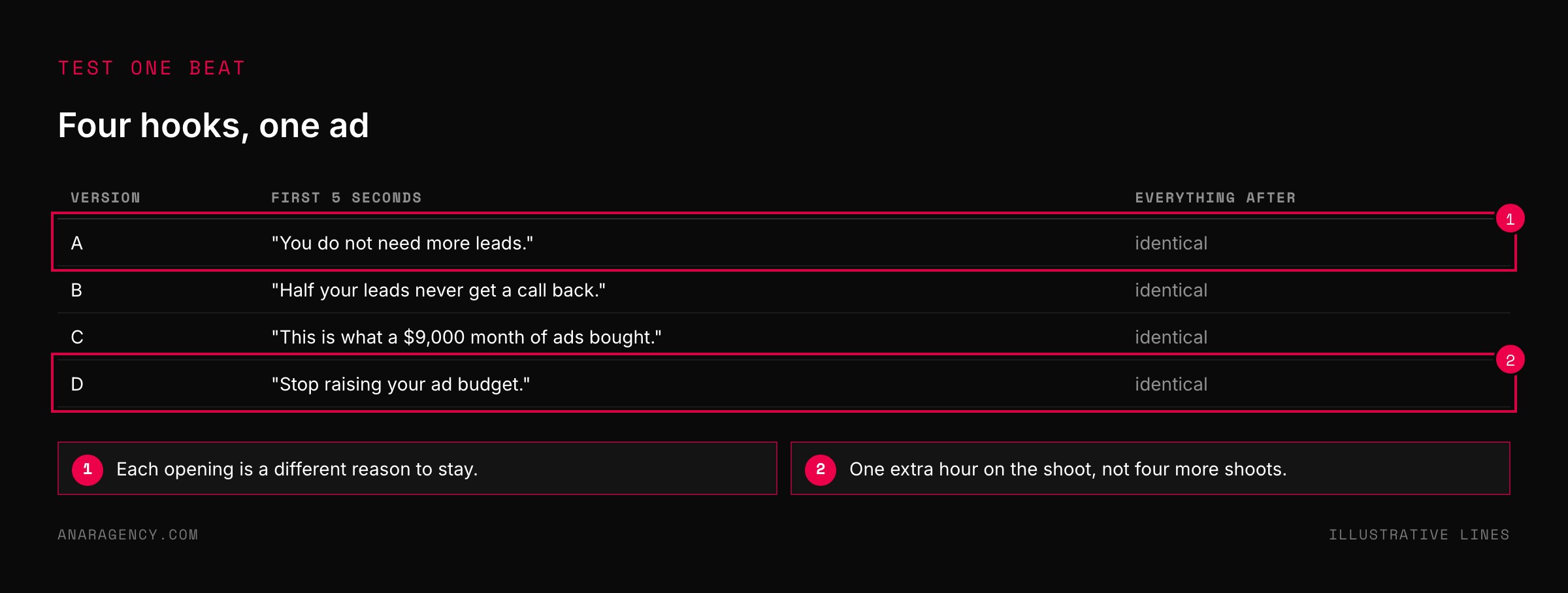
Start with the hook. Shoot one body and five different openings. Everything after the first five to ten seconds is identical.
Whichever opening holds the most viewers is your hook.
Then change the expansion. Keep the winning hook. Make a few versions of the next twenty seconds.
This is the same logic we use for static ads, where you hold the picture and change the words. We cover that in text-on-image ads.
It is also much cheaper to produce. Five hooks is one extra hour on the shoot day. Five different ads is five shoot days.
"Which number tells me if it is working?"
You may be looking at a screen full of video metrics and wondering which one to trust. For diagnosis, start with two. Google defines both.
View rate is views divided by impressions. It tells you how many of the people who were shown the ad stayed long enough to count. It is the report card for your hook.
Click-through rate is clicks divided by impressions. It tells you how many acted. It is the report card for your offer.
Put them together. A low view rate means people are leaving early, so fix the hook and touch nothing else. A healthy view rate with a low click rate means people watched and did not move, so fix the offer and the close.
If both look healthy and there are still no sales, stop editing the video. The problem is on the page after the click, which we cover in ad-to-page alignment.
You may have heard there is a magic ratio between these two numbers. We have seen one quoted and could not verify it, so we do not use it. What is a good number depends on your market and your offer.
Compare your ads to each other, not to a figure from a stranger.
What to read next, and why
Skippable in-stream ads (Google Ads Help): The format's rules in one page. The five-second line is the one to build around.
About cost-per-view bidding (Google Ads Help): Exactly when you are charged. Read it before you assume a skipped ad cost you money.
About the ABCDs of effective video ads (Google Ads Help): Google's own creative guidelines, with the research behind them. A good check on any script.
About YouTube ads and view metrics (Google Ads Help): The definitions of every number in your report. Two minutes that prevent a lot of misreading.
So the simple takeaway is this: write for the skip button, not against it. Five seconds to earn the stay, thirty to earn the charge, and two numbers to tell you which part to fix.
Questions executives ask
How long should a YouTube ad be?
Long enough to do five jobs: hook, expand, prove, offer, and close. For direct-response ads that often means 90 seconds to two minutes. The first five seconds matter most, because that is when a viewer of a skippable ad can first leave.
When do I pay for a skippable YouTube ad?
With cost-per-view bidding, Google says you pay when a viewer watches 30 seconds of your video, or the full video if it is shorter, or interacts with it, whichever comes first. A viewer who skips before that does not trigger a charge under that bidding type.
What should the first five seconds of a YouTube ad say?
One line that either goes against something the viewer believes or describes their exact situation. Skip the logo animation and the greeting. The goal is to make the right viewer want the next sentence and let the wrong viewer leave.
What is a good view rate for a YouTube ad?
It depends on the market, the audience, and the offer, so compare your own ads to each other. View rate is views divided by impressions. If it is low compared with your other ads, the hook is the problem.
If it is fine and clicks are low, the offer is.
What are the ABCDs of YouTube ads?
Google's four principles for effective video ads: attention, branding, connection, and direction. Google says ads that follow them can deliver as much as a 30 percent lift in short-term sales likelihood and a 17 percent lift in long-term brand contribution.

Filip Kovacevic is the founder of Anar Agency in Phoenix. He spent five years running SEO, Meta ads, email, and content for medical practices across the United States, and now does the same work for healthcare, home-service, legal, and professional-service businesses, alongside AI implementation. More from Filip →
Talk it through in 15 minutes
Bring one AI question from this article. We will tell you what we would do, whether or not you hire us.
Book a 15-Min Chat →