Show Rate: Pre-Call Sequences That Get People to Attend
Show rate is the share of booked calls where the person turns up. It rises when people commit actively, are reminded at the right moments, and expect to get something. Send four messages between booking and the call: a confirmation saying what they will get, a customer story a day or two before, a morning-of note about what you have prepared, and a reminder by text and email an hour before.
Shorten the gap between booking and call where you can. If someone misses, follow up the same hour with concern, not blame, and an easy way to rebook.
A pen, a card, and a sign on the wall
Missed appointments cost the British health service a great deal of money. In a study published in 2012, a small team set out to reduce them at a group of health centres.
They did not buy software. They made three small changes.
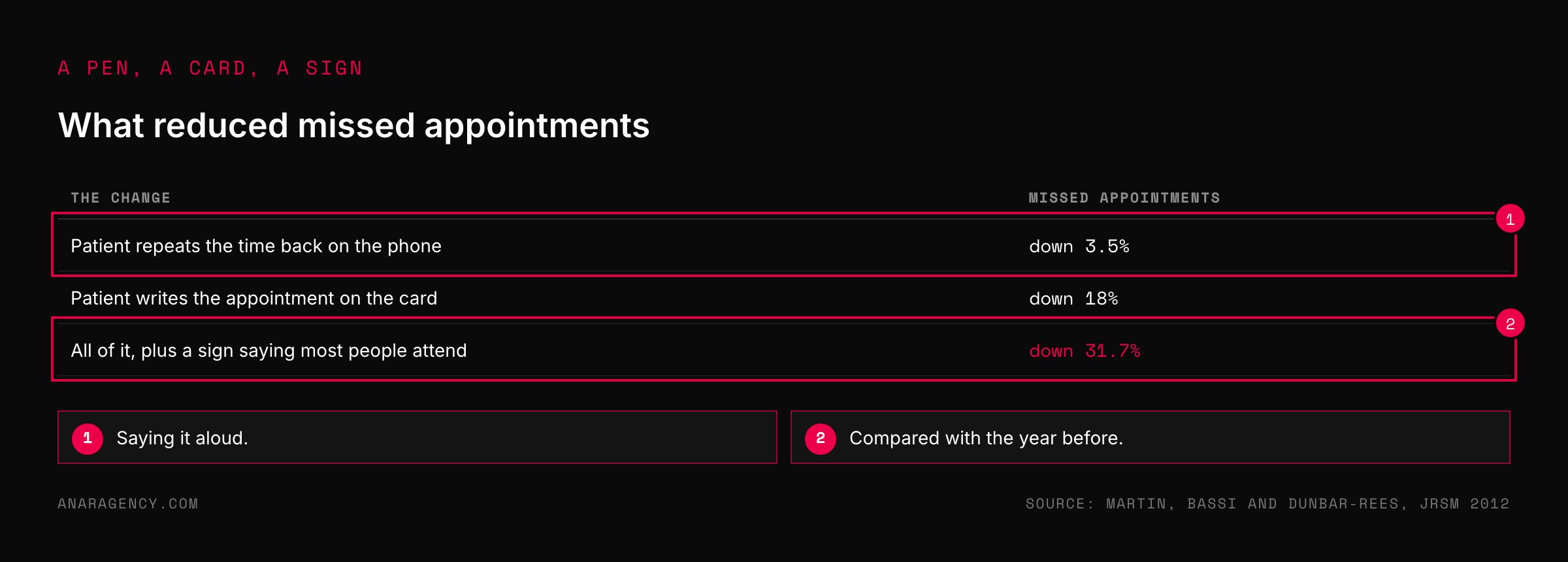
First, when patients phoned to book, the receptionist asked them to repeat the time and date back. Missed appointments fell by 3.5 percent the next month.
Second, at the desk, staff stopped writing the next appointment on the card and asked the patient to write it. Missed appointments fell by 18 percent.
Third, they replaced a sign saying how many people had missed appointments with one saying how many had turned up. With all three running, missed appointments were down 31.7 percent on the year before.
Why booked people do not show
A no-show feels like rudeness. It is usually something duller.
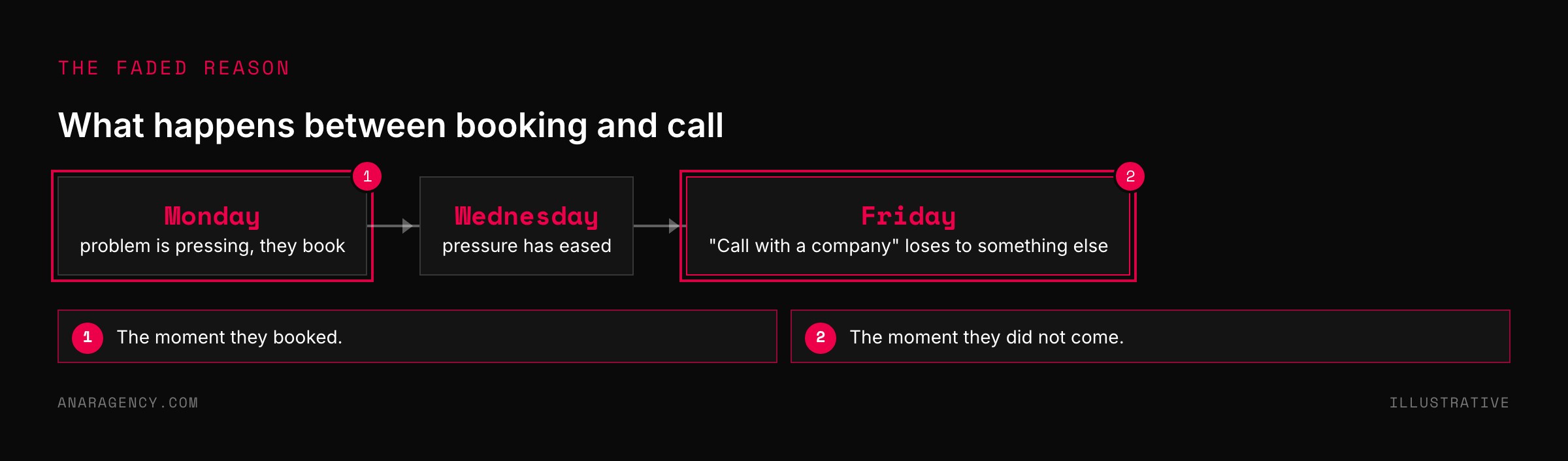
The person booked at a moment when the problem was pressing. Four days later the pressure has eased and the calendar entry reads "Call with a company." Something else comes up and wins.
So a missed call is mostly a faded reason, and the health-centre study shows what restores it.
An active commitment. Saying the time aloud or writing it down makes it theirs. Research on implementation intentions finds that people who specify when and where they will do something are far more likely to do it.
A sense that showing up is normal. Telling people that most attend made more attend.
Something to come for. That was not in the study, but it is the part a business controls most. A call the person expects to get something from is a call they keep.
Four messages between booking and call: a confirmation that says what they will get, a customer story one or two days before, a morning-of note about what you have prepared, and a text and email one hour before. Match the count to the gap and shorten the gap where you can. Have the person confirm actively, name the calendar entry properly, ask a few questions first, and put a reschedule link in every message.
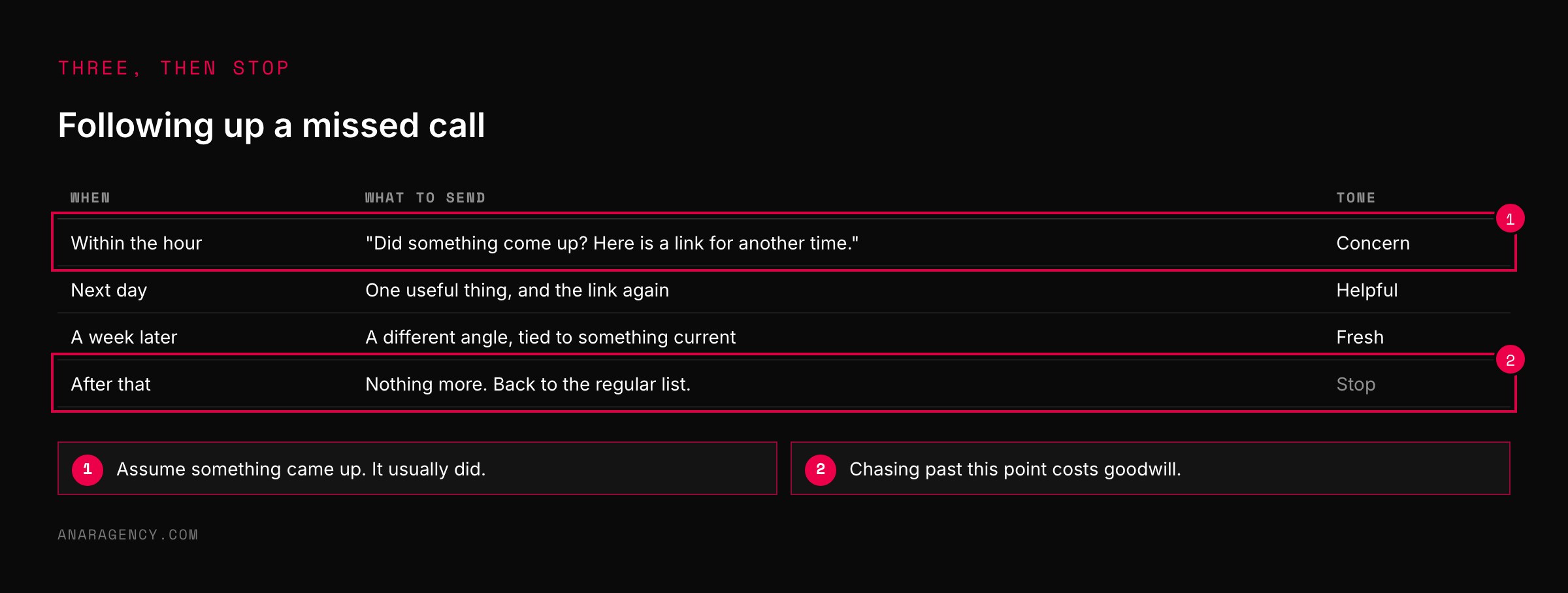
Follow up a no-show within the hour with concern, then twice more, then stop.
The Show-Rate Stack
Four messages sit between the booking and the call. Each has a job.
The confirmation, at once. Say what they will get, how long it takes, and whether to bring anything. Write it as what you will do for them.
"Here is what I am going to cover for you" beats "please make sure you attend."
A story, one or two days before. One customer who had the doubt this person probably has, and what happened. It answers the worry they would not have voiced.
The morning-of note. "I have been through your site and have three things to show you." Only say it if you have.
People return effort that is made for them, the tendency known as reciprocity.
The final reminder, an hour before. A short text and an email, both with the link. Texts are read quickly, and the link is what they will be hunting for at one minute to.
Adjust to the gap. A call booked for this afternoon needs the first and last only. A call more than five days out needs all four and something useful at the midpoint.
Better still, shorten the gap. If your calendar offers slots tomorrow, fewer people have time to cool.
Hosts: what high-show firms do
Some firms get most of their booked calls attended, with no tricks and no threats. They treat the call as an event the guest is invited to. We call them Hosts.
They let the person choose and confirm. The prospect picks the time, and the confirmation asks them to reply "yes" or add it to their own calendar. That is the pen and the card.
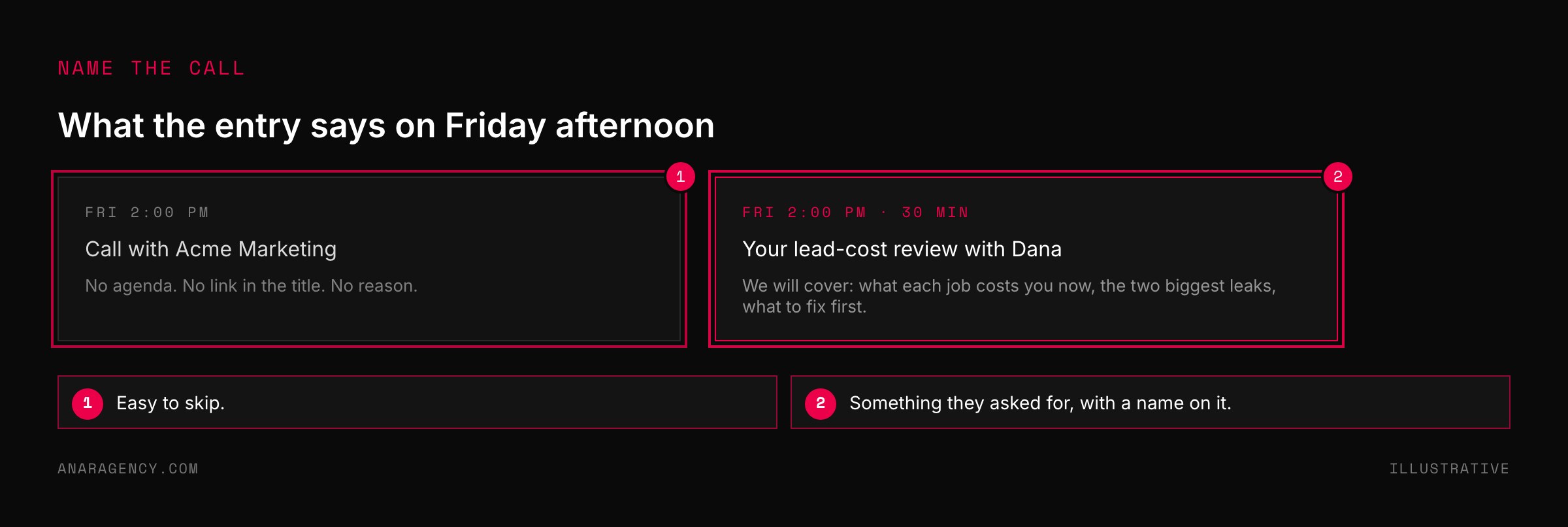
They name the call properly. The calendar entry says what will be covered. "Your lead-cost review with Dana, 30 minutes."
They ask a few questions first. A short questionnaire makes the call specific. People also value what they have put effort into, which psychologists call effort justification.
The questions are in qualify before the call.
They say that people show up. If it is true, say it. "Nearly everyone who books makes it, so we hold the slot for you alone."
They make moving easy. A reschedule link in every message. Someone who moves a call is still a lead.
Someone who silently skips it often is not.
They track it weekly. Booked, showed, rescheduled, missed. It is one of the four rates in book-a-call math, and the one that moves fastest.
"Should I charge a deposit, or chase people who miss?"
You may be tempted to punish no-shows. A deposit can work for high-priced services, where it is refunded on the call or credited to the purchase. For most small firms it removes more bookings than it saves.
Try the four messages first. They cost nothing and usually move the number further.
When someone does miss, follow up within the hour, and do it with concern. "I had us down for two today. Did something come up?
Here is a link if you would like another time."
One line is worth adding. "Was there anything I could have done to make this easier?" It reads as care, and now and then the answer tells you what is wrong with your process.
Write again the next day with something useful attached, and once more a week later with a different angle. After three, stop and return them to the regular list.
And be straight about availability. "I take four of these a week" is a fine thing to say if it is true. Invented scarcity is a false claim, and people can tell.
What to read next, and why
Commitments, norms and custard creams (journal article): The health-centre study. Short, readable, and the source of the figures above.
Implementation intention (encyclopedia entry): Why stating when and where makes people follow through.
Reciprocity (encyclopedia entry): Why visible preparation on your side brings attendance on theirs.
Effort justification (encyclopedia entry): Why a short questionnaire raises the value of the call in the booker's mind.
So the simple takeaway is this: rewrite your confirmation email to say what the person will get, and add a text one hour before. Measure show rate for a month before and a month after.
Questions executives ask
What is a good show rate for sales calls?
It varies by price, lead source, and how long people wait for the call, so the useful comparison is with your own previous months. Track booked, showed, rescheduled, and missed each week and aim to improve on your own baseline.
How do you reduce no-shows for booked calls?
Have the person confirm actively, send a confirmation that says what they will get, follow with a relevant customer story, a morning-of note, and a reminder by text and email an hour before. Shortening the time between booking and call also helps.
How many reminders should I send before a sales call?
It depends on the gap. Two for a same-day call, three for a call one or two days away, four for three to five days, and an extra useful message at the midpoint if the wait is longer.
Should I charge a deposit to reduce no-shows?
It can suit high-priced services when the deposit is refunded or credited. For most small businesses it reduces bookings more than it reduces no-shows. Improve the messages between booking and call first.
What should I say to someone who missed a call?
Write within the hour, assume something came up, and offer a link to choose another time. Avoid blame. Asking whether anything could have made it easier sometimes reveals a fixable problem in your process.

Filip Kovacevic is the founder of Anar Agency in Phoenix. He spent five years running SEO, Meta ads, email, and content for medical practices across the United States, and now does the same work for healthcare, home-service, legal, and professional-service businesses, alongside AI implementation. More from Filip →
Talk it through in 15 minutes
Bring one AI question from this article. We will tell you what we would do, whether or not you hire us.
Book a 15-Min Chat →