Sequence Words: Once, When, Then
Sequence words are small words that put events in order: once, when, then, after. They make a reader picture a result as a step on a timeline instead of a question. "If you get more calls" leaves the outcome in doubt.
"Once the calls start coming in" treats it as the next thing that happens. Use if early, where the reader really is undecided, move to when as they begin to picture it, and close on after. Only attach them to things that are true and that you can deliver, because a sequence word turns a hope into an implied promise.
One word in a courtroom
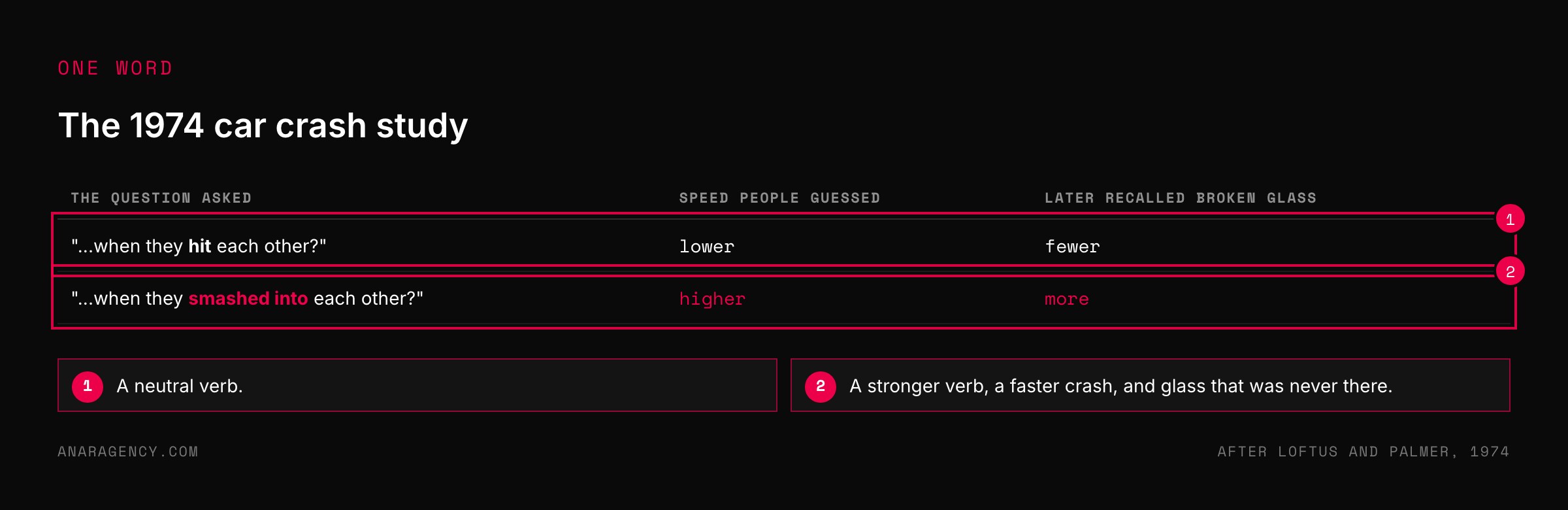
In 1974 two psychologists showed people a film of a car accident and then asked one question. How fast were the cars going when they hit each other?
Except they did not ask everyone the same question. Some people got "hit." Others got "smashed into."
Others got "contacted."
Everyone had watched the same film. The people who heard "smashed" guessed a higher speed than the people who heard "hit."
A week later the researchers asked whether there had been broken glass. There had not. People who had heard "smashed" were more likely to remember seeing some.
One verb changed the estimate and then changed the memory. Words do not only describe what a reader pictures. They build it.
The word that plants doubt
Now look at the most common word in sales copy. It is "if."
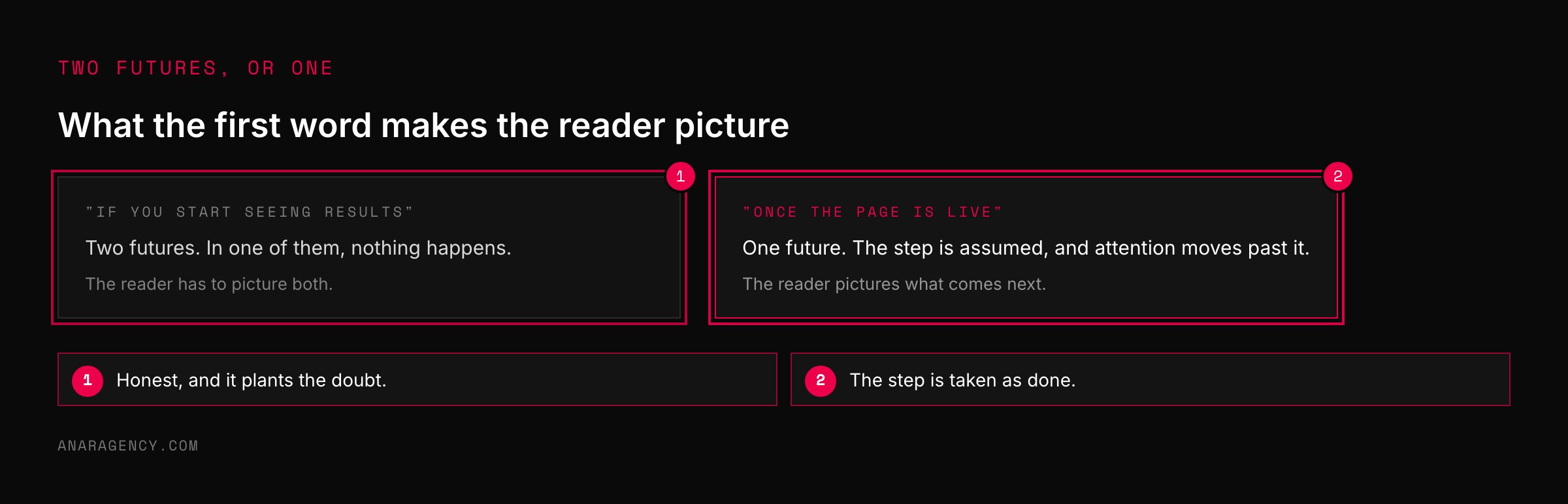
"If you want more leads." "If this works for you." "If you start seeing results."
"If" is an honest word, and it has one effect. It opens the question of whether the thing happens at all. The reader has to picture two futures, and one of them is failure.
Compare "once the page is live." There is only one future in that sentence. The page going live is assumed, and the reader's attention is already on what comes after.
Linguists call this a presupposition: something a sentence takes for granted without stating it. "Have you stopped missing calls?" assumes you were missing them. "Once" assumes the first step gets done.
Once, when, then, and after put events in order and make a reader picture a result as a step on a timeline. Use if at the top of a page, where the reader is truly undecided. Move to when in the middle, as they start to picture it.
End on after, speaking from the far side. Attach sequence words only to steps you control and that are true. For outcomes you cannot guarantee, use honest conditional language.
Once, when, then
Three words carry most of the load.
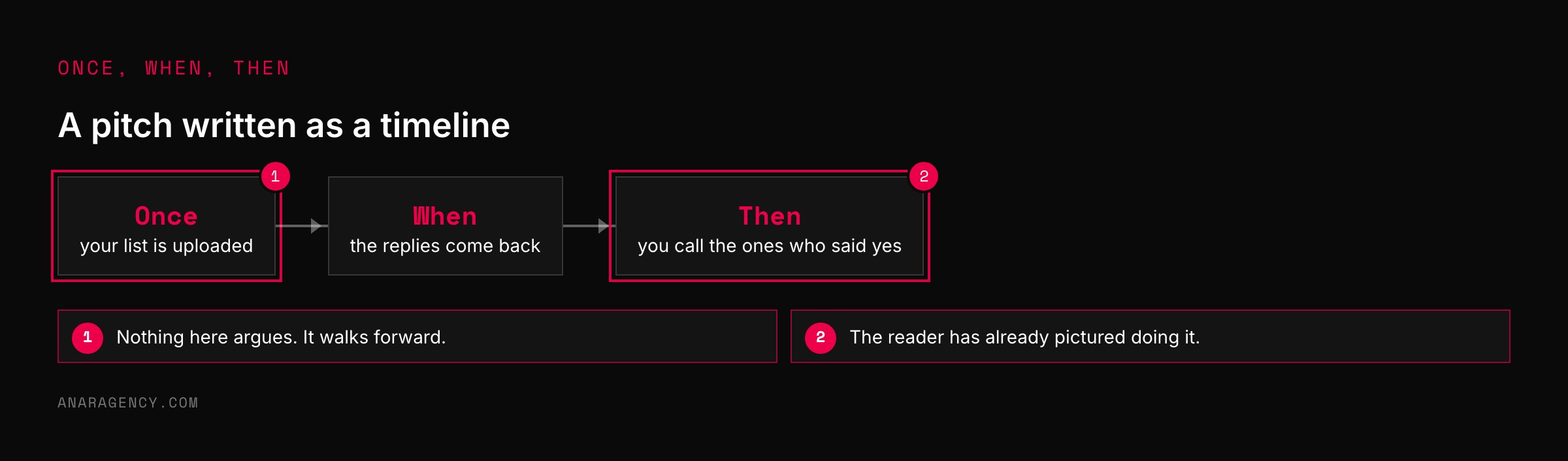
Once treats a step as finished and looks past it. "Once your list is uploaded."
When names a moment that is on its way. "When the first reply comes back."
Then says what follows. "Then you send the calendar link."
Put together they turn a pitch into a schedule. "Once your list is uploaded, the first message goes out that afternoon. When the replies come back, you will see them in one inbox.
Then you call the ones who said yes."
Nothing in that passage argues. It just walks forward, and the reader walks with it.
There is research on why this form is so sticky. Psychologists who study follow-through have found that people are much more likely to act when they phrase a plan as "when this happens, I will do that." They call these implementation intentions.
A sequence is easier to carry out than a wish.
Timeline Writers: if, when, after
The best copy does not use one tense all the way through. It moves. We call the people who write this way Timeline Writers.
They start with if. At the top of the page the reader really is undecided, and pretending otherwise sounds pushy. "If your phone has gone quiet this quarter..."
They move to when. By the middle the reader is picturing it. "When you open the report on Monday, you will see four numbers."
They finish with after. At the end they speak from the far side. "After the first month, you will know which of the four to fix."
If, when, after. Possibility, expectation, arrival. The reader starts where they are and ends where they want to be, and the small words did the moving.
People buy new beginnings. A page that walks them into one, step by step, is doing what a good salesperson does out loud.
This pairs with choosing the right opening word for the reader, which we cover in before-words and after-words.
"Is this not just manipulation?"
You may be uneasy about writing as though the result is certain. You should be. That unease is the guardrail.
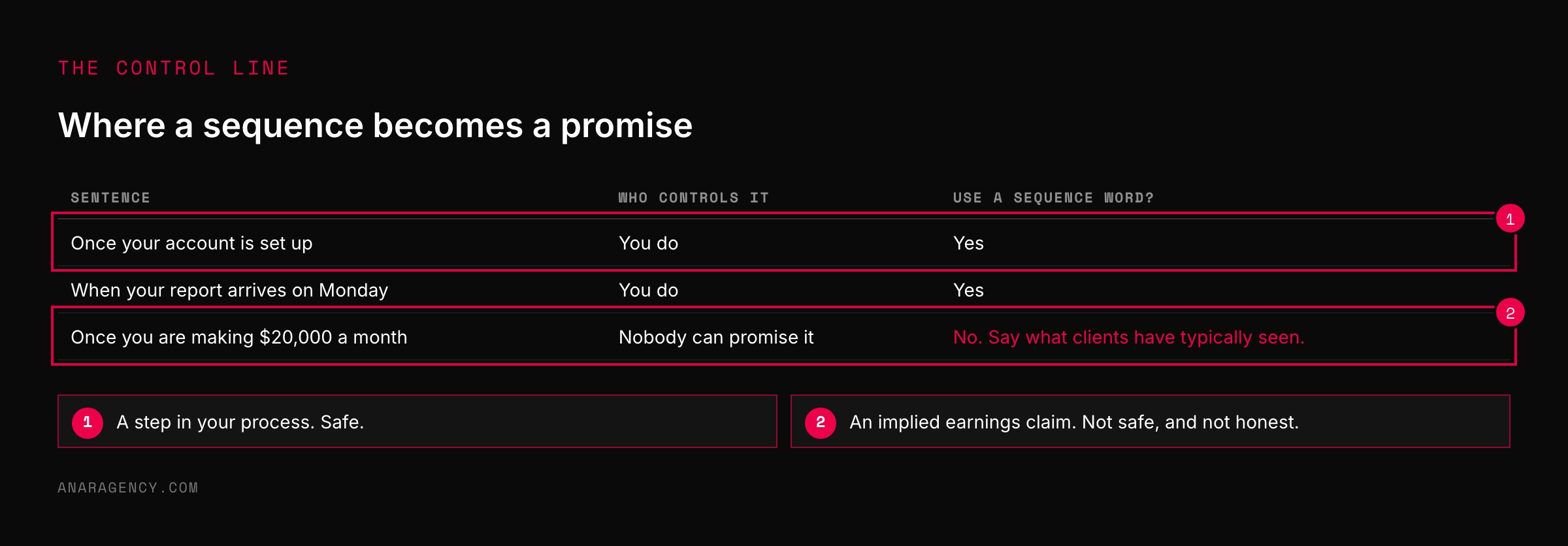
A sequence word turns a possibility into an implied promise. "Once you double your leads" claims, quietly, that leads will double.
So the rule is strict. Only put once, when, and then in front of things that are true and within your control.
"Once your account is set up" is fine. You set it up. "When your first report arrives on Monday" is fine.
You send it.
"Once you are making $20,000 a month" is a claim about a result you cannot guarantee. The law treats it as a claim. The FTC's advertising guidance says ads must be truthful and that claims need evidence before they are made, whether stated or implied.
Use sequence words for the steps of the process, which you control. Use honest, conditional language for the outcome. The reader gets a clear path and no false promise, which is the same balance we describe in selling outcomes.
What to read next, and why
Reconstruction of automobile destruction (encyclopedia entry): The 1974 study in full. A short read that will make you careful with verbs.
Presupposition (encyclopedia entry): How a sentence assumes things without saying them. The mechanism behind "once."
Implementation intention (encyclopedia entry): Why "when X, I will do Y" gets followed through.
Advertising FAQs: A Guide for Small Business (FTC guide): Where an implied promise becomes a claim you have to back up.
So the simple takeaway is this: go through your page and circle every "if." Keep the ones at the top. For the rest, ask whether the thing really is in doubt, and if it is not, say when.
Questions executives ask
What are sequence words in copywriting?
Small words that put events in order, such as once, when, then, and after. They present what follows as the next step on a timeline, so the reader pictures it happening instead of weighing whether it will.
Why should I avoid the word "if" in sales copy?
You should not avoid it everywhere. "If" opens the question of whether something happens, which is right early on when the reader is undecided. Later in a page, where the step is certain, "once" or "when" keeps the reader moving forward.
What is the if, when, after pattern?
A way of moving a page from possibility to arrival. Open with if to meet the undecided reader, shift to when as they begin to picture the result, and close with after to describe life on the far side.
Is using presuppositions in copy deceptive?
It can be. A sequence word implies that the thing it introduces will happen. That is honest for steps you control, like setup or delivery.
For results you cannot guarantee, an implied promise is still a claim that needs evidence under FTC advertising rules.
Can one word really change what people believe?
Research suggests it can. In a 1974 study, people who were asked how fast cars were going when they "smashed into" each other gave higher speed estimates than those asked with the word "hit," and were more likely to later recall broken glass that was not in the film.

Filip Kovacevic is the founder of Anar Agency in Phoenix. He spent five years running SEO, Meta ads, email, and content for medical practices across the United States, and now does the same work for healthcare, home-service, legal, and professional-service businesses, alongside AI implementation. More from Filip →
Talk it through in 15 minutes
Bring one AI question from this article. We will tell you what we would do, whether or not you hire us.
Book a 15-Min Chat →