Agree on the Cause First, Then Make the Argument
Every piece of sales copy is an argument, and every argument needs a reason to exist. Most copy jumps straight to its position: our service is better. The reader answers with their own counter-argument.
Instead, open with the cause: a change, a cost, or a problem the reader already accepts as true. Then agree on what the problem really is. Only then propose what to do.
A reader who has agreed to the cause is no longer arguing against you. They are inside your frame, asking a question you can answer.
What the news decided
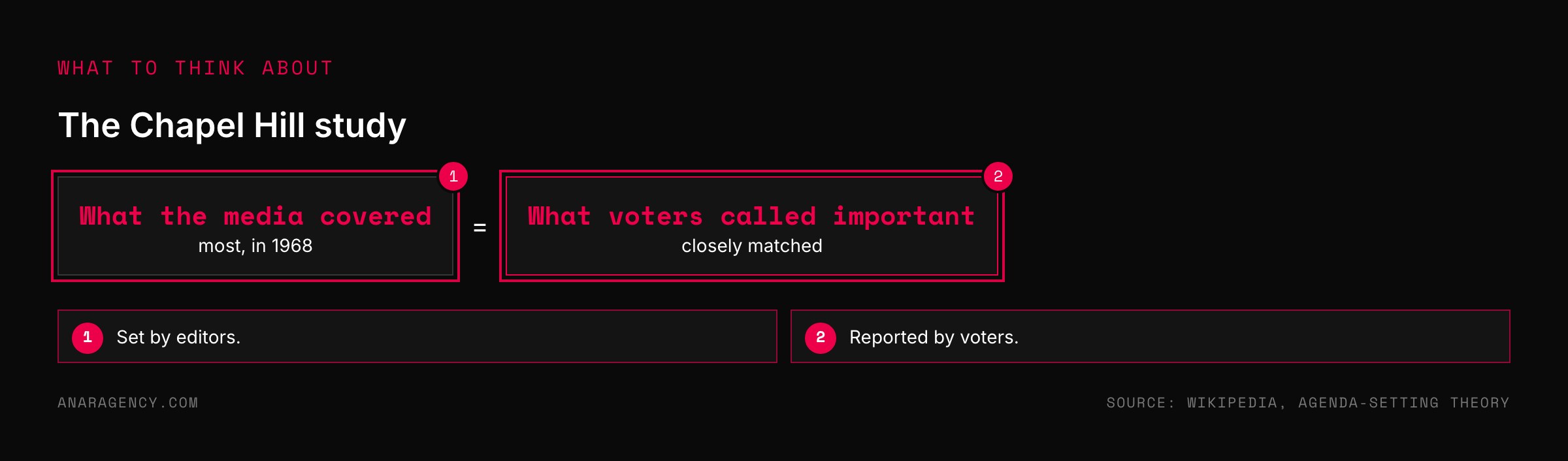
During the 1968 American presidential campaign, two researchers in Chapel Hill, North Carolina, asked a hundred undecided voters what they thought the most important issues were.
Then they analyzed what the local newspapers, magazines, and television had covered.
The two lists matched closely. The issues voters rated most important were the issues the media had given most attention.
The finding grew into what is called agenda-setting theory. The media did not necessarily tell people what to think. They had a strong influence on what people thought about.
That is the most important power in any argument. Decide what the conversation is about, and you have decided most of where it will end.
Why arguing your position fails
Most sales copy begins with its conclusion. Our firm is better. Our product is faster.
This approach works.
The reader has heard it before, and they answer with their own counter-argument. Maybe they are happy with what they have. Maybe they think every firm says that.
Now two positions are pushing against each other, and the reader's own position has the advantage of being theirs.
Persuasion research shows how much the frame matters. The same choice, described as lives saved or as lives lost, leads people to opposite decisions. The facts were identical.
The frame decided.
So the question is not how to argue harder. It is which frame the argument happens in, and who set it.
Every piece of copy is an argument, and an argument needs a cause. Work in three steps: the cause, a change or cost the reader already accepts; the definition, what the problem really is; and the position, what to do. Choose a cause the reader already believes, state it about the world and not the reader, and let it make outside alternatives irrelevant.
Know your position before writing. Use only causes you can support, and only ones that truly lead to your offer.
Cause First
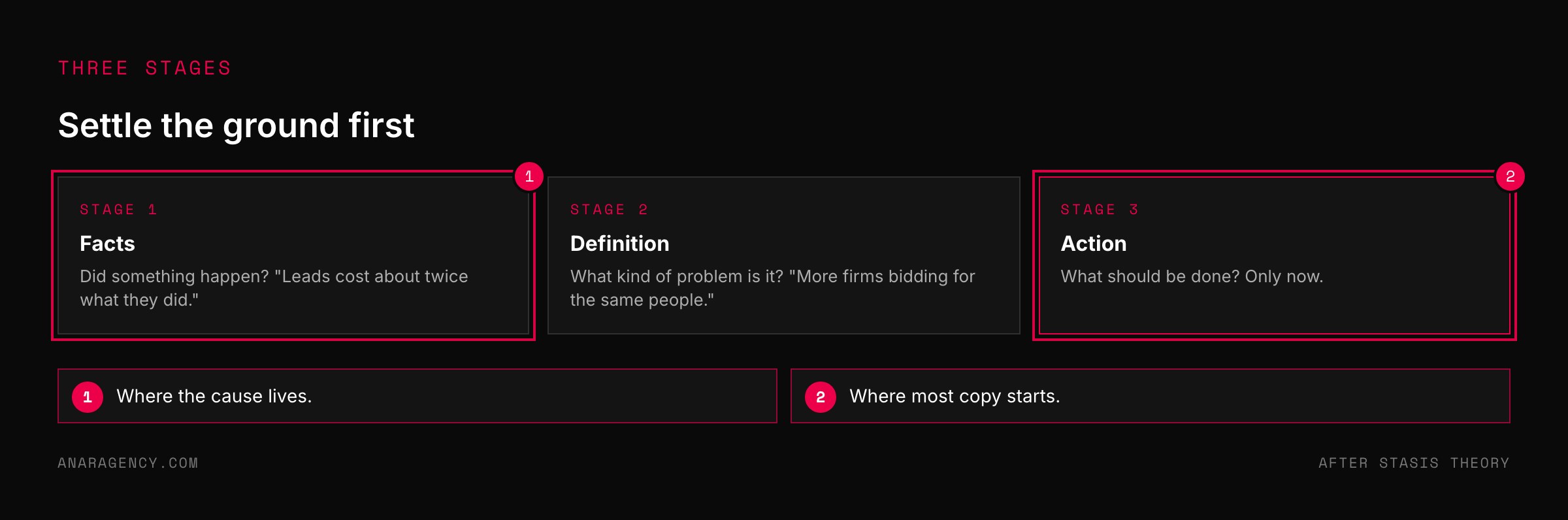
Teachers of rhetoric in ancient Greece and Rome worked this out. They taught that a dispute had to be settled in stages, a method later called stasis theory.
First, agree on the facts: did something happen? Then on the definition: what kind of thing is it? Only then on the action: what should be done?
Arguments that skip to the action, while the parties still disagree about the facts, go nowhere.
Sales copy is no different. We put it in three steps.
The cause. What is the reason for this conversation? A change, a cost, a problem the reader already accepts.
"Leads cost most small firms about twice what they did three years ago."
The definition. What is the problem really? "It is not that ads stopped working.
It is that more firms are bidding for the same people."
The position. Now, and only now, what to do. By this point the reader has agreed twice, and the proposal is the natural next step.
Frame Setters: how they choose a cause
Some writers seem to win arguments the reader did not know they were having. They choose the ground before the fight. We call them Frame Setters.
They pick a cause the reader already believes. Not one they have to prove. The best cause is something the reader has said aloud this month.
They make it about the world, not the reader. "Costs have doubled" is a fact about the market. "You are wasting money" is an accusation, and on Meta it can break the rule on personal attributes.
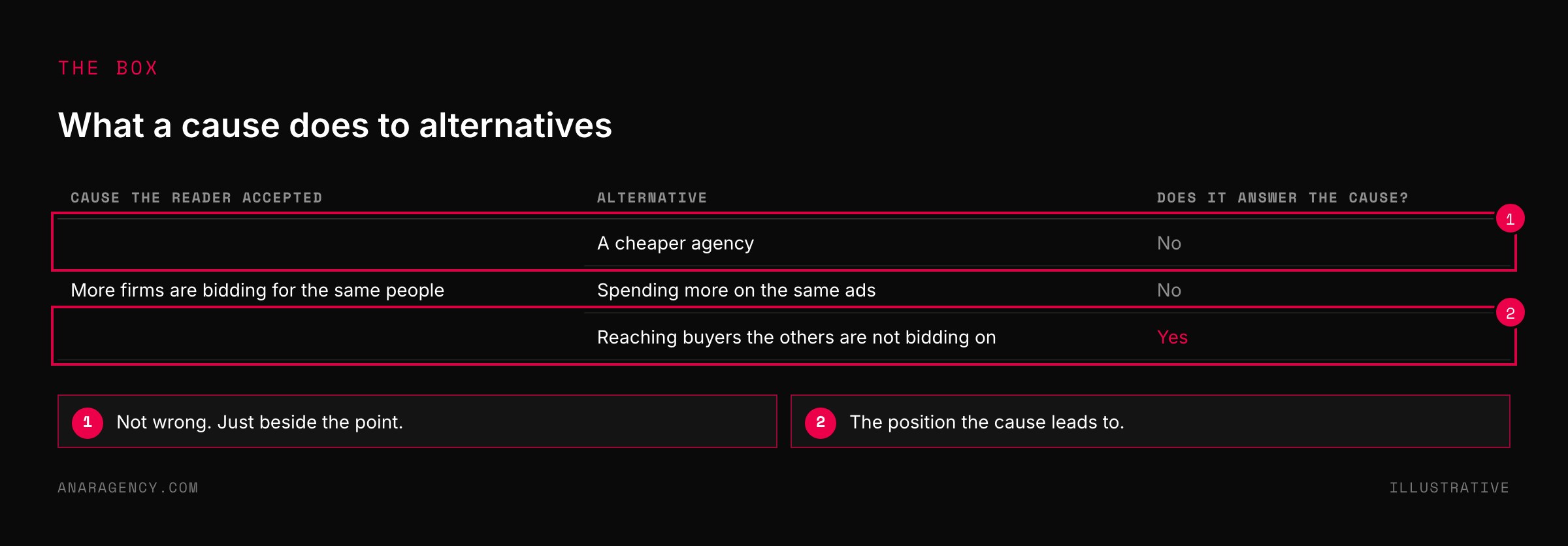
They draw the box. Once the cause is set, alternatives outside it look beside the point. If the cause is that more firms are bidding for the same people, then a cheaper agency does not answer it.
They see the end before they write. Knowing the position you are heading for lets each line be the reason for the next. Writers who start without a cause tend to wander.
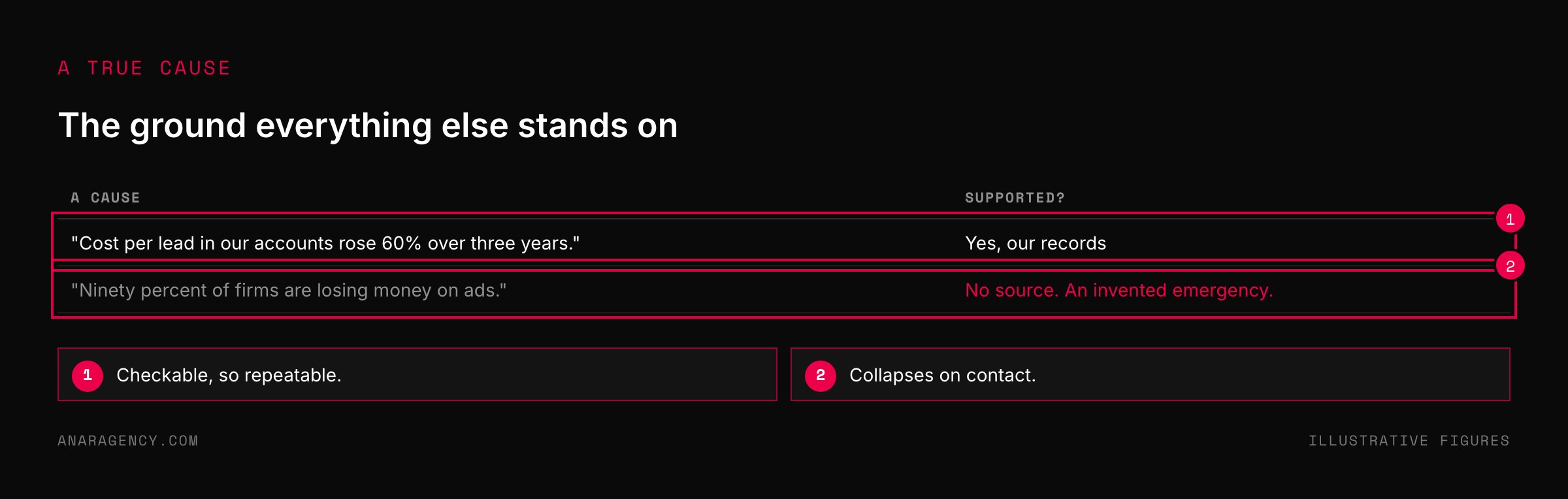
They keep it true. A cause must be real and checkable. The rest of the argument stands on it.
The same structure underlies action is desire minus objections and the opening of the first 90 seconds.
"Is this not just framing people?"
It is framing. All communication frames. The choice is only whether you do it on purpose and honestly.
Framing becomes manipulation when the cause is false or distorted. "Ninety percent of firms are losing money on ads" with no source is not a cause. It is an invented emergency.
Use causes you can support with a figure, a public report, or your own records. If a reader checks, the cause should hold.
And choose causes that genuinely lead to your position. If agreeing with your cause would lead a sensible reader to a competitor's product, it is the wrong cause, or the wrong product.
There is a practical benefit to honesty here. A true cause is one the reader will repeat to their partner or their boss, and the argument travels with it.
When the cause needs proof, the kinds that persuade are covered in the Proof Grid.
What to read next, and why
Agenda-setting theory (encyclopedia entry): The 1968 study and what has been learned since.
Stasis (rhetoric) (encyclopedia entry): The classical method of settling facts before arguing action.
Framing effect (encyclopedia entry): How the same facts lead to different choices depending on how they are presented.
Meta's Personal Attributes advertising policy (policy): Why the cause should describe the world, not the reader.
So the simple takeaway is this: before your next sales page or ad, write one sentence that your reader would agree with before they know who you are. Open with that.
Questions executives ask
What is a cause for argument in copywriting?
The reason the conversation needs to happen at all: a change, a cost, or a problem the reader already accepts. Establishing it first gets the reader's agreement before you propose anything, so your proposal answers a question they now share.
Why does leading with your position fail?
Because readers meet a claim like ours is better with their own counter-argument. Two positions then push against each other, and the reader's own view has the advantage.
What is stasis theory?
A method from classical rhetoric for settling a dispute in stages: first agree on the facts, then on how to define the issue, and only then on what should be done. Arguments that skip ahead tend to stall.
What is agenda-setting theory?
A theory from a 1968 study in Chapel Hill showing that the issues voters considered most important closely matched those the local media covered most. It suggests that shaping what people think about is a powerful form of influence.
Is framing an argument manipulative?
All communication involves framing. It becomes manipulative when the frame is false or distorted. Use causes you can support with evidence, and only those that genuinely lead to your offer.

Filip Kovacevic is the founder of Anar Agency in Phoenix. He spent five years running SEO, Meta ads, email, and content for medical practices across the United States, and now does the same work for healthcare, home-service, legal, and professional-service businesses, alongside AI implementation. More from Filip →
Talk it through in 15 minutes
Bring one AI question from this article. We will tell you what we would do, whether or not you hire us.
Book a 15-Min Chat →