Teach Them and They Move: Educational Copy That Motivates

Copy can teach what a thing is, show what it does for the reader, or describe who they become. Teaching asks the reader to store new information, which takes effort and leaves less attention for feeling anything. Showing what it does draws on pictures they already have, which is easy.
So teach as little as the reader needs, explain new ideas through things they already know, and spend most of the page on what the product does for them. After reading, they should feel something about it, not just know about it.
Five gigabytes, or a thousand songs
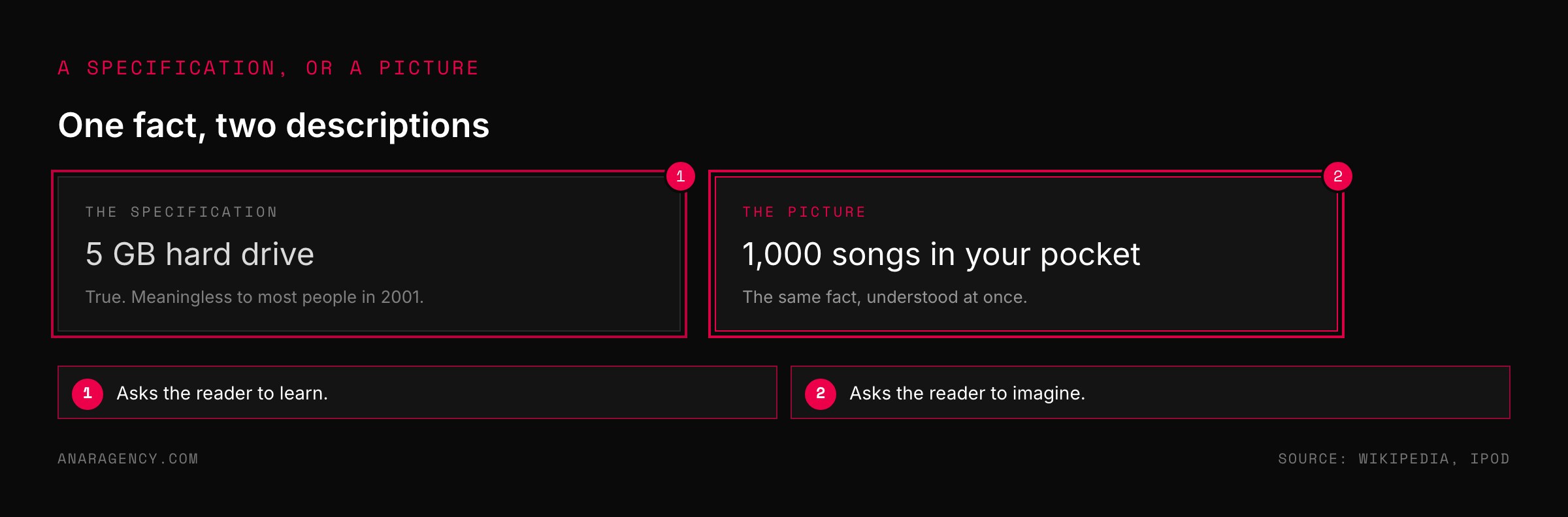
In October 2001 a computer company launched a small music player. It had a 5 GB hard drive.
That was the fact. Most people in 2001 had no idea what five gigabytes would hold.
The launch described it as putting 1,000 songs in your pocket.
Nobody needed to learn anything to understand that. Everyone already knew what a song was, what a pocket was, and roughly how many albums sat on their shelf.
The specification was true and meant nothing. The picture was the same fact, and it meant everything.
Learning costs effort. Recognizing does not.
When you read something new, your mind has to build a place to keep it. That takes work.
Psychologists describe the limit on that work as cognitive load. There is only so much new material a person can take in at once, and anything beyond it is lost or skipped.
Recognizing something is different. A word that calls up a picture you already have costs almost nothing. You can read about familiar things for a long time without tiring.
That is why a page full of features and mechanisms feels heavy. Every line asks the reader to store something.
And a reader spending effort on understanding has little left for wanting. The more a page educates, the more it risks leaving people informed and unmoved.
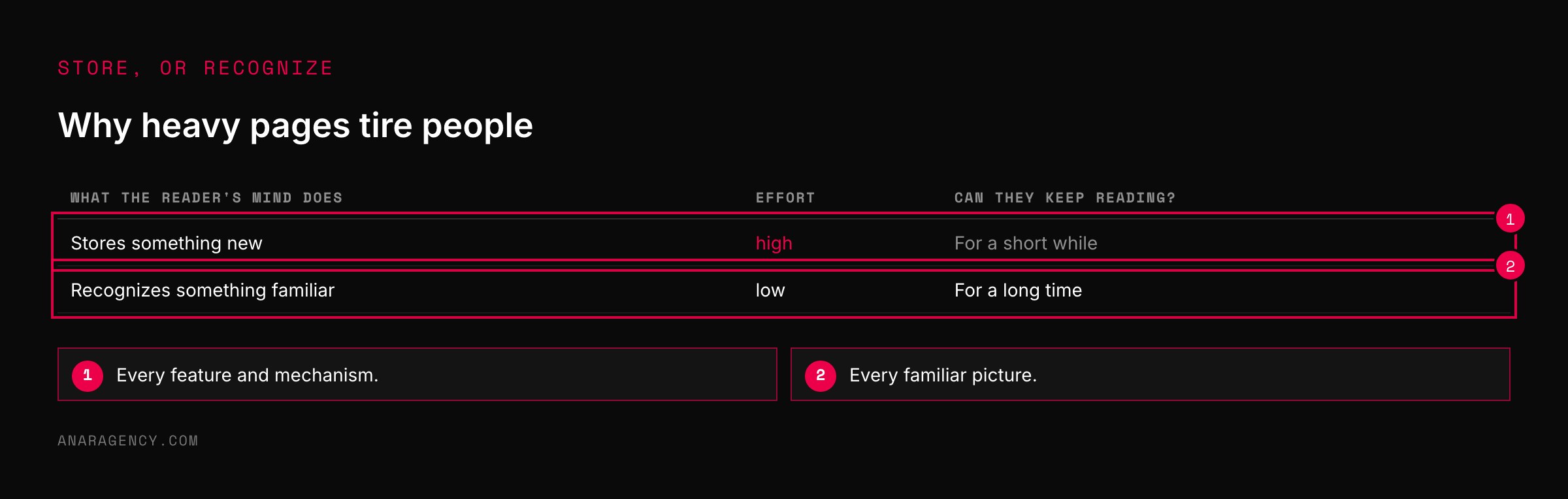
Teaching costs a reader effort, recognizing costs almost none. Teach only the one idea the reader needs, through something they already understand. Then spend most of the page on what the product does for them and who they become.
Cut jargon, teach one thing per section, and turn numbers into objects. Put full specifications after the reason to care, for readers who want to check. Test every page: after reading, does a stranger feel something about it, or only know about it?
Teach-Then-Move
This is not an argument against teaching. Some buyers need to understand a thing before they will trust it. It is an argument about proportion and order.
Teach only what the reader needs. The one idea without which the rest makes no sense. Not every feature.
Not the history.
Teach through what they already know. People make sense of new things by fitting them to existing mental structures, which psychologists call schemas. "It works like a smoke alarm for your inbox" uses a structure the reader already owns.
Then move. Spend most of the page on what the thing does for them, and on how life looks with it. Those draw on pictures they already have, so they are easy to read.
There are three registers. Educational says what it is. Motivational says what it does for you.
Inspirational says who you become. Strong copy touches the first and lives in the other two.
How a picture turns into wanting is the subject of desire is a gap.
Bridge Builders: how they explain hard things
Some writers can explain a complicated service so that a stranger understands it in one read. They build bridges from what the reader knows. We call them Bridge Builders.
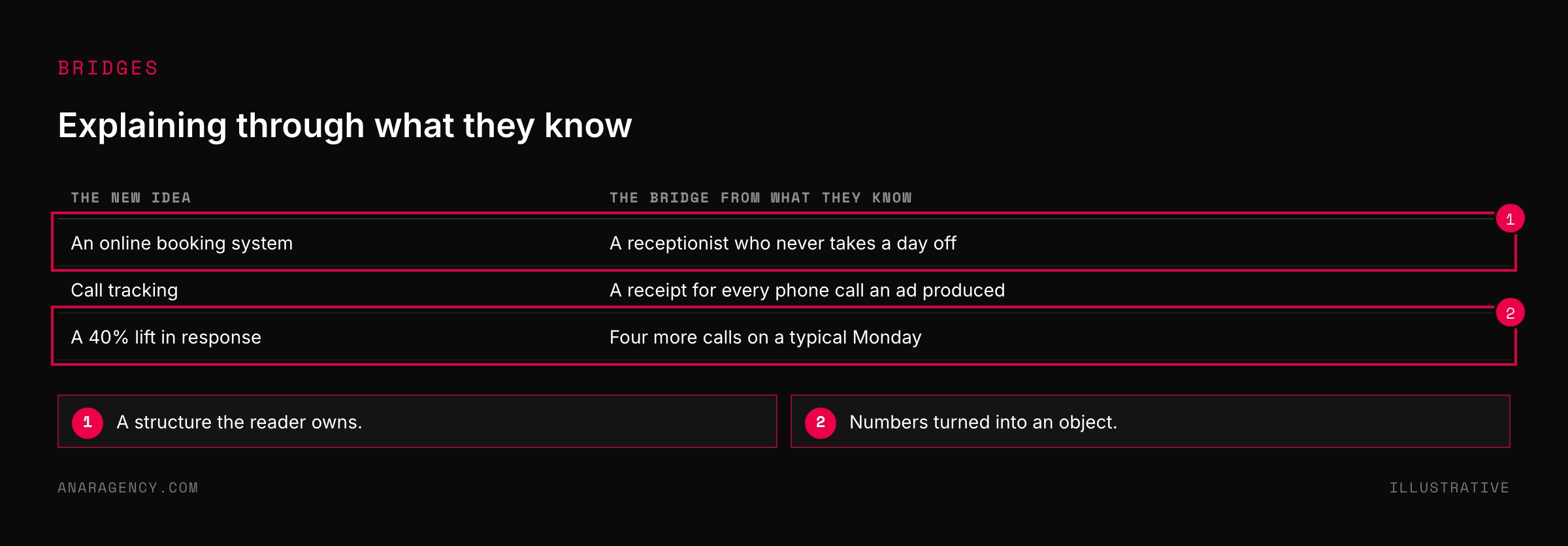
They find the familiar version. Every new idea has an older cousin the reader already understands. A booking system is a receptionist.
A data pipeline is plumbing.
They cut the jargon. Experts forget what it was like not to know their own field, a trap called the curse of knowledge. Every term of art is a word the reader must store.
They teach one thing per section. Then they let the reader rest on something familiar before the next.
They convert numbers into objects. Not "5 GB" but a thousand songs. Not "a 40 percent increase in response" but "four more calls on a typical Monday."
They run the walk-away test. After reading, does a stranger know about it, or feel something about it? If only the first, the page educates and stops.
Sophisticated buyers want more detail, which we discuss in selling to buyers who have seen it all. Even then, the detail goes after the reason to care.
"My buyers want the specifications"
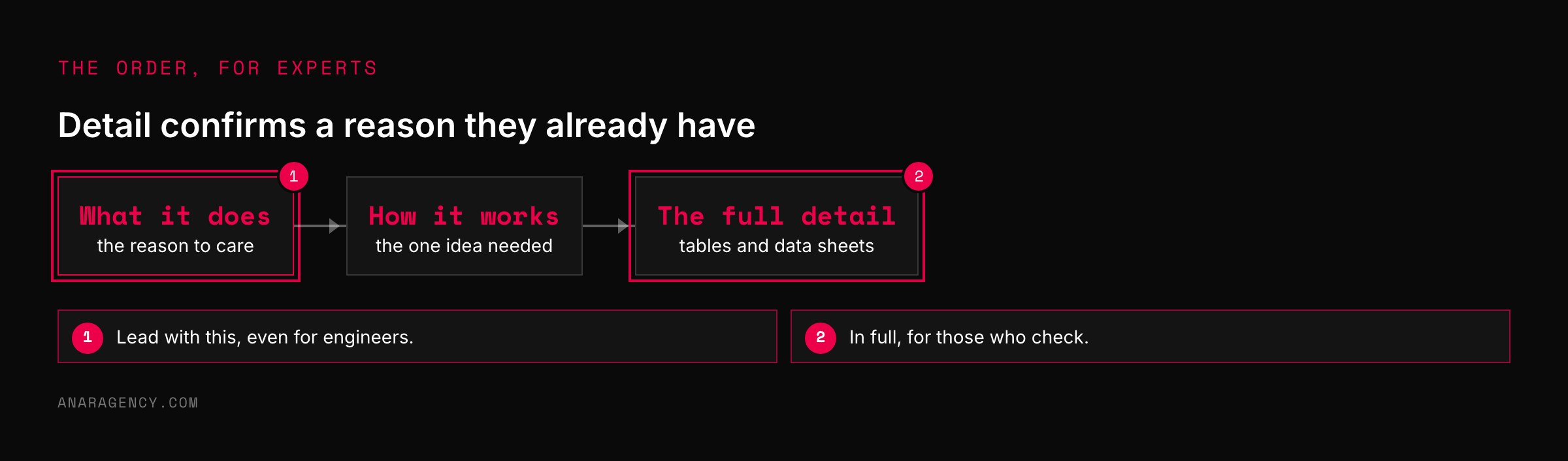
Engineers, finance directors, and specialists do want the facts. Give them all of them. Put them second.
The order matters because a specification only means something once the reader knows why they would want it. A 5 GB drive is impressive to someone who has already pictured a thousand songs in a pocket.
So lead with what it does, then provide the detail in full for those who want to check. A table, a data sheet, a technical page.
That way the motivated reader is not slowed down, and the careful reader is not left short.
Keep the translation honest. "A thousand songs" was a fair description of what that drive held at the time. A picture that overstates what the product does is a false claim made more vivid.
And keep the facts correct when you simplify. An analogy that misleads about how something works will be noticed by exactly the expert buyers you want.
What to read next, and why
iPod (encyclopedia entry): The 2001 launch and how it was described.
Cognitive load (encyclopedia entry): The research on how much new information people can take in at once.
Schema (psychology) (encyclopedia entry): How people understand new things by fitting them to what they know.
Curse of knowledge (encyclopedia entry): Why experts explain their own field badly.
So the simple takeaway is this: find the most technical sentence on your sales page and rewrite it as something the reader could picture holding. Then move the original to a details section below.
Questions executives ask
What is the difference between educational and motivational copy?
Educational copy explains what a product is, its features and how it works. Motivational copy shows what it does for the reader. Educational copy asks the reader to learn, while motivational copy draws on pictures they already have, which is easier to read and more likely to prompt action.
How do you explain a complex product in marketing?
Teach only the single idea the buyer needs, through an analogy to something they already understand. Turn numbers into objects they can picture, cut jargon, and place full technical detail after the reason to care.
Is educational content bad for conversion?
No, but too much of it can be. Learning takes effort, and a reader spending effort on understanding has less attention left for wanting the product. Teach briefly and then show what it does for them.
Why did 1,000 songs in your pocket work?
It described a 5 GB drive in terms everyone already understood. People knew what a song and a pocket were, so they could picture the benefit at once without learning what a gigabyte was.
Should technical buyers get specifications first?
Give them the full specifications, but after a clear statement of what the product does for them. The detail then confirms a reason they already have instead of asking them to work out the reason themselves.

Filip Kovacevic is the founder of Anar Agency in Phoenix. He spent five years running SEO, Meta ads, email, and content for medical practices across the United States, and now does the same work for healthcare, home-service, legal, and professional-service businesses, alongside AI implementation. More from Filip →
Talk it through in 15 minutes
Bring one AI question from this article. We will tell you what we would do, whether or not you hire us.
Book a 15-Min Chat →