Local Lead Gen: Zip-Code Targeting and Messenger-First Ads
Local ads work best when the money follows the map. Spend the most in the few miles around your door, less in the next band, and beyond that only in the neighborhoods that match your buyer, chosen with public Census data. Open the conversation with one easy question in Messenger instead of a form, and keep four ways to buy open at once: message, call, book online, walk in.
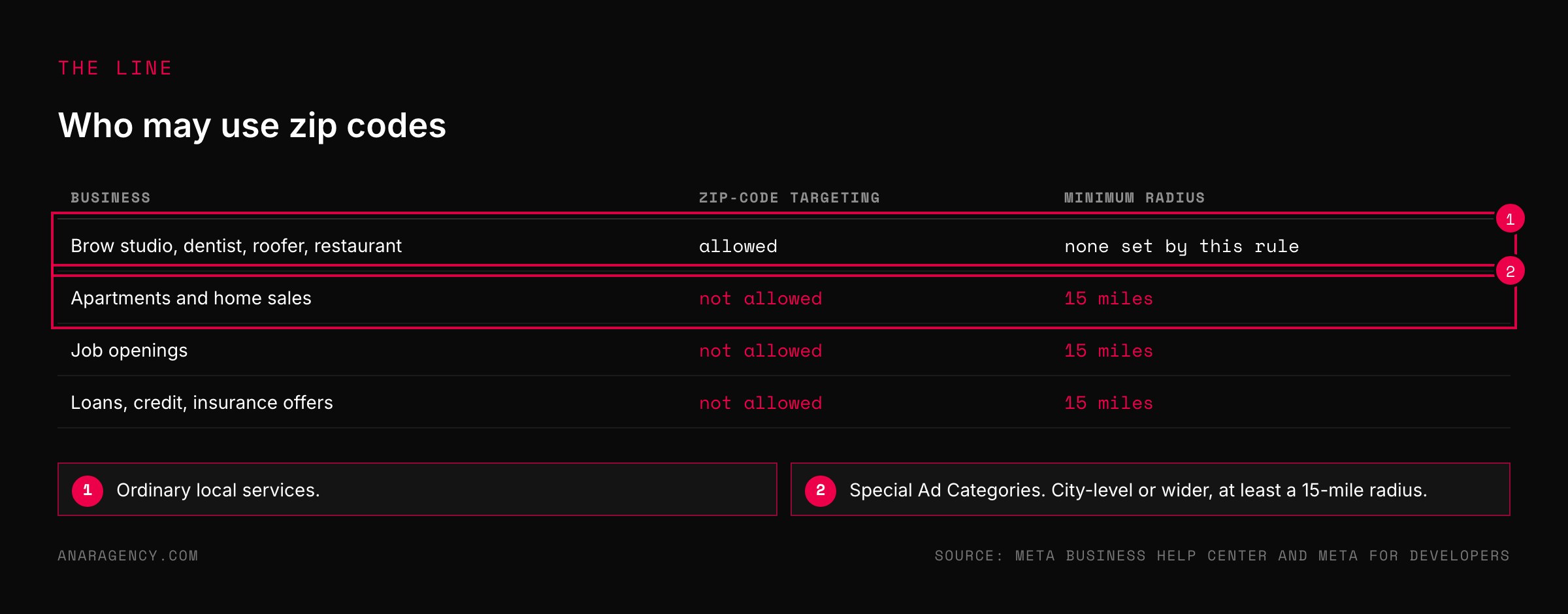
One warning: if you advertise housing, jobs, or credit, Meta does not allow zip-code targeting at all, and you must use a radius of at least 15 miles.
The one thing a national brand cannot do
A national advertiser has to guess where its customers are. You do not.
You can look out the window. You know which neighborhoods your best customers drive in from. You know the street where nobody has ever booked.
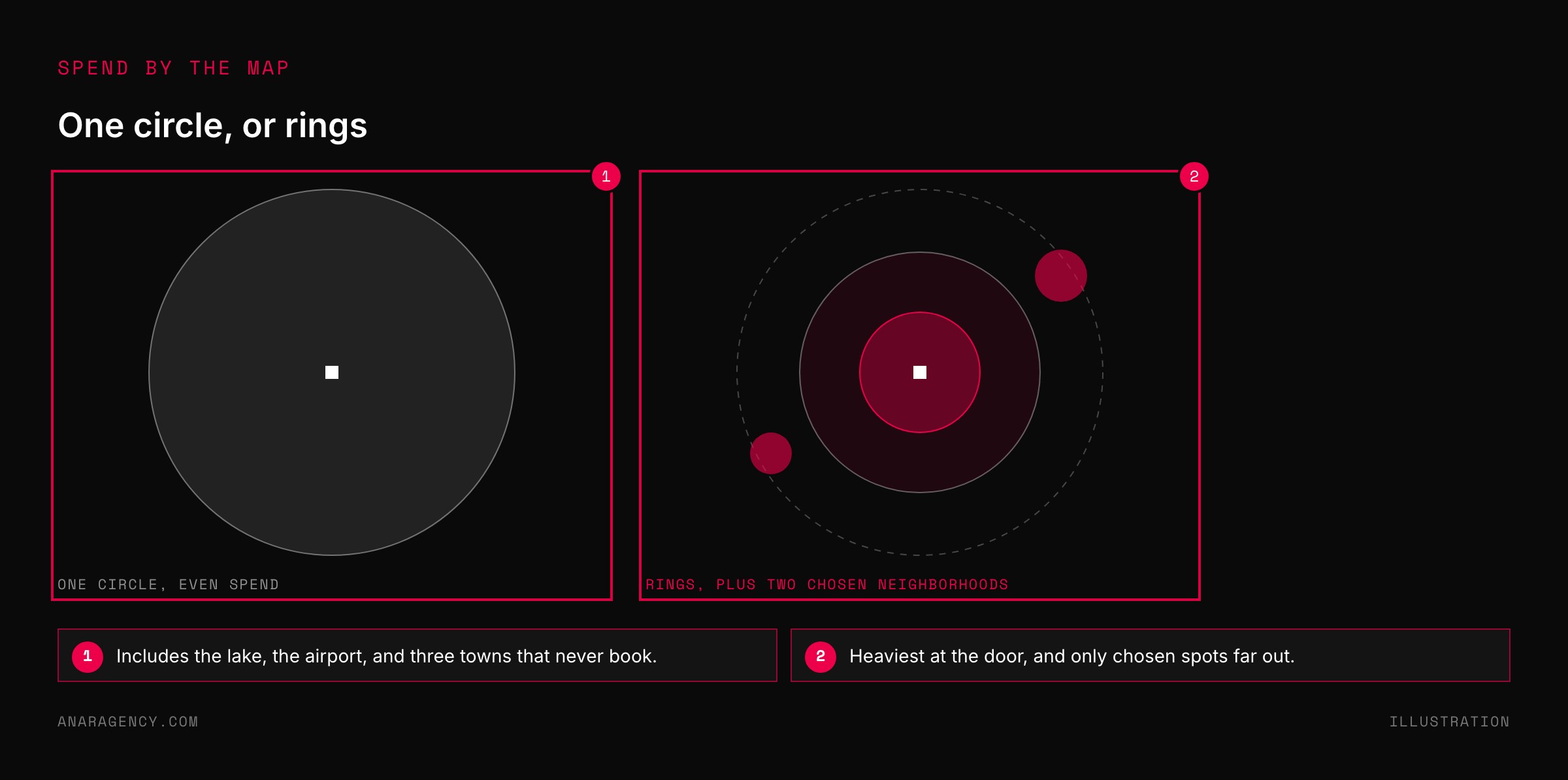
That is an advantage money cannot buy, and most local businesses throw it away. They set the ad to "25 miles around the shop" and let it spend evenly across a circle that includes a lake, an airport, and three towns nobody will drive from.
This article is about spending by the map instead.
Radius Rings
Start with distance. Meta lets you target by country, region, city, or postal code, and by a radius around a point.
Most people draw one circle. Draw three.
Ring one is the doorstep. The closest few miles. These people can be at your counter in ten minutes.
They get most of the budget, they see the ads most often, and the message can be plain: we are close, we have openings this week.
Ring two is the drive. Farther out, less budget. Here the ad has to give a reason worth twenty minutes in the car.
Ring three is the stretch. Do not buy the whole outer band. Pick the specific neighborhoods that fit your buyer and leave the rest dark.
How do you pick them? You do not need a paid tool. The U.S. Census Bureau publishes median household income and age by area, free.
A studio selling a $1,500 service can find the handful of zip codes where that is an ordinary purchase.
There is a quiet benefit to doing it this way. You never have to ask a prospect whether they can afford you. The map already answered, and the conversation can stay about what they want.
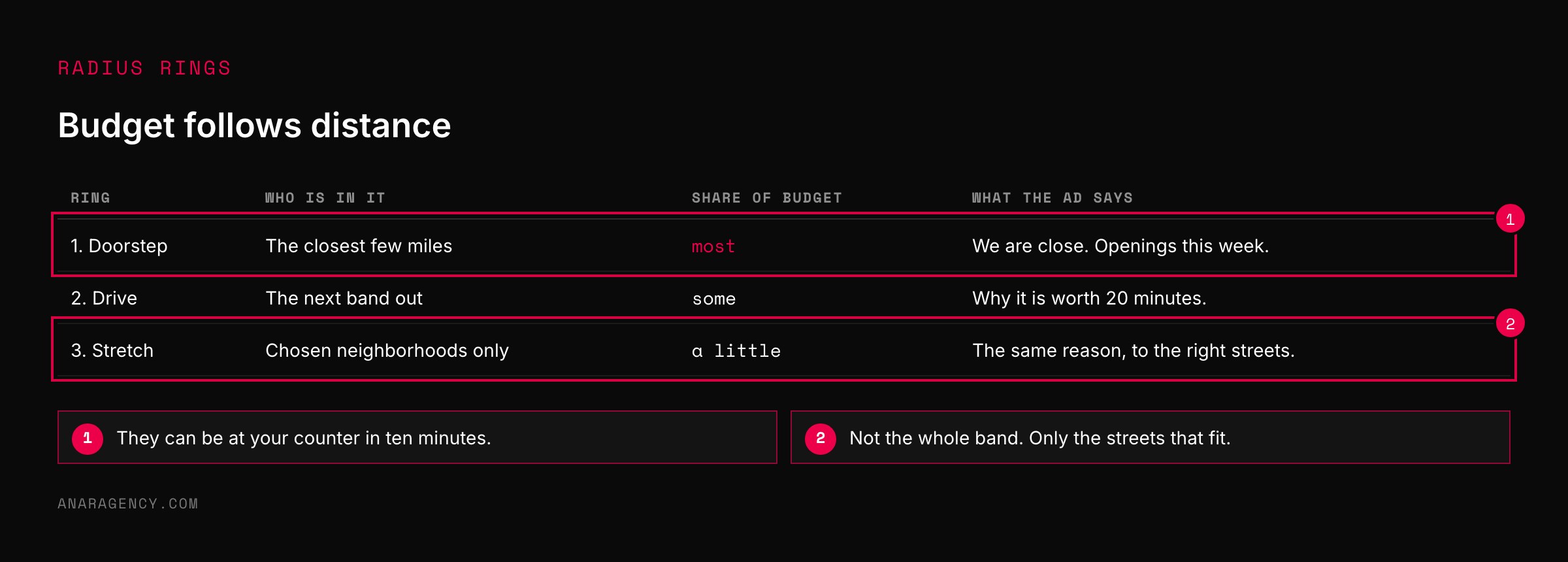
Draw three rings around your door and spend by distance. Ring one, the closest few miles, gets most of the budget, the highest frequency, and a plain message about being close and available. Ring two gets less, with a reason worth the drive.
Ring three is not a full band, only the neighborhoods that match your buyer, chosen with public Census data. Open in Messenger with one question about what they want to change, get a phone number early, and keep message, call, online booking, and walk-in all open. Do not use zip-code targeting for housing, employment, or credit ads.
The rule that changed in 2019
Before you copy this for every client, there is a hard line, and it has a history.
For years advertisers could aim Facebook ads for apartments, jobs, and loans at some zip codes and not others. Civil rights groups argued that this let landlords, employers, and lenders quietly exclude whole communities.
In March 2019, Facebook settled several of those cases. ProPublica reported that advertisers could no longer target by age, gender, or zip code for housing, employment, and credit offers.
The rule is still in force. Meta's current guidance for those ad categories says you can target by country, region, state, or city, but not by zip code or postal code. Its developer documentation adds that any location you pick must include at least a 15-mile radius.
So Radius Rings with zip codes are fine for a brow studio, a roofer, a dentist, or a restaurant. They are not allowed for a property manager, a staffing firm, or a lender.
If you are not sure which side you are on, assume the strict one and check. Getting this wrong is not a rejected ad. It is a legal problem.
One question, not a form
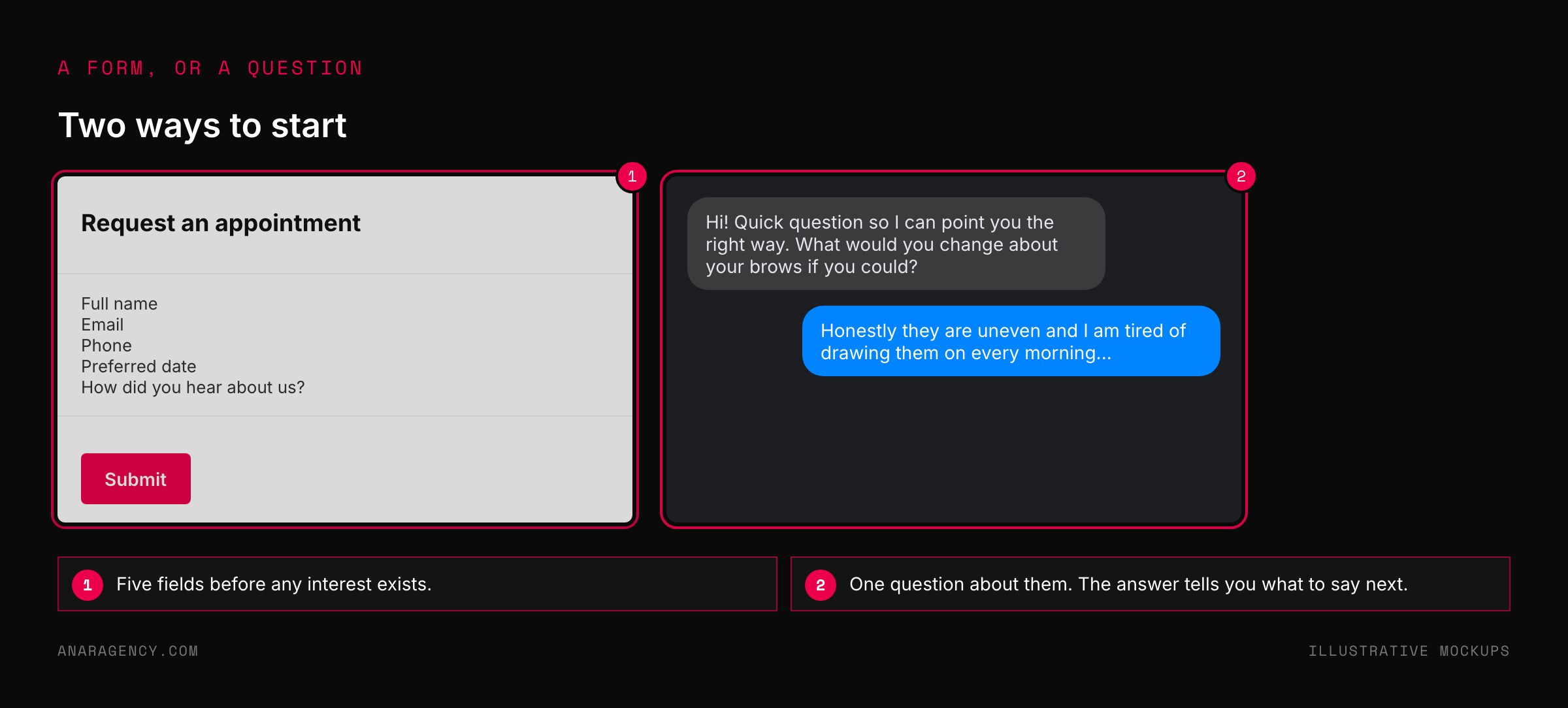
Now the ad itself. The usual local ad sends people to a page with a form: name, email, phone, "how did you hear about us."
For a local service, that is backward. The person does not want to apply. They want to ask one thing.
So let them. Meta lets you set Messenger as the place a conversion happens, so a tap on the ad opens a chat instead of a page.
The opening question does most of the work. Generic ones fail. "Do you have any questions?" gets silence, and "When would you like to come in?" is asking for a commitment before there is any interest.
The kind that works is about them, not about your calendar. Ask what they would change about the thing you fix: their brows, their yard, their kitchen. People will write a paragraph in answer.
Now you know exactly what they want, in their words, and everything you say next can be about that. Then get a phone number early, so the conversation does not depend on one app.
Speed matters here as much as anywhere. The Harvard Business Review's lead-response research found that the odds of reaching a lead fall fast as the minutes pass. A chat left unanswered until tomorrow is a lost customer.
"Should everyone not go through one booking page?"
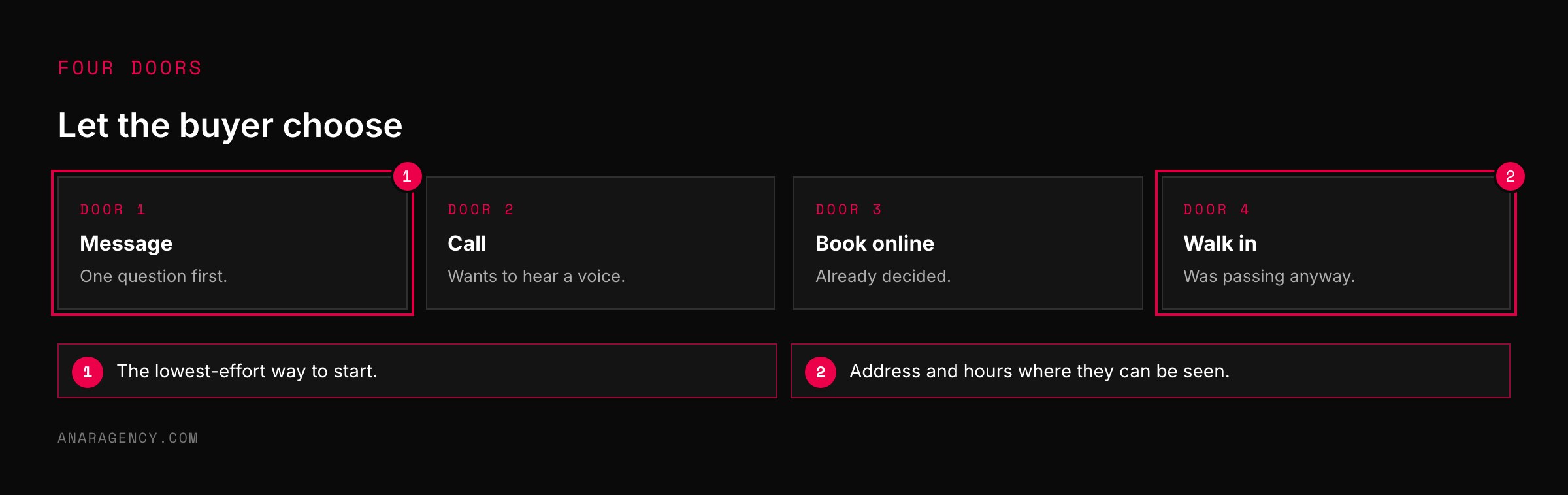
You may have been told a funnel should have one path. For a local business, that advice costs customers.
People choosing a local service like to look around first. They want the photos, the reviews, the prices, and the map, in whatever order they please. A page that hides all of that behind an email box feels like a toll gate.
So keep four doors open at once. Message. Call.
Book online. Walk in. Different buyers pick different doors, and the one who wanted to call will not fill in your form.
Reviews are the fifth thing they check, and a new business starts with none. Google's own advice is simply to ask customers. Ask everyone, at the counter, with a link or a code they can scan.
Do not pay for them. The Federal Trade Commission's 2024 rule prohibits giving compensation or incentives conditioned on a review expressing a particular sentiment, and it bans fake reviews outright.
One last thing about pictures. Before-and-after photos are popular, but be careful with claims in health and beauty. Show real work, with the customer's permission, and let people compare for themselves.
What to read next, and why
About location targeting in Meta Ads Manager (Meta documentation): What you can and cannot aim at. Start here before drawing any rings.
About audiences for housing, employment or financial products and services (Meta documentation): The restricted categories, in Meta's words. Read it if you have any client near those lines.
Facebook Won't Let Employers, Landlords or Lenders Discriminate in Ads Anymore (news): The story behind the rule. It makes the reason for it hard to forget.
Explore Census Data (public data): Income and age by area, free. An afternoon here replaces a paid targeting tool.
So the simple takeaway is this: you already know where your customers live. Spend there first, ask them one question, and leave every door open.
Questions executives ask
How do I target Facebook ads to a local area?
Use location targeting in Meta Ads Manager, which allows cities, postal codes, and a radius around a point. Instead of one wide circle, split it into bands by distance and put most of the budget closest to your location, then add only the specific neighborhoods farther out that match your buyer.
Can I target Facebook ads by zip code?
For most businesses, yes. For ads about housing, employment, or financial products and services, no. Meta's guidance for those categories says you may target by country, region, state, or city but not by zip or postal code, and its developer documentation requires at least a 15-mile radius around any selected location.
Why did Facebook remove zip code targeting for housing and job ads?
In March 2019 Facebook settled civil rights cases that argued its targeting let advertisers exclude people from housing, employment, and credit opportunities. As part of the changes, advertisers in those categories could no longer target by age, gender, or zip code.
Are Messenger ads good for local businesses?
They suit services where the buyer wants to ask a question before committing. A tap opens a chat instead of a form. Open with one question about what the person wants to change, answer fast, and collect a phone number early so the conversation does not depend on one app.
Can I offer a discount for a Google review?
Be careful. The FTC's 2024 rule on reviews prohibits giving compensation or incentives conditioned on a review expressing a particular sentiment, and Google's guidance is simply to ask customers for reviews. Ask everyone, and do not reward only the positive ones.

Filip Kovacevic is the founder of Anar Agency in Phoenix. He spent five years running SEO, Meta ads, email, and content for medical practices across the United States, and now does the same work for healthcare, home-service, legal, and professional-service businesses, alongside AI implementation. More from Filip →
Talk it through in 15 minutes
Bring one AI question from this article. We will tell you what we would do, whether or not you hire us.
Book a 15-Min Chat →