Emotion First, Claims Down
Put feeling at the top of a page and claims lower down. Claims are only read by people who already care, so the opening should describe the reader's situation in a way they recognize and feel. Then explain what changes and why.
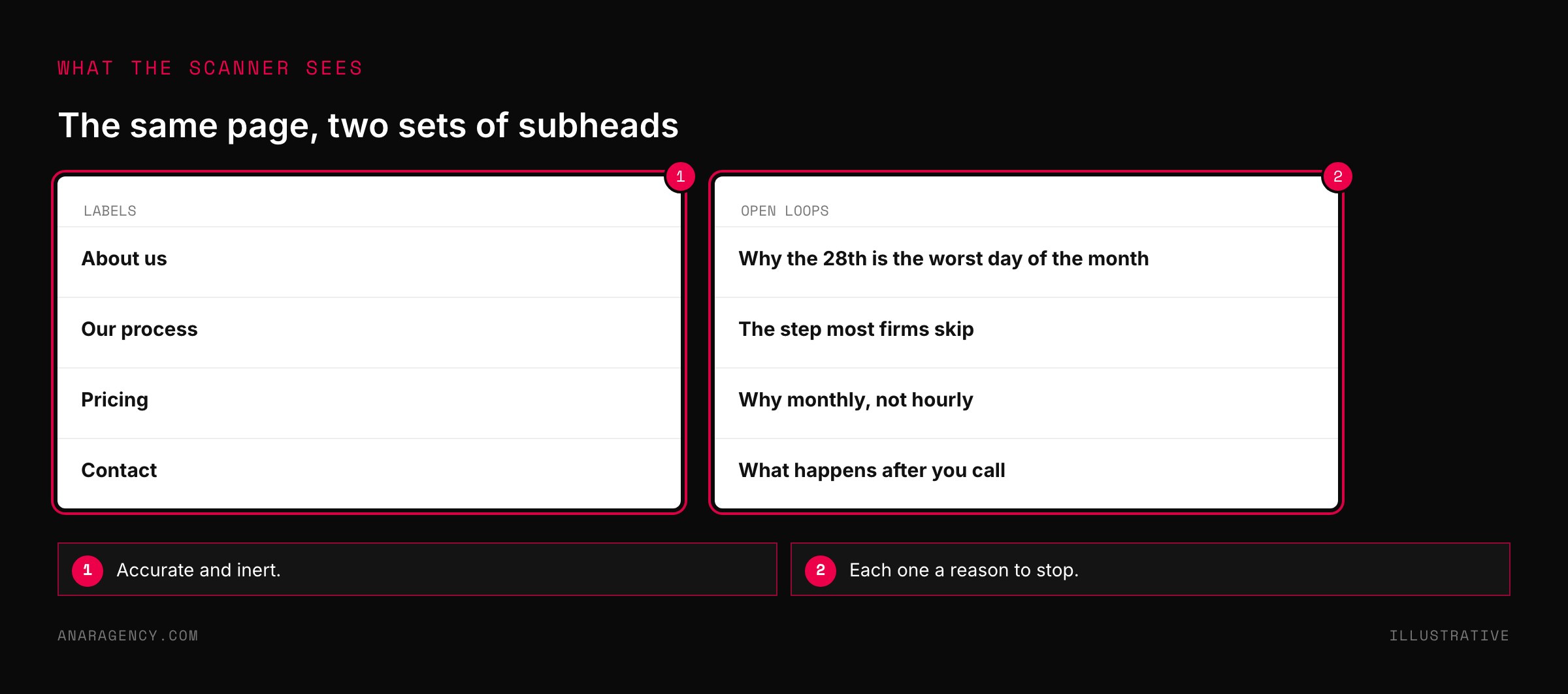
Then give the figures and proof. Because most people scan, the subheads carry the page. Replace label subheads like "Our process" with open-loop subheads like "The step most firms skip, and what it costs them."
Unfinished questions hold attention, and a scanner who meets one is pulled back in to read.
The waiter's memory
In the 1920s the psychologist Kurt Lewin was sitting in a Berlin restaurant and noticed something about the waiter.
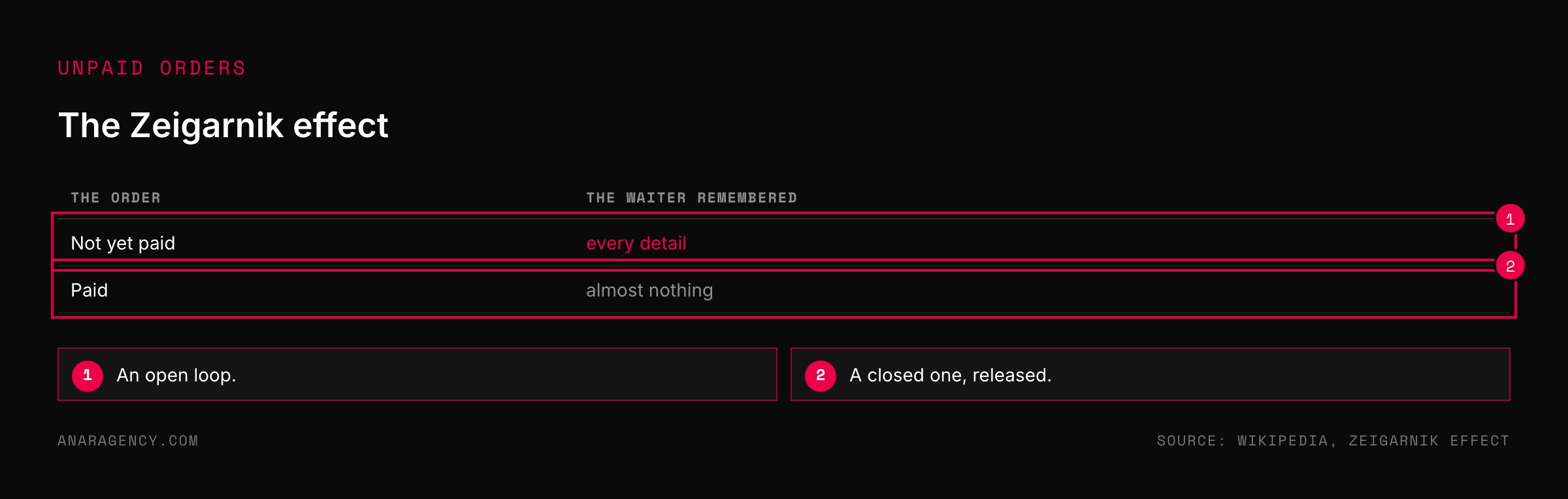
The waiter could remember every detail of the orders that had not yet been paid. Once a table paid, he could recall almost nothing about it.
Lewin's student Bluma Zeigarnik went on to study the effect. People tend to remember unfinished tasks better than finished ones.
It became known as the Zeigarnik effect. An open loop keeps a place in the mind. A closed one lets go.
Most sales pages close every loop as fast as they can. Each section announces what it is and then delivers it, and the reader feels no pull to continue.
Readers scan, and decide by feel
Very few people read a web page from top to bottom. Eye-tracking research has found that people often scan in a pattern shaped like the letter F, reading the first lines and then moving down the left edge, catching the starts of sections. The Nielsen Norman Group calls it the F-shaped pattern.
So for most visitors the subheads are the page. They read the top, glance down the headings, and decide whether to stop anywhere.
And the decision to stop is rarely reasoned. People judge quickly by how something makes them feel, a shortcut psychologists call the affect heuristic.
Put those together. A page that opens with claims and is divided by labels gives the scanner nothing to feel and nothing to wonder about.
They leave, not because the claims were wrong, but because they never reached the point of caring whether they were right.
Order a page by layers: feeling at the top, as a scene the reader recognizes; the reason in the middle; claims and proof lower down, where people who already care will read them. Because most visitors scan, write subheads as questions or costs the section answers, not labels. Every loop opened must close within its section, promises must be true, and the feeling must be accurate.
Test by reading the subheads alone.
Emotion first, claims down
The fix is an order of layers.
At the top, feeling. The reader's situation, as a scene they recognize. Not "we offer bookkeeping."
Instead: "It is the 28th, and you still do not know if you made money this month."
In the middle, the reason. What changes, and why it changes. A short explanation in plain words.
Lower down, the evidence. Figures, case studies, guarantees, credentials.
Evidence still matters. It is read by people who already care, and it confirms what they have started to feel.
Placed at the top, the same evidence is read by people who do not yet care, which means it is mostly not read. How a feeling is built from words is in desire is a gap.
Loop Writers: subheads that pull
Some pages are hard to stop reading even when you are only scanning. Their subheads do the work. We call the people who write them Loop Writers.
They write questions the section answers. "Why we charge monthly, not by the hour" instead of "Pricing." The reader wants the answer.
They name a cost. "The step most firms skip, and what it costs them." A possible loss pulls harder than a feature.
They hint, then deliver. A gap between what the reader knows and wants to know is one well-known account of curiosity. The subhead opens the gap.
The section must close it.
They watch their words. Some words carry more than their meaning. "Sorry" can sound like an admission of serious wrong.
"Share" feels more generous than "show." A careless word changes the feeling of a whole section, as in word infection.
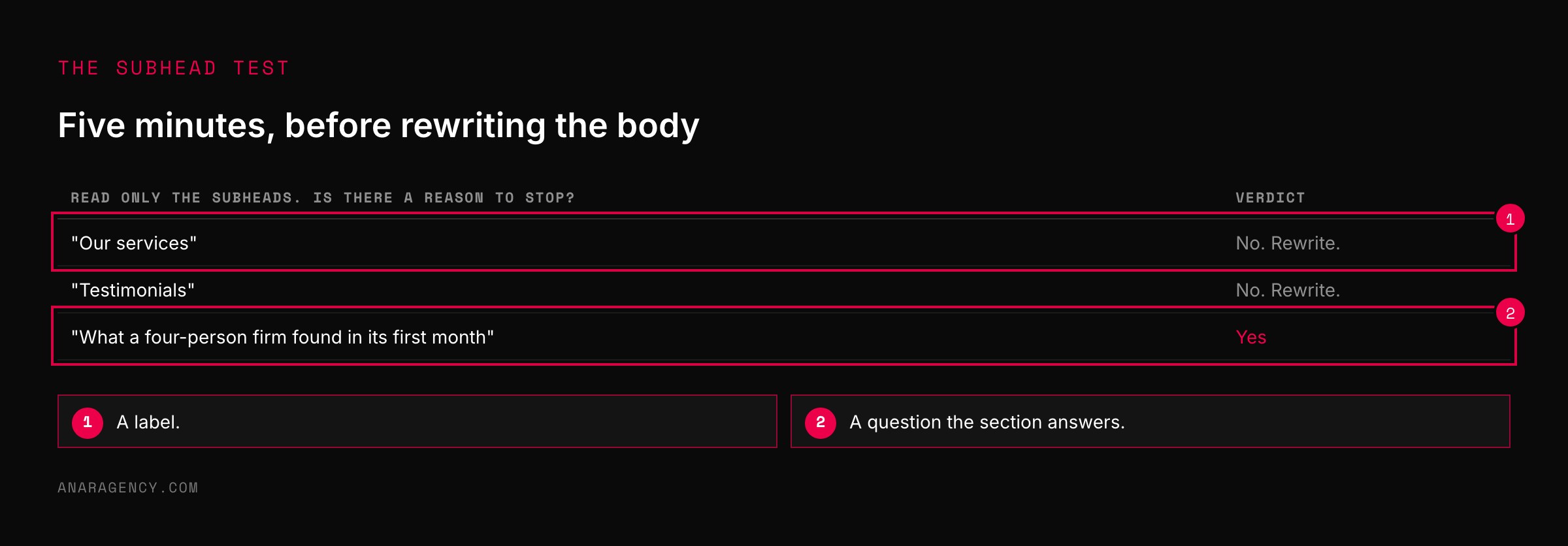
They test by scanning. Read only the subheads, top to bottom. Is there a reason to stop?
If not, rewrite them before touching the body.
"Open loops sound like clickbait"
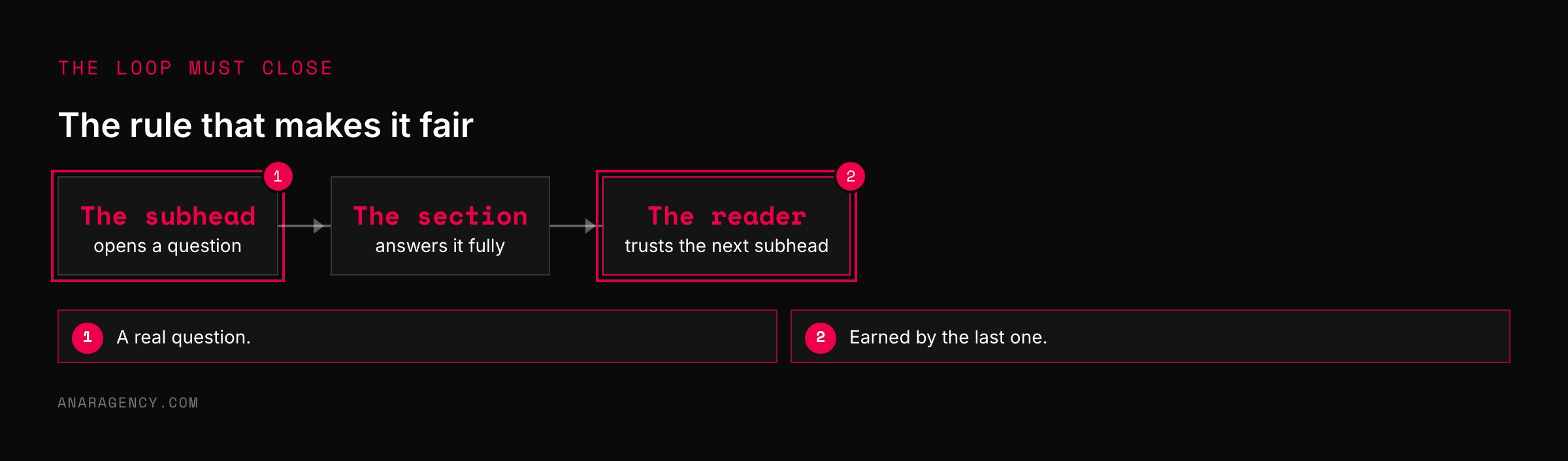
They become clickbait when the section does not deliver. A subhead that promises a secret and gives a platitude teaches the reader to stop trusting your subheads.
The rule is simple. Every loop you open must close, and close well, within the section.
Do not promise what the section cannot give. "The one trick that doubles leads" is a claim, and it had better be true and supported.
And keep the feeling honest. An opening that dwells on fear the reader does not have, or exaggerates their pain, will be felt as manipulation.
Describe the situation as it really is for most of your buyers. The aim is recognition, not alarm.
When the emotion is accurate and every loop pays off, the page reads as generous. The scanner becomes a reader because each section gave them something.
What to read next, and why
Zeigarnik effect (encyclopedia entry): The waiter, the experiments, and why open tasks stay in mind.
F-Shaped Pattern of Reading on the Web (Nielsen Norman Group): The eye-tracking research on how people scan.
Affect heuristic (encyclopedia entry): How feeling stands in for reasoning in quick judgments.
Curiosity (encyclopedia entry): Including the idea that curiosity comes from a gap in what we know.
So the simple takeaway is this: read only the subheads on your main page. Turn every label into a question the section answers, and move the first claim below the first feeling.
Questions executives ask
What is emotional copywriting?
Copy that leads with how the reader feels about their situation, using scenes they recognize, before presenting claims and evidence. Feeling decides whether someone keeps reading. Evidence then confirms what they have started to believe.
How should I write subheadings for a landing page?
Write them as questions or costs that the section answers, such as why we charge monthly, not by the hour, instead of labels such as pricing. Many visitors read only the subheads, so each should give a reason to stop.
What is an open loop in copywriting?
A question or unfinished idea that the reader wants resolved. It draws on the Zeigarnik effect, the tendency to remember unfinished tasks better than finished ones. Every open loop should be closed within the section that opens it.
Should claims go at the top of a sales page?
Usually not the first thing. Claims are read closely only by people who already care. Lead with the reader's situation, explain what changes, then place the claims and proof below.
How do people read web pages?
Most scan rather than read. Eye-tracking research by the Nielsen Norman Group describes an F-shaped pattern: people read the first lines, then move down the left side, catching the beginnings of sections and subheads.

Filip Kovacevic is the founder of Anar Agency in Phoenix. He spent five years running SEO, Meta ads, email, and content for medical practices across the United States, and now does the same work for healthcare, home-service, legal, and professional-service businesses, alongside AI implementation. More from Filip →
Talk it through in 15 minutes
Bring one AI question from this article. We will tell you what we would do, whether or not you hire us.
Book a 15-Min Chat →