AI Consultant vs In-House Team: The Real Math

For most companies the answer is a sequence, not a choice. Use an outside partner to ship the first proven workflows and install the operating patterns, which takes 60 to 120 days. Hire a lean internal owner as those workflows stabilize.
Keep specialists on tap for spikes. A full-time team hired before any workflow is proven burns 6 to 12 months of payroll on exploration a partner has already done somewhere else.
The real cost table
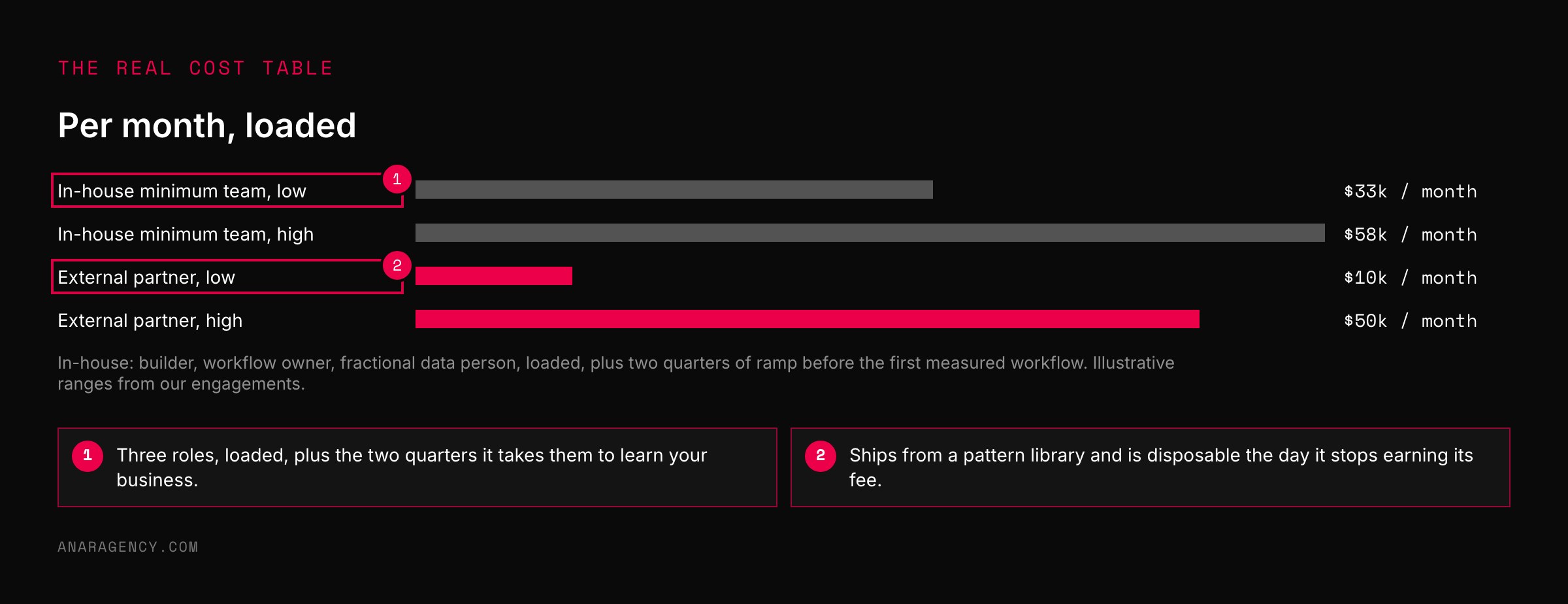
An in-house AI capability is not one hire. The credible minimum is an engineer who can build harnesses, someone product-shaped to own the workflows, and a fraction of a data person.
Realistically that is $400k to $700k a year loaded. Then add the two quarters it takes them to learn your business and make the mistakes a specialist has already made on someone else's budget. That investment is correct once AI is core to your product, or once you have a portfolio of proven workflows to run.
A competent partner lands in the $10k to $50k per month range depending on scope. They ship from a pattern library instead of from scratch, and you can let them go the day they stop earning the fee.
The honest weakness: partners leave. If the engagement was set up as "they build, we watch," the capability leaves with them.
The sequencing that outperforms both extremes
Phase one, prove (external-heavy, 60 to 120 days). A partner ships two or three measured workflows end to end and installs the harness, the evaluation habit, and the governance page. What you receive is working systems plus documents your team can run.
Phase two, transfer (mixed, the next quarter). You hire or appoint one internal owner. The partner's job changes from building to teaching: pairing, documentation, and handoff under the deployment rule that the business owns every build.
Phase three, scale (internal-heavy, ongoing). Your team owns the portfolio and the roadmap. The partner comes back for spikes: a new vertical, a hard integration, an audit.
Between spikes the partner headcount goes to zero, which is the point.
The pattern fails in only one way: phase two gets skipped. That is also the most common way it is sold. Insist on the transfer phase in the contract.
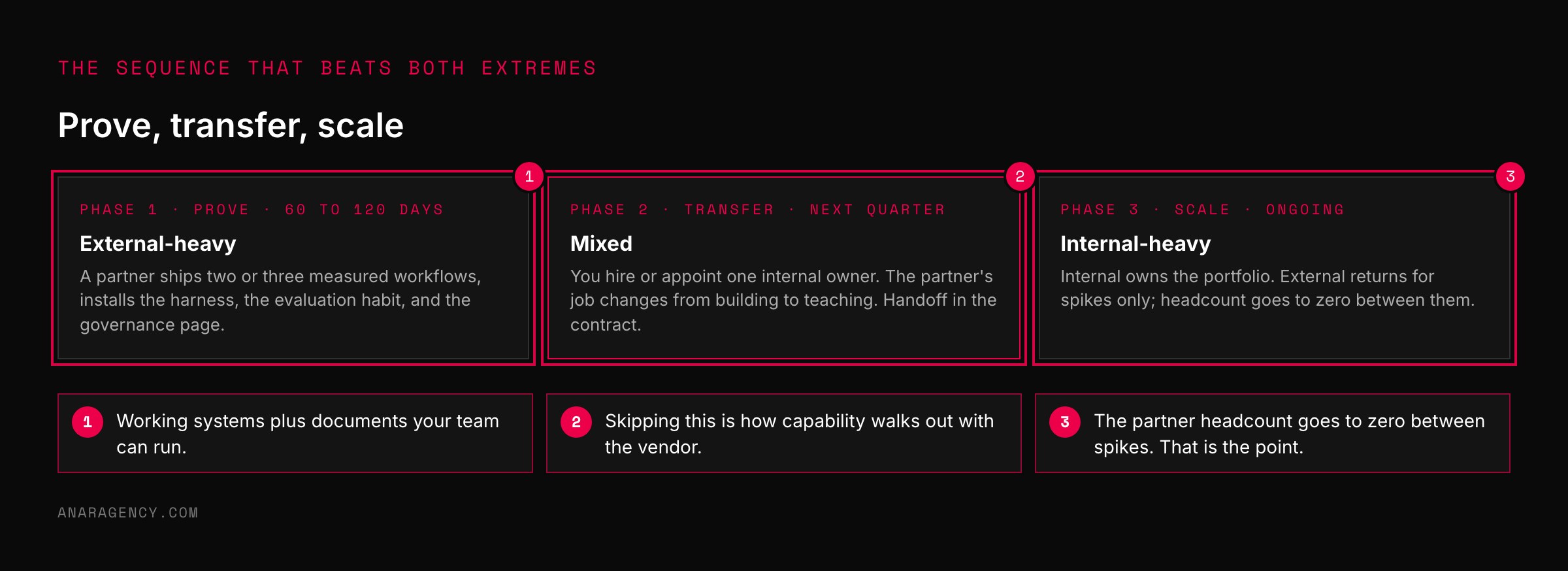
Phase one: external partner ships two or three measured workflows and installs the operating patterns. Phase two: one internal hire; the partner switches from building to teaching, with handoff in the contract. Phase three: internal runs the portfolio; external returns for spikes only.
Skipping phase two is how capability walks out with the vendor.
Six questions that expose a weak AI partner
You do not need to be technical to vet a partner. You need six questions.
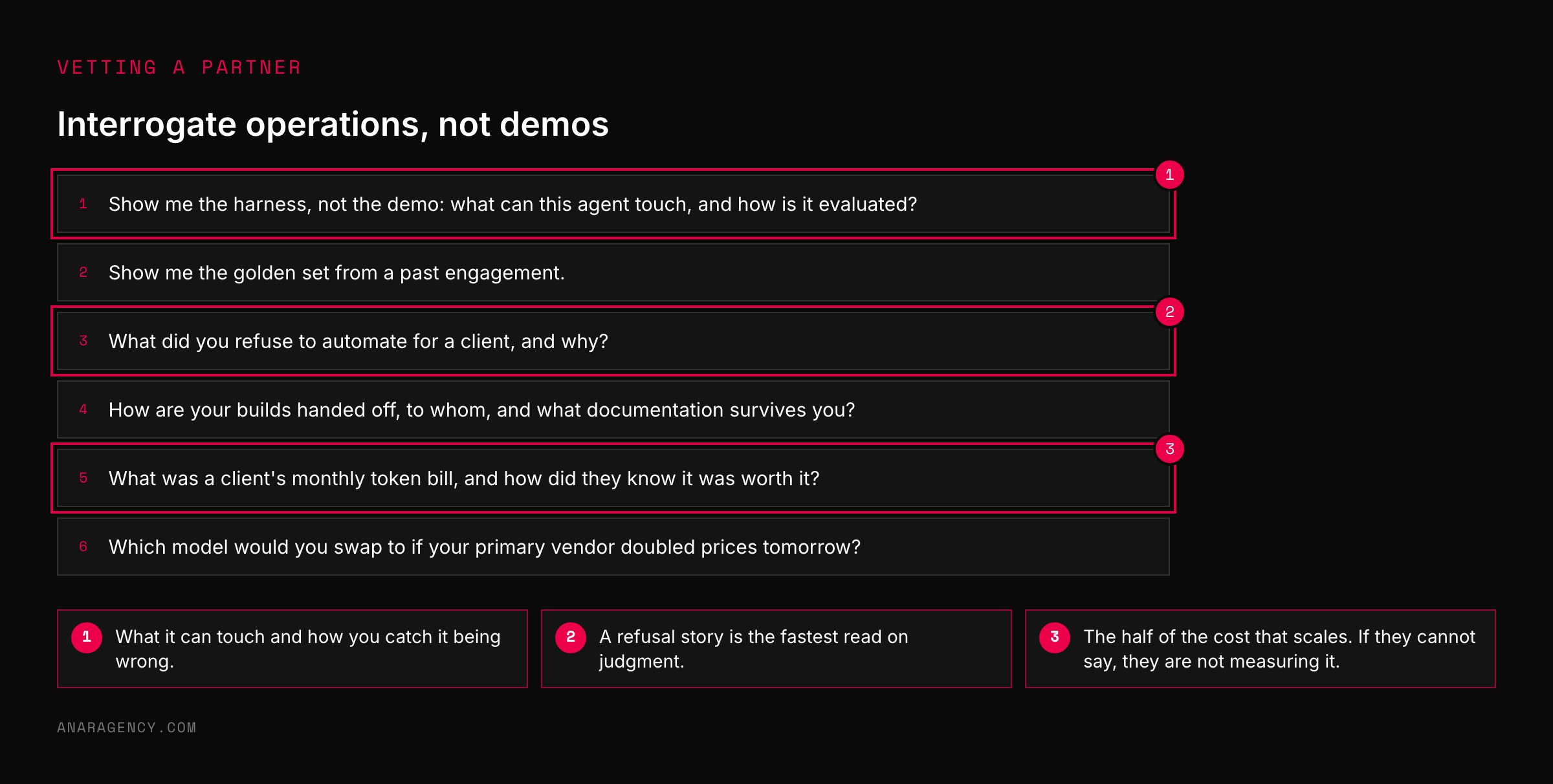
Ask to see the harness, not the demo: what can this agent touch, and how is it evaluated? Ask for the golden set from a past engagement. Ask what they refused to automate for a client, and why.
Ask how their builds are handed off, to whom, and what documentation survives them. Ask what the client's monthly token bill was and how they knew it was worth it. Ask which model they would swap to if their primary vendor doubled prices tomorrow.
A strong partner answers all six with specifics and artifacts. A demo-driven one changes the subject to capabilities. The questions work because they test operations discipline, which is where AI engagements actually succeed or fail.
What a CEO actually needs to know
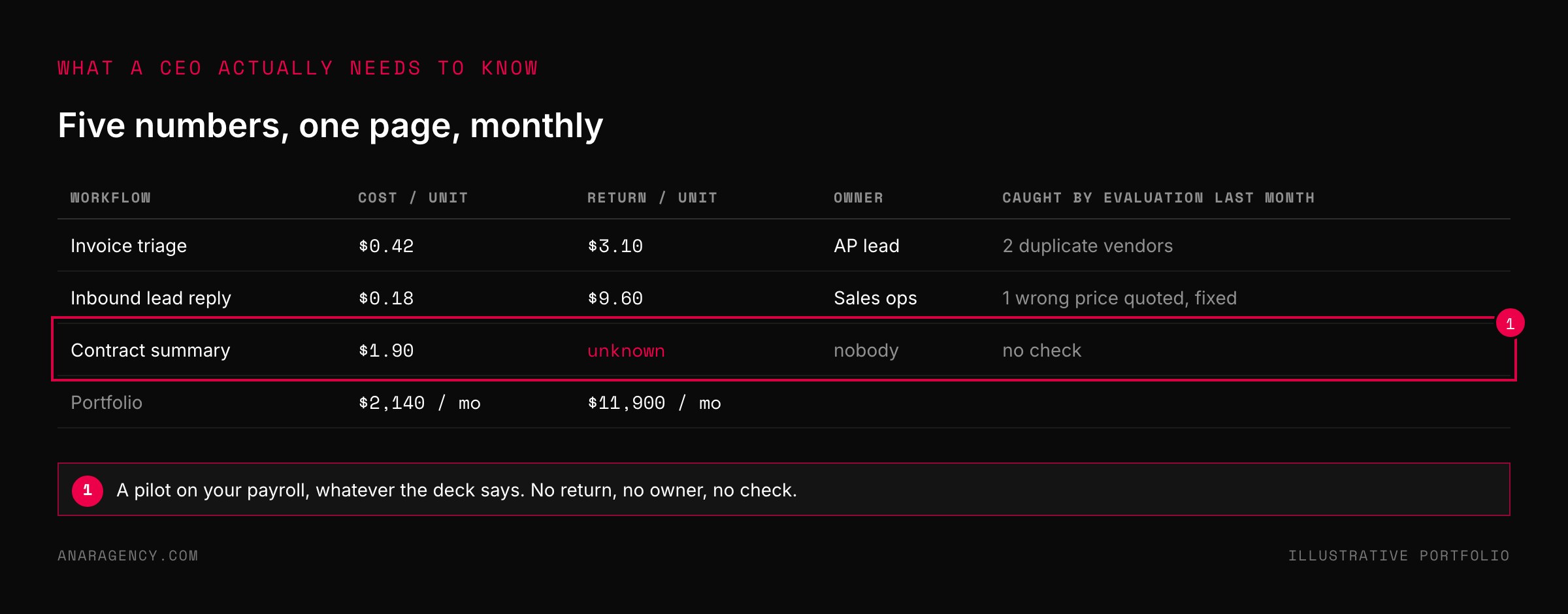
Not the technology. Five numbers.
Which workflows run on AI. What each one costs per unit and returns per unit. Who owns each one.
What the evaluation caught last month. What the portfolio spends and saves in total.
A partner or a team that cannot put those five numbers on one page, every month, is running pilots on your payroll, whatever the deck says.
Consultant, agency, engineer, or partner: the words are not the decision
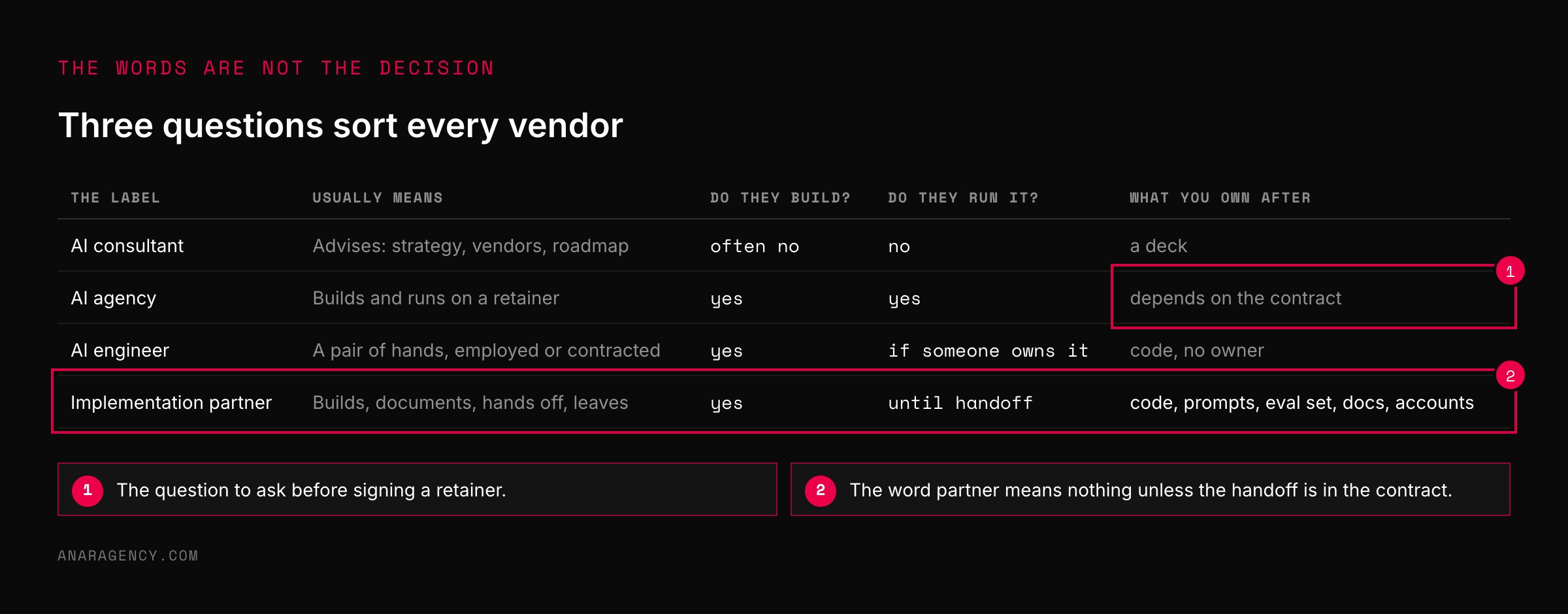
The question shows up in five phrasings: consultant versus agency, consultant versus engineer, partner versus consultant, consulting versus in-house development. The phrasing matters less than people think, because vendors use the labels loosely.
A consultant advises and may not build. An agency builds and usually runs what it builds on a retainer. An engineer is a pair of hands, employed or contracted, who needs someone else to own the workflow and the roadmap.
An implementation partner is an agency that contracts to transfer the capability and leave.
The same firm will call itself three of these in one proposal.
So ignore the label and ask three questions. Do you build, or only advise? Do you run it after it ships, and for how long?
What do we own when you leave: the code, the prompts, the evaluation set, the documentation, the accounts?
The answers sort every vendor into the sequence above, whatever the business card says. A consultant who does not build belongs at the very start, if anywhere. An agency that will not commit to a handoff belongs nowhere in phase two.
An engineer belongs inside a team that already has an owner.
The cost math changes with the answer too. Advice is cheap per hour and expensive per outcome, because nothing ships. A retainer is expensive per month and cheap per outcome if the workflows are measured, and ruinous if they are not.
A hire is the largest fixed cost and the only one that compounds, which is why it belongs in phase two, after the first workflows have proven there is a portfolio to run.
For what hiring actually costs, two documents decide whether a given engineer is a hire or a vendor in the eyes of the law: the Small Business Administration's guide to hiring and managing employees and the IRS's contractor-versus-employee test. That matters more than the title on the invoice.
Where the numbers come from, and how to check them yourself
You do not have to take our numbers on faith. The loaded cost of an in-house minimum team is three salaries plus benefits, tools, and management time, and the public data to sanity-check it is free.
The Department of Labor's occupational profile for data scientists carries wage distributions, and the Stanford AI Index tracks the hiring market and adoption rates year over year. Add the total cost of ownership items most budgets leave out, such as recruiting, ramp, turnover, and the tools the team will ask for, and the range above is conservative.
The running cost of the workflows themselves is the other half, and it is the same on both paths: model usage billed per token. Anthropic's pricing, OpenAI's API pricing, and the independent comparisons at Artificial Analysis make that cost checkable to the cent per workflow.
A partner who cannot tell you a client's monthly token bill, one of the six questions above, is not measuring the half of the cost that scales. Our article on controlling AI token spend shows how to put that number on one line per workflow.
The governance cost is the same on both paths too. Whoever builds, the five decisions in our governance framework have to be made. The NIST AI Risk Management Framework is the reference most auditors will reach for.
And Anthropic's own guide to building effective agents is a fair test of whether a vendor's architecture is simple enough to hand over. A build nobody can hand over is a build you are renting.
Questions executives ask
Should we hire an AI team or use a consultant?
Sequence it: a partner proves the first workflows and installs the patterns in 60 to 120 days, one internal owner takes over as they stabilize, and specialists return for spikes. Hire a full team only once AI is core to your product or portfolio.
How much does an AI consultant cost versus an in-house team?
Competent partners typically run $10k to $50k per month and ship from proven patterns. A credible in-house minimum (builder, workflow owner, fractional data) is $400k to $700k a year loaded, plus two quarters of ramp.
How do we evaluate an AI consulting firm?
Interrogate operations, not demos: their harness design, a real golden set, a refusal story, their handoff process, a client's token economics, and their model-swap plan. Specifics and artifacts distinguish operators from presenters.
What is the difference between an AI consultant and an AI agency?
A consultant advises, on strategy, vendors, and a roadmap, and often does not build. An agency builds and usually runs what it builds on a monthly retainer. Labels are used loosely, so ask three questions instead: do you build, do you run it, and what do we own when you leave.
AI consultant or AI engineer: which should a small business hire first?
Neither first. Use a partner that builds and hands off to prove two or three measured workflows, then hire one internal owner. An engineer alone has no one to own the workflow and the roadmap; a consultant alone ships nothing.

Filip Kovacevic is the founder of Anar Agency in Phoenix. He spent five years running SEO, Meta ads, email, and content for medical practices across the United States, and now does the same work for healthcare, home-service, legal, and professional-service businesses, alongside AI implementation. More from Filip →
Talk it through in 15 minutes
Bring one AI question from this article. We will tell you what we would do, whether or not you hire us.
Book a 15-Min Chat →