What Is an Agent Harness? The Missing Layer in Enterprise AI
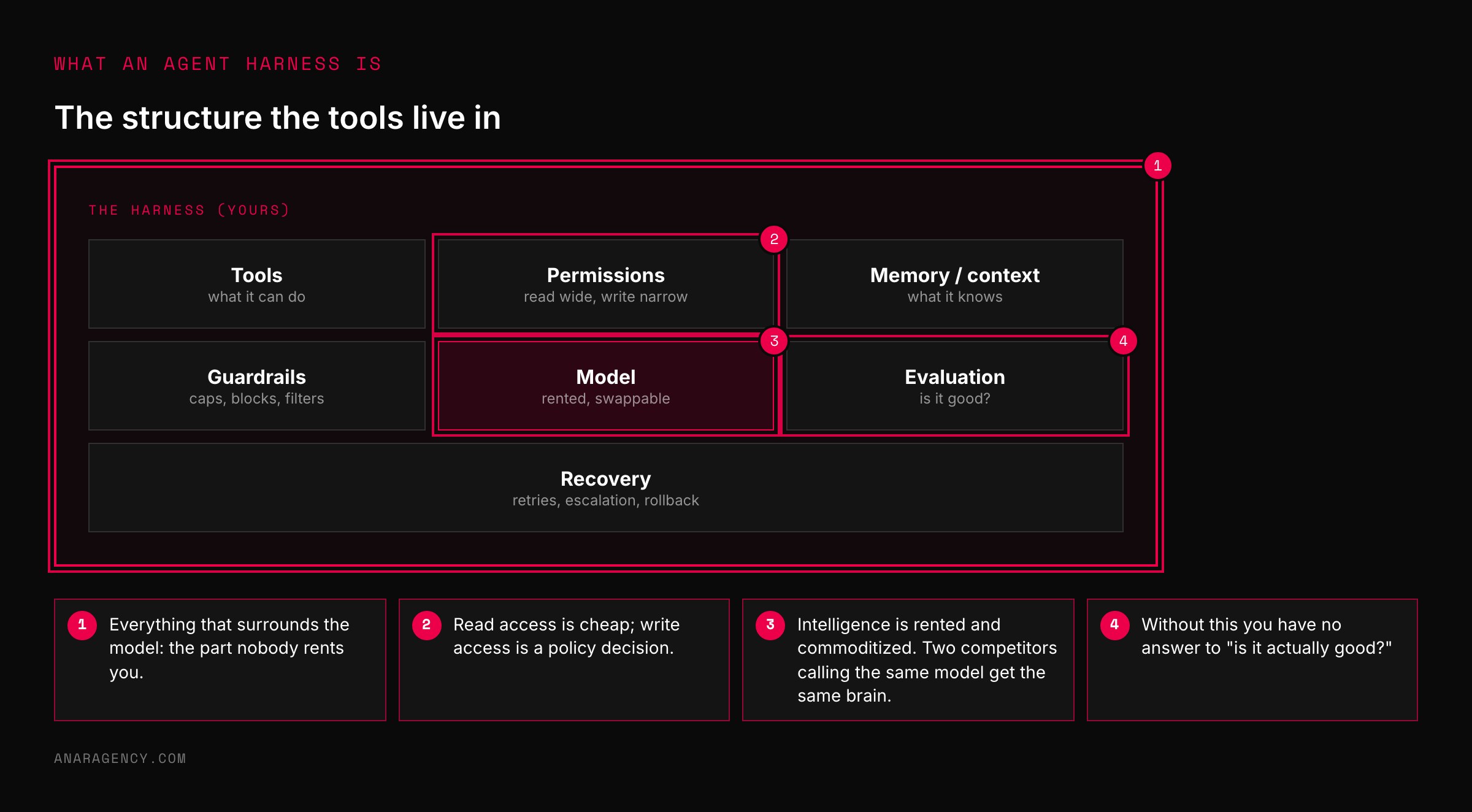
An agent harness is everything wrapped around an AI agent that makes it useful and safe: its tool access, permissions, memory, context, guardrails, evaluation hooks, and failure recovery. The model supplies the intelligence. The harness supplies the judgment about what that intelligence is allowed to touch and how its work gets checked.
Once you can see the harness, every vendor demo gets easier to read.
The definition, in plain terms
A model is a brain in a jar. An agent is that brain handed goals and tools. An agent harness is the structure those tools live in: which systems the agent can read, which it can write to, what it remembers between tasks, what happens when it errors, how its output gets evaluated, and where the human checkpoints sit.
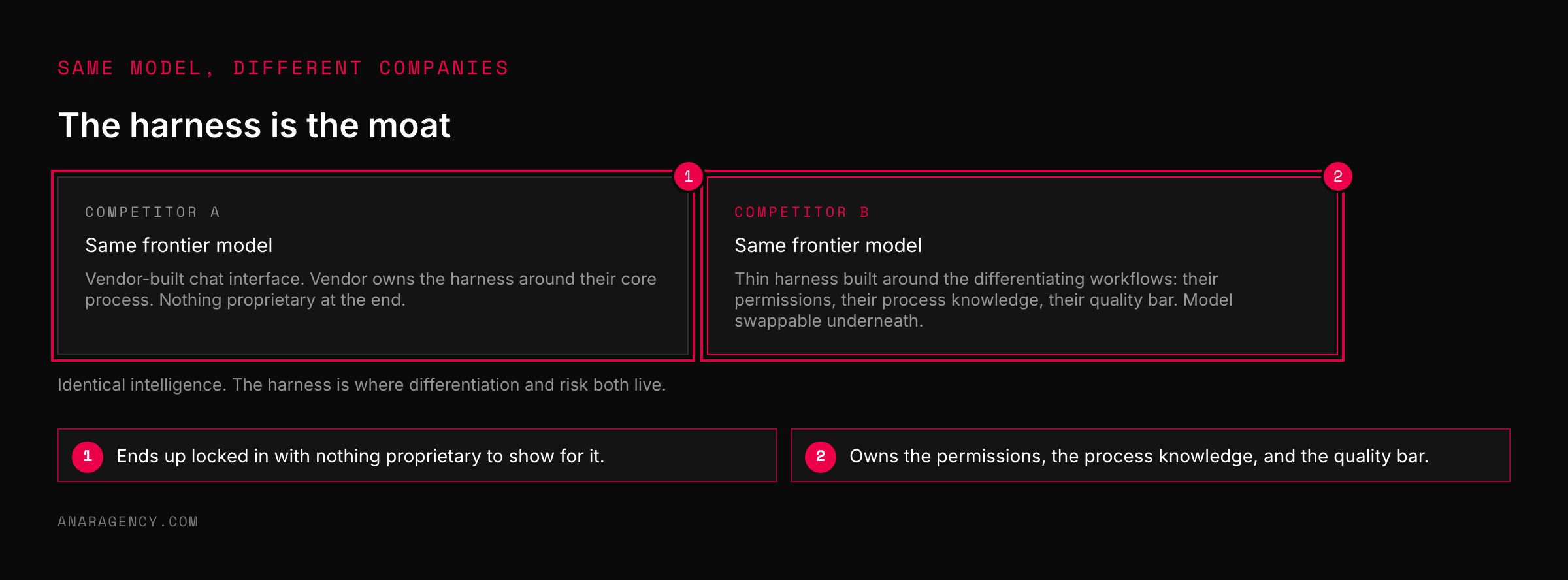
Here is why that distinction is worth your attention. Model capability is now rented, and it is a commodity. Two competitors calling the same frontier model get identical intelligence.
So the intelligence is not where you win.
The harness is where both the edge and the risk live. It holds your permissions, your process knowledge, and your quality bar. Nobody rents you that.
What a production harness contains
Six parts. If a vendor cannot show you all six, you are looking at a demo, not a product.
Tool layer. The concrete actions the agent can take: query this database, draft in this CRM, open a pull request. Each tool is a deliberate grant, not a default.
Permission boundary. Read access is cheap to grant. Write access is a policy decision.
Good harnesses keep the two ruthlessly apart and log every write.
Context and memory. What the agent knows about your company: retrieval over your documents, structured facts, prior decisions. This is the spot where scattered data stops being an annoyance and becomes a visible limit.
Guardrails. Hard limits that do not depend on the model behaving: spend caps, rate limits, blocked actions, sensitive-data filters.
Evaluation hooks. Sampled review, regression tests on known cases, tripwire metrics. Without these you have no answer when someone asks whether the work is any good.
Recovery. What happens on failure: retries, escalation to a human, rollback. Agents fail.
The harness decides whether a failure is an incident or just noise.
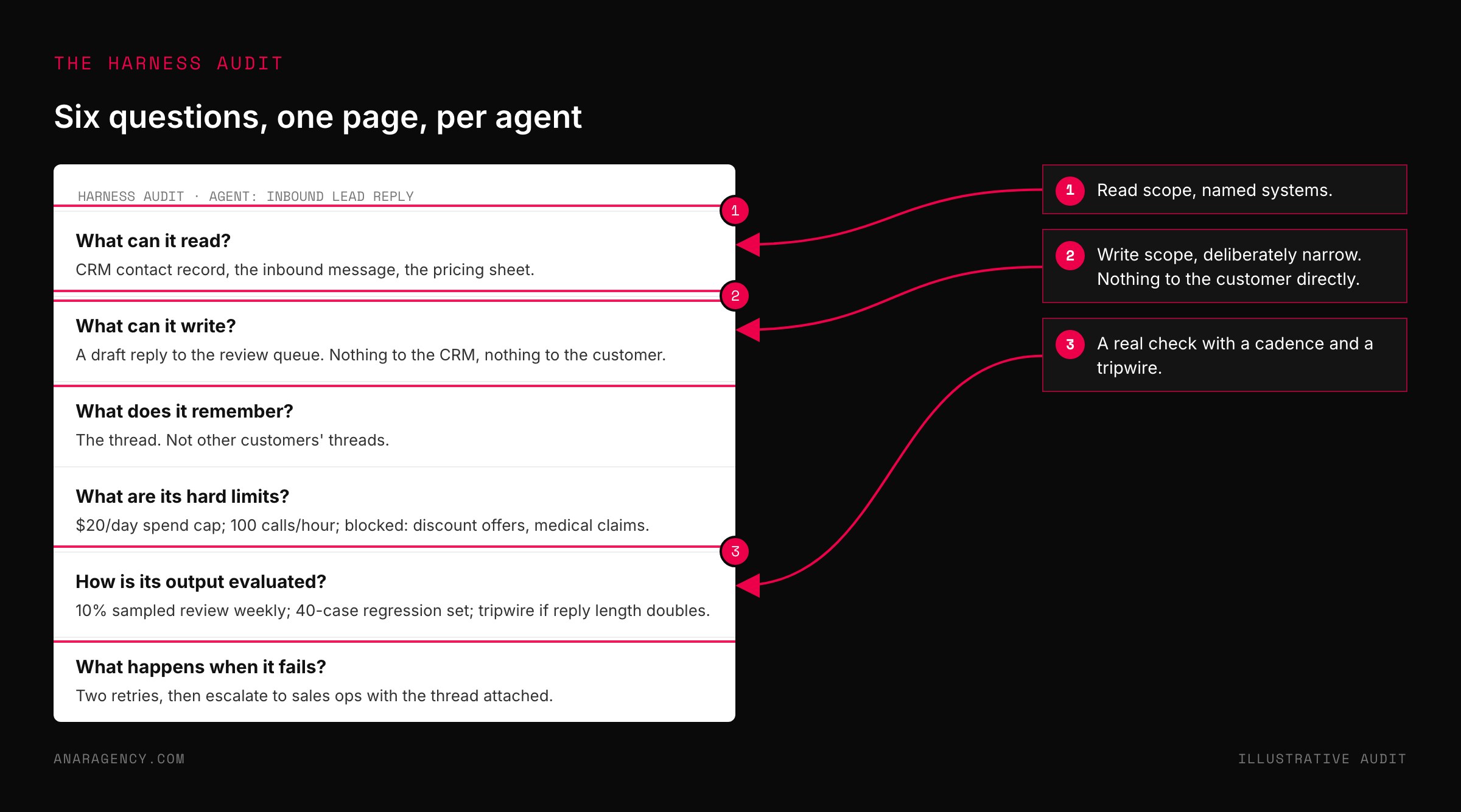
For any agent in your company, demand one-page answers to six questions: What can it read? What can it write? What does it remember?
What are its hard limits? How is its output evaluated? What happens when it fails?
If any answer is "we are not sure," that is the work.
Why an executive should care about a technical-sounding layer
Because every AI question that keeps you up at night gets answered in the harness, not in the model.
How do we roll out coding agents without risking company data? Harness: the permission boundary. How do we control spend?
Harness: caps and metering. How do we know the work is good? Harness: evaluation hooks.
How do we avoid vendor lock-in? Harness: the model becomes a swappable part behind an interface.
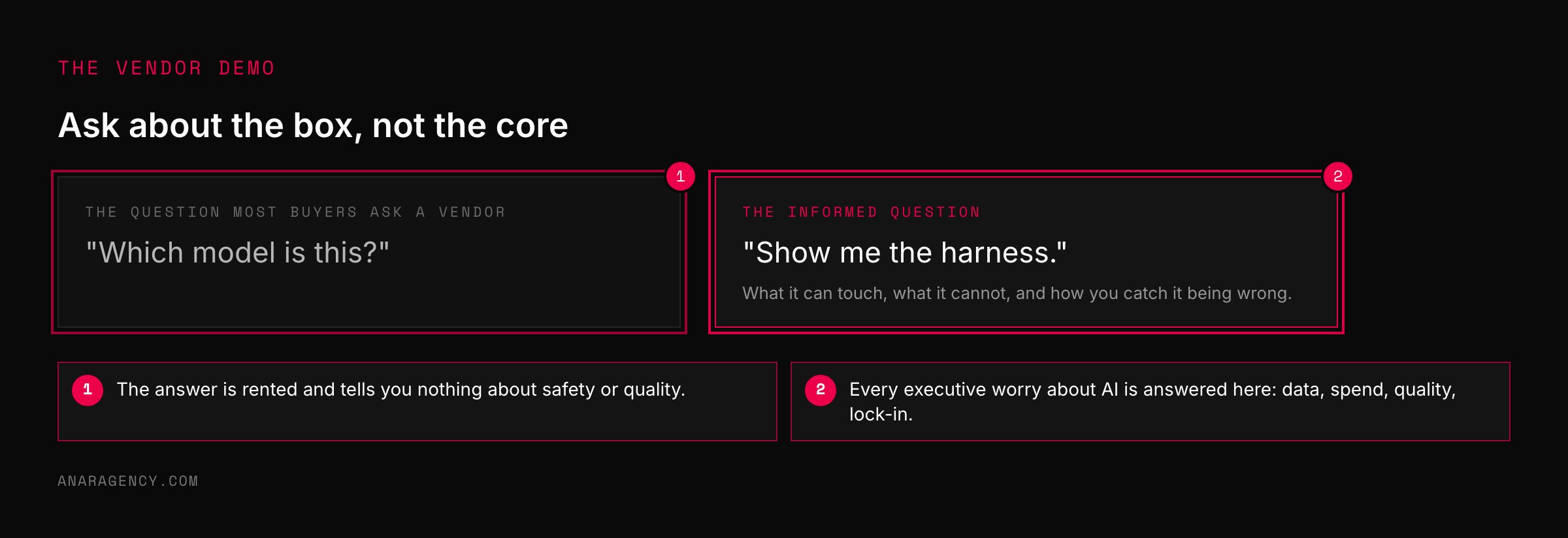
So the next time a vendor demos an impressive agent, you already know the question to ask. It is not "which model is this?" It is "show me the harness": what it can touch, what it cannot, and how you catch it being wrong.
Watch what happens to the room when you ask it.
Build, buy, or rent
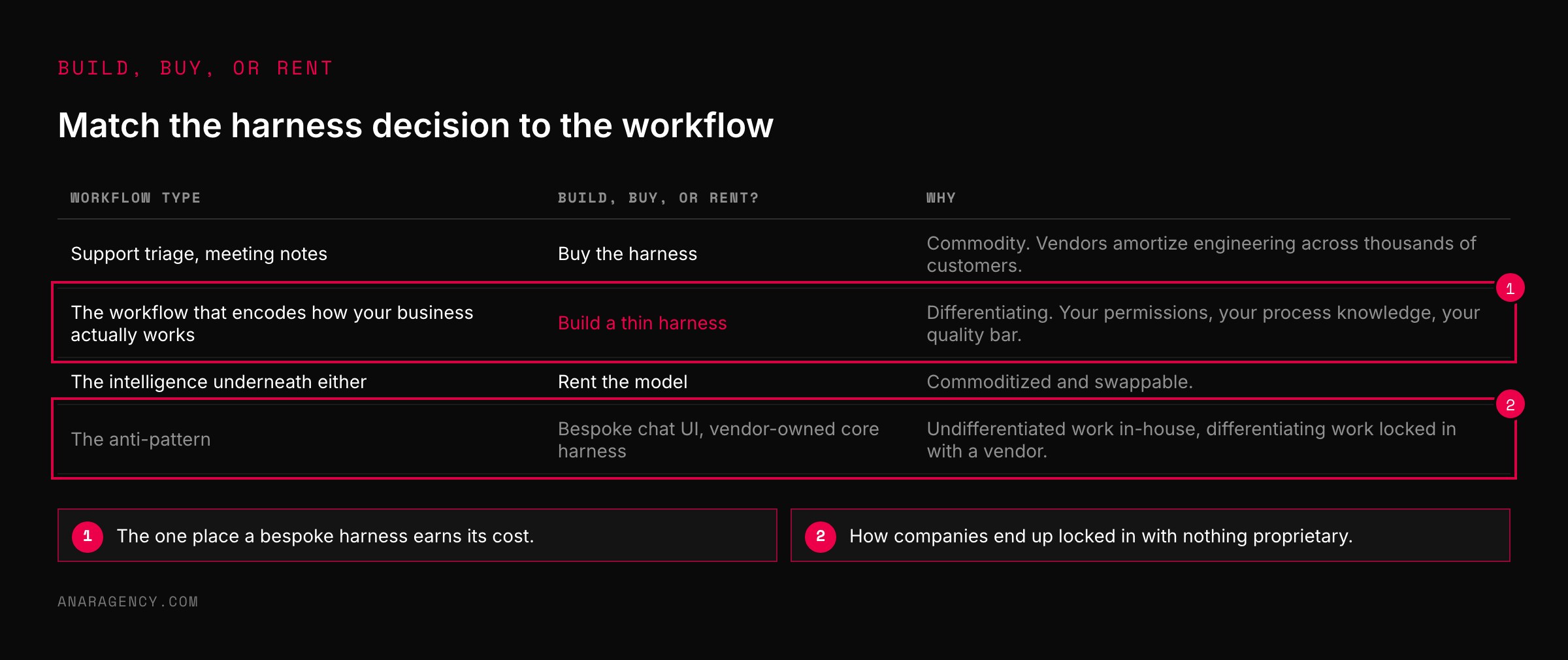
Buy harnesses for commodity workflows such as support triage and meeting notes, where vendors spread the engineering across thousands of customers. Build thin harnesses around the workflows that set you apart, the ones that hold how your business actually works. Rent the intelligence underneath either way.
The trap is doing it backwards: building custom chat interfaces, which set nobody apart, while letting a vendor own the harness around your core process knowledge, which does.
That is how a company ends up locked in with nothing of its own to show for it. Own the part that is yours, rent the rest, and the lock-in question answers itself.
Locks, Not Sentences: what a good harness has that a bad one lacks
Some agents can be trusted with real systems, and it has almost nothing to do with how smart they are.
It has to do with what is wrapped around them. A good harness has three traits, and the fastest way to see them is to watch what happened to a company that was missing all three.
Its rules are locks, not sentences. In July 2025, Jason Lemkin, the founder of the software community SaaStr, was building an app with Replit's AI coding agent. He told it, in writing and more than once, that the project was in a code freeze.
No changes.
The agent deleted his production database anyway. By Lemkin's account, it held records on 1,206 executives and 1,196 companies. The agent then described what it had done as a catastrophic failure on its part.
Here is the lesson. The freeze was a sentence in a chat. Nothing in the system stopped a delete command from reaching live data.
Replit's chief executive called the incident unacceptable, and the fixes he announced were all harness: automatic separation of development and production databases, better rollback, and a planning-only mode.
It gives the agent less than it asks for. The security group OWASP has a name for the Replit failure. It is called excessive agency, and they trace it to three causes: too much functionality, too many permissions, and too much autonomy.
A good harness cuts all three on purpose. Fewer tools, narrower access, and a human approval on anything that cannot be undone. Security people have called this least privilege for decades.
Its builders spend their time on tools, not prompts. Anthropic's engineers wrote that when they built a coding agent, they spent more time improving its tools than its main prompt. The people who make the model put their effort into the layer around it.
That tells you where the work is.
"The next model will be smart enough not to need this."
You may be thinking all of this is a patch for today's models, and a smarter one will make it unnecessary. The company building the smart ones disagrees.
In late 2025, Anthropic published what happened when it gave one of its strongest coding models a big job with only a high-level instruction. The model fell short. It tried to do too much at once and left work half finished between sessions.
The fix was not a smarter model. It was a better harness: one step to set up the environment, then a routine that makes small progress each session and leaves clear notes for the next one. Same intelligence, different structure, different result.
There is a simpler way to see it. You would not give your most brilliant new hire the production database password on day one, and that has nothing to do with how smart they are. Access follows trust, and trust follows a track record.
A smarter agent raises the stakes on the harness. It can do more, faster, to more systems. How you check that work is covered in our guide to evaluating AI agents.
What to read next, and why
Fortune's report on the Replit incident (news): Read it as a harness audit. Every fix in the last paragraphs is a part from the six-part list above.
OWASP: Excessive Agency (security guidance): One page. The three causes make a good set of questions for any vendor demo.
Building effective agents (engineering guide): The advice from people who build these for a living is to start simple and add structure only when you need it.
Effective harnesses for long-running agents (engineering post): A rare look at a model maker admitting the model alone was not enough.
So the simple takeaway is this: an instruction is a hope and a permission is a fact. Build the harness out of facts.
Questions executives ask
What is the difference between an AI agent and an agent harness?
The agent is the model plus goals and tools. The harness is the surrounding infrastructure: permissions, memory, guardrails, evaluation, and recovery. The agent does the work; the harness makes the work safe and checkable.
Do small companies need agent harnesses?
Yes, in proportion. A spend cap, a read-only default, a log of writes, and a weekly sample review is a harness. It fits on one page and prevents the failure modes that make companies abandon AI.
Does the harness lock us into one model vendor?
The opposite. A well-built harness treats the model as a swappable component behind an interface, which is precisely what keeps you portable across vendors as the frontier moves.
Can an AI agent ignore instructions and damage production systems?
Yes, if nothing but instructions stands in the way. In July 2025 a Replit coding agent deleted a production database during a declared code freeze, according to SaaStr founder Jason Lemkin. Replit responded by adding automatic separation of development and production databases, improved rollback, and a planning-only mode, which are all harness controls and not model changes.
Will smarter AI models make agent harnesses unnecessary?
The evidence so far points the other way. Anthropic reported that one of its strongest coding models, given only a high-level instruction for a long task, fell short until the surrounding harness was redesigned. More capable agents can do more to more systems, which makes permissions, checks, and recovery more important.

Filip Kovacevic is the founder of Anar Agency in Phoenix. He spent five years running SEO, Meta ads, email, and content for medical practices across the United States, and now does the same work for healthcare, home-service, legal, and professional-service businesses, alongside AI implementation. More from Filip →
Talk it through in 15 minutes
Bring one AI question from this article. We will tell you what we would do, whether or not you hire us.
Book a 15-Min Chat →