Assumptive Questions: Never Let the Reader Ask
Every reader has questions they never type into a contact form: why you, will it work for me, what does it really cost, what happens next. If the page leaves a question open, the reader answers it themselves, usually against you. Asking it out loud, as in "you might be wondering," makes them stop and weigh it.
The better approach is to answer it in passing, as a stated fact, at the point it would occur to them. List your buyer's questions in order, then make sure the page settles each one where it arises.
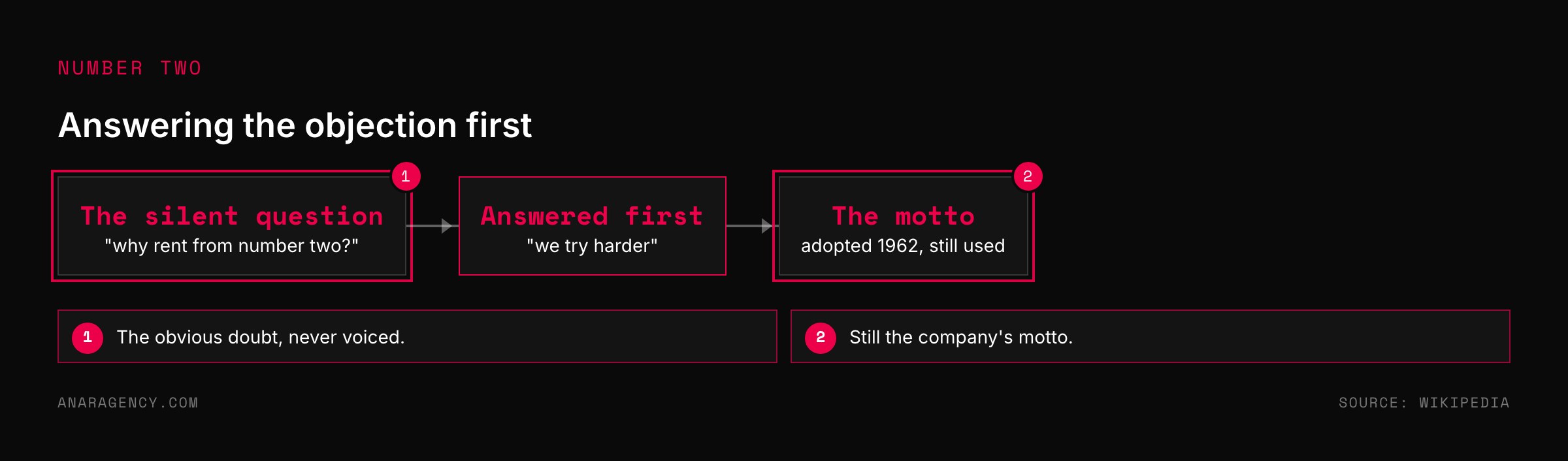
Number two
In the early 1960s Avis was the second-largest car rental company in America, well behind the leader. Every customer standing at its counter could have asked the obvious question.
If you are not the biggest, why should I rent from you?
Most companies would have avoided the subject. Avis put it at the center of its advertising. The campaign said, in effect, that it tried harder because it was number two.
"We Try Harder" became the company motto in 1962 and it still is.
The advertisement did not wait for customers to raise the objection. It answered it first, in a way that turned the weakness into the reason to choose them.
The questions nobody types
A person reading your page is holding a conversation in their head. Most of it is questions.
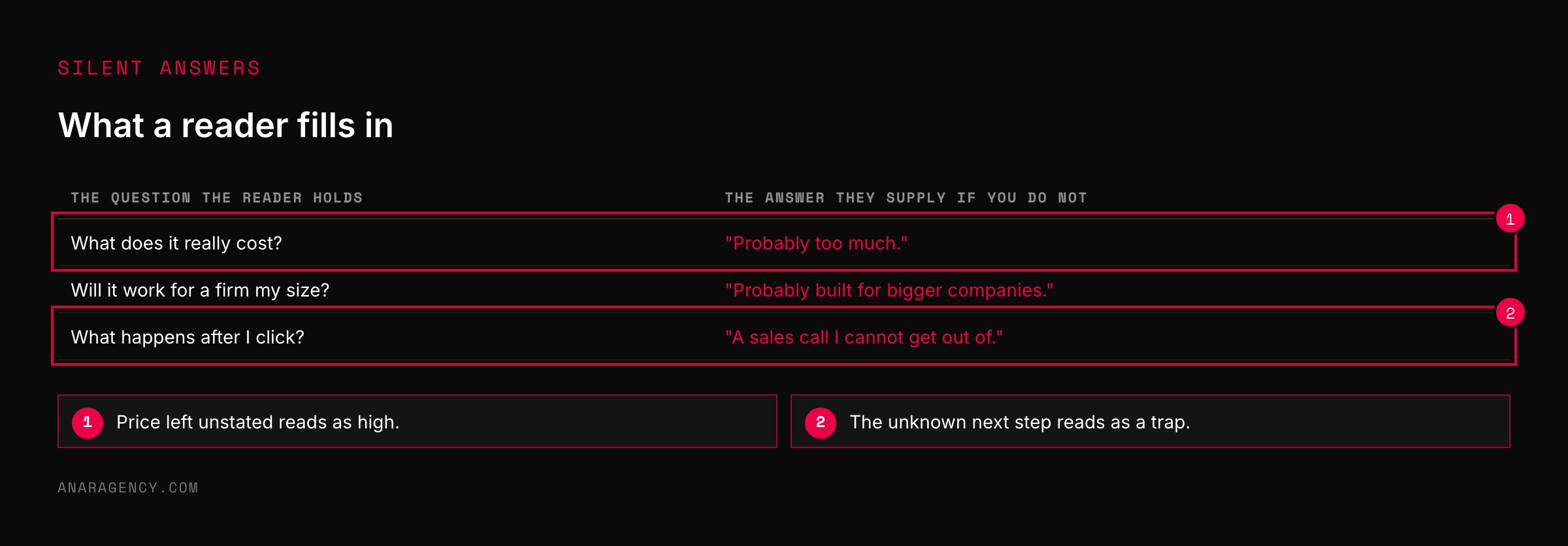
Why this firm and not the one with more reviews? Will this work for a business my size? What will it really cost once I am signed up?
What happens after I press the button?
They almost never send those questions to you. Usability research finds that most people scan web pages instead of reading them closely. A reader with an unanswered question does not write in.
They answer it themselves, quietly, and move on.
The answers they supply are rarely generous. "Probably expensive." "Probably not for someone like me."
So every question your page leaves open is answered by the reader, and usually against you.
Readers carry questions they never ask, and answer the open ones themselves, usually against you. Collect the questions from calls and emails, put them in the order a buyer would think of them, and answer each where it arises, as a stated fact using because and when. Asking the question aloud slows the reader.
Keep the FAQ for leftovers. Never assume things about the reader that may be untrue, avoid loaded questions, and only pre-answer with what actually happens.
Ask it, or answer it
The common fix is to raise the question out loud. "You might be wondering whether this works for small firms."
It is better than ignoring it. It also has a cost. A question invites the reader to stop and consider it, and now they are weighing doubts you put in front of them.
The stronger technique is to answer it in passing, as though it had already been settled.
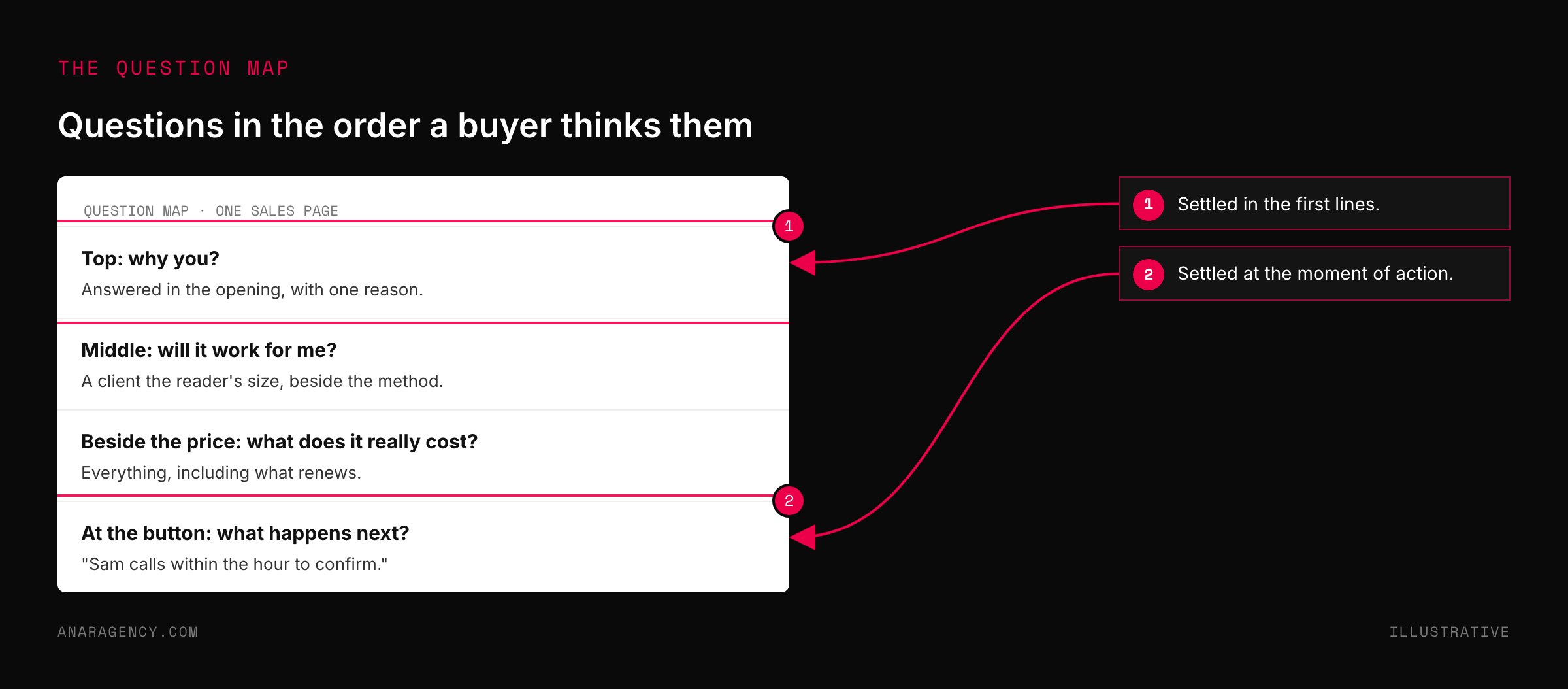
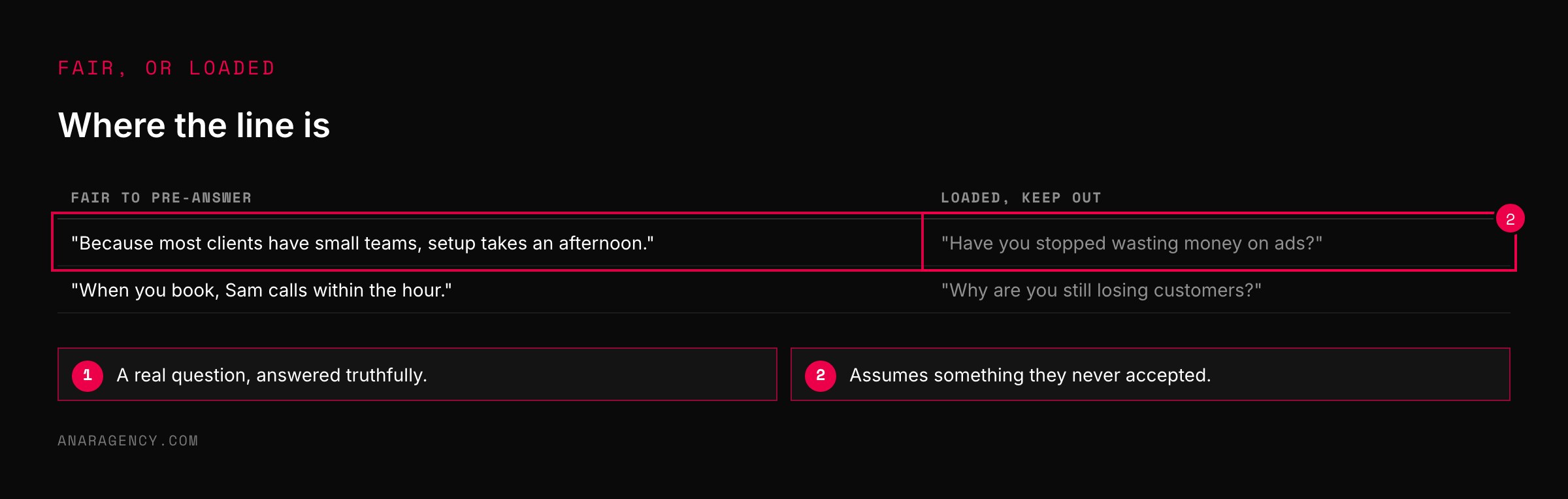
"Because most of our clients run teams of two to ten, the setup takes an afternoon, not a month." The question about size has been answered before the reader finished forming it.
Or: "When you book, Sam calls within the hour to confirm." The question about what happens next never gets the chance to arise.
We call this the Pre-Answered Question. The page reads as confident, because it is not stopping to defend itself.
Question Mappers: how they find every question
Pages that feel complete are not longer. They answer the right questions in the right places. We call the people who write them Question Mappers.
They collect the questions. From sales calls, from emails, from the support inbox. The questions people ask out loud are the ones many more ask silently.
They put them in order. The order a buyer would think of them. "Why you" comes before "what does it cost," which comes before "what happens next."
They answer each where it arises. A question about price belongs next to the price, not in an FAQ at the bottom.
They use because and when. "Because" gives a reason, which settles a doubt. "When" describes the next step as already happening.
See sequence words.
They keep the FAQ for leftovers. An FAQ is where questions go that did not fit the flow. It is not where the important ones belong.
This is the same discipline as the unasked questions, applied line by line.
"Is answering a question before it is asked manipulative?"
It can be, if the answer is false or the framing is a trick. Answering a real question honestly and early is the opposite of manipulation. It is respect for the reader's time.
The line is in what you assume. Assuming the reader wants to know how setup works is fair. Assuming something about them that may not be true is not.
The worst form is the loaded question: a question built on an assumption the person has not accepted. "Have you stopped wasting money on ads?" assumes they were.
Avoid that in copy. It tends to read as an accusation, and on some ad platforms describing the viewer's situation that way breaks the rules.
And never pre-answer with something untrue. "Setup takes an afternoon" has to be what actually happens for most clients.
A pre-answered question works because it is true and it arrives at the right moment. Remove either and it is just an assertion.
What to read next, and why
Doyle Dane Bernbach (encyclopedia entry): The agency behind the campaign and its other famous work.
Avis Car Rental (encyclopedia entry): The company and the motto it adopted in 1962.
How Users Read on the Web (Nielsen Norman Group): The research on scanning, and why unanswered questions go unasked.
Loaded question (encyclopedia entry): The kind of question to keep out of copy.
So the simple takeaway is this: write down the five questions your last five prospects asked, in the order they asked them. Then check your page answers each one at the moment it would come to mind.
Questions executives ask
What is an assumptive question in copywriting?
A way of handling a reader's likely question by answering it as a settled fact, without raising it as a question first. For example, stating that setup takes an afternoon because most clients have small teams, instead of writing that the reader might be wondering about setup.
How do you handle objections in copy?
Collect the questions real buyers ask, put them in the order they would occur to a reader, and answer each at the point it arises. Stating the answer directly is usually stronger than raising the objection first.
Should I use "you might be wondering" in copy?
It is better than ignoring the question, but it asks the reader to stop and weigh a doubt. Answering in passing, with a reason, usually keeps them moving.
What was the Avis We Try Harder campaign?
An advertising campaign from the early 1960s in which Avis, then second-largest in car rental, openly acknowledged being number two and gave that as the reason it tried harder. We Try Harder became the company motto in 1962.
Where should FAQs go on a landing page?
Important questions belong in the body of the page, next to the topic they concern. An FAQ section is useful for remaining questions that did not fit naturally into the flow.

Filip Kovacevic is the founder of Anar Agency in Phoenix. He spent five years running SEO, Meta ads, email, and content for medical practices across the United States, and now does the same work for healthcare, home-service, legal, and professional-service businesses, alongside AI implementation. More from Filip →
Talk it through in 15 minutes
Bring one AI question from this article. We will tell you what we would do, whether or not you hire us.
Book a 15-Min Chat →