Shadow AI Is a Demand Signal: Guardrails That Do Not Kill the Front Line
Shadow AI is your people using AI tools nobody approved, to get their work done. Read it as a demand signal, not a discipline problem: every instance marks a workflow where your official tools are failing someone. The fix is a one-page acceptable use policy, safe defaults, and a fast approval path.
A ban only pushes the usage somewhere you cannot see it.
Why bans backfire
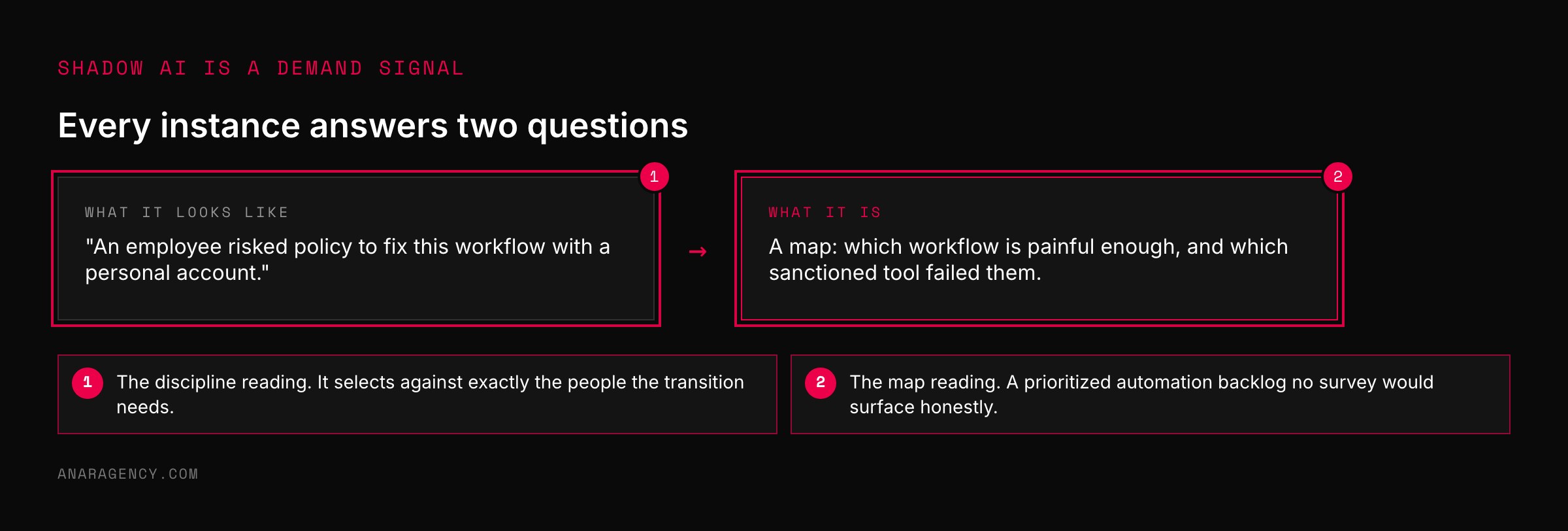
When a company bans AI tools without offering approved ones, the usage does not stop. It moves to personal phones and home accounts, where you have zero visibility, zero logging, and zero legal standing.
You took a policy problem you could manage and made it invisible.
And here is the uncomfortable math. Your most motivated employees are the ones most likely to route around the ban, because they have the most to gain from the tools. Punish initiative and you select against exactly the people an AI transition needs.
Read shadow AI as a map
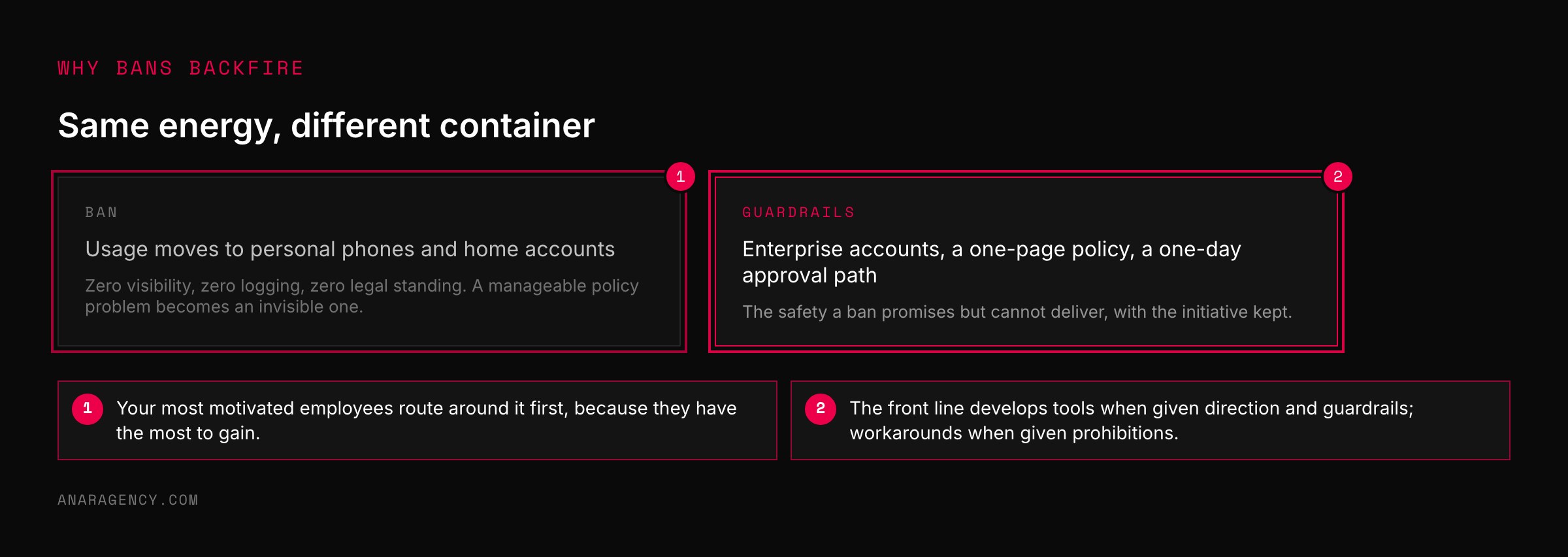
Every unapproved use answers two questions for you, free of charge: which workflow hurts enough that someone risked policy to fix it, and which approved tool let them down.
So audit shadow usage with amnesty, not punishment. What comes back is a ranked backlog of automation demand that no survey would ever surface honestly.
The front line builds useful tools when it is given direction and guardrails. It builds workarounds when it is given prohibitions. Same energy, different container.
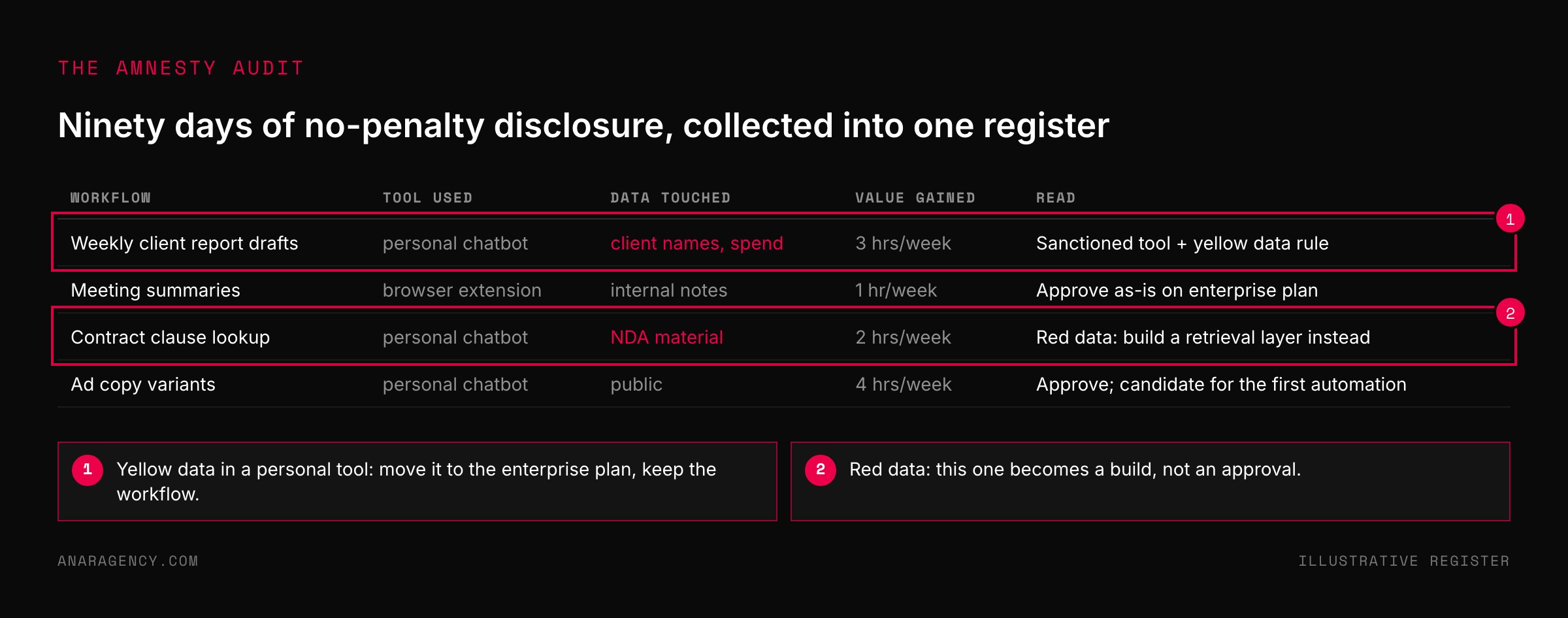
Announce ninety days of no-penalty disclosure for shadow AI use. Collect every instance into a register: workflow, tool, data touched, value gained. You will get your automation backlog, your risk map, and your future champions from one exercise.
The one-page acceptable use policy
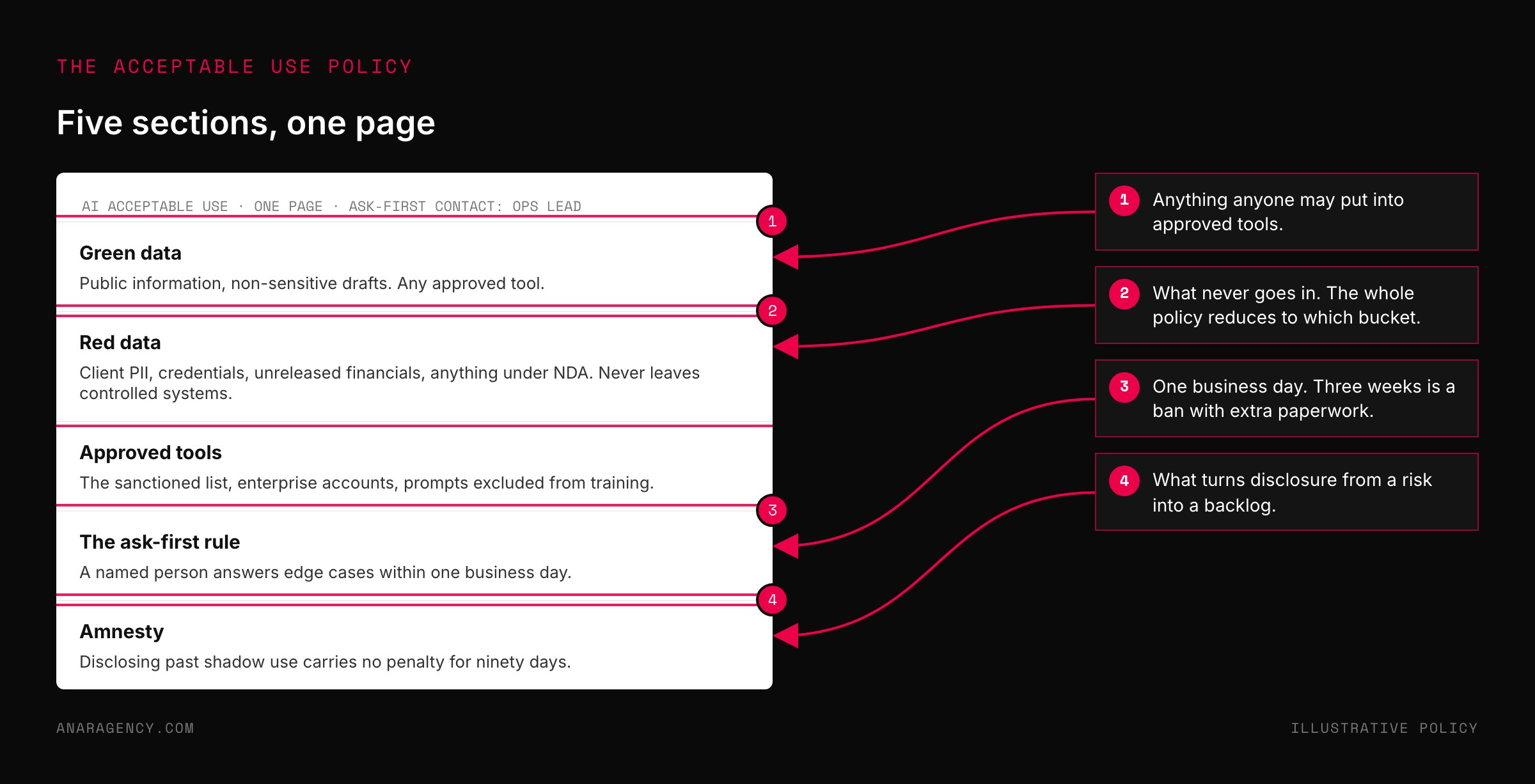
Long policies go unread, so write one page with exactly five sections. Green data: what anyone may put into approved tools, such as public information and non-sensitive drafts. Red data: what never goes in, such as client PII, credentials, unreleased financials, and anything under NDA.
Approved tools: the sanctioned list, on enterprise accounts so prompts are not training data. The ask-first rule: a named person who answers edge cases within one business day. The amnesty clause: disclosing past shadow use carries no penalty for ninety days.
The ask-first turnaround is the clause holding the whole page up. If approval takes three weeks, the policy is a ban with extra paperwork, and the shadow comes back.
Guardrails that scale with trust
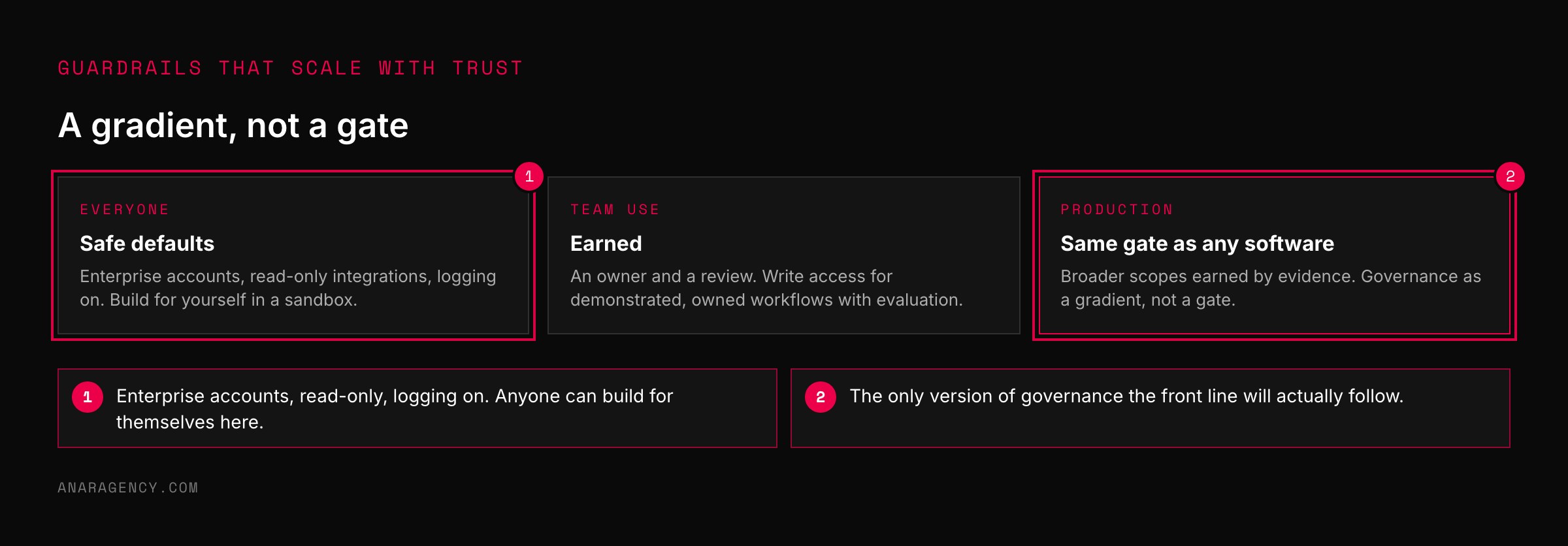
Start everyone on safe defaults: enterprise accounts, read-only integrations, logging on. Let teams earn write access and wider scopes by showing owned workflows with evaluation in place.
Building tools follows the same ladder. Anyone can build for themselves in a sandbox. Promoting a tool to team use takes an owner and a review.
Promoting it to production takes the same gate as any other software.
That turns governance from a gate into a gradient, and a gradient is the only version the front line will actually follow. When people can see the next rung, they climb it instead of going around.
Lights On: what companies that handle shadow AI well have in common
Some companies have almost no shadow AI problem, and it is not because their people are more obedient.
They do three things the rest do not. None of the three is a ban. We call these companies Lights On, because the usage is the same as everywhere else and the difference is that they can see it.
They assume it is already happening. Microsoft and LinkedIn surveyed 31,000 knowledge workers across 31 markets and found that 75 percent use generative AI at work. Of those users, 78 percent bring their own tools.
At small and mid-size companies the number is 80 percent.
So the question is not whether your people paste work into AI tools you did not approve. Most of them do. The only open question is whether you know which tools and which data.
They replace before they ban. In 2023, Samsung found that staff had uploaded sensitive code to ChatGPT. The company banned generative AI tools on its devices.
That part made the headlines.
The part that did not: in the same announcement, Samsung said it was preparing its own internal AI tools. Even the most famous ban in this story came with a replacement plan, because the company knew the demand was not going away.
They look. IBM's 2025 breach research studied 600 organizations that had been breached. One in five reported a breach tied to shadow AI.
Companies with high levels of it paid an average of $670,000 more per breach.
And here is the number that should bother you. Sixty-three percent of those organizations had no AI governance policy or were still writing one, and of the ones that had a policy, only 34 percent ran regular audits for unapproved AI. Most companies wrote the page and never checked.
"Our people would not do that."
You may be thinking this is a young-employee problem, or a careless-employee problem, and your team is neither. The data says otherwise.
In the Microsoft survey, bringing your own AI to work cut across every age group. Eighty-five percent of Gen Z users did it, and so did 73 percent of users who are baby boomers or older. This is not a generation.
It is everybody.
And they are not being careless. They are being productive with the only tools they have. That is the demand signal this article started with, now with a number on it.
The risk is also not going away while you wait. Gartner predicts that by 2030 more than 40 percent of organizations will suffer a security or compliance incident caused by unauthorized AI tools. In the same research, 69 percent of security leaders said they have evidence or suspect that employees are using public AI tools at work.
So write the one page, pick the approved tools, and then do the step most companies skip: look, every quarter, with amnesty. The page itself is one of the five decisions in our AI governance framework.
What to read next, and why
AI at Work Is Here. Now Comes the Hard Part (report): The source of the 78 percent figure. Send the age chart to anyone who thinks this is a Gen Z issue.
IBM's 2025 Cost of a Data Breach findings (press release): The first time this long-running study measured shadow AI. The governance numbers are worse than the breach numbers.
Samsung's ban, in the Bloomberg report carried by The Straits Times (news): Short, and a useful reminder that the ban and the internal tool were announced together.
OWASP: Sensitive Information Disclosure (security guidance): A plain list of how data leaks through AI tools. Good raw material for the red-data section of your one page.
So the simple takeaway is this: you cannot stop people from using AI, and you would not want to. You can only decide whether it happens where you can see it.
Questions executives ask
What is shadow AI?
Shadow AI is employees using AI tools without sanction or oversight: personal chatbot accounts, browser extensions, unapproved integrations. It concentrates wherever official tooling underserves a painful workflow.
Should we ban ChatGPT and similar tools at work?
Bans push usage onto personal devices where you have no visibility or control. Enterprise accounts, a one-page acceptable use policy, and a fast approval path give you the safety a ban promises but cannot deliver.
What belongs in an AI acceptable use policy?
Five things: green data (allowed), red data (never), the approved tool list, a named ask-first contact with a one-day SLA, and an amnesty clause for past use. One page, reviewed quarterly.
How common is shadow AI?
Very. Microsoft and LinkedIn's 2024 Work Trend Index, a survey of 31,000 knowledge workers, found that 78 percent of people who use AI at work bring their own tools, and 80 percent at small and mid-size companies. It spans every age group, from 85 percent of Gen Z users to 73 percent of baby boomers and older.
How much does shadow AI add to the cost of a data breach?
IBM's 2025 Cost of a Data Breach research found that organizations with high levels of shadow AI saw an average of $670,000 in higher breach costs than those with little or none. One in five organizations studied reported a breach due to shadow AI, and 63 percent had no AI governance policy or were still developing one.

Filip Kovacevic is the founder of Anar Agency in Phoenix. He spent five years running SEO, Meta ads, email, and content for medical practices across the United States, and now does the same work for healthcare, home-service, legal, and professional-service businesses, alongside AI implementation. More from Filip →
Talk it through in 15 minutes
Bring one AI question from this article. We will tell you what we would do, whether or not you hire us.
Book a 15-Min Chat →